
The sine and cosine rules
What this lesson covers
- Use the sine rule when you have a side and its opposite angle.
- Use the cosine rule for two sides and the angle between them.
- Use the cosine rule for three sides.
Which rule
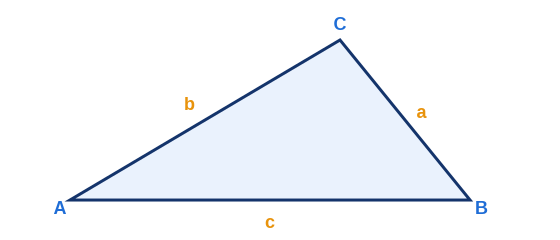
- Sine rule: a/sin A = b/sin B = c/sin C.
- Cosine rule: a² = b² + c² − 2bc cos A.
- To find an angle from three sides: cos A = (b² + c² − a²) ÷ 2bc.
Sine rule
- A = 40°, B = 60°, a = 10. Find b.
- b/sin 60° = 10/sin 40°
- b = 10 × 0.8660 ÷ 0.6428
- b = 13.47
Cosine rule for a side
- b = 7, c = 9, A = 50°. Find a.
- a² = 49 + 81 − 126 cos 50°
- a² = 130 − 80.99 = 49.01
- a = 7.00
Cosine rule for an angle
- The sides are 5, 6 and 7. Find the largest angle, opposite the 7.
- cos C = (25 + 36 − 49) ÷ 60
- cos C = 0.2
- C = 78.5°
Try it: change the triangle
- Set two sides and the angle between them. The cosine rule gives the third side.
Triangle solver
Two possible triangles
- a = 8, b = 10, A = 40°. An angle from sin B may have two answers.
- sin B = 10 sin 40° ÷ 8 = 0.8035
- B = 53.5° or B = 126.5°
- both fit: A + B is under 180°
Try it: two possible triangles
Try it: sine or cosine?
Common mistakes
- Using a calculator set to radians.Check it shows degrees before you start.
- Calculating (b² + c² − 2bc) × cos A.Only the last term carries cos A.
Your turn
Two angles and a side are known. Which rule?
Three sides are known. Which rule finds an angle?
A = 30°, a = 5, B = 90°. Find b.
Sides 3 and 4 with 60° between. Find the third side.
In the cosine rule a² = b² + c² − 2bc cos A, which is true?
A student finds a from b = 5, c = 8, A = 60° by working a² = (25 + 64 − 80) × 0.5. What is the correct value of a?
A triangular section in Tauranga has sides 12 m, 15 m and 20 m. Find its largest angle.
a = 7, b = 10, A = 35°. Find all possible values of B.
Show answer
1. Sine rule 2. Cosine rule 3. b = 5 sin 90° ÷ sin 30° = 10 4. √13 = 3.61 5. A is the angle between sides b and c. It is the angle opposite side a, so it sits between the other two sides. 6. a = 7. Only the last term carries cos A: a² = 25 + 64 − 80 × 0.5 = 49, so a = 7. 7. 94.9°. The largest angle is opposite 20 m: cos C = (144 + 225 − 400) ÷ 360 = −0.0861, so C = 94.9°. 8. 55.0° or 125.0°. sin B = 10 sin 35° ÷ 7 = 0.8194, so B = 55.0° or 180° − 55.0° = 125.0°, and both fit as 35° + 125.0° is under 180°.
Sample question: Achieved
In triangle ABC, A = 52°, B = 71° and a = 15 cm. Find b.
Hint
You have a side and its opposite angle, so use the sine rule.
Answer
b ≈ 18.00 cm
Step by step
- Side a and angle A are opposite each other: a matching pair. That means the sine rule.
- bsin B = asin A, so bsin 71° = 15sin 52°.
- Multiply both sides by sin 71°: b = 15 sin 71°sin 52°.
- b ≈ 15 × 0.9455 ÷ 0.7880 ≈ 18.00 cm.
- Check: the bigger angle is opposite the bigger side. 71° > 52° and 18.00 > 15. Correct.
- Classic mistake: putting sin 52° on top. Keep the unknown side on top so it is easy to solve.
Full working
- bsin 71° = 15sin 52°sine rule
- b = 15 sin 71°sin 52°
- b ≈ 18.00 cm
Sample questions: Merit
A triangle has sides 8 cm, 11 cm and 15 cm. Find all three angles.
Hint
Use the cosine rule for the largest angle first; then the other two angles must be acute, so the sine rule is safe.
Answer
About 31.3°, 45.6° and 103.1°
Step by step
- With three sides and no angles, the cosine rule is the only way in.
- Find the largest angle first, opposite the 15 cm side: cos C = (8² + 11² − 15²) ÷ (2 × 8 × 11) = (64 + 121 − 225) ÷ 176 = −40176.
- cos C is negative, so C is obtuse: C ≈ 103.14°.
- Why largest first? A triangle has at most one obtuse angle, so the other two are now known to be acute. The sine rule cannot mislead us.
- Angle opposite 8 cm: sin A = 8 sin 103.14°15 ≈ 0.5194, so A ≈ 31.29°.
- The last angle: 180° − 103.14° − 31.29° ≈ 45.57°.
- Classic mistake: finding a small angle first with the sine rule and then the largest angle by sine too. The calculator would give an acute answer for the obtuse angle.
- Check the 45.57° with the cosine rule: cos B = (64 + 225 − 121) ÷ 240 = 0.7, which gives 45.57°. It matches.
Full working
- cos C = 64 + 121 − 225176 = −40176cosine rule, largest angle
- C ≈ 103.14°
- sin A = 8 sin 103.14°15, so A ≈ 31.29°sine rule, acute
- B = 180° − 103.14° − 31.29° ≈ 45.57°angle sum
- 31.3°, 45.6° and 103.1°
In triangle ABC, a = 9 cm, b = 12 cm and A = 38°. Find the two possible lengths of side c.
Hint
Use the sine rule to find B. Sine gives two angles between 0° and 180°, so check whether both fit.
Answer
c ≈ 14.60 cm or c ≈ 4.32 cm
Step by step
- A and a are a matching pair, so the sine rule finds B: sin B = 12 sin 38°9 ≈ 0.8209.
- B ≈ 55.17°, or B = 180° − 55.17° = 124.83°. Sine is positive in both places.
- Do both fit? 38° + 55.17° and 38° + 124.83° = 162.83° are both under 180°. So there are two triangles.
- Case 1: C = 180° − 38° − 55.17° = 86.83°. c = 9 sin 86.83°sin 38° ≈ 14.60 cm.
- Case 2: C = 180° − 38° − 124.83° = 17.17°. c = 9 sin 17.17°sin 38° ≈ 4.32 cm.
- Why two? The side a = 9 is opposite the given angle and shorter than b = 12, so it can swing to meet the base line in two places.
- Classic mistake: stopping at the calculator's B = 55.17° and giving one answer.
- Check case 2 with the cosine rule: 9² should equal 12² + 4.32² − 2 × 12 × 4.32 × cos 38°: 144 + 18.63 − 81.63 ≈ 81. Correct.
Full working
- sin B = 12 sin 38°9 ≈ 0.8209sine rule
- B ≈ 55.17° or 124.83°both under 180° − 38°
- C ≈ 86.83° or 17.17°angle sum
- c = 9 sin Csin 38°sine rule
- c ≈ 14.60 cm or c ≈ 4.32 cm
Sample questions: Excellence
In triangle ABC, A = 30°, a = 5 cm and b = x cm. Find the range of values of x for which two different triangles are possible. Then, for x = 8, find both possible lengths of side c.
Hint
With sin 30° = 12, the sine rule gives sin B = x10. Two triangles need 0 < sin B < 1 and the obtuse B to still fit.
Answer
Two triangles when 5 < x < 10; for x = 8, c ≈ 9.93 cm or c ≈ 3.93 cm
Step by step
- Sine rule: sin Bx = sin 30°5, so sin B = x × ½ ÷ 5 = x10.
- If sin B > 1 (x > 10) there is no triangle. If sin B = 1 (x = 10) there is exactly one, with a right angle at B.
- If x < 10, sin B < 1 gives two angles: an acute B and an obtuse 180° − B.
- The obtuse one only fits if A + (180° − B) < 180°, that is, B > 30°. That needs sin B > ½, so x10 > ½ and x > 5.
- If x ≤ 5, side a is at least as long as b, and only the acute B works. One triangle.
- So two triangles exist exactly when 5 < x < 10.
- For x = 8: sin B = 0.8, so B ≈ 53.13° or 126.87°.
- Then C ≈ 180° − 30° − 53.13° = 96.87°, or C ≈ 180° − 30° − 126.87° = 23.13°.
- c = 5 sin Csin 30° = 10 sin C, so c ≈ 10 × 0.9928 = 9.93 cm, or c ≈ 10 × 0.3928 = 3.93 cm.
- Check: 8 is between 5 and 10, so two triangles is what the range predicts.
- Classic mistake: giving 0 < x < 10. For x ≤ 5 the obtuse angle makes the angle sum too big.
Full working
- sin B = x sin 30°5 = x10sine rule
- two values of B need x10 < 1x < 10
- obtuse B fits only if B > 30°, so x10 > 12x > 5
- 5 < x < 10
- x = 8: B ≈ 53.13° or 126.87°, C ≈ 96.87° or 23.13°
- c = 10 sin C ≈ 9.93 or 3.93
- 5 < x < 10; c ≈ 9.93 cm or 3.93 cm
From a point A on flat ground, the angle of elevation of the top T of a hill is 18°. A surveyor walks 400 m straight towards the hill to point B, where the angle of elevation is 27°. Find the height of the hill.
Hint
Work in triangle ABT first: find its angles, use the sine rule for BT, then use the right triangle under T.
Answer
About 358.7 m
Step by step
- Let F be the point on the ground directly below T. The height is TF.
- Triangle ABT: angle at A is 18°. Angle ABT is 180° − 27° = 153°, because it sits next to the 27° on a straight line.
- Angle ATB = 180° − 18° − 153° = 9°.
- Sine rule: BTsin 18° = 400sin 9°, so BT = 400 sin 18°sin 9° ≈ 790.15 m.
- Right triangle BFT: TF = BT sin 27° ≈ 790.15 × 0.4540 ≈ 358.7 m.
- Why not tan straight away? Neither right triangle has a known side: we know only the gap of 400 m between A and B. Triangle ABT links them.
- Classic mistake: using 27° − 18° as an angle at A. The 9° is the angle at the top of the hill.
- Check: AF should be 358.7 ÷ tan 18° ≈ 1104 m and BF = 358.7 ÷ tan 27° ≈ 704 m. Their difference is 400 m. Correct.
- Limitation: this assumes the ground is level and that B is on the straight line from A to the hill.
Full working
- ∠ABT = 180° − 27° = 153°straight line at B
- ∠ATB = 180° − 18° − 153° = 9°angle sum
- BT = 400 sin 18°sin 9° ≈ 790.15 msine rule
- h = BT sin 27°right triangle BFT
- about 358.7 m
What to take away
- A matching side and angle: sine rule.
- Otherwise: cosine rule.
Challenge
The sides of a triangle are x, x + 1 and x + 2 centimetres, and its largest angle is 120°. Find x, and the perimeter of the triangle.
Hint
The largest angle is opposite the longest side. Write the cosine rule for that side, using cos 120° = −½, and you get a quadratic in x.
Answer
x = 1.5; the sides are 1.5, 2.5 and 3.5 cm, so the perimeter is 7.5 cm
Step by step
- The largest angle is opposite the longest side, x + 2.
- Cosine rule: (x + 2)² = x² + (x + 1)² − 2x(x + 1) cos 120°.
- cos 120° = −½, so the last term becomes + x(x + 1).
- Expanding: x² + 4x + 4 = 3x² + 3x + 1, which gives 2x² − x − 3 = 0.
- Factorise: (2x − 3)(x + 1) = 0. A length cannot be −1, so x = 1.5.
- Check: 2.5² + 1.5² + 1.5 × 2.5 = 6.25 + 2.25 + 3.75 = 12.25 = 3.5². Correct.
Full working
- (x + 2)² = x² + (x + 1)² − 2x(x + 1) cos 120°cosine rule, longest side
- x² + 4x + 4 = x² + x² + 2x + 1 + x² + xcos 120° = −½
- 2x² − x − 3 = 0, so (2x − 3)(x + 1) = 0
- x = 1.5x = −1 is not a length
- sides 1.5, 2.5, 3.5check 6.25 + 2.25 + 3.75 = 12.25
- x = 1.5 cm, perimeter 7.5 cm
At noon two boats leave the same marina. The Kahu travels at 18 km per hour on a bearing of 040°. The Tui travels at 24 km per hour on a bearing of 145°. Find how far apart they are at 2 pm and the bearing of the Tui from the Kahu at that moment. At what time, to the nearest minute, were they exactly 50 km apart?
Hint
Draw the marina and both boats at 2 pm. The angle at the marina is the difference of the bearings. For the last part: the triangle keeps the same shape as time passes, it just gets bigger.
Answer
About 67.04 km apart; the Tui is on a bearing of about 176° from the Kahu; they were 50 km apart at about 1:29 pm (1.49 hours after noon)
Step by step
- At 2 pm the Kahu is 36 km from the marina and the Tui is 48 km. The angle between their paths is 145° − 40° = 105°.
- Cosine rule: d² = 36² + 48² − 2 × 36 × 48 × cos 105° ≈ 4494.5, so d ≈ 67.04 km.
- Sine rule for the angle at the Kahu: sin K = 48 sin 105° ÷ 67.04 ≈ 0.6916, so K ≈ 43.76°. It is acute because the 105° angle is already the largest.
- From the Kahu the marina is on the back bearing 040° + 180° = 220°. The Tui is 43.76° anticlockwise from that line, so its bearing is about 220° − 43.76° ≈ 176°.
- Both distances grow in proportion to time, so the triangle only scales: after t hours they are 33.52t km apart.
- 33.52t = 50 gives t ≈ 1.49 hours, which is 89.5 minutes, so about 1:29 pm.
Full working
- angle at marina = 145° − 40° = 105°36 km and 48 km after 2 hours
- d² = 36² + 48² − 2(36)(48) cos 105° ≈ 4494.5cosine rule
- d ≈ 67.04 km
- sin K = 48 sin 105° ÷ 67.04 ≈ 0.6916, K ≈ 43.76°sine rule
- bearing = 220° − 43.76° ≈ 176°back bearing to the marina is 220°
- 67.04 ÷ 2 = 33.52t = 50, t ≈ 1.49 hdistance grows in proportion to time
- 67.04 km, bearing 176°, 50 km apart at about 1:29 pm
In triangle ABC, AB = 7 cm and AC = 11 cm. D is the midpoint of BC, and AD = 6 cm. Find the length of BC and the size of angle BAC.
Hint
Call BD = DC = m and the angle ADB = θ. Then angle ADC = 180° − θ, and cos(180° − θ) = −cos θ. Write the cosine rule in triangles ABD and ADC, then add.
Answer
BC = 14 cm and angle BAC ≈ 99.7°
Step by step
- Let BD = DC = m and angle ADB = θ. The angles at D sit on a straight line, so angle ADC = 180° − θ and its cosine is −cos θ.
- Triangle ABD: 7² = 6² + m² − 12m cos θ.
- Triangle ADC: 11² = 6² + m² + 12m cos θ.
- Adding the two equations removes the unknown angle: 49 + 121 = 72 + 2m², so m² = 49 and m = 7. So BC = 14 cm.
- Now all three sides of ABC are known: cos A = (7² + 11² − 14²) ÷ (2 × 7 × 11) = −26154, so A ≈ 99.7°.
- A negative cosine means an obtuse angle, which fits: 14² = 196 is more than 7² + 11² = 170.
Full working
- 49 = 36 + m² − 12m cos θcosine rule in ABD
- 121 = 36 + m² + 12m cos θcosine rule in ADC, cos(180° − θ) = −cos θ
- 170 = 72 + 2m², m² = 49, m = 7add to remove cos θ
- BC = 2m = 14 cm
- cos A = (49 + 121 − 196) ÷ 154 = −26154 ≈ −0.1688cosine rule for an angle
- BC = 14 cm, angle BAC ≈ 99.7°