
Area of any triangle
What this lesson covers
- Area = ½ab sin C.
- The angle must be between the two sides.
- Finding an angle from an area can give two answers.
The formula
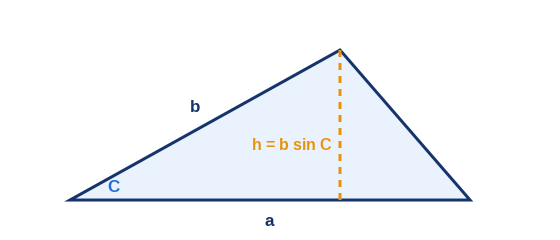
- Area = ½ab sin C, where C sits between sides a and b.
- It is ½ × base × height, with b sin C as the height.
Try it: ½ab sin C
Sides 8 and 11 with 35° between
- Put the values straight in.
- A = ½ × 8 × 11 × sin 35°
- A = 44 × 0.5736
- A = 25.24 square units
Working backwards
- A triangle has area 30 with sides 8 and 10.
- 30 = ½ × 8 × 10 × sin C
- sin C = 0.75
- C = 48.6° or C = 131.4°
Triangle solver
Where it comes from
- The height is b sin C, so ½ × base × height becomes ½ab sin C.
Try it: two sides and the angle
A parallelogram
- Sides 6 and 8 with 50° between. It is two equal triangles.
- 2 × ½ × 6 × 8 × sin 50°
- = 36.77 square units
Try it: a parallelogram is two triangles
Common mistakes
- Using an angle that is not between the two sides.Find the included angle first.
- Giving one answer to sin C = 0.75.An obtuse angle has the same sine, so check both.
Your turn
Sides 10 and 6 with 30° between. Find the area.
Sides 4 and 5 with 90° between. Find the area.
Sides 8 and 9 with area 18. Find C.
Which angle does the formula use?
Triangle PQR has PQ = 7, QR = 9 and angle R = 50°. Why is ½ × 7 × 9 × sin 50° wrong for its area?
A triangle has area 24 cm², with sides 6 cm and b cm and 30° between them. Find b.
A triangular garden in Whanganui has sides 12 m and 15 m with 110° between them. Find its area.
A parallelogram has sides 9 cm and 14 cm and area 100 cm². Find the acute angle between the sides.
Show answer
1. 15 2. 10 3. sin C = 0.5, so 30° or 150° 4. The angle between the two sides 5. 50° is not between PQ and QR. Those sides meet at Q, so the formula needs angle Q. 6. b = 16. 24 = ½ × 6 × b × sin 30° = 1.5b, so b = 16. 7. 84.57 m². Area = ½ × 12 × 15 × sin 110° = 90 × 0.9397 = 84.57 m². 8. 52.5°. It is two equal triangles, so 100 = 2 × ½ × 9 × 14 × sin θ, giving sin θ = 0.7937 and θ = 52.5°.
Sample question: Achieved
A triangle has sides 12 cm and 9 cm with an angle of 48° between them. Find its area.
Hint
The angle is between the two sides, so use Area = ½ab sin C.
Answer
40.13 cm²
Step by step
- Check the angle is between the two sides you know. It is, so Area = ½ab sin C works.
- Put the values in: Area = ½ × 12 × 9 × sin 48°.
- ½ × 12 × 9 = 54, and sin 48° ≈ 0.7431.
- Area ≈ 54 × 0.7431 ≈ 40.13 cm².
- Classic mistake: having the calculator in radians. sin 48 in radians is about −0.77, which gives a negative area.
- Check: a right angle would give the most area, ½ × 12 × 9 = 54. 40.13 is less, which makes sense for 48°.
Full working
- Area = ½ × 12 × 9 × sin 48°½ab sin C
- = 54 × 0.7431
- 40.13 cm²
Sample questions: Merit
Triangle PQR has PQ = 10 cm, QR = 14 cm and area 50 cm². Find both possible sizes of angle Q, and find the length PR when Q is obtuse.
Hint
Use Area = ½ × PQ × QR × sin Q to find sin Q. Sine is positive in two places between 0° and 180°.
Answer
Q = 45.6° or Q = 134.4°; when Q is obtuse, PR ≈ 22.18 cm
Step by step
- Angle Q sits between PQ and QR, so the area formula uses exactly those two sides.
- 50 = ½ × 10 × 14 × sin Q = 70 sin Q, so sin Q = 5070 ≈ 0.7143.
- The calculator gives Q = sin⁻¹(0.7143) ≈ 45.6°.
- But sin(180° − x) = sin x, so Q = 180° − 45.6° = 134.4° gives the same sine. Both make a triangle, because neither angle uses up 180°.
- So there are two different triangles with the same two sides and the same area.
- For the obtuse case, use the cosine rule: PR² = 10² + 14² − 2 × 10 × 14 × cos 134.4°.
- cos 134.4° ≈ −0.700, so PR² ≈ 296 + 196.0 = 492.0 and PR ≈ 22.18 cm.
- Classic mistake: giving only the calculator's angle. Working backwards from a sine often has two answers.
- Check: the acute triangle has PR² ≈ 296 − 196.0 = 100.0, so PR ≈ 10.0. The obtuse angle should give the longer side, and it does.
Full working
- 50 = ½ × 10 × 14 × sin Qarea formula
- sin Q = 5070 ≈ 0.7143
- Q = 45.6° or 180° − 45.6° = 134.4°two angles, same sine
- PR² = 100 + 196 − 280 cos 134.4° ≈ 492.0cosine rule
- Q = 45.6° or 134.4°; PR ≈ 22.18 cm
A triangular garden bed has sides 6 m, 8 m and 11 m. Find its area.
Hint
You need an angle between two sides first. Find one with the cosine rule, then use ½ab sin C.
Answer
23.42 m²
Step by step
- The area formula needs two sides and the angle between them. We have no angles, so find one first.
- Choose angle C between the 6 m and 8 m sides. It is opposite the 11 m side.
- Cosine rule for an angle: cos C = (6² + 8² − 11²) ÷ (2 × 6 × 8) = (36 + 64 − 121) ÷ 96 = −2196.
- cos C is negative, so C is obtuse: C ≈ 102.64°.
- Area = ½ × 6 × 8 × sin 102.64° ≈ 24 × 0.9758 ≈ 23.42 m².
- Classic mistake: pairing the angle with the wrong sides. The 6 and 8 in the area formula must be the two sides that make angle C.
- Keep full calculator values. Rounding C to 103° gives 23.38, slightly off.
- Check with another angle: the angle opposite 6 m has cos = (64 + 121 − 36) ÷ 176 ≈ 0.8466, about 32.16°, and ½ × 8 × 11 × sin 32.16° ≈ 23.42. It matches.
Full working
- cos C = 36 + 64 − 12196 = −2196cosine rule, C opposite 11
- C ≈ 102.64°
- Area = ½ × 6 × 8 × sin 102.64°½ab sin C
- 23.42 m²
Sample questions: Excellence
A triangle has two sides x cm and (x + 2) cm with an angle of 30° between them. Its area is 12 cm². Find x, and then find the length of the third side.
Hint
Write the area formula with x in it. sin 30° = 12 makes it a quadratic.
Answer
x = 6, so the sides are 6 cm and 8 cm; the third side is about 4.11 cm
Step by step
- The 30° is between the two sides, so Area = ½ × x × (x + 2) × sin 30°.
- sin 30° = 12 exactly, so the area is ¼x(x + 2).
- Set it equal to 12: ¼x(x + 2) = 12, so x(x + 2) = 48.
- Expand and rearrange: x² + 2x − 48 = 0.
- Factorise: two numbers that multiply to −48 and add to 2 are 8 and −6. So (x + 8)(x − 6) = 0.
- x = 6 or x = −8. A length cannot be negative, so x = 6. The sides are 6 cm and 8 cm.
- Third side by the cosine rule: c² = 6² + 8² − 2 × 6 × 8 × cos 30° = 100 − 96 × 0.8660 ≈ 16.86.
- c ≈ 4.11 cm.
- Check: ½ × 6 × 8 × ½ = 12. Correct.
- Classic mistake: rounding sin 30° to 0.5 is fine, but using 30 in radians is not. Always check the calculator mode.
Full working
- 12 = ½ × x(x + 2) × sin 30°area formula
- x(x + 2) = 48, so x² + 2x − 48 = 0sin 30° = 12
- (x + 8)(x − 6) = 0, so x = 6length must be positive
- c² = 36 + 64 − 96 cos 30° ≈ 16.86cosine rule
- x = 6; third side ≈ 4.11 cm
A regular polygon with n sides is drawn inside a circle of radius r, with every corner on the circle. Show that its area is (n2)r² sin(360°n). Use this to find the area of a regular octagon in a circle of radius 10 cm, and say what percentage of the circle it fills.
Hint
Join every corner to the centre. That makes n identical triangles, each with two sides r.
Answer
Area = n × ½r² sin(360°n); the octagon has area 200√2 ≈ 282.84 cm², about 90.0% of the circle's 314.16 cm²
Step by step
- Join each corner to the centre of the circle. This splits the polygon into n triangles.
- Each triangle has two sides equal to the radius r, because every corner is on the circle.
- The n angles at the centre are equal and make a full turn, so each is 360°n.
- Area of one triangle: ½ × r × r × sin(360°n) = ½r² sin(360°n).
- There are n of them: total area = (n2)r² sin(360°n). That is what we had to show.
- Octagon: n = 8 and r = 10. The angle is 360° ÷ 8 = 45°.
- Area = 4 × 100 × sin 45° = 400 × √22 = 200√2 ≈ 282.84 cm².
- The circle's area is π × 10² ≈ 314.16 cm², so the octagon fills 282.84 ÷ 314.16 ≈ 90.0% of it.
- As n grows, the polygon hugs the circle more closely, so the percentage climbs towards 100%.
- Check with a square, n = 4: (42) × r² × sin 90° = 2r². A square in a circle of radius r has diagonal 2r, so area ½ × (2r)² = 2r². Correct.
Full working
- n triangles, each with sides r, r and angle 360°njoin corners to the centre
- one triangle = ½r² sin(360°n)½ab sin C
- total = (n2)r² sin(360°n)shown
- octagon: 4 × 100 × sin 45° = 200√2 ≈ 282.84 cm²
- 282.84 ÷ 314.16 ≈ 0.900
- octagon ≈ 282.84 cm², about 90.0% of the circle
What to take away
- Two sides and the angle between gives the area.
- Backwards, there may be two angles.
Challenge
A triangle has sides 7 cm and 8 cm, and its area is 14√3 cm² (about 24.25 cm²). Its third side is a whole number of centimetres. Find the angle between the 7 cm and 8 cm sides, the third side and the perimeter.
Hint
sin C has two possible angles. Find the third side for each one with the cosine rule, then use the whole-number fact.
Answer
The angle is 120°, the third side is 13 cm and the perimeter is 28 cm (an angle of 60° would give a third side of √57 ≈ 7.55 cm, not a whole number)
Step by step
- ½ × 7 × 8 × sin C = 14√3, so 28 sin C = 14√3 and sin C = √32.
- So C = 60° or C = 120°. Both are possible angles in a triangle.
- C = 60°: third side² = 49 + 64 − 2 × 7 × 8 × cos 60° = 113 − 56 = 57, so the side is √57 ≈ 7.55 cm. Not a whole number.
- C = 120°: cos 120° = −½, so third side² = 113 + 56 = 169 and the side is 13 cm.
- So C = 120°, the third side is 13 cm and the perimeter is 7 + 8 + 13 = 28 cm.
Full working
- ½ × 7 × 8 × sin C = 14√3, so sin C = √32area formula
- C = 60° or C = 120°two angles with the same sine
- 60°: c² = 113 − 56 = 57, c ≈ 7.55cosine rule, not whole
- 120°: c² = 113 + 56 = 169, c = 13cos 120° = −½
- C = 120°, third side 13 cm, perimeter 28 cm
Quadrilateral ABCD has AB = 5 cm, BC = 8 cm, CD = 3 cm, DA = 5 cm and angle ABC = 60°. Find the exact area of ABCD and give it to 2 decimal places.
Hint
Split the shape along the diagonal AC. You know an angle in triangle ABC, but in triangle ACD you will need to find one first.
Answer
AC = 7 cm and angle ADC = 120°; area = 10√3 + 3.75√3 = 13.75√3 ≈ 23.82 cm²
Step by step
- In triangle ABC: AC² = 5² + 8² − 2 × 5 × 8 × cos 60° = 89 − 40 = 49, so AC = 7 cm.
- Area of ABC = ½ × 5 × 8 × sin 60° = 20 × √32 = 10√3.
- Triangle ACD has sides 3, 5 and 7, but no known angle. Use the cosine rule for the angle at D, opposite AC: cos D = (3² + 5² − 7²) ÷ (2 × 3 × 5) = −15 ÷ 30 = −½.
- So angle D = 120°, and the area of ACD = ½ × 3 × 5 × sin 120° = 7.5 × √32 = 3.75√3.
- Total area = 13.75√3 ≈ 23.82 cm².
- Classic mistake: using angle B in triangle ACD. Each triangle needs its own included angle.
Full working
- AC² = 25 + 64 − 40 = 49, so AC = 7cosine rule in ABC
- area ABC = ½ × 5 × 8 × sin 60° = 10√3
- cos D = 9 + 25 − 4930 = −½, so D = 120°cosine rule in ACD
- area ACD = ½ × 3 × 5 × sin 120° = 3.75√3
- 13.75√3 ≈ 23.82 cm²
Triangle ABC has AB = 12 cm, AC = 15 cm and angle A = 50°. A straight cut is made from P on AB to Q on AC. Show that the area of triangle APQ divided by the area of triangle ABC is AP × AQAB × AC, whatever the angle at A. If AP = 8 cm, where must Q be for the cut to split the triangle into two equal areas? Explain why no cut from a point P with AP = 4 cm can do this.
Hint
Both triangles use the same angle A, so write both areas with ½ × side × side × sin A.
Answer
The ratio is (½ × AP × AQ × sin A) ÷ (½ × AB × AC × sin A) = AP × AQAB × AC; AQ = 11.25 cm; with AP = 4 cm you would need AQ = 22.5 cm, longer than AC = 15 cm
Step by step
- Area of APQ = ½ × AP × AQ × sin A and area of ABC = ½ × AB × AC × sin A, with the same angle A in both.
- Dividing, ½ and sin A cancel, so the ratio is AP × AQAB × AC. It does not depend on the size of A.
- Half the area means AP × AQ = ½ × 12 × 15 = 90.
- With AP = 8: AQ = 90 ÷ 8 = 11.25 cm, which fits on AC (15 cm). Check: ½ × 8 × 11.25 × sin 50° ≈ 34.47, half of ½ × 12 × 15 × sin 50° ≈ 68.94.
- With AP = 4: AQ = 90 ÷ 4 = 22.5 cm, but AC is only 15 cm. Even with Q at C, triangle APQ is only 4 × 1512 × 15 = 13 of the area.
Full working
- area APQarea ABC = ½ × AP × AQ × sin A½ × AB × AC × sin Asame angle A
- = AP × AQAB × AC½ sin A cancels
- AP × AQ = ½ × 12 × 15 = 90half the area
- AQ = 90 ÷ 8 = 11.25AP = 8
- AP = 4 needs AQ = 22.5 > 15impossible
- AQ = 11.25 cm; AP = 4 cm cannot work