
Bearings and 3D problems
What this lesson covers
- A bearing is a three-digit angle clockwise from north.
- Draw a north line at every point.
- A 3D problem splits into flat triangles.
Reading a bearing
- Measure clockwise from north, and write three digits, such as 060°.
- Draw a north line at each point before marking angles.
Try it: bearings and back bearings
A ship's journey
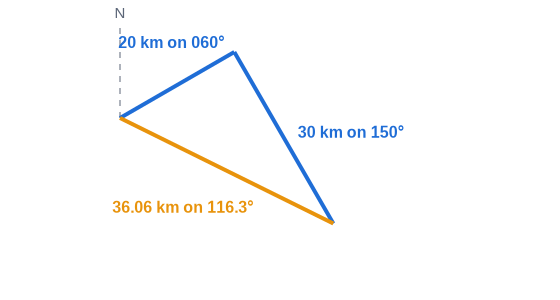
- A ship sails 20 km on 060°, then 30 km on 150°. The 90° change of course gives a right angle.
- d = √(20² + 30²) = 36.06 km
- angle at start = tan⁻¹(30/20) = 56.3°
- bearing = 60° + 56.3°
- bearing = 116.3°
A tower in 3D
- A 40 m tower is seen from A at 30° elevation and from B at 45°. The two lines to its base meet at 90°. Find AB.
- base to A = 40 ÷ tan 30° = 69.28 m
- base to B = 40 ÷ tan 45° = 40 m
- AB² = 4800 + 1600
- AB = 80 m
Try it: the tower
Draw it first
- The 90° turn makes this a right-angled triangle.
Back bearings
- B is on a bearing of 060° from A. Find the bearing of A from B.
- 60° + 180°
- = 240°
Try it: voyage, back bearing, tower
Common mistakes
- Measuring a bearing from east.Bearings always start from north.
- Treating a slanted line as flat.Find the flat distances on the ground first.
Your turn
What is the bearing of due east?
Find the back bearing of 060°.
Walk 3 km and 4 km at right angles. How far from the start?
A tree is 20 m away at 45° elevation. How tall is it?
What is the bearing of south-west?
A boat sails 10 km on a bearing of 140°. How far south of its start is it?
A tramper walks 6 km north, then 8 km east. Find her bearing from the start.
A box is 12 cm long, 4 cm wide and 3 cm high. Find the angle between its longest diagonal and the base.
Show answer
1. 090° 2. 240° 3. 5 km 4. 20 m 5. 225°. Clockwise from north: east is 090°, south is 180°, and south-west is 45° further, 225°. 6. 7.66 km. The angle from the south line is 180° − 140° = 40°, so south = 10 cos 40° = 7.66 km. 7. 053.1°. The angle from north is tan⁻¹(8/6) = 53.1°, so the bearing is 053.1°. 8. 13.3°. The base diagonal is √(12² + 4²) = 12.65 cm, so the angle is tan⁻¹(3 ÷ 12.65) = 13.3°.
Sample question: Achieved
A yacht sails 12 km on a bearing of 040°, then 9 km on a bearing of 130°. Find its distance and bearing from its starting point.
Hint
The course changes by 90°, so the two legs form a right angle. Use Pythagoras, then find the angle at the start.
Answer
15 km on a bearing of 076.9°
Step by step
- Draw a north line at each point. The course turns from 040° to 130°, a change of 90°, so the two legs meet at a right angle.
- Distance: Pythagoras gives √(12² + 9²) = √(144 + 81) = √225 = 15 km.
- Angle at the start, between the first leg and the line back to the yacht: tan⁻¹(912) ≈ 36.87°.
- The second leg turns clockwise, so add this to the first bearing: 40° + 36.87° = 76.87°.
- Write bearings with three digits: 076.9°.
- Check: the answer should lie between 040° and 130°, and 076.9° does.
Full working
- 130° − 40° = 90°right angle between the legs
- d = √(12² + 9²) = 15 km
- tan⁻¹(912) ≈ 36.87°angle at the start
- bearing = 40° + 36.87°
- 15 km on 076.9°
Sample questions: Merit
A boat sails 10 km on a bearing of 035°, then 14 km on a bearing of 110°. Find how far it is from its start, and the bearing it must sail to return directly.
Hint
Find the angle inside the triangle at the turning point using north lines, then use the cosine rule, then the sine rule.
Answer
About 19.20 km; it must sail on a bearing of about 259.8° to return
Step by step
- Call the start A, the turning point B and the end C. Draw a north line at A and at B.
- The boat turns from 035° to 110°, a turn of 75°. So the angle inside the triangle at B is 180° − 75° = 105°.
- Cosine rule for AC: AC² = 10² + 14² − 2 × 10 × 14 × cos 105° ≈ 296 + 72.47 = 368.47.
- AC ≈ 19.20 km.
- Angle at A, by the sine rule: sin A = 14 sin 105°19.20 ≈ 0.7045, so A ≈ 44.79°. It must be acute, because 105° is already the largest angle.
- The bearing of C from A is 35° + 44.79° ≈ 79.79°, because C is clockwise from the first leg.
- To return, sail the back bearing: 79.79° + 180° ≈ 259.8°.
- Classic mistake: using 75° as the angle in the triangle. 75° is the change of course; the inside angle is 180° minus that.
- Check: 259.8° is between 180° and 270°, so the boat heads south-west. It went north-east, so that makes sense.
Full working
- angle at B = 180° − (110° − 35°) = 105°north lines
- AC² = 100 + 196 − 280 cos 105° ≈ 368.47cosine rule
- AC ≈ 19.20 km
- sin A = 14 sin 105°19.20, so A ≈ 44.79°sine rule
- bearing of C = 35° + 44.79° ≈ 079.8°
- about 19.20 km; return on 259.8°
A 25 m flagpole stands at one corner of a flat rectangular field that measures 60 m by 80 m. Find the angle of elevation of the top of the pole from the opposite corner of the field, and the length of a straight wire from the top of the pole to that corner.
Hint
Split the 3D problem into two flat right triangles: one on the ground across the diagonal, then one standing up.
Answer
The angle of elevation is about 14.0°, and the wire is about 103.08 m
Step by step
- A 3D problem splits into flat triangles. First the ground, then the vertical one.
- On the ground, the diagonal of the field joins the two corners: √(60² + 80²) = √10 000 = 100 m.
- The vertical triangle has the 100 m diagonal along the ground and the 25 m pole standing up at one end, with a right angle at the foot of the pole.
- Angle of elevation: tan θ = opposite ÷ adjacent = 25 ÷ 100, so θ = tan⁻¹(0.25) ≈ 14.0°.
- Wire: Pythagoras in the vertical triangle: √(100² + 25²) = √10 625 ≈ 103.08 m.
- Classic mistake: using 80 m, a side of the field, as the ground distance. The opposite corner is across the diagonal.
- Check: sin θ = 25 ÷ 103.08 ≈ 0.2425, giving θ ≈ 14.0° again.
Full working
- diagonal = √(60² + 80²) = 100 mground triangle
- tan θ = 25100vertical triangle
- θ ≈ 14.0°
- wire = √(100² + 25²) ≈ 103.08 m
- elevation ≈ 14.0°, wire ≈ 103.08 m
Sample questions: Excellence
From point A, the top of a radio mast is at an angle of elevation of 28°, and the foot of the mast is on a bearing of 050°. Point B is 200 m due east of A, on the same level ground. From B, the foot of the mast is on a bearing of 340°. Find the height of the mast.
Hint
First solve the flat triangle A, B and the foot of the mast F, using the bearings. Then use the elevation from A.
Answer
About 106.3 m
Step by step
- Plan: the bearings fix the flat triangle on the ground, ABF. The elevation then gives the height from AF.
- At A: B is due east, bearing 090°, and F is on 050°. So angle FAB = 90° − 50° = 40°.
- At B: A is due west, bearing 270°, and F is on 340°. So angle FBA = 340° − 270° = 70°.
- The angles of a triangle add to 180°, so angle AFB = 180° − 40° − 70° = 70°.
- Sine rule for AF: AFsin 70° = 200sin 70°, so AF = 200 m. The triangle is isosceles.
- Now the vertical triangle at A: tan 28° = height ÷ AF.
- Height = 200 × tan 28° ≈ 200 × 0.5317 ≈ 106.3 m.
- Classic mistake: using AB as the ground distance to the mast. The elevation was measured from A to the mast, so the distance needed is AF.
- Check: two equal angles of 70° mean the sides opposite them, AF and AB, are equal. So AF = 200 m makes sense.
Full working
- ∠FAB = 90° − 50° = 40°bearings at A
- ∠FBA = 340° − 270° = 70°bearings at B
- ∠AFB = 70°angle sum
- AF = 200 sin 70°sin 70° = 200 msine rule
- h = 200 tan 28°vertical triangle at A
- about 106.3 m
Two ships leave a port at noon. One sails on a bearing of 065° at 18 km per hour, the other on a bearing of 160° at 24 km per hour. At 2 pm, how far apart are they, and what is the bearing of the second ship from the first?
Hint
Find the distances after 2 hours and the angle between the courses, use the cosine rule, then use the sine rule and the north line at the first ship.
Answer
About 62.46 km apart; the second ship is on a bearing of about 195.0° from the first
Step by step
- After 2 hours: the first ship S₁ is 36 km from the port P, and the second S₂ is 48 km from P.
- The angle between the courses at P is 160° − 65° = 95°.
- Cosine rule: S₁S₂² = 36² + 48² − 2 × 36 × 48 × cos 95° ≈ 3600 + 301.2 = 3901.2.
- S₁S₂ ≈ 62.46 km.
- Now the angle at S₁ in the triangle: sin S₁ = 48 sin 95°62.46 ≈ 0.7656, so the angle is about 49.96°. It is acute, because 95° is the largest angle.
- Draw a north line at S₁. The bearing of P from S₁ is the back bearing of 065°: 065° + 180° = 245°.
- S₂ is anticlockwise from P as seen from S₁, because S₂ lies to the south of S₁ and P lies to its south-west.
- So the bearing of S₂ from S₁ is 245° − 49.96° ≈ 195.0°.
- Classic mistake: adding the 49.96° instead of subtracting. A quick sketch with the north line shows which way to turn.
- Check with coordinates (east, north): S₁ ≈ (32.6, 15.2), S₂ ≈ (16.4, −45.1). From S₁, S₂ is 16.2 west and 60.3 south: a little west of due south, so just over 180°. 195.0° fits.
Full working
- PS₁ = 36 km, PS₂ = 48 km, ∠P = 160° − 65° = 95°
- S₁S₂² = 1296 + 2304 − 3456 cos 95° ≈ 3901.2cosine rule
- S₁S₂ ≈ 62.46 km
- sin S₁ = 48 sin 95°62.46, so ∠S₁ ≈ 49.96°sine rule
- bearing of P from S₁ = 245°back bearing of 065°
- bearing of S₂ from S₁ = 245° − 49.96°
- about 62.46 km; bearing about 195.0°
What to take away
- Draw it first, with a north line at each point.
- Split 3D shapes into flat triangles.
Challenge
A ferry sails due east at a steady 15 km per hour. At 10 am a lighthouse is on a bearing of 040° from the ferry. At 11 am the lighthouse is on a bearing of 330°. How far is the ferry from the lighthouse at 11 am? What is the closest the ferry came to the lighthouse, and at what time?
Hint
Draw the two ferry positions 15 km apart on an east line, with a north line at each. Find all three angles of the triangle, then use the sine rule. The closest point is where the path is at right angles to the line to the lighthouse.
Answer
About 12.23 km at 11 am; the closest distance was about 10.59 km, at about 10:36 am
Step by step
- Call the 10 am and 11 am positions P and Q, with PQ = 15 km due east, and the lighthouse L.
- At P, the angle between east (090°) and the line to L (040°) is 50°. At Q, the angle between west (270°) and the line to L (330°) is 60°. So the angle at L is 180° − 50° − 60° = 70°.
- Sine rule: QL = 15 sin 50° ÷ sin 70° ≈ 12.23 km, and PL = 15 sin 60° ÷ sin 70° ≈ 13.82 km.
- The closest point is the foot of the perpendicular from L to the path: distance = PL sin 50° ≈ 10.59 km.
- That point is PL cos 50° ≈ 8.886 km east of P. At 15 km per hour this takes 8.886 ÷ 15 ≈ 0.592 hours ≈ 35.5 minutes, so about 10:36 am.
Full working
- angle P = 90° − 40° = 50°, angle Q = 330° − 270° = 60°north lines
- angle L = 70°angles add to 180°
- QL = 15 sin 50°sin 70° ≈ 12.23, PL = 15 sin 60°sin 70° ≈ 13.82sine rule
- closest = 13.82 sin 50° ≈ 10.59perpendicular to the path
- 13.82 cos 50° ≈ 8.886 km, 8.886 ÷ 15 ≈ 0.592 h ≈ 35.5 mintime after 10 am
- 12.23 km at 11 am; closest 10.59 km at about 10:36 am
A hillside in the Port Hills is a flat slope at 30° to the horizontal. A walking track runs straight across it, making an angle of 50° with the line of greatest slope (the line straight up the hill). How much height does a walker gain in 400 m along the track, and at what angle to the horizontal does the track climb? The council wants a track that climbs at exactly 10°. What angle must it make with the line of greatest slope?
Hint
Split the 400 m into a part straight up the slope and a part level across it. Only the part straight up the slope gains height.
Answer
About 128.6 m of height; the track climbs at about 18.7°; for 10° it must make about 69.7° with the line of greatest slope
Step by step
- On the slope, the track is the hypotenuse of a right-angled triangle: 400 cos 50° ≈ 257.1 m straight up the slope and 400 sin 50° level across it.
- The 257.1 m straight up the slope rises at 30°, so the height gained is 257.1 × sin 30° ≈ 128.6 m.
- The track is 400 m long and rises 128.6 m, so its angle to the horizontal is sin⁻¹(128.6 ÷ 400) ≈ 18.7°.
- In general, height gained per metre of track is cos φ × sin 30°, where φ is the angle with the line of greatest slope. So the track's angle θ has sin θ = sin 30° cos φ.
- For θ = 10°: cos φ = sin 10° ÷ sin 30° ≈ 0.3473, so φ ≈ 69.7°.
- Classic mistake: treating 400 m as a flat distance. The track lies on the slope, so split it on the slope first.
Full working
- 400 cos 50° ≈ 257.1 mstraight up the slope
- 257.1 sin 30° ≈ 128.6 mheight gained
- sin θ = 128.6400, θ ≈ 18.7°track angle
- sin θ = sin 30° cos φgeneral track
- cos φ = sin 10°sin 30° ≈ 0.3473, φ ≈ 69.7°
- 128.6 m; 18.7°; 69.7° from the line of greatest slope
From point A on flat ground, the foot of a tower is on a bearing of 030° and its top is at an angle of elevation of 30°. Point B is 200 m due north of A, and from B the top is at an angle of elevation of 45°. Show that the tower could be 100 m or 200 m tall. From B, the foot of the tower is on a bearing between 090° and 180°. Which height is correct?
Hint
Call the height h. Write the ground distances from A and from B to the foot in terms of h, then use the cosine rule in the flat triangle A, B, foot.
Answer
Both heights fit the cosine rule (h² − 300h + 20 000 = 0); from B the foot is on a bearing of 120° when h = 100 m and 060° when h = 200 m, so the tower is 100 m tall
Step by step
- Let the foot be F and the height h. From A: AF = h ÷ tan 30° = h√3. From B: BF = h ÷ tan 45° = h.
- In the flat triangle ABF, AB = 200 m and the angle at A is 30° (B is due north, F is on 030°).
- Cosine rule: h² = (h√3)² + 200² − 2 × h√3 × 200 × cos 30° = 3h² + 40 000 − 600h.
- So 2h² − 600h + 40 000 = 0, which is h² − 300h + 20 000 = 0, or (h − 100)(h − 200) = 0. So h = 100 or h = 200.
- h = 100: F is 86.6 m east and 150 m north of A, so 50 m south of B: from B the bearing is 120°. h = 200: F is 300 m north of A, north of B: the bearing is 060°.
- The bearing from B is between 090° and 180°, so the tower is 100 m tall.
Full working
- AF = h√3, BF = hground distances
- h² = 3h² + 200² − 2(h√3)(200) cos 30°cosine rule, angle A = 30°
- h² − 300h + 20 000 = 0, so (h − 100)(h − 200) = 0
- h = 100: bearing of F from B is 120°F south-east of B
- h = 200: bearing of F from B is 060°F north-east of B
- the tower is 100 m tall