
Radians, arcs and sectors
What this lesson covers
- π radians equals 180°.
- Arc length is rθ.
- Sector area is ½r²θ.
Measuring in radians
- Π radians = 180°.
- Multiply by π/180 to reach radians and by 180/π to return.
- With θ in radians: s = rθ and A = ½r²θ.
Try it: arcs and sectors
r = 8, θ = 1.5 radians
- These are direct substitutions.
- s = 8 × 1.5 = 12
- A = ½ × 64 × 1.5
- A = 48 square units
Try it: radians round the circle
r = 6, angle 120°
- Convert first.
- 120° = 2π/3 radians
- s = 6 × 2π/3 = 4π = 12.57
- A = ½ × 36 × 2π/3
- A = 12π = 37.70 square units
A segment
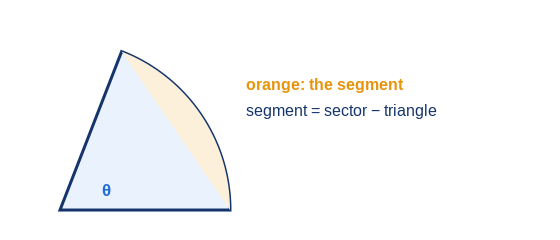
- r = 10, θ = 1.2. A segment is the sector minus the triangle.
- sector = ½ × 100 × 1.2 = 60
- triangle = ½ × 100 × sin 1.2 = 46.60
- segment = 13.40 square units
Sector and segment
- The segment is the part between the chord and the arc.
Common mistakes
- Using s = rθ with θ in degrees.These formulas only work in radians.
- Leaving the calculator in degrees for sin 1.2.Switch to radians.
Try it: dodge the radian traps
Your turn
Convert 90° to radians.
Convert π/3 to degrees.
r = 4, θ = 1.5. Find the arc.
r = 4, θ = 0.5. Find the sector area.
An arc of length 15 cm is on a circle of radius 6 cm. Find the angle θ in radians.
r = 5 cm and the angle is 60°. A student writes s = 5 × 60 = 300 cm. Find the correct arc length.
A pizza slice is a sector with radius 18 cm and angle 40°. Find its area.
r = 6 and θ = π/3. Find the area of the segment.
Show answer
1. π/2 2. 60° 3. 6 4. ½ × 16 × 0.5 = 4 5. θ = 2.5. From s = rθ, θ = 15 ÷ 6 = 2.5 radians. 6. 5.24 cm. Convert first: 60° = π/3, so s = 5 × π/3 = 5.24 cm. 7. 113.10 cm². 40° = 2π/9, so A = ½ × 324 × 2π/9 = 36π = 113.10 cm². 8. 3.26 square units. Sector = ½ × 36 × π/3 = 18.85, triangle = ½ × 36 × sin(π/3) = 15.59, so segment = 3.26 square units.
Sample question: Achieved
A sector has radius 9 cm and angle 2π5 radians. Find its exact arc length and area, then give each to 2 decimal places.
Hint
The angle is already in radians, so use s = rθ and A = ½r²θ directly.
Answer
Arc 18π5 ≈ 11.31 cm; area 81π5 ≈ 50.89 cm²
Step by step
- The angle is in radians, so the formulas s = rθ and A = ½r²θ can be used straight away.
- Arc length: s = 9 × 2π5 = 18π5 ≈ 11.31 cm.
- Area: A = ½ × 81 × 2π5 = 81π5 ≈ 50.89 cm².
- Classic mistake: using these formulas with an angle in degrees. They only work in radians.
- Check: 2π5 is a fifth of a full turn (2π). A fifth of the circumference 18π is 18π5, and a fifth of the area 81π is 81π5. Both match.
Full working
- s = 9 × 2π5 = 18π5s = rθ
- A = ½ × 81 × 2π5 = 81π5A = ½r²θ
- s ≈ 11.31 cm, A ≈ 50.89 cm²
Sample questions: Merit
A sector has area 48 cm² and arc length 12 cm. Find its radius and its angle in radians and in degrees.
Hint
Write both facts as equations in r and θ. Replacing rθ with 12 in the area formula leaves just r.
Answer
r = 8 cm and θ = 1.5 radians ≈ 85.9°
Step by step
- Two facts give two equations: rθ = 12 and ½r²θ = 48.
- Notice ½r²θ = ½ × r × (rθ). The bracket is the arc length, 12.
- So ½ × r × 12 = 48, which gives 6r = 48 and r = 8 cm.
- Then θ = 12 ÷ 8 = 1.5 radians.
- In degrees: 1.5 × 180π ≈ 85.9°.
- Classic mistake: dividing the two equations the wrong way round and getting r = 18. Check the sizes make sense.
- Check: arc 8 × 1.5 = 12 and area ½ × 64 × 1.5 = 48. Both correct.
Full working
- rθ = 12 and ½r²θ = 48
- ½ × r × 12 = 48replace rθ with 12
- r = 8, θ = 12 ÷ 8 = 1.5
- 1.5 × 180π ≈ 85.9°
- r = 8 cm, θ = 1.5 radians ≈ 85.9°
A chord 10 cm long is drawn in a circle of radius 8 cm. Find the area of the smaller segment cut off by the chord.
Hint
Find the angle at the centre first: split the isosceles triangle into two right triangles. Then segment = sector − triangle, in radians.
Answer
About 11.98 cm²
Step by step
- A segment is the sector minus the triangle, and both need the angle θ at the centre.
- The triangle from the centre to the chord is isosceles with sides 8, 8 and 10. Halve it: a right triangle with hypotenuse 8 and opposite side 5.
- sin(θ2) = 58, so θ2 ≈ 0.6751 radians and θ ≈ 1.3503 radians. Use radian mode.
- Sector area: ½ × 8² × 1.3503 ≈ 43.21 cm².
- Triangle area: ½ × 8² × sin 1.3503 ≈ 32 × 0.9758 ≈ 31.22 cm².
- Segment = 43.21 − 31.22 ≈ 11.98 cm² (using unrounded values).
- Classic mistake: mixing modes. If θ is found in degrees, it must be converted before using ½r²θ.
- Check with the cosine rule: cos θ = (64 + 64 − 100) ÷ 128 = 0.21875, which also gives θ ≈ 1.3503.
Full working
- sin(θ2) = 58, so θ ≈ 1.3503 radhalf the isosceles triangle
- sector = ½ × 64 × 1.3503 ≈ 43.21
- triangle = ½ × 64 × sin 1.3503 ≈ 31.22
- segment = 43.208 − 31.225sector − triangle
- about 11.98 cm²
Sample questions: Excellence
A sector has a perimeter of 30 cm. Show that its area is A = 15r − r², where r is the radius. Hence find the radius and the angle that give the largest possible area, and that area.
Hint
The perimeter is two radii plus the arc, so the arc is 30 − 2r. Then use A = ½rs, which is ½r²θ with s = rθ.
Answer
A = 15r − r²; the largest area is 56.25 cm², when r = 7.5 cm and θ = 2 radians
Step by step
- The perimeter of a sector is two radii plus the arc: 2r + s = 30, so s = 30 − 2r.
- Sector area is ½r²θ = ½r(rθ) = ½rs.
- So A = ½r(30 − 2r) = 15r − r². That is what we had to show.
- "Hence": A = 15r − r² is a parabola in r that opens downwards, so its greatest value is at the vertex.
- Complete the square: 15r − r² = −(r − 7.5)² + 56.25. The vertex is at r = 7.5, with A = 56.25.
- Then the arc is s = 30 − 15 = 15 cm and θ = s ÷ r = 15 ÷ 7.5 = 2 radians.
- Interesting: the best sector has its arc equal to two radii, for any perimeter.
- Limits: r must be more than 0, and s must be positive, so r < 15. Also θ cannot pass 2π, which needs r > 302 + 2π ≈ 3.62. r = 7.5 is inside all of these.
- Classic mistake: thinking the perimeter is just the arc. The two straight edges count too.
- Check: r = 7 gives 105 − 49 = 56, and r = 8 gives 120 − 64 = 56. Both are less than 56.25.
Full working
- s = 30 − 2rperimeter 2r + s = 30
- A = ½rs = ½r(30 − 2r) = 15r − r²shown
- A = −(r − 7.5)² + 56.25complete the square
- r = 7.5, s = 15, θ = 15 ÷ 7.5 = 2
- largest area 56.25 cm² at r = 7.5 cm, θ = 2 radians
Two circles each have radius 6 cm, and each centre lies on the other circle. Find the exact area of the region inside both circles, then give it to 2 decimal places.
Hint
Join the two centres to the two points where the circles cross. You get two equilateral triangles, so the angle at each centre is 2π3.
Answer
24π − 18√3 ≈ 44.22 cm²
Step by step
- Call the centres A and B and the crossing points P and Q. AB = 6, because each centre is on the other circle.
- AP, BP, AQ and BQ are all radii, so all are 6. Triangles ABP and ABQ are equilateral.
- So angle PAQ = 60° + 60° = 120° = 2π3 radians. The same is true at B.
- The overlap is two equal segments, one cut from each circle by the chord PQ.
- One segment = sector − triangle = ½r²θ − ½r² sin θ = ½ × 36 × (2π3 − sin(2π3)).
- sin(2π3) = √32, so one segment = 18(2π3 − √32) = 12π − 9√3.
- Two segments: 24π − 18√3 ≈ 75.40 − 31.18 ≈ 44.22 cm².
- Classic mistake: adding two sectors. The two sectors overlap in the rhombus APBQ, so that counts the middle twice.
- Sense check: one circle has area 36π ≈ 113.10, and the overlap is about 39% of it. Looking at the picture, a bit over a third seems right.
Full working
- AB = AP = BP = 6equilateral triangles
- ∠PAQ = 2π360° + 60°
- segment = ½ × 36(2π3 − √32) = 12π − 9√3sector − triangle
- overlap = 2(12π − 9√3)two equal segments
- 24π − 18√3 ≈ 44.22 cm²
What to take away
- Convert to radians before using the formulas.
- Segment = sector − triangle.
Challenge
A stormwater pipe has a circular cross-section of radius 50 cm and lies level. Water in it is 25 cm deep. What fraction of the cross-section is full of water, to 3 decimal places? After heavy rain the water is 75 cm deep. What fraction is full now, and why do the two fractions add to exactly 1?
Hint
Draw the centre, the water surface (a chord) and the two radii to its ends. The centre is 25 cm above the water surface, which gives you the angle at the centre. The water is a segment.
Answer
25 cm deep: 13 − √34π ≈ 0.196 of the pipe; 75 cm deep: ≈ 0.804. The two water surfaces are the same distance from the centre, so the dry part at 75 cm is exactly the same shape as the wet part at 25 cm.
Step by step
- The water surface is a chord. The centre is 50 − 25 = 25 cm above it.
- In the right triangle made by the centre, the middle of the chord and one end of the chord, cos(θ2) = 2550 = 12, so θ2 = π3 and θ = 2π3.
- The water is a segment: sector minus triangle, so its area is ½r²(θ − sin θ) = 1250(2π3 − √32) ≈ 1535.46 cm².
- The whole pipe is π × 50² = 2500π ≈ 7853.98 cm², so the fraction is about 0.196.
- At 75 cm deep the water surface is 25 cm above the centre. The dry part above it is the same segment as before, turned upside down.
- So the wet fraction is 1 − 0.196 = 0.804, and the two fractions add to 1.
Full working
- cos(θ2) = 2550 = 12, so θ = 2π3centre is 25 cm above the chord
- segment = ½ × 50² × (2π3 − sin(2π3))sector minus triangle
- = 1250(2π3 − √32) ≈ 2617.99 − 1082.53 = 1535.46 cm²
- fraction = 1535.46 ÷ 7853.98 ≈ 0.196circle area 2500π
- 75 cm deep: 1 − 0.196 = 0.804dry part is the same segment
- 0.196 full at 25 cm; 0.804 full at 75 cm
Draw an equilateral triangle with sides 6 cm. With each corner as centre, draw the arc of radius 6 cm joining the other two corners. The three arcs make a curved triangle, the shape used for some drill bits and guitar picks. Show that its perimeter is the same as the circumference of a circle of diameter 6 cm. Then find its exact area, and what percentage of that circle's area it is.
Hint
Each arc belongs to a sector of angle π3. Three such sectors cover the shape, but they overlap: the triangle in the middle is counted three times.
Answer
Perimeter 6π cm (same as the circle); area 18π − 18√3 = 18(π − √3) ≈ 25.37 cm², about 89.7% of the circle
Step by step
- Each angle of an equilateral triangle is 60°, which is π3 radians.
- Each arc has length 6 × π3 = 2π, so the perimeter is 3 × 2π = 6π cm. A circle of diameter 6 cm has circumference π × 6 = 6π cm. They are equal.
- Each sector has area ½ × 36 × π3 = 6π. The three sectors together cover the shape, but the middle triangle is inside all three.
- So the shape is three sectors minus two copies of the triangle. The triangle's area is ½ × 6 × 6 × sin(π3) = 9√3.
- Area = 18π − 18√3 ≈ 25.37 cm². The circle has area π × 3² = 9π ≈ 28.27 cm², so the shape is about 89.7% of it.
Full working
- arc = 6 × π3 = 2π, perimeter = 3 × 2π = 6πs = rθ
- circle of diameter 6: π × 6 = 6πsame perimeter
- sector = ½ × 6² × π3 = 6πA = ½r²θ
- triangle = ½ × 6 × 6 × sin(π3) = 9√3area rule
- area = 3 × 6π − 2 × 9√3 = 18π − 18√3 ≈ 25.37 cm²triangle counted 3 times, keep it once
- 25.37 ÷ 9π = 2(π − √3)π ≈ 0.897circle area 9π
- Area 18(π − √3) ≈ 25.37 cm², about 89.7% of the circle
A drive belt is pulled tight around two pulleys. The small pulley has radius 10 cm, the large one has radius 30 cm, and their centres are 40 cm apart. The belt does not cross over itself. Find the exact length of the belt, then give it to 2 decimal places.
Hint
Each straight part of the belt is a tangent, so it meets both radii at right angles. Slide one straight part across until it passes through the small pulley's centre: you get a right triangle with hypotenuse 40 cm and one side 30 − 10 = 20 cm.
Answer
40√3 + 140π3 ≈ 215.89 cm
Step by step
- Join the centres. Each straight section of belt is at right angles to the radius at each end.
- Moving one straight section parallel to itself to pass through the small centre makes a right triangle with hypotenuse 40 and short side 30 − 10 = 20.
- So the straight section is √(40² − 20²) = 20√3 cm, and the angle α between it and the line of centres has sin α = 2040, so α = π6.
- The belt wraps further round the large pulley than half way: π + 2α = 4π3. It wraps less than half way round the small one: π − 2α = 2π3.
- Arc lengths: 30 × 4π3 = 40π and 10 × 2π3 = 20π3.
- Total: 2 × 20√3 + 40π + 20π3 = 40√3 + 140π3 ≈ 215.89 cm.
Full working
- straight part = √(40² − 20²) = 20√3right triangle, side 30 − 10
- sin α = 2040, so α = π6angle with the line of centres
- large wrap = π + 2α = 4π3, small wrap = π − 2α = 2π3belt hugs the big pulley more
- arcs: 30 × 4π3 = 40π and 10 × 2π3 = 20π3s = rθ
- L = 40√3 + 40π + 20π3 = 40√3 + 140π3two straights plus two arcs
- L = 40√3 + 140π3 ≈ 215.89 cm