Expanding, factorising and solving
What this lesson covers
- The properties of operations (commutative, distributive, associative, inverse, and identity) and the order of operations apply to numbers and variables.
- When operating on or writing equations with fractions, fractions of magnitude greater than 1 are usually written as improper fractions.
You already do this with numbers
- Three times twenty-seven: do three twenties and three sevens.
- That is the distributive law, and you have used it for years.
- Algebra is the same law with the number left out.
| Working | Split up | Gives |
|---|---|---|
| 3 × 27 | 3 × 20 + 3 × 7 | 60 + 21 = 81 |
| 3(x + 7) | 3 × x + 3 × 7 | 3x + 21 |
| Same law | one has a number | one has a letter |
| Algebra | is arithmetic | with the number withheld |
Collecting like terms
- Only terms with the same letter part can join up.
- Three x take one x is two x. Five y and two y is seven y.
- Two x plus seven y is finished. It does not go further.
| Expression | Doing | Gives |
|---|---|---|
| 3x + 5y − x + 2y | sort them | |
| The x terms | 3x − x | 2x |
| The y terms | 5y + 2y | 7y |
| Answer | 2x + 7y | and it stops there |
Multiplying out a bracket
- The thing outside multiplies everything inside.
- Three lots of two x is six x. Three lots of five is fifteen.
- Miss one term and the whole answer is wrong.
Two brackets
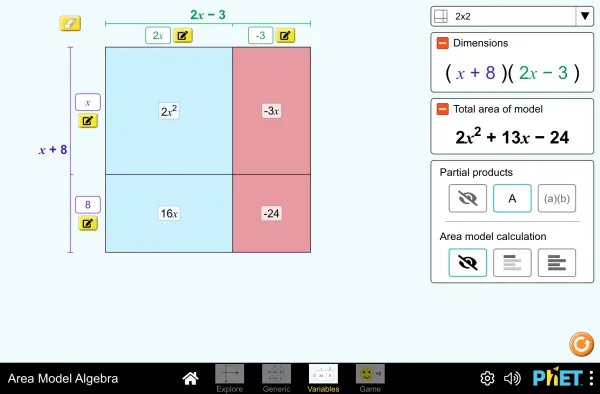
- Every term in the first meets every term in the second.
- Four multiplications, then collect what matches.
- x squared, four x, three x, twelve. The middle two join.
| Expression | Working | Result |
|---|---|---|
| 3(2x + 5) | both terms | 6x + 15 |
| (x + 3)(x + 4) | all four pairs | |
| x·x, x·4, 3·x, 3·4 | x² + 4x + 3x + 12 | |
| Collect the middle | 4x + 3x | x² + 7x + 12 |
Try it: two brackets as an area
Factorising: the same line backwards
- Six x plus fifteen. What divides into both? Three.
- Take it outside and see what is left inside.
- Three, bracket, two x plus five. Expand it to check.
| Step | Question | Answer |
|---|---|---|
| 6x + 15 | what divides both? | 3 |
| Take it out | 3( ? + ? ) | |
| 6x ÷ 3, 15 ÷ 3 | 2x and 5 | 3(2x + 5) |
| Check | expand it again | 6x + 15 |
Factorising a quadratic
- x squared plus seven x plus twelve. Look for two numbers.
- They must multiply to twelve and add to seven.
- Three and four. So it is x plus three, x plus four.
| Expression | The search | Found |
|---|---|---|
| x² + 7x + 12 | need × 12, + 7 | |
| Pairs for 12 | 1,12 2,6 3,4 | |
| 3 and 4 | add to 7 | that is it |
| So | (x + 3)(x + 4) |
When the last number is negative
- Multiplying to minus eight means one of them is negative.
- Four and minus two: they multiply to minus eight, add to two.
- So x plus four, x minus two.
| Expression | The search | Found |
|---|---|---|
| x² + 2x − 8 | need × −8, + 2 | |
| So one is negative | 4 and −2 | |
| 4 × −2 = −8 | 4 + −2 = 2 | both fit |
| So | (x + 4)(x − 2) |
The long way, which keeps working
- Split the middle term using the same two numbers.
- Group the four terms in pairs and factorise each pair.
- The same bracket appears twice. Take it out.
| Step | Working | Note |
|---|---|---|
| x² + 2x − 8 | split the middle | |
| Using 4 and −2 | x² + 4x − 2x − 8 | |
| Group in pairs | x(x + 4) − 2(x + 4) | |
| Common bracket | (x − 2)(x + 4) | same answer |
Solving a linear equation
- The scales balance. Whatever you do, do to both sides.
- Take seven off both. Then divide both by five.
- x is six, and you check it by putting it back in.
| Step | Leaves | Note |
|---|---|---|
| 5x + 7 = 37 | start | |
| Take 7 off both sides | 5x = 30 | |
| Divide both by 5 | x = 6 | |
| Check | 5 × 6 + 7 | 37, correct |
With a fraction in it
- Two x over three, plus four, equals ten.
- Take the four off, then multiply both sides by three.
- Two x is eighteen, so x is nine. Nothing new happened.
| Step | Leaves | Note |
|---|---|---|
| 2x/3 + 4 = 10 | start | |
| Take 4 off both | 2x/3 = 6 | |
| Times both by 3 | 2x = 18 | |
| Divide by 2 | x = 9 | check: 6 + 4 = 10 |
An inequality, and its one extra rule
- Solve it exactly like an equation, until one step.
- Multiplying or dividing by a negative reverses the sign.
- So less than or equal becomes greater than or equal.
| Step | Working | Result |
|---|---|---|
| −2/5 x + 5 ≤ −10 | start | |
| Take 5 off both | −2/5 x ≤ −15 | |
| Times by −5/2 | the sign reverses | x ≥ 37.5 |
| Check x = 40 | −16 + 5 = −11 | ≤ −10, correct |
Solving a factorised quadratic
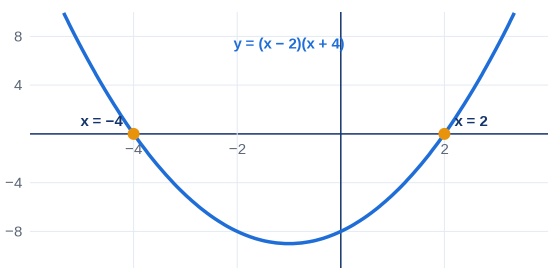
- Two things multiply together and give zero.
- That can only happen if one of them is zero.
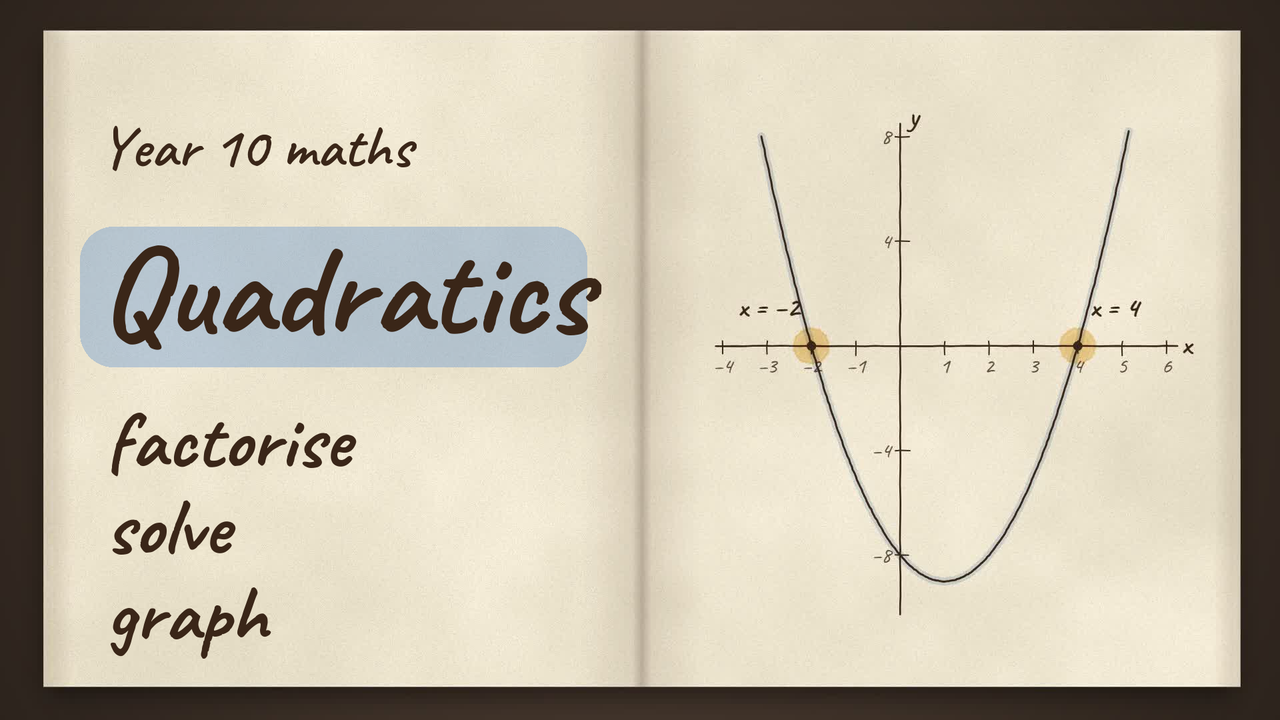
- So x is two, or x is minus four. Two answers.
| Step | Reasoning | Result |
|---|---|---|
| (x − 2)(x + 4) = 0 | two things multiply to 0 | |
| So one of them is 0 | x − 2 = 0 | or x + 4 = 0 |
| Giving | x = 2 | or x = −4 |
| Two solutions | and that is normal |
Try it: right or wrong?
And the x squared plus c kind
- x squared minus nine is zero, so x squared is nine.
- Three works, and so does minus three. Both are answers.
- But x squared plus nine has none. Nothing squares to minus nine.
| Equation | Rearranged | Solutions |
|---|---|---|
| x² − 9 = 0 | x² = 9 | x = 3 or −3 |
| Both work | 3² = 9 | (−3)² = 9 |
| x² + 9 = 0 | x² = −9 | |
| No real answer | nothing squares negative |
What to take away
- Seven lines, and the first one is the reason for the rest.
| Algebra follows the same laws | as arithmetic |
| Collect only like terms | 2x and 7y stay apart |
| Expanding | every term times every term |
| Factorising | the same line backwards |
| For x² + bx + c | find two numbers: × c, + b |
| Solve by undoing | in the reverse order |
| Times by a negative | reverses an inequality |
Common mistakes
- (x + 3)(x + 4) = x² + 12Every term meets every term: x × 4 and 3 × x give a middle term of 7x, so it is x² + 7x + 12.
- −2/5 x ≤ −15, so x ≤ 37.5Multiplying both sides by −5/2 reverses the sign, so x ≥ 37.5; checking x = 40 gives −11 ≤ −10, which is true.
- (x + 6)(x − 1) = 0, so x = 6 or x = −1Set each bracket to zero: x + 6 = 0 gives x = −6 and x − 1 = 0 gives x = 1, so the signs flip.
- x² − 9 = 0, so x² = 9 and x = 3(−3)² is also 9, so x = 3 or x = −3; give both solutions.
Your turn: eight questions
- Write all eight out.
- Question 2 needs two numbers with a negative product.
- Question 4 wants both answers, and watch the signs.
Expand and simplify (x + 5)(x − 2).
Factorise x² − x − 12.
Solve 3x/4 − 2 = 7.
Solve (x + 6)(x − 1) = 0.
Simplify 4a + 3b − a + 5b.
Factorise 8x − 20 fully.
Which of these equations has no real solutions?
Solve 7 − 3x > 19.
Show answer
1. x² + 3x − 10. Every term times every term gives x² − 2x + 5x − 10, and the middle two collect to 3x. 2. (x − 4)(x + 3). You need two numbers that multiply to −12 and add to −1. Negative four and positive three do both. 3. x = 12. Add 2 to both sides for 3x/4 = 9, times both sides by 4 for 3x = 36, then divide by 3. 4. x = −6 or x = 1. Two things multiply to zero, so one of them is zero. Note the signs flip: the bracket x + 6 gives the solution negative six. 5. 3a + 8b. The a terms give 4a − a = 3a and the b terms give 3b + 5b = 8b, and unlike terms stay apart. 6. 4(2x − 5). 4 divides into both: 8x ÷ 4 = 2x and 20 ÷ 4 = 5. Check: 4(2x − 5) = 8x − 20. 7. x² + 16 = 0. It needs x² = −16, and nothing squares to a negative number. 8. x < −4. Take 7 off both sides for −3x > 12, then divide by −3, which reverses the sign.
The answers
- x squared plus three x minus ten.
- x minus four, x plus three.
- x is twelve.
- x is minus six, or x is one. The signs flip over.
Area Model Algebra
Full screen · PhET Interactive Simulations, University of Colorado Boulder, CC BY 4.0
Challenge
Find every whole number x (positive, negative or zero) that makes both of these true at the same time: 3 − 2x < 11 and x + 13 ≤ 2. How many whole numbers is that, and what do they add up to?
Hint
Solve each inequality on its own first. Watch the step where you divide by a negative number. Then keep only the numbers that pass both.
Answer
9 whole numbers (−3 up to 5), which add up to 9
Step by step
- Take 3 off both sides of the first one: −2x < 8.
- Divide by −2. Dividing by a negative reverses the sign, so x > −4.
- For the second one, times both sides by 3 to get x + 1 ≤ 6, so x ≤ 5.
- So x is bigger than −4 but at most 5: the whole numbers −3, −2, −1, 0, 1, 2, 3, 4, 5.
- That is 9 numbers. The −3 to 3 pairs cancel out, leaving 4 + 5 = 9.
Full working
- 3 − 2x < 11first inequality
- −2x < 8take 3 off both sides
- x > −4divide by −2, so the sign reverses
- x + 13 ≤ 2, so x + 1 ≤ 6, so x ≤ 5second inequality
- −4 < x ≤ 5: x = −3, −2, −1, 0, 1, 2, 3, 4, 5whole numbers that pass both
- (−3 + 3) + (−2 + 2) + (−1 + 1) + 0 + 4 + 5 = 9the pairs cancel
- 9 whole numbers, sum 9
a is a whole number. Expand and simplify (x + a)(x + 5) − (x + 2)(x + 7). Find the one value of a that makes this expression have the same value whatever x is, and find that value. Hence work out 104 × 105 − 102 × 107 without a calculator.
Hint
After expanding, the x² terms cancel. For the answer not to depend on x, what must happen to the x term?
Answer
The expression is (a − 4)x + 5a − 14. It has the same value for every x when a = 4, and that value is 6. With x = 100, 104 × 105 − 102 × 107 = 6.
Step by step
- (x + a)(x + 5) = x² + 5x + ax + 5a, and (x + 2)(x + 7) = x² + 9x + 14.
- Subtracting, the x² terms cancel, leaving (a − 4)x + 5a − 14.
- The value does not change with x only when the x term vanishes, so a − 4 = 0 and a = 4.
- Then the expression is 5 × 4 − 14 = 6, for every x.
- Putting x = 100 gives 104 × 105 − 102 × 107, so it equals 6.
Full working
- (x + a)(x + 5) = x² + (a + 5)x + 5aexpand
- (x + 2)(x + 7) = x² + 9x + 14expand
- difference = (a + 5 − 9)x + 5a − 14 = (a − 4)x + 5a − 14x² cancels
- a − 4 = 0, so a = 4no x term left
- 5 × 4 − 14 = 6the constant value
- x = 100: 104 × 105 − 102 × 107 = 6check: 10920 − 10914 = 6
- a = 4, value 6, and 104 × 105 − 102 × 107 = 6
Mere solves (x − 3)(x + 2) = (x − 3)(2x − 5). She divides both sides by (x − 3), gets x + 2 = 2x − 5, and says x = 7 is the only answer. Find all the solutions, and explain what went wrong.
Hint
Move everything to one side so it equals zero. Can you see a bracket that both terms share? What happens if x − 3 is zero?
Answer
x = 3 or x = 7. Dividing by (x − 3) loses x = 3, because you cannot divide by zero.
Step by step
- Take the right-hand side away from both sides so the equation equals zero.
- Both terms contain (x − 3), so take it out as a common factor.
- Inside the second bracket: (x + 2) − (2x − 5) = x + 2 − 2x + 5 = 7 − x.
- Now (x − 3)(7 − x) = 0, so x − 3 = 0 or 7 − x = 0. That is x = 3 or x = 7.
- Mere divided by (x − 3). When x = 3 that is dividing by zero, so that answer vanished.
- Check x = 3: both sides are 0 × 5 = 0 and 0 × 1 = 0, so it works.
Full working
- (x − 3)(x + 2) − (x − 3)(2x − 5) = 0make it equal zero
- (x − 3)[(x + 2) − (2x − 5)] = 0common factor (x − 3)
- (x − 3)(7 − x) = 0x + 2 − 2x + 5 = 7 − x
- x − 3 = 0 or 7 − x = 0product is zero, so one factor is zero
- x = 3: left 0 × 5 = 0, right 0 × 1 = 0the answer Mere lost
- x = 3 or x = 7