
Transverse and longitudinal waves, sound and the EM spectrum
What this lesson covers
- Transverse waves, where the oscillation is at right angles to the direction of travel
- Longitudinal waves, where the oscillation is along the direction of travel
- Sound as a longitudinal mechanical wave, and how frequency sets pitch and amplitude sets loudness in decibels
- Why sound is fastest in solids and slowest in gases
- Using the wave equation v = fλ
- Electromagnetic waves, which need no medium, and the order of the electromagnetic spectrum
- Judging which models show each kind of wave best
Transverse waves
- Part 1 described waves by amplitude, wavelength and frequency. Waves also differ in which way the medium moves.
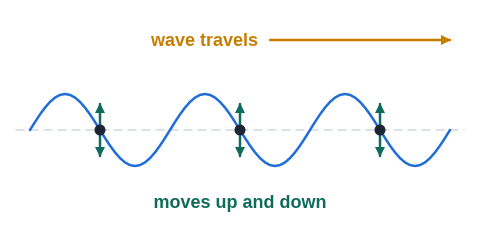
- In a transverse wave, each bit of the medium moves at right angles (perpendicular) to the direction the wave travels.
- Tie a rope to a post and flick your hand up and down: the wave runs along the rope, but each part of the rope only moves up and down.
- Transverse waves have crests and troughs. Waves on a rope, all light waves and (very nearly) ripples on water are transverse.
Longitudinal waves
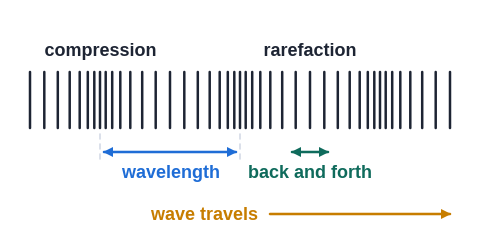
- In a longitudinal wave, the medium moves back and forth in the same direction (parallel to) the way the wave travels.
- Stretch a slinky along the floor and push one end in and out: bunched-up coils travel along it.
- Regions where coils are squashed together are compressions; regions where they are spread apart are rarefactions.
- One wavelength is the distance from one compression to the next.
- Sound and the primary (P) waves that arrive first after an earthquake are longitudinal.
| Transverse | Longitudinal | |
|---|---|---|
| Medium moves | at right angles to travel | along the line of travel |
| Features | crests and troughs | compressions and rarefactions |
| Wavelength | crest to crest | compression to compression |
| Examples | rope, water ripples, light | sound, slinky pushed, P waves |
Light and waves
Which model shows a wave best?
- Every model shows some features of a wave well and gets others wrong, so choose the model for the feature you want to explain.
- A slinky is the most versatile: it can show both types, and a ribbon on one coil proves the coils only oscillate.
- Falling dominoes show energy passing along a line, but each domino falls once and never returns, so they miss the repeated oscillation completely.
- A wavy line diagram looks like a transverse wave. For sound, the same curve is only a graph of air pressure, not a picture of the air.
| Model | Shows well | Misleading |
|---|---|---|
| Slinky | both wave types, energy moves while coils stay | real sound is far faster and invisible |
| Rope flicked up and down | transverse wave, crests and troughs | cannot show longitudinal waves |
| Row of dominoes | energy passed from particle to particle | no oscillation, no return, a single pulse only |
| People in a line pushing shoulders | compressions moving along | people do not spring back on their own |
| Wavy line diagram | amplitude and wavelength clearly | for sound it is a graph, not the wave's shape |
Sound is a longitudinal mechanical wave
- Every sound starts with something vibrating: your vocal cords, a guitar string or a speaker cone.
- As a speaker cone moves out it squashes the air in front into a compression; as it moves back it leaves a rarefaction.
- These compressions and rarefactions travel outward through the air to your ear, where they make your eardrum vibrate.
- Because the air must be pushed along, sound needs a medium, which makes it a mechanical wave.
Pitch and loudness
- The frequency of a sound decides its pitch: higher frequency, higher note. A tūī can sing notes too high for us to hear.
- Young people hear from about 20 Hz to 20,000 Hz, and the top limit drops with age.
- The amplitude decides the loudness: bigger vibrations carry more energy and sound louder.
- Sound level is measured in decibels (dB). Every 10 dB step means ten times the sound energy, and sounds about twice as loud.
- Long exposure above about 85 dB can damage hearing permanently, which is why workers in loud jobs wear earmuffs.
| Sound | Approximate level |
|---|---|
| quietest sound you can hear | 0 dB |
| whisper | 30 dB |
| normal conversation | 60 dB |
| busy road | 80 dB |
| lawnmower | 90 dB |
| rock concert near the speakers | 110 dB |
Sound is fastest in solids
- Sound moves by each particle pushing on its neighbour.
- In a stiff solid, particles are tightly bonded, so a push is passed on almost instantly.
- In a gas, particles are far apart and only pass the push on when they collide, so sound is slowest.
- Put your ear to a long steel fence while someone taps the far end: you hear the tap through the metal before the sound through the air arrives.
| Medium | State | Speed of sound (approx.) |
|---|---|---|
| air at 20 °C | gas | 343 m/s |
| seawater | liquid | 1,500 m/s |
| steel | solid | 5,900 m/s |
The wave equation: v = fλ
- If a source makes f waves every second, and each is λ metres long, the wave travels f × λ metres every second.
- So wave speed v = frequency f × wavelength λ, with v in m/s, f in Hz and λ in m.
- Rearranged: f = v ÷ λ and λ = v ÷ f.
- In one medium the speed is fixed, so raising the frequency makes the wavelength shorter.
Worked example: the wavelength of a note
- A violin plays the A note at 440 Hz. Sound travels at 343 m/s in the room. Find the wavelength.
- v = fλ, so λ = v ÷ fwe want the wavelength
- λ = 343 ÷ 440v = 343 m/s, f = 440 Hz
- λ ≈ 0.78 m
- 440 × 0.78 ≈ 343
Worked example: depth from an echo
- A ship in Cook Strait sends a sound pulse straight down. The echo from the seabed returns 0.80 s later. Sound travels at 1,500 m/s in seawater. How deep is the water?
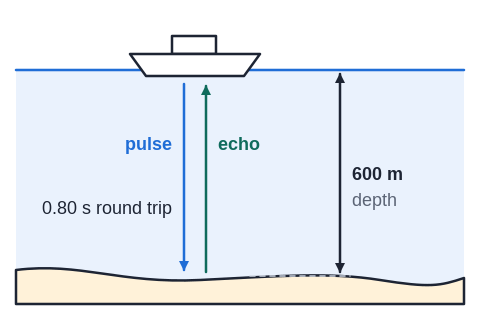
- distance = speed × timethe pulse moves at a steady speed
- 1,500 × 0.80 = 1,200 mthe total path
- 1,200 mwrong: that is down and back up
- depth = 1,200 ÷ 2the sound went to the seabed and back
- depth = 600 m
Try it: a sound quest
Electromagnetic waves need no medium
- Electromagnetic (EM) waves are made of electric and magnetic fields that oscillate together, at right angles to the direction of travel, so they are transverse.
- Fields can exist in empty space, so EM waves can cross a vacuum. That is how sunlight reaches us across 150 million km of space.
- Sound from the Sun cannot reach us, because sound is mechanical and needs particles.
- Light, radio, microwaves and X-rays are all EM waves; they differ only in wavelength and frequency.
The electromagnetic spectrum
- The EM spectrum is the whole family of EM waves, arranged in order of wavelength.
- Going from radio to gamma, wavelength gets shorter and frequency gets higher.
- Higher frequency EM waves carry more energy, which is why ultraviolet, X-rays and gamma rays can damage living cells.
- Visible light is only a narrow slice in the middle.
- One way to remember the order: Raging Martians Invaded Venus Using X-ray Guns.
| Type | Typical wavelength | About the size of |
|---|---|---|
| Radio | 30 cm to kilometres | a person to a mountain |
| Microwave | 1 mm to 30 cm | a grain of sand to a ruler |
| Infrared | 0.0007 mm to 1 mm | a hair's width |
| Visible light | 400 to 700 nm | a bacterium |
| Ultraviolet | 10 to 400 nm | a virus |
| X-ray | 0.01 to 10 nm | an atom |
| Gamma ray | below 0.01 nm | an atom's nucleus |
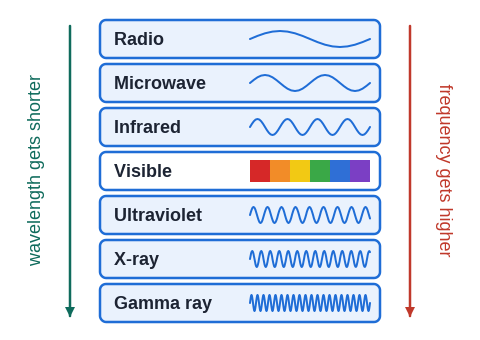
Try it: across the spectrum
Common mistakes
- Sound travels fastest in air, because there is less stuff in the way.Sound is fastest in solids, because tightly bonded particles pass each push on to their neighbours much faster than far-apart gas particles.
- The echo returns after 0.80 s at 1,500 m/s, so the sea is 1,200 m deep.The sound went down and back up, so halve the distance: the sea is 600 m deep.
- A higher note travels faster than a low one.In one medium every sound has the same speed; a higher frequency just means a shorter wavelength, since v = fλ.
- A high-pitched sound is a loud sound.Frequency sets the pitch and amplitude sets the loudness, so a high note can be quiet and a low note can be loud.
A spoon that rings like a bell
You need: a metal spoon, ideally a big serving spoon, about 1 m of string or kitchen twine
- Tie the middle of the string around the handle of the spoon so it hangs evenly with two long ends.
- Wind one end of the string around the first finger of each hand.
- Let the spoon swing gently against the edge of a table and listen to the sound it makes through the air.
- Now press your string-wrapped fingertips gently against the outside of your ear openings, lean forward so the string hangs tight and swing the spoon against the table again.
- Look for: through the air the spoon makes a thin clink, but through the string it sounds like a loud, deep church bell, because the vibrations travel along the string as a longitudinal wave, and a solid passes sound on far better than air does.
Safety: Only rest your fingertips against the outside of your ears, never push anything into the ear canal, and tap the spoon gently so the sound is not painfully loud.
Your turn
Say whether each is transverse or longitudinal: a ripple on a pond, a sound wave, a light wave, a slinky pushed in and out.
A dog whistle makes sound at 34,300 Hz in air at 343 m/s. Find the wavelength, and explain why people cannot hear it.
A whale call in seawater (1,500 m/s) has a wavelength of 3.0 m. What is its frequency?
Explain why you can hear a train coming through the rail before you hear it through the air.
Put these in order from longest to shortest wavelength: X-rays, radio, visible light, microwaves.
A guitarist plucks the same string again, but harder. How does the sound change?
A lawnmower is about 90 dB and normal conversation about 60 dB. How many times more sound energy does the lawnmower give out?
A boat off Kaikōura sends a sound pulse straight down. The echo returns after 1.2 s. Sound travels at 1,500 m/s in seawater. How deep is the water?
Show answer
1. Transverse, longitudinal, transverse, longitudinal. 2. λ = 343 ÷ 34,300 = 0.01 m (1 cm); 34,300 Hz is above the 20,000 Hz limit of human hearing. 3. f = 1,500 ÷ 3.0 = 500 Hz. 4. Steel is stiff, so sound travels in it about 17 times faster than in air. 5. Radio, microwaves, visible light, X-rays. 6. Plucking harder gives bigger vibrations, so the amplitude increases and the sound is louder. The frequency, and so the pitch, stays the same. 7. 90 − 60 = 30 dB is three 10 dB steps, and each step is ten times the energy, so 10 × 10 × 10 = 1,000 times. 8. The total path is 1,500 × 1.2 = 1,800 m, down and back up, so the depth is 1,800 ÷ 2 = 900 m.
Waves Intro
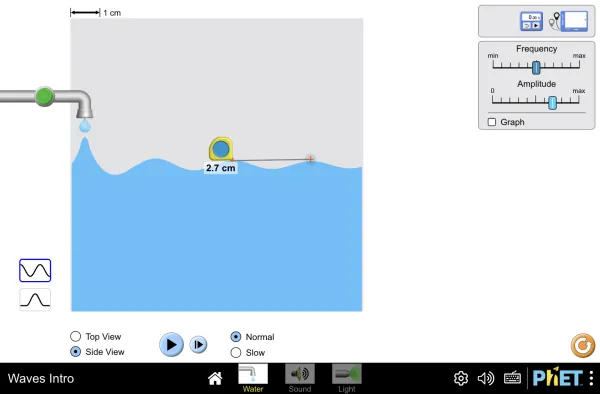
Full screen · PhET Interactive Simulations, University of Colorado Boulder, CC BY 4.0
Recap
- Transverse: the medium moves at right angles to the travel. Longitudinal: it moves along the travel, making compressions and rarefactions.
- Sound is a longitudinal mechanical wave started by vibrations; frequency sets pitch and amplitude sets loudness, measured in dB.
- Sound speed ranks solids first, then liquids, with gases last, because stiffness passes each push on faster.
- Wave speed v = fλ, so λ = v ÷ f and f = v ÷ λ.
- EM waves are oscillating electric and magnetic fields and can travel through a vacuum.
- The EM spectrum runs radio, microwave, infrared, visible, ultraviolet, X-ray, gamma: wavelength falls and frequency rises.
Challenge
A council grounds worker hears 90 dB from her leaf blower, while normal conversation is about 60 dB. (a) How many times more sound energy reaches her ear from the blower than from conversation? (b) The whole crew of 10 workers then runs 10 identical blowers together, all the same distance from her. What sound level does she now hear, and how much louder does it sound than one blower? (c) Sound of about 120 dB is painful. How many identical blowers would it take to reach 120 dB at her ear?
Hint
Each 10 dB step means ten times the energy. Sound energy from separate machines adds, so 10 blowers give 10 times the energy of one.
Answer
(a) 1000 times. (b) 100 dB, which sounds about twice as loud as one blower. (c) 1000 blowers.
Step by step
- From 60 dB to 90 dB is three steps of 10 dB, and each step multiplies the energy by ten.
- Ten blowers give ten times the energy of one, which is one 10 dB step up.
- A 10 dB rise sounds about twice as loud.
- From 90 dB to 120 dB is again three steps of 10 dB, so the energy must be 1000 times that of one blower.
- So it takes 1000 blowers, which shows how huge the energy is at painful levels.
Full working
- 90 − 60 = 30 dB = 3 steps of 10 dBcompare the two levels
- energy ratio = 10 × 10 × 10 = 1000ten times per step
- 10 blowers = 10 × energy = one stepenergies add
- 90 + 10 = 100 dBone step is 10 dB
- 120 − 90 = 30 dB = 3 stepsfrom one blower to pain level
- blowers needed = 10 × 10 × 10 = 1000each blower adds one blower's energy
- (a) 1000 times (b) 100 dB, about twice as loud (c) 1000 blowers
On a mild morning beside a straight railway line, Mere puts her ear to the steel rail while her friend taps the rail with a hammer some distance away. Sound travels at 340 m s⁻¹ in the air and 5,100 m s⁻¹ in this steel. Mere hears the tap through the rail, and 0.70 s later she hears it again through the air. How far away is her friend?
Hint
Work out how many times faster sound is in steel than in air. If the rail trip takes t seconds, how long does the air trip take, and what is the gap between them?
Answer
255 m
Step by step
- Sound in this steel is 5,100 ÷ 340 = 15 times faster than in air.
- Over the same distance the air trip therefore takes 15 times as long as the rail trip.
- If the rail trip takes t, the air trip takes 15t, and the gap between them is 14t.
- That gap is 0.70 s, so t can be found, and then distance = speed × time.
- Check with the air: 255 m at 340 m s⁻¹ takes 0.75 s, which is 0.70 s more than the 0.05 s through steel.
Full working
- 5,100 ÷ 340 = 15steel is 15 times faster
- rail time = t, air time = 15tsame distance, 15 times slower
- 15t − t = 14t = 0.70 sthe gap Mere hears
- t = 0.70 ÷ 14 = 0.05 stime through the rail
- distance = 5,100 × 0.05 = 255 mdistance = speed × time
- check: 255 ÷ 340 = 0.75 s, and 0.75 − 0.05 = 0.70 sair trip minus rail trip
- 255 m
A tramper stands somewhere between two steep cliff walls in a gorge and blows one sharp blast on her whistle. She hears a first echo 1.2 s after the blast and a second echo 2.0 s after the blast. Sound travels at 340 m s⁻¹. (a) How far apart are the two cliffs? (b) She then hears a third, fainter echo. Explain how it is made and when she hears it. (c) Her whistle's note has a frequency of 850 Hz. How many wavelengths of this note would fit across the gorge from cliff to cliff?
Hint
Each echo is a trip to a cliff and back, so halve the distance. For the third echo, think of sound that bounces off one cliff, passes her, and then bounces off the other.
Answer
(a) 544 m. (b) Sound that bounces off both cliffs, one after the other, arriving 3.2 s after the blast. (c) 1360 wavelengths.
Step by step
- The first echo comes from the nearer cliff: the sound went there and back, so the one-way distance is half of speed × time.
- The second echo comes from the further cliff in the same way.
- She stands between them, so the gap between the cliffs is the sum of the two one-way distances.
- Sound that has echoed off the nearer cliff carries on past her, reaches the further cliff and returns, so its time is 1.2 s + 2.0 s. Sound going the other way round takes the same total time.
- The wavelength comes from v = fλ, and the number that fits is the gorge width divided by one wavelength.
Full working
- near cliff = 340 × 1.2 ÷ 2 = 204 mthere and back, so halve
- far cliff = 340 × 2.0 ÷ 2 = 340 mthere and back, so halve
- width = 204 + 340 = 544 mshe is between the cliffs
- third echo time = 1.2 + 2.0 = 3.2 sone round trip to each cliff
- λ = v ÷ f = 340 ÷ 850 = 0.4 mv = fλ rearranged
- wavelengths = 544 ÷ 0.4 = 1360width ÷ one wavelength
- (a) 544 m (b) 3.2 s, off both cliffs (c) 1360 wavelengths