Pythagoras, distance, speed and time
What this lesson covers
- For right-angled triangles, Pythagoras’ theorem states that the square of the hypotenuse (longest side) is equal to the sum of the squares of the other two sides.
- If (a,b,c) is a Pythagorean triple, then so is (ka,kb,kc), where k is a positive integer.
- There is a fixed relationship between speed, distance, and time: speed = distance/time.
- In position-time graphs, the gradient represents speed.
- Decimal measures are used for very small durations (e.g. milliseconds); the rest of time measurement uses a different system, based principally on 12 and 60.
One theorem, three different jobs
- Right-angled triangles have a rule nothing else does.
- It finds a missing side, and it tests whether a corner is square.
- And it measures the distance between any two points on a grid.
Name the sides first
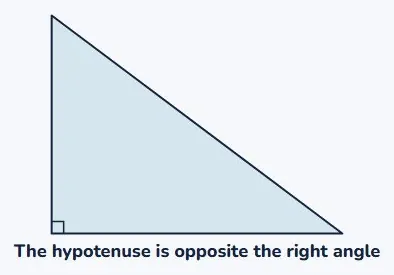
- The hypotenuse is the side opposite the right angle.
- It is always the longest side. That is a useful check.
- In a squared plus b squared equals c squared, c is that side.
Finding a missing side
- Short sides three and four: nine plus sixteen is twenty-five.
- That is c squared, so c is five.
- If the hypotenuse is known instead, subtract rather than add.
| Given | Working | Answer |
|---|---|---|
| Sides 3 and 4 | 9 + 16 | 25 |
| So c²= 25 | square root | c = 5 |
| Hypotenuse 13, side 5 | 169 − 25 | 144 |
| Missing side | square root | 12 |
Try it: change the triangle
Try it: find the missing side
Add or subtract?
- Looking for the longest side: add the two squares.
- Looking for a short side: subtract from the longest squared.
- If your answer is longer than the hypotenuse, you added by mistake.
Is that corner actually square?
- Sides six, eight and eleven. Square the two short ones and add.
- A hundred. But eleven squared is a hundred and twenty-one.
- They do not match, so there is no right angle in it.
| Step | Working | Result |
|---|---|---|
| Sides 6, 8 and 11 | test it | |
| Short sides | 36 + 64 | 100 |
| Longest squared | 11² | 121 |
| 100 is not 121 | so no right angle |
Triples, and why they multiply
- Three, four, five works. So does six, eight, ten.
- Scale all three sides and the relationship survives.
- Recognising them saves you the arithmetic entirely.
| Triple | Where from | Check |
|---|---|---|
| 3, 4, 5 | the famous one | 9 + 16 = 25 |
| 6, 8, 10 | that doubled | still works |
| 9, 12, 15 | tripled | still works |
| 5, 12, 13 | a different one | 25 + 144 = 169 |
Distance between two points
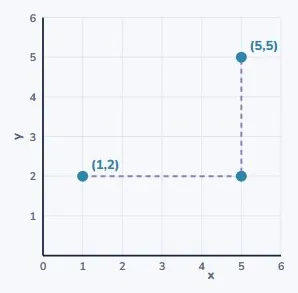
- Across four and up three. Draw those in and look.
- You have made a right-angled triangle without meaning to.
- So the distance is the hypotenuse. Sixteen plus nine, root, five.
That is the distance formula
- The x difference and the y difference are the two short sides.
- So the formula is Pythagoras with the gaps written out.
- Nothing new to memorise. Draw the triangle instead.
A four metre ladder
- Base a metre and a half from the wall. How high does it reach?
- Sixteen take two point two five is thirteen point seven five.
- Root of that, three point seven one metres. Not a tidy number.
| Step | Working | Result |
|---|---|---|
| Ladder 4 m | base 1.5 m out | |
| So | 16 − 2.25 | 13.75 |
| Height reached | √13.75 | 3.71 m |
| Most answers | are not whole numbers |
Speed, and where it hides on a graph
- Speed is distance divided by time. You know that already.
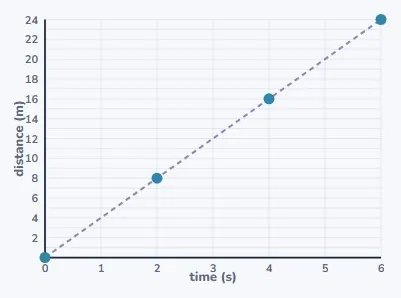
- On a position-time graph, distance is up and time is across.
- So distance over time is rise over run. The gradient is the speed.
Reading the shape before the numbers
- A steeper section means more distance in the same time. Faster.
- A flat section means time passing and distance not changing.
- That is not missing data. That is standing still.
| On the graph | Means | So |
|---|---|---|
| A flat section | time passes | distance does not change |
| Which means | stopped | |
| A steeper section | more distance per second | faster |
| Read the shape | before the numbers |
Try it: read the shape first
Working it out
- A hundred and twenty metres, over twenty seconds.
- Rise over run: a hundred and twenty divided by twenty.
- Six metres per second.
| Reading | Working | Answer |
|---|---|---|
| Distance up the side | time along the bottom | |
| Gradient | distance ÷ time | which is speed |
| 120 m in 20 s | 120 ÷ 20 | 6 m/s |
| Steeper line | faster |
Time is the one thing that is not decimal
- Sixty seconds, sixty minutes, twenty-four hours, twelve on the clock.
- So two point five hours is two hours thirty, not two hours fifty.
- Below a second it goes decimal again. Milliseconds behave normally.
| Written | Working | Really |
|---|---|---|
| 2.5 hours | half an hour is 30 min | 2 h 30 |
| Not 2 h 50 | that is the trap | |
| 3.75 hours | three quarters is 45 | 3 h 45 |
| 90 minutes | 90 ÷ 60 | 1.5 hours |
Try it: corner, gap, clock
What to take away
- Seven lines, and the first three are one theorem.
| a² + b² = c² | c is always the hypotenuse |
| Forwards | two sides give the third |
| Backwards | three sides test for a right angle |
| On a grid | across and up are the short sides |
| A triple scaled up | is still a triple |
| Position-time gradient | is the speed |
| 2.5 hours | is 2 h 30, not 2 h 50 |
Common mistakes
- Ladder 4 m, base 1.5 m: height = √(16 + 2.25) = 4.27 mThe ladder is the hypotenuse, so subtract: √(16 − 2.25) = √13.75 ≈ 3.71 m; a leg can never be longer than the hypotenuse.
- 3² + 4² = 7², so the hypotenuse is 7.Square, add, then square root: 9 + 16 = 25, and √25 = 5.
- 2.5 hours = 2 hours 50 minutesTime is in sixties: 0.5 of an hour is 30 minutes, so 2.5 hours is 2 h 30 min.
- A flat section on a position-time graph means the data is missing.Time passes but distance does not change, so the object has stopped; its speed there is 0.
Your turn: eight questions
- Work all eight.
- Questions 1 and 3 are both triples in disguise.
- Question 2 wants a yes or no, with a reason.
Legs 9 and 12. Find the hypotenuse.
Is 7, 24, 25 a right-angled triangle?
Distance from (2, 1) to (7, 13)?
150 m in 12 s. Speed to 3 s.f.?
On a position-time graph, a walker's line is flat for 5 minutes. What was the walker doing then?
A drive from Taupō to Wellington takes 3.25 hours. How long is that in hours and minutes?
Which set of side lengths makes a right-angled triangle?
A rectangular gate is 2.0 m wide, and its diagonal brace is 2.5 m long. How tall is the gate?
Show answer
1. 15. Eighty-one plus a hundred and forty-four is two hundred and twenty-five, and the square root of that is fifteen. It is the three, four, five triangle tripled. 2. Yes. Forty-nine plus five hundred and seventy-six is six hundred and twenty-five, which is exactly twenty-five squared. 3. 13. Across is five and up is twelve, so it is the five, twelve, thirteen triple. Twenty-five plus a hundred and forty-four is a hundred and sixty-nine. 4. 12.5 metres per second. Distance over time, and both numbers have at least three significant figures, so the answer keeps three. 5. Standing still. A flat section means time passes but the distance does not change, so the speed is 0. 6. 3 h 15 min. The 0.25 is a quarter of an hour, and a quarter of 60 minutes is 15. 7. 10, 24, 26. It is the 5, 12, 13 triple doubled: 100 + 576 = 676, which is 26². 8. 1.5 m. The brace is the hypotenuse, so subtract: 6.25 − 4 = 2.25, and √2.25 = 1.5.
The answers
- Fifteen. It is three, four, five tripled.
- Yes: forty-nine plus five seven six is six two five, which is 25².
- Thirteen. Across five, up twelve.
- Twelve point five metres per second.
Challenge
A 6.5 m ladder leans against a vertical wall with its top 6 m up the wall. The top slips 0.8 m straight down the wall. How far does the foot of the ladder slide out from the wall?
Hint
The ladder is the hypotenuse both before and after. Find where the foot is each time, then take the difference.
Answer
1.4 m
Step by step
- Before: the foot is √(6.5² − 6²) = √(42.25 − 36) = √6.25 = 2.5 m from the wall.
- After the slip, the top is 6 − 0.8 = 5.2 m up.
- Now the foot is √(6.5² − 5.2²) = √(42.25 − 27.04) = √15.21 = 3.9 m from the wall.
- The foot moved from 2.5 m to 3.9 m, so it slid 1.4 m.
- The top dropped only 0.8 m but the foot moved 1.4 m: the two changes are not equal.
Full working
- foot before = √(42.25 − 36) = √6.25 = 2.5 msubtract, looking for a short side
- new height = 6 − 0.8 = 5.2 mtop slips down
- foot after = √(42.25 − 27.04) = √15.21 = 3.9 msame ladder, same hypotenuse
- 3.9 − 2.5 = 1.4 mhow far it slid
- 1.4 m
At 9:40 am, Aroha and Ben leave the same spot. Aroha walks due north at 5 km per hour and Ben cycles due east at 12 km per hour. Their radios work up to 3.9 km apart. (a) At what time do they lose contact? (b) Explain why the distance between them grows at a steady rate, and give that rate in m s⁻¹ to 3 significant figures.
Hint
Look at where they are after 1 hour. Do the two distances, and the gap between them, remind you of a Pythagorean triple?
Answer
(a) 9:58 am (b) the gap is always 13 km per hour, about 3.61 m s⁻¹
Step by step
- After t hours, Aroha is 5t km north and Ben is 12t km east, so they form a right-angled triangle.
- 5, 12, 13 is a triple, and scaling by t keeps it a triple, so the gap is always 13t km.
- The gap grows by 13 km every hour, a steady rate.
- 13t = 3.9 gives t = 0.3 h, which is 18 minutes, so they lose contact at 9:58 am.
- 13 km per hour = 13 000 m in 3600 s, which is about 3.61 m s⁻¹.
Full working
- gap² = (5t)² + (12t)² = 169t²Pythagoras
- gap = 13t km√169 = 13
- 13t = 3.9, so t = 0.3 h = 18 min0.3 × 60
- 9:40 + 18 min = 9:58 amadd the time
- 13 000 ÷ 3600 = 3.61 m s⁻¹km per hour to m s⁻¹
- (a) 9:58 am (b) 3.61 m s⁻¹
A kayaker paddles 1.2 km due east, then 0.5 km due north, at a steady 6 km per hour. Tired, she paddles straight back to her start at 4 km per hour. (a) How long does the whole trip take, in minutes and seconds? (b) What is her average speed for the whole trip, to 3 significant figures? (c) Explain why the answer is not simply the average of 6 and 4.
Hint
The way back is the hypotenuse of a right-angled triangle. Find the time for each part separately. Average speed is total distance ÷ total time.
Answer
(a) 36 minutes 30 seconds (b) 4.93 km per hour (c) she spends longer at the slower speed
Step by step
- The way out is 1.2 + 0.5 = 1.7 km. At 6 km per hour that takes 1.7 ÷ 6 h = 17 minutes.
- The way back is the hypotenuse: √(1.2² + 0.5²) = √1.69 = 1.3 km.
- At 4 km per hour that takes 1.3 ÷ 4 = 0.325 h = 19.5 minutes, which is 19 minutes 30 seconds.
- Total: 3.0 km in 36 minutes 30 seconds, which is 36.5 ÷ 60 h.
- Average speed = 3.0 ÷ (36.5 ÷ 60) ≈ 4.93 km per hour.
- That is below 5 because she spends more minutes going slowly than going fast, so the slow speed counts for more.
Full working
- out: 1.2 + 0.5 = 1.7 km, 1.7 ÷ 6 × 60 = 17 mintime = distance ÷ speed
- back: √(1.44 + 0.25) = √1.69 = 1.3 kmPythagoras
- 1.3 ÷ 4 × 60 = 19.5 min = 19 min 30 s0.5 min is 30 s
- total: 17 + 19.5 = 36.5 min = 36 min 30 sadd the parts
- 3.0 ÷ (36.5 ÷ 60) = 4.93 km per hourtotal distance ÷ total time
- (a) 36 min 30 s (b) 4.93 km per hour