Circles, surface area, and where the formulae come from
What this lesson covers
- The area of a circle is given by A = πr².
- The surface area of a solid object is a measure of the total area that the surface of the object occupies.
Six formulae, and none of them handed over
- A formula you were given is one you can forget.
- A formula you worked out is one you can rebuild.
- So everything in this lesson gets built in front of you.
The area of a circle
- Everything about a circle comes from the radius.
- The area is π times the radius squared.
- One measurement in, and the whole circle comes out.
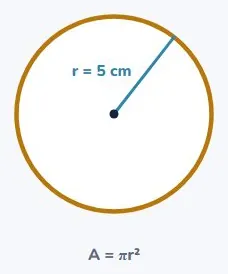
Square the radius first
- Π r squared means π times r squared.
- Not π times r, and then that squared.
- Five squared is 25, then times π. Not 15.7, squared.
| Step | Doing | Result |
|---|---|---|
| A = πr² | square the radius first | |
| r = 5 | 5² = 25 | then × π |
| Area | 25π | 78.5 cm² |
| Not (π × 5)² | that gives 246.7 | π times too big |
Try it: grow the circle
Half a circle, and a quarter
- There is no separate formula to learn here.
- Half a circle has half the area. Work out the circle, halve it.
- A quarter circle is the same idea divided by four.
| Shape | Reasoning | Area |
|---|---|---|
| Half a circle | half of πr² | πr² ÷ 2 |
| r = 6 | 36π ÷ 2 | 18π = 56.5 |
| A quarter circle | a quarter of πr² | πr² ÷ 4 |
| r = 4 | 16π ÷ 4 | 4π = 12.6 |
A shape made of two shapes
- A rectangle with a semicircle sitting on top of it.
- Work out each piece separately, then add them.
- Sixty, plus fourteen point one, is seventy-four point one.
| Part | Working | Area |
|---|---|---|
| Rectangle 10 by 6 | 10 × 6 | 60 |
| Semicircle on top | radius 3 | 9π ÷ 2 = 14.1 |
| Add them | 60 + 14.1 | 74.1 cm² |
| Break it up | then add | every time |
What surface area actually is
- It is the total area of every face of a solid.
- Which is exactly the area of its net, cut open and laid flat.
- So if you can draw the net, you can find the surface area.
| Idea | Meaning |
|---|---|
| Surface area | the total area of every face |
| Which is | the area of its net |
| So cut it open | and measure what is flat |
| Units | always squared |
A cube, by counting
- How many faces does a cube have? Six.
- How big is each one? s by s, so s squared.
- So the surface area is six s squared. Nothing memorised.
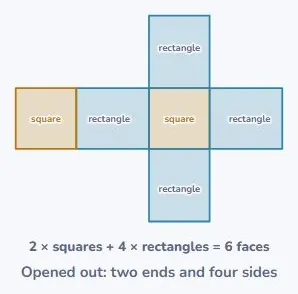
A box, by pairing
- Opposite faces of a box are identical, so they come in pairs.
- Front and back, top and bottom, and the two ends.
- Three different areas, each counted twice.
| Pair | Each one | Working |
|---|---|---|
| Front and back | l × w, twice | |
| Top and bottom | l × h, twice | |
| The two ends | w × h, twice | |
| 5 by 3 by 2 | 2(15 + 10 + 6) | 62 cm² |
Now unroll a cylinder
- Two circles, one at each end. That part is easy.
- And the curved side flattens out into a rectangle.
- How wide is that rectangle? It was wrapped around a circle.
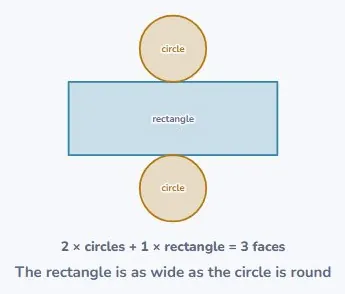
Shapes and nets
Which is where 2πrh comes from
- That rectangle edge used to be the circle itself.
- So its width is the circumference, two π r.
- Times the height, and the curved side is two π r h.
| Part | Why | Area |
|---|---|---|
| Unroll a cylinder | two circles and a rectangle | |
| The two circles | 2 × πr² | 2πr² |
| The rectangle is as wide | as the circle is round | 2πr |
| So the body is | 2πr × h | 2πrh |
A cylinder with numbers in it
- Radius three, height ten. Two circles first: eighteen π.
- Then the body: two π times three times ten, sixty π.
- Seventy-eight π altogether, about 245 square centimetres.
| Part | Working | Area |
|---|---|---|
| r = 3, h = 10 | ||
| Two circles | 2 × 9π | 18π |
| The body | 2π × 3 × 10 | 60π |
| Total | 78π | 245 cm² |
Try it: volume and surface area
Try it: break it up, then add
Volume, from what a prism is
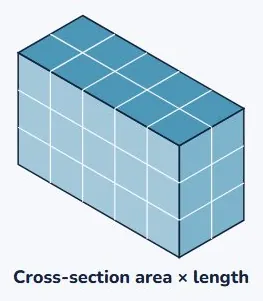
- A prism has the same cross-section all the way through.
- So the volume is that area, times how long it is.
- A cylinder is a prism whose cross-section is a circle.
And a pyramid holds a third
- Same base, same height, a third of the volume.
- So it is base area times height, divided by three.
- That one is told to you. Proving it is a later year.
| Fact | Detail | |
|---|---|---|
| A pyramid | on the same base | and the same height |
| Holds exactly | a third of the prism | |
| So | base area × height ÷ 3 | |
| Proving that | is a later year |
What to take away
- Seven lines, and none of them needs memorising.
| A = πr² | square the radius first |
| Half a circle | is half of that |
| Composite shapes | break up, then add |
| Surface area | is the area of the net |
| A cube | six faces, so 6s² |
| A cylinder | 2πr² + 2πrh, from its net |
| A prism | cross-section area × length |
Common mistakes
- r = 5, so A = (π × 5)² = 246.7 cm²Square the radius first, then multiply by π: 5² = 25, so A = 25π ≈ 78.5 cm².
- Area of a circle with diameter 10 is π × 10² = 314 cm².The formula uses the radius, so halve the diameter first: π × 5² ≈ 78.5 cm².
- Surface area of a cylinder, r = 2, h = 5: 2πrh = 20π ≈ 62.8 cm²Add the two circular ends too: 2πr² + 2πrh = 8π + 20π = 28π ≈ 87.9 cm².
- A 5 by 3 by 2 box has surface area 15 + 10 + 6 = 31 cm².Each face has an identical opposite face, so double it: 2(15 + 10 + 6) = 62 cm².
Your turn: eight questions
- Work all eight.
- Leave your answers in terms of π until the last step.
- Question 4 does not tell you the shape, and does not need to.
Area of a circle, radius 7, to 3 s.f.
Area of a semicircle of radius 10.
Surface area of a cylinder, r 2, h 5.
Volume: cross-section 12 cm², length 9 cm.
A cube has edges of 4 cm. What is its surface area?
A tin is a cylinder with radius 5 cm and height 8 cm. What is its volume, to 3 s.f.?
A semicircle is cut out of a square of side 8 cm, with one side of the square as its diameter. Area left, to 3 s.f.?
A pyramid has a square base 6 cm by 6 cm and a height of 10 cm. What is its volume?
Show answer
1. 154 square centimetres. Seven squared is 49, so the exact area is 49π, and to three significant figures that is 154. 2. 50π, which is about 157 square centimetres. Ten squared is a hundred, times π, halved. 3. 28π, about 87.9 square centimetres. Two circles give 2 × 4π, which is 8π, and the body is 2π × 2 × 5, which is 20π. 4. 108 cubic centimetres. The cross-section area times the length, and notice you were never told what shape the cross-section was, because for a prism it does not matter. 5. 96 cm². A cube has 6 faces, each 4 × 4 = 16 cm², and 6 × 16 = 96. 6. 628 cm³. A cylinder is a prism with a circle cross-section: π × 5² = 25π, times 8 is 200π ≈ 628. 7. 38.9 cm². Square 8 × 8 = 64, semicircle radius 4 is 16π ÷ 2 = 8π ≈ 25.1, and 64 − 25.1 = 38.9. 8. 120 cm³. Base area 36 × height 10 is 360, and a pyramid holds a third of that: 360 ÷ 3 = 120.
The answers
- Forty-nine π, which is 154 square centimetres.
- Fifty π, about 157.
- Eight π plus twenty π is twenty-eight π, about 87.9.
- A hundred and eight cubic centimetres.
Challenge
A semicircle has a diameter of 12 cm. Along that diameter, two smaller semicircles with diameters 4 cm and 8 cm are cut out, sitting side by side inside the big one. (a) Find the area of the shape that is left, as a multiple of π and to 1 decimal place. (b) Find the perimeter of the shape that is left. What do you notice about it?
Hint
A semicircle's area is half of πr², so halve each diameter to get the radius first. The left-over shape's edge is made only of curved arcs: the big one and the two small ones.
Answer
(a) 8π ≈ 25.1 cm² (b) 12π ≈ 37.7 cm, exactly twice the big semicircle's arc
Step by step
- Big semicircle: radius 6, area 36π ÷ 2 = 18π.
- Small ones: radius 2 gives 4π ÷ 2 = 2π, and radius 4 gives 16π ÷ 2 = 8π.
- Area left = 18π − 2π − 8π = 8π, about 25.1 cm².
- Each arc is half a circumference: π × 6, π × 2 and π × 4, which is 6π, 2π and 4π.
- The perimeter is 6π + 2π + 4π = 12π: the two small arcs together are exactly as long as the big arc, so the perimeter is double the big arc.
Full working
- big semicircle area = π × 6² ÷ 2 = 18πradius 6
- small areas = π × 2² ÷ 2 + π × 4² ÷ 2 = 2π + 8πradii 2 and 4
- area left = 18π − 10π = 8π ≈ 25.1 cm²subtract the holes
- arcs = π × 6 + π × 2 + π × 4half of πd for each
- perimeter = 6π + 2π + 4π = 12π ≈ 37.7 cm2π + 4π = 6π, the big arc again
- (a) 8π ≈ 25.1 cm² (b) 12π ≈ 37.7 cm, twice the big arc
A closed cylindrical tin has a radius of 4 cm. Its total surface area is exactly 3 times the combined area of its two circular ends. (a) Find the height of the tin. (b) Find its total surface area, as a multiple of π and to 1 decimal place.
Hint
Write the total surface area as ends plus curved side: 2πr² + 2πrh. If the total is 3 lots of the ends, how many lots of the ends must the curved side be?
Answer
(a) 8 cm (b) 96π ≈ 301.6 cm²
Step by step
- The two ends have area 2πr², and the curved side is 2πrh.
- If the total is 3 lots of the ends, the curved side must be the other 2 lots: 2πrh = 2 × 2πr².
- Divide both sides by 2πr: h = 2r, so the height is twice the radius.
- With r = 4, h = 8 cm.
- Ends = 2 × 16π = 32π, so the total is 3 × 32π = 96π, about 301.6 cm².
Full working
- total = 2πr² + 2πrh = 3 × 2πr²the condition
- 2πrh = 4πr²take away the ends
- h = 2r = 8 cmdivide by 2πr
- ends = 2π × 4² = 32πtwo circles
- total = 3 × 32π = 96π ≈ 301.6 cm²check: 32π + 2π × 4 × 8 = 32π + 64π
- (a) 8 cm (b) 96π ≈ 301.6 cm²
A wooden cube has edges of 6 cm. A cylindrical hole is drilled straight through it, from the centre of one face to the centre of the opposite face. (a) With a hole of radius 1 cm, find the total surface area of the block, including the inside of the hole, to 1 decimal place. (b) Show that a hole of any radius less than 3 cm makes the surface area bigger than the solid cube's. (c) Which hole radius, 1 cm, 2 cm or 2.5 cm, gives the largest surface area?
Hint
Drilling removes two circles from the outside, but adds a new curved surface inside: an unrolled cylinder that is 6 cm long. Write the change in surface area for radius r.
Answer
(a) 216 + 10π ≈ 247.4 cm² (b) the change is 2πr(6 − r), which is positive (c) 2.5 cm, giving 216 + 17.5π ≈ 271.0 cm²
Step by step
- The solid cube has 6 faces of 6 × 6, so 216 cm².
- The hole takes away a circle of area πr² from two faces, so we lose 2πr².
- It adds the inside wall, a cylinder side of length 6: 2πr × 6 = 12πr.
- Change = 12πr − 2πr² = 2πr(6 − r). For r = 1 that is 10π, so the area is 216 + 10π ≈ 247.4 cm².
- For any r between 0 and 3, both 2πr and 6 − r are positive, so the change is positive and the area goes up.
- Change for r = 1, 2, 2.5: 10π, 16π, 17.5π. The 2.5 cm hole gives the most: 216 + 17.5π ≈ 271.0 cm².
Full working
- solid cube = 6 × 6² = 216 cm²six square faces
- lost: 2 × πr²two circular holes in the faces
- gained: 2πr × 6 = 12πrinside wall unrolls to a rectangle
- change = 12πr − 2πr² = 2πr(6 − r)positive when 0 < r < 6, so for every r < 3
- r = 1: 216 + 10π ≈ 247.4 cm²(a)
- r = 2: 2π × 2 × 4 = 16π; r = 2.5: 2π × 2.5 × 3.5 = 17.5πcompare the gains
- (a) 247.4 cm² (b) gain 2πr(6 − r) > 0 (c) 2.5 cm, 271.0 cm²