Factorising patterns, finding a line, moving a curve
What this lesson covers
- There are specific factorising relationships that are useful to recognise: x(x + a) = x² + ax difference of two squares: (x + a)(x − a) = x² − a² square of a sum: (x + a)² = x² + 2ax + a² square of a difference: (x − a)² = x² − 2ax + a².
- The solution to a linear inequality is a set of values which may be represented with a number line.
- For a specific straight line, the gradient, m, and y-intercept, c, are fixed, and x varies with y according to the rule y = mx + c.
- The y-intercept touches the y-axis and has coordinates (0,c).
- The gradient m of a straight line can be determined with the formula m = rise/run = Δy/Δx .
- A vertical line has an infinite gradient. This cannot be expressed in the formula m = rise/run as it becomes m = rise/0, which cannot be evaluated.
- The equation of a vertical line is x = b, where the x-intercept is (b,0).
Four shapes worth knowing on sight
- Last time, factorising was a search through pairs of numbers.
- Four cases do not need searching, because you can recognise them.
- Knowing them turns thirty seconds of work into about one.
| This | Is this |
|---|---|
| x(x + a) | x² + ax |
| (x + a)(x − a) | x² − a² |
| (x + a)² | x² + 2ax + a² |
| (x − a)² | x² − 2ax + a² |
A square take away a square
- x plus five, times x minus five. Expand it and watch the middle.
- Minus five x and plus five x cancel each other out completely.
- So it is x squared minus twenty-five, with no middle term at all.
| Step | Working | Note |
|---|---|---|
| (x + 5)(x − 5) | expand it | |
| x² − 5x + 5x − 25 | the middle cancels | |
| x² − 25 | a square take a square | |
| So x² − 49 | is (x + 7)(x − 7) | on sight |
Squaring a bracket
- x plus three, squared, means that bracket times itself.
- Expanding gives x squared, three x, three x, and nine.
- The two middle terms add. Six x, and that is the one people lose.
| Step | Gives | |
|---|---|---|
| (x + 3)² | means (x + 3)(x + 3) | |
| Expand | x² + 3x + 3x + 9 | |
| Collect | x² + 6x + 9 | |
| The 6x | is the part people lose |
Try it: square a bracket
Testing the mistake
- Is x plus three, squared, the same as x squared plus nine?
- Do not argue about it. Put a number in and see.
- At x equals one: sixteen against ten. So no, they are different.
| Test | Working | Value |
|---|---|---|
| Is (x + 3)² = x² + 9? | try x = 1 | |
| (1 + 3)² | 4² | 16 |
| 1² + 9 | 1 + 9 | 10 |
| 16 is not 10 | so no, they differ |
And with a minus in the bracket
- x minus four, squared, gives x squared minus eight x plus sixteen.
- The middle term is negative. The last one is still positive.
- Minus four times minus four is plus sixteen, every time.
An inequality answers with a set
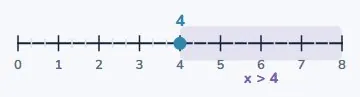
- Two x plus three is greater than eleven, so x is greater than four.
- That is not one answer. It is every number above four.
- Four itself does not work, so the circle is open.
The gradient formula
- It is rise over run, written for two named points.
- The y difference on top, the x difference underneath.
- Subtract in the same order top and bottom, or the sign flips.
| Rule | Meaning |
|---|---|
| m = rise / run | the same as before |
| Between two points | the y difference over the x difference |
| (2,5) to (6,17) | 12 over 4, which is 3 |
| Subtract the same way round | on top and bottom |
Finding a line from two points
- Gradient first: twelve up, four across, so m is three.
- Now put one of the points back in to find c.
- Five equals three times two, plus c. So c is minus one.
| Step | Working | Result |
|---|---|---|
| Points (2,5) and (6,17) | ||
| Gradient | 12 ÷ 4 | m = 3 |
| Put (2,5) in | 5 = 3×2 + c | c = −1 |
| So | y = 3x − 1 | check: 3×6 − 1 = 17 |
Try it: find the line
From a gradient and one point
- You already have m, so skip straight to the second half.
- Ten equals four times three, plus c.
- c is minus two. Same method, one step shorter.
| Step | Working | Result |
|---|---|---|
| Gradient 4, through (3,10) | ||
| Put it in | 10 = 4×3 + c | |
| So c | 10 − 12 | −2 |
| Answer | y = 4x − 2 |
The line that does not fit
- A vertical line goes up but never across. Its run is zero.
- So its gradient would be rise divided by zero, which has no value.
- It cannot be written y equals m x plus c. It is x equals four.
| Fact | Because | So |
|---|---|---|
| A vertical line | goes up, never across | |
| So the run is 0 | m = rise ÷ 0 | cannot be done |
| It has no m at all | so no y = mx + c | |
| Its equation | x = 4 | and nothing else |
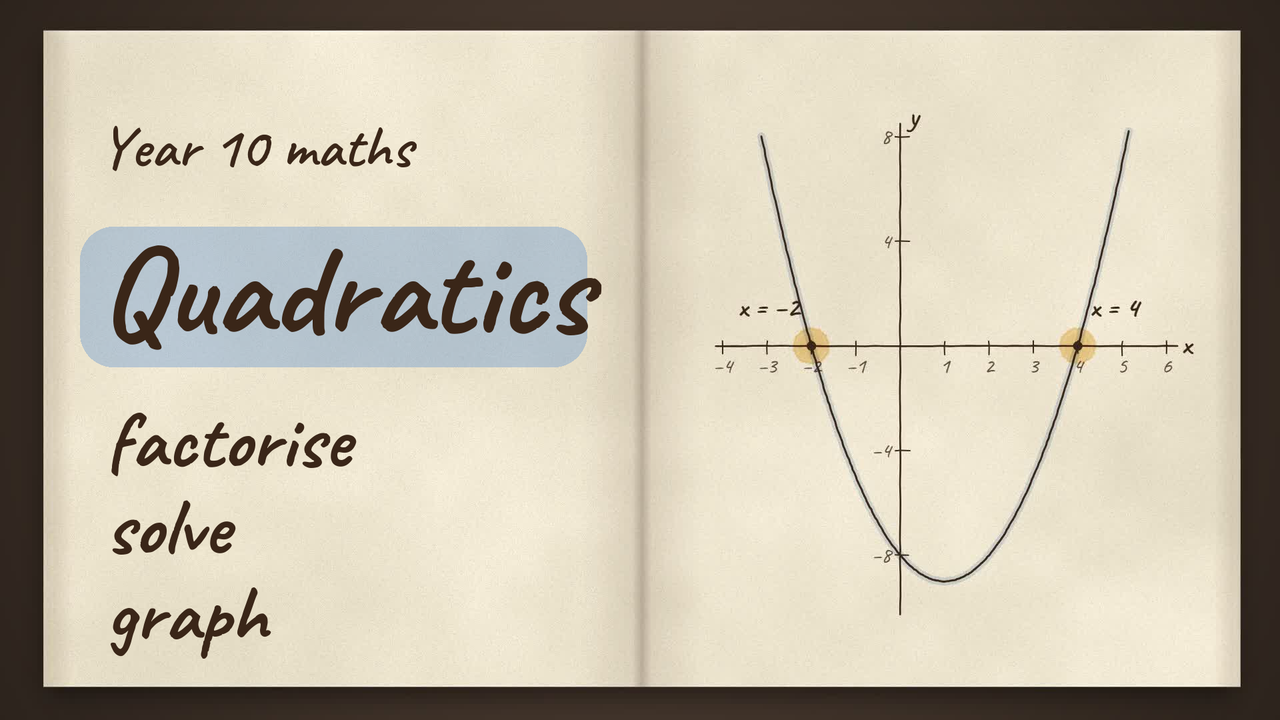
Changing the number in front of x squared
- y equals x squared is 1 when x is 1.
- y equals two x squared is 2 there, and four x squared is 4.
- A bigger a climbs faster, so the curve is narrower.
| Curve | Where | Height |
|---|---|---|
| y = x² | at x = 1 | y = 1 |
| y = 2x² | at x = 1 | y = 2 |
| y = 4x² | at x = 1 | y = 4 |
| Bigger a | climbs faster | narrower curve |
And changing the number on the end
- Adding three lifts every single point by three.
- The bottom of the curve moves from the origin up to nought, three.
- The shape does not change at all. It has moved, not stretched.
| Curve | What happens | Bottom at |
|---|---|---|
| y = x² | bottom at (0,0) | |
| y = x² + 3 | every point up 3 | bottom at (0,3) |
| y = x² − 5 | every point down 5 | bottom at (0,−5) |
| Same shape | moved, not stretched |
Two numbers, two different jobs
- A changes the width of the curve.
- c slides the whole thing up or down.
- Neither one does the other’s job, which is what makes it readable.
Graphing calculator
Try it: lines and curves
What to take away
- Seven lines, and the second one is the exam favourite.
| x² − a² | factorises to (x + a)(x − a) |
| (x + a)² | is x² + 2ax + a², never x² + a² |
| An inequality | has a set of answers |
| m | the y difference over the x difference |
| To find a line | get m, then put a point in for c |
| A vertical line | is x = b, and has no gradient |
| In y = ax² + c | a changes the width, c moves it |
Common mistakes
- (x + 3)² = x² + 9(x + 3)² means (x + 3)(x + 3) = x² + 6x + 9; test x = 1: 16 is not 10.
- (x − 4)² = x² − 8x − 16−4 × −4 is +16, so (x − 4)² = x² − 8x + 16; only the middle term is negative.
- Line through (2, 5) and (6, 17) is y = 3x + 5, using the point's y as c.c is where the line crosses the y-axis: put (2, 5) into 5 = 3 × 2 + c, so c = −1 and y = 3x − 1.
- y = x² − 5 makes the curve narrower.The number on the end moves the curve down 5, bottom at (0, −5); only the number in front of x² changes the width.
Your turn: eight questions
- Work all eight out.
- Question 1 has a middle term. Do not lose it.
- Question 3 is gradient first, then put a point in.
Expand (x − 6)².
Factorise x² − 49.
Find the line through (1, 2) and (4, 11).
What does y = x² − 5 do to y = x²?
A vertical line passes through (−3, 5). What is its equation?
How does the graph of y = 3x² compare with y = x²?
Solve 5x − 2 > 13. How does the answer show on a number line?
A line has gradient −2 and passes through (3, 1). Find its equation.
Show answer
1. x² − 12x + 36. It means x minus six, times x minus six, so the middle term is two lots of minus six x. 2. (x + 7)(x − 7). A square take away a square, which is the difference of two squares every time. 3. y = 3x − 1. The gradient is 11 − 2 over 4 − 1, which is 9 over 3, so 3. Then put the point (1,2) in: 2 = 3 + c, so c is −1. Check with the other point: 3 × 4 − 1 = 11. 4. It moves the whole curve down five. The shape is unchanged, and the bottom of it sits at (0, −5) instead of at the origin. 5. x = −3. Every point on a vertical line has the same x-value, and it has no gradient. 6. Same bottom point, narrower. The a of 3 makes it climb faster, and with no c it still sits at (0,0). 7. x > 3: open circle at 3, arrow right. 5x > 15 gives x > 3, and 3 itself does not work, so the circle is open. 8. y = −2x + 7. Put the point in: 1 = −2 × 3 + c, so c = 1 + 6 = 7. Check: −2 × 3 + 7 = 1.
The answers
- x squared minus twelve x plus thirty-six.
- x plus seven, x minus seven.
- y equals three x minus one.
- It moves the whole curve down five. Same shape.
Graphing Quadratics
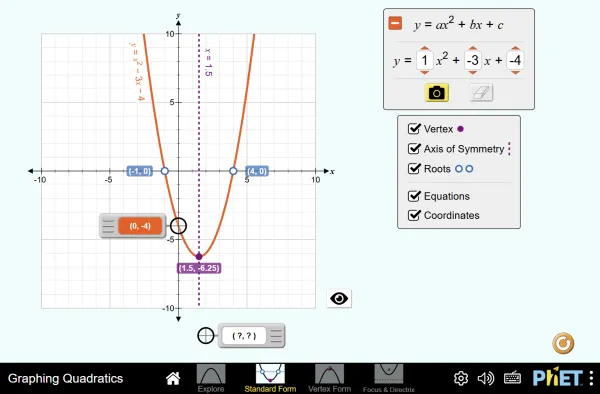
Full screen · PhET Interactive Simulations, University of Colorado Boulder, CC BY 4.0
Challenge
Without a calculator, work out 47 × 53 and 1003² − 997². Show which special product you used each time.
Hint
47 is 50 − 3 and 53 is 50 + 3. For the second one, x² − a² factorises into two brackets.
Answer
47 × 53 = 2491 and 1003² − 997² = 12 000
Step by step
- Write 47 × 53 as (50 − 3)(50 + 3). That is a difference of two squares.
- So it equals 50² − 3² = 2500 − 9 = 2491.
- For 1003² − 997², use x² − a² = (x + a)(x − a) backwards.
- That is (1003 + 997)(1003 − 997) = 2000 × 6 = 12 000.
Full working
- 47 × 53 = (50 − 3)(50 + 3)3 either side of 50
- = 50² − 3² = 2500 − 9 = 2491(x + a)(x − a) = x² − a²
- 1003² − 997² = (1003 + 997)(1003 − 997)factorise the difference of two squares
- = 2000 × 6 = 12 000easy numbers
- 2491 and 12 000
A straight line passes through (1, −2) and (5, 6). The line, the vertical line x = 6 and the x-axis enclose a triangle. Find its area. Why can the line x = 6 not be written in the form y = mx + c?
Hint
Find the line's equation first. Then find where it meets the x-axis (y = 0) and where it meets x = 6. Sketch the three corners.
Answer
Area 16 square units. The line x = 6 is vertical, so its run is 0 and its gradient cannot be worked out.
Step by step
- Gradient: up 6 − (−2) = 8, across 5 − 1 = 4, so m = 2.
- Put (1, −2) in: −2 = 2 + c, so c = −4. The line is y = 2x − 4.
- It meets the x-axis where 0 = 2x − 4, so at (2, 0). It meets x = 6 at y = 2 × 6 − 4 = 8, so at (6, 8).
- The corners are (2, 0), (6, 0) and (6, 8): a right-angled triangle with base 4 and height 8.
- Area = ½ × 4 × 8 = 16.
- x = 6 goes straight up, never across, so rise ÷ run would divide by zero. It has no m.
Full working
- m = (6 − (−2)) ÷ (5 − 1) = 8 ÷ 4 = 2rise over run
- −2 = 2 × 1 + c, so c = −4: y = 2x − 4put a point in
- y = 0: x = 2, corner (2, 0)meets the x-axis
- x = 6: y = 8, corner (6, 8); third corner (6, 0)meets the vertical line
- ½ × 4 × 8 = 16base 6 − 2 = 4, height 8
- 16 square units; x = 6 has run 0, so no gradient
(a) Write x² − 8x + 21 in the form (x − a)² + b. (b) Use your answer to explain why x² − 8x + 21 is never less than 5, and find the only value of x that makes it equal to 5. (c) Find the smallest possible value of x² − 8x + 21 + y² + 6y, and the values of x and y that give it.
Hint
(x − 4)² expands to x² − 8x + 16. How much more than 16 is 21? For the y part, compare y² + 6y with (y + 3)².
Answer
(a) (x − 4)² + 5. (b) A square is never negative, so the expression is at least 0 + 5 = 5, and it equals 5 only when x = 4. (c) The smallest value is −4, when x = 4 and y = −3.
Step by step
- The square of a difference is (x − 4)² = x² − 8x + 16, which matches the first two terms.
- 21 is 5 more than 16, so x² − 8x + 21 = (x − 4)² + 5.
- (x − 4)² can be 0 but never negative, so the whole expression is never below 5; it is exactly 5 only when x − 4 = 0.
- In the same way, (y + 3)² = y² + 6y + 9, so y² + 6y = (y + 3)² − 9.
- The total is (x − 4)² + (y + 3)² − 4, and both squares are smallest (0) at x = 4 and y = −3, giving −4.
Full working
- (x − 4)² = x² − 8x + 16square of a difference
- x² − 8x + 21 = (x − 4)² + 521 = 16 + 5
- (x − 4)² ≥ 0, so (x − 4)² + 5 ≥ 5a square is never negative
- (x − 4)² + 5 = 5 when x = 4the only way the square is 0
- (y + 3)² = y² + 6y + 9, so y² + 6y = (y + 3)² − 9square of a sum
- x² − 8x + 21 + y² + 6y = (x − 4)² + (y + 3)² − 45 − 9 = −4
- Smallest value −4, at x = 4 and y = −3