
Pressure in liquids and gases, depth and hydraulics
What this lesson covers
- Pressure is force spread over an area, P = F/A, measured in pascals.
- Fluids push on surfaces and within themselves, and the air above us causes atmospheric pressure.
- In a liquid or gas, pressure pushes equally in all directions.
- Pressure in a liquid gets bigger the deeper you go.
- Hydraulic systems pass pressure through a trapped liquid to multiply a force, giving mechanical advantage.
Pressure is force on each square metre
- Pressure tells you how concentrated a force is: P = F ÷ A.
- Force is in newtons (N), area in square metres (m²), and pressure in pascals (Pa), where 1 Pa = 1 N/m².
- The same force on a small area gives a big pressure, which is why a sharp knife cuts and a drawing pin goes into a board.
- The same force on a large area gives a small pressure, which is why snowshoes and wide tractor tyres do not sink in.
- Pressures are often large numbers, so kilopascals are common: 1 kPa = 1000 Pa.
| Quantity | Symbol | Unit |
|---|---|---|
| Pressure | P | pascal (Pa) = N/m² |
| Force | F | newton (N) |
| Area | A | square metre (m²) |
Example: boots or snowshoes?
- A tramper weighs 600 N.
- Standing in boots, the area touching the snow is 0.04 m². In snowshoes it is 0.2 m².
- Compare the pressure on the snow.
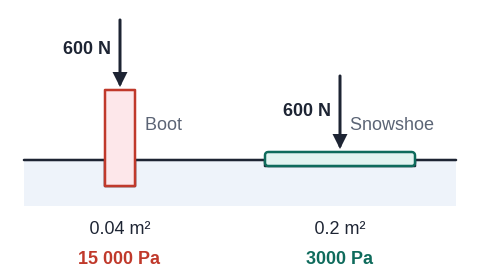
- boots: P = 600 ÷ 0.04 = 15 000 PaP = F ÷ A
- snowshoes: P = 600 ÷ 0.2 = 3000 Pasame force, 5 times the area
- 15 000 ÷ 3000 = 5compare the two
- snowshoes give one fifth of the pressure, so the tramper sinks far less
Fluids press on everything they touch
- Liquids and gases are both fluids: their particles move around and keep colliding with each other and with any surface.
- Each collision is a tiny push, and billions of them together make a steady pressure on the surface and inside the fluid itself.
- The air above you has weight, and that weight pressing down causes atmospheric pressure.
- At sea level it is about 101 kPa, so roughly 101 000 N pushes on every square metre of your body.
- You do not get crushed because the fluids inside your body push outwards just as hard.
- Higher up there is less air above you, so the pressure is lower: near the top of Aoraki it is only about 64 kPa.
Pressure in a fluid pushes in every direction
- At any point in a liquid or gas, the pressure pushes equally up, down and sideways.
- Water in a glass pushes down on the bottom and also outwards on the sides.
- Poke holes around a plastic bottle full of water at the same height, and water squirts out sideways from every hole with the same strength.
- A balloon taken underwater gets squashed evenly from all sides, not just from above.
- Air pressure works the same way, which is why a sealed empty drink bottle carried down from a mountain gets crushed from every side.
Pressure rises with depth
- The deeper you go in a liquid, the more liquid there is above you pressing down, so the pressure is greater.
- The extra pressure from a liquid is density × g × depth, or P = ρgh, with density in kg/m³, g = 9.8 N/kg and depth in metres.
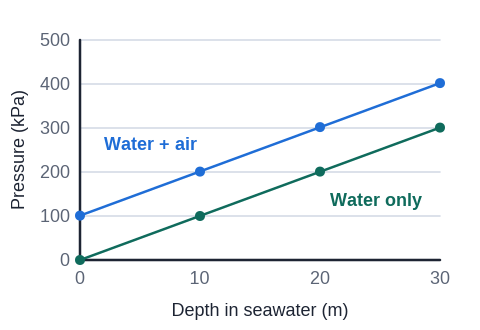
- Seawater has a density of about 1025 kg/m³, so every 10 m of depth adds about 100 kPa, roughly one extra atmosphere.
- A diver at the Poor Knights Islands feels this as pressure on the ears, which must be equalised on the way down.
- Dams such as the Clyde Dam are much thicker at the base because the water pushes hardest at the bottom.
| Depth in seawater | Pressure from water | Total pressure (water + air) |
|---|---|---|
| 0 m (surface) | 0 kPa | about 101 kPa |
| 10 m | about 100 kPa | about 201 kPa |
| 20 m | about 201 kPa | about 302 kPa |
| 30 m | about 301 kPa | about 402 kPa |
Example: pressure on a diver at 18 m
- A diver is 18 m down in seawater (density 1025 kg/m³). Use g = 9.8 N/kg and atmospheric pressure 101 kPa.
- Find the pressure from the water, and the total pressure on the diver.
- P = ρgh = 1025 × 9.8 × 18pressure from the water above
- P = 180 810 Pa ≈ 181 kPadivide by 1000 for kPa
- total = 181 + 101 = 282 kPathe air presses on the sea surface too
- about 282 kPa, nearly three times the pressure at the surface
Try it: pressure in a fluid
Hydraulics: passing pressure through a liquid
- Liquids hardly squash at all, so a push on a trapped liquid raises the pressure everywhere in it by the same amount.
- A hydraulic system has a small piston and a large piston joined by a pipe full of oil.
- Pushing the small piston creates a pressure, and that same pressure acts on the large piston.
- Because the large piston has more area, the force on it is bigger: F = P × A.
- In a car's brakes, your foot pushes a small piston in the master cylinder, brake fluid carries the pressure to every wheel, and larger pistons there clamp the brake pads onto the discs.
- Car hoists, diggers and log loaders at a port use the same idea.
Try it: a hydraulic jack
Mechanical advantage
- Mechanical advantage compares the force a machine gives out with the force you put in.
- Mechanical advantage = output force ÷ input force, and it has no units.
- A mechanical advantage of 50 means your push is multiplied 50 times.
- There is a catch: the small piston has to move much further than the large one, so you do not get extra energy for free.
| Small piston | Large piston | |
|---|---|---|
| Area | Small | Large |
| Pressure | Same | Same |
| Force | Small (input) | Large (output) |
| Distance moved | Long | Short |
Example: a hydraulic jack
- A jack has a small piston of area 0.002 m² and a large piston of area 0.1 m².
- A mechanic pushes the small piston with 50 N.
- Find the output force and the mechanical advantage.
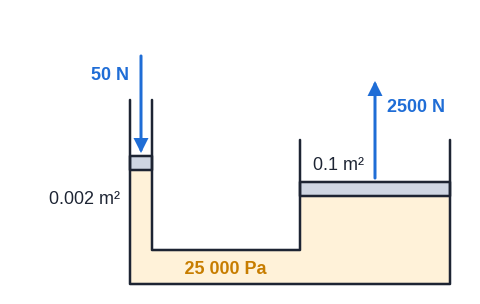
- P = 50 ÷ 0.002 = 25 000 Papressure made by the small piston
- F = 25 000 × 0.1 = 2500 Nsame pressure on the large piston
- MA = 2500 ÷ 50 = 50output ÷ input
- output 2500 N, mechanical advantage 50
- area ratio 0.1 ÷ 0.002 = 50the area ratio gives the same answer
Example: predicting how brakes change motion
- A 1500 kg car is travelling at 20 m/s. The hydraulic brakes produce a total backward friction force of 6000 N.
- Use Newton's laws to predict what happens.
- net force = 6000 N backwardsunbalanced, so the motion must change
- a = F ÷ m = 6000 ÷ 1500 = 4 m/s²Newton's second law
- time to stop = 20 ÷ 4 = 5 sloses 4 m/s each second
- the car slows by 4 m/s every second and stops in 5 s
- passengers lurch forwardinertia: their bodies keep moving until the seatbelts pull them back
Testing pressure and depth, and judging the method
- Change: the depth of a pressure sensor in a tall tube of water, in steps of 10 cm.
- Measure: the pressure reading at each depth, three times, taking the mean.
- Keep the same: the liquid, its temperature, the sensor and the way depth is measured (to the centre of the sensor).
- If the pressure goes up by the same amount for each extra 10 cm, that shows pressure rises steadily with depth.
- Accuracy is how close a result is to the true value; reliability is whether you get the same result when you repeat it.
- A cheaper version punches holes in a bottle at different heights and measures how far each jet reaches, but the water level drops as it drains, which makes it less accurate.
| Problem | Affects | Improvement |
|---|---|---|
| Reading a ruler at an angle | Accuracy | Read at eye level, or fix the ruler to the tube |
| Only one reading per depth | Reliability | Repeat three times and average |
| Water level falls as a bottle drains | Accuracy | Keep topping up so the level stays at the mark |
| Sensor reads only to the nearest kPa | Accuracy | Use a sensor with finer readings, or bigger depth steps |
Common mistakes
- P = 600 ÷ 400 cm² = 1.5 Pa.Area must be in m² for pascals, and 1 cm² is 0.0001 m², so 400 cm² is 0.04 m² and P = 15 000 Pa.
- Pressure in water only pushes down.At any point in a fluid the pressure pushes equally in all directions, which is why water squirts sideways out of a hole in a bottle.
- The water pressure on a dam is bigger when the lake behind it stretches back further, even at the same depth.Liquid pressure depends only on depth and density (P = ρgh), so how far the lake stretches back makes no difference.
- A hydraulic jack gives you more energy than you put in.It multiplies force, but the small piston has to move much further than the large one, so no extra energy is made.
Three jets from one bottle
You need: an empty 1.5 L plastic drink bottle, scissors, sticky tape, water
- With an adult, make three small holes in a line up one side of the bottle, near the bottom, in the middle and near the top, by twisting the point of the scissors into the plastic.
- Cover all three holes with one strip of sticky tape, take the cap off and fill the bottle to the top.
- Stand the bottle at the edge of the sink, or outside on a step, with the holes facing out over the drop.
- Pull the tape off quickly and see how far out each jet reaches, topping the bottle up so the water level stays near the top.
- Look for: the bottom jet shoots out hardest and furthest and the top one only dribbles out, because the deepest water has the most water above it pressing down, so its pressure is greatest.
Safety: The scissor point can slip off the curved plastic and stab a hand, so an adult makes the holes, pushing away from the hand holding the bottle.
Your turn
A box weighing 240 N rests on a face of area 0.6 m². What pressure does it put on the floor?
Find the pressure from the water 5 m down in Lake Taupō. Fresh water has density 1000 kg/m³; use g = 9.8 N/kg.
Explain why a dam wall is built thicker at the bottom than at the top.
A hydraulic lift has a small piston of 0.0005 m² and a large piston of 0.05 m². A 40 N push is applied to the small piston. Find the output force and the mechanical advantage.
A student measures each jet from a holed bottle once, with a ruler held by hand. Suggest two improvements, and say whether each improves accuracy or reliability.
A sealed, empty drink bottle is carried down from Ruapehu to the coast and ends up crushed on every side. Why?
A student says the water pushes harder on the Benmore dam than on a smaller dam of the same depth, because Lake Benmore stretches back further. Is this right?
Air pressure at sea level is about 101 kPa. What force does the air push down with on the top of a table of area 0.5 m²?
Show answer
1. P = 240 ÷ 0.6 = 400 Pa. 2. P = 1000 × 9.8 × 5 = 49 000 Pa = 49 kPa from the water (about 150 kPa in total with the air above). 3. Pressure in a liquid increases with depth, so the water pushes hardest on the bottom of the wall, which needs to be strongest there. 4. Pressure = 40 ÷ 0.0005 = 80 000 Pa; output force = 80 000 × 0.05 = 4000 N; mechanical advantage = 4000 ÷ 40 = 100. 5. For example: repeat each measurement three times and average (reliability); clamp the ruler in place and keep the water topped up to the same level (accuracy). 6. The bottle was sealed high up, where the air pressure is lower. Near the coast there is more air above, so the pressure outside is higher than inside, and fluid pressure pushes equally in all directions, so it is squashed from every side. 7. No. Liquid pressure depends only on depth and density (P = ρgh), so how far the lake stretches back makes no difference to the pressure at the dam. 8. F = P × A = 101 000 × 0.5 = 50 500 N. The table is not crushed because the air underneath pushes up just as hard.
Under Pressure
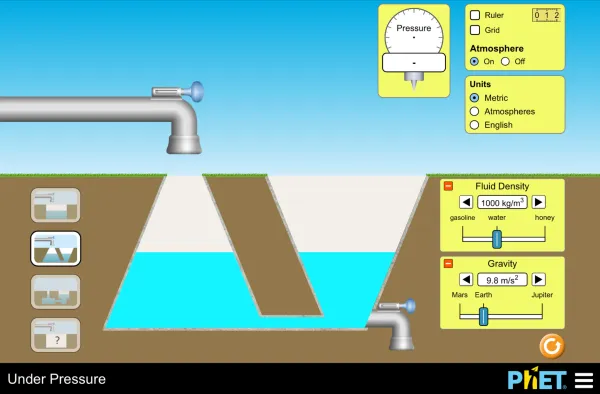
Full screen · PhET Interactive Simulations, University of Colorado Boulder, CC BY 4.0
Recap
- Pressure is force per unit area, P = F ÷ A, in pascals.
- Fluids push on every surface and in every direction, and the weight of the air gives about 101 kPa at sea level.
- Liquid pressure grows with depth: P = ρgh, about 100 kPa extra for every 10 m of seawater.
- Hydraulics pass the same pressure to a bigger piston, multiplying the force.
- Mechanical advantage = output force ÷ input force, paid for by moving the input further.
| Idea | Formula or fact |
|---|---|
| Pressure | P = F ÷ A (Pa = N/m²) |
| Atmospheric pressure | about 101 kPa at sea level |
| Liquid pressure | P = ρgh, g = 9.8 N/kg |
| Hydraulics | same pressure, F = P × A on each piston |
| Mechanical advantage | output force ÷ input force |
Challenge
A garage car hoist has a small piston of area 5 cm² and a large piston of area 250 cm². The mechanic pushes the small piston with 120 N. (a) Find the force on the large piston. (b) The large piston must rise 0.2 m to lift a car. Oil cannot be squashed, so the volume of oil pushed out of the small cylinder equals the volume that goes into the large one. How far must the small piston move in total (over many pumps)? (c) Work done = force × distance moved. Show that the mechanic does no less work than the hoist does on the car.
Hint
Convert the areas to m² first: 1 cm² = 0.0001 m². For (b), volume = area × distance for each piston, and the two volumes are equal.
Answer
(a) 6000 N (b) 10 m (c) both are 1200 J, so no energy is gained
Step by step
- The small piston is 0.0005 m² and the large one 0.025 m².
- Pressure in the oil is 120 ÷ 0.0005 = 240 000 Pa, and that same pressure pushes on the large piston, giving 240 000 × 0.025 = 6000 N.
- Lifting the large piston 0.2 m needs 0.025 × 0.2 = 0.005 m³ of oil.
- That oil must come from the small cylinder, so the small piston moves 0.005 ÷ 0.0005 = 10 m in total.
- Work in is 120 × 10 = 1200 J and work out is 6000 × 0.2 = 1200 J: the force is multiplied 50 times, but the distance is divided by 50.
Full working
- 5 cm² = 0.0005 m², 250 cm² = 0.025 m²1 cm² = 0.0001 m²
- P = 120 ÷ 0.0005 = 240 000 PaP = F ÷ A
- F = 240 000 × 0.025 = 6000 Nsame pressure on the large piston
- volume = 0.025 × 0.2 = 0.005 m³oil needed to lift 0.2 m
- distance = 0.005 ÷ 0.0005 = 10 msame volume leaves the small cylinder
- work in = 120 × 10 = 1200 J, work out = 6000 × 0.2 = 1200 Jequal
- (a) 6000 N (b) 10 m (c) 1200 J in and 1200 J out
A diver's gauge measures total pressure (water plus air). On one dive in Lake Taupō it reads 250 kPa. Lake Taupō is about 360 m above sea level, where the air pressure is about 97 kPa, and fresh water has density 1000 kg per m³. (a) How deep is the diver? (b) On another dive off the Poor Knights Islands the gauge again reads 250 kPa. Seawater has density 1025 kg per m³ and the air pressure is 101 kPa. How deep is this diver? (c) Explain the two reasons the depths differ. Use g = 9.8 N per kg.
Hint
Work backwards. First take away the air pressure to find the pressure from the water alone, change it to pascals, then rearrange P = ρgh to get h = P ÷ (ρ × g).
Answer
(a) about 15.6 m (b) about 14.8 m (c) the lake has less air pressing on it, so more of the reading comes from water; and fresh water is less dense, so more depth is needed for the same pressure
Step by step
- In Taupō the water alone gives 250 − 97 = 153 kPa, which is 153 000 Pa.
- Depth = 153 000 ÷ (1000 × 9.8) ≈ 15.6 m.
- At sea the water alone gives 250 − 101 = 149 kPa, which is 149 000 Pa.
- Depth = 149 000 ÷ (1025 × 9.8) ≈ 14.8 m.
- The lake diver is deeper for two reasons: the thinner air at altitude leaves more of the 250 kPa for the water, and each metre of fresh water adds a little less pressure than seawater.
Full working
- water pressure = 250 − 97 = 153 kPa = 153 000 Paremove the air pressure
- h = 153 000 ÷ (1000 × 9.8) ≈ 15.6 mh = P ÷ (ρg)
- water pressure = 250 − 101 = 149 kPa = 149 000 Pasea level air
- h = 149 000 ÷ (1025 × 9.8) ≈ 14.8 mdenser seawater
- (a) about 15.6 m (b) about 14.8 m (c) lower air pressure and less dense water at Taupō
A research submarine sits 200 m down in seawater (density 1025 kg per m³). Its escape hatch has an area of 0.5 m². Inside, the air is kept at normal sea-level pressure, 101 kPa. Use g = 9.8 N per kg. (a) Find the overall (net) force pushing the hatch inwards. (b) Explain why you do not need to include atmospheric pressure to get this answer. (c) A 1500 kg car has a weight of about 14 700 N. Roughly how many such cars resting on the hatch would give the same force?
Hint
The outside of the hatch feels the water plus the air above the sea; the inside feels the cabin air. The net push comes from the difference between the two pressures.
Answer
(a) about 1 000 000 N (1 004 500 N) inwards (b) the 101 kPa of air acts on both sides of the hatch and cancels (c) about 68 cars
Step by step
- Outside the hatch, the pressure is the water's ρgh plus the 101 kPa of air pressing on the sea surface.
- Inside, the cabin air pushes outwards with 101 kPa, so the two 101 kPa parts cancel.
- That leaves only the water pressure: 1025 × 9.8 × 200 = 2 009 000 Pa.
- Net force = pressure × area = 2 009 000 × 0.5 = 1 004 500 N, about a million newtons.
- Dividing by one car's weight, 1 004 500 ÷ 14 700 ≈ 68 cars stacked on a hatch half a square metre in size.
Full working
- outside = ρgh + 101 kPa, inside = 101 kPapressure on each face
- net pressure = ρgh = 1025 × 9.8 × 200 = 2 009 000 Paair pressures cancel
- F = 2 009 000 × 0.5 = 1 004 500 NF = P × A
- 1 004 500 ÷ 14 700 ≈ 68.3compare with one car
- (a) about 1 000 000 N inwards (b) air pressure acts on both sides (c) about 68 cars