
Buoyancy: why things float or sink
What this lesson covers
- Buoyancy is the upward push a liquid or gas gives an object that is partly or completely in it.
- The buoyant force equals the weight of the fluid the object pushes aside (Archimedes' principle).
- An object floats when the buoyant force balances its weight, and sinks when the buoyant force is smaller.
- Pushing aside the same volume of a denser fluid gives a bigger buoyant force.
Buoyancy is an upward push from a fluid
- When an object is partly or completely in a liquid or gas, the fluid pushes up on it. This upward force is called buoyancy, or the buoyant force.
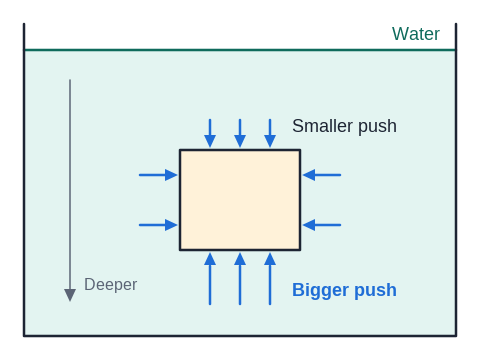
- It happens because fluid pressure increases with depth, so the fluid pushes harder on the bottom of the object than on the top.
- The difference between the upward push underneath and the downward push on top is the buoyant force.
- You notice it when a friend feels lighter to lift in a swimming pool, or when a beach ball held underwater shoots back up.
- Gases give a buoyant force too, which is what lifts a helium balloon or a hot-air balloon.
Archimedes' principle
- An object in a fluid pushes some of the fluid out of the way. This is the displaced fluid.
- The buoyant force is equal to the weight of the fluid that has been displaced.
- To use it: volume displaced × density of fluid gives the mass of fluid, then mass × g gives its weight. Use g = 9.8 N/kg.
- One litre of fresh water has a mass of 1 kg, so each litre displaced gives a buoyant force of 9.8 N.
- A spring balance shows buoyancy directly: an object seems lighter in water, and the difference between its weight in air and in water is the buoyant force.
| Step | Calculation | Unit |
|---|---|---|
| Mass of fluid displaced | density × volume displaced | kg |
| Weight of fluid displaced | mass × 9.8 | N |
| Buoyant force | equal to that weight | N |
| From a spring balance | weight in air − reading in fluid | N |
Example: weighing a rock in air and in water
- A rock hangs from a spring balance. It reads 12.0 N in air.
- When the rock is lowered completely into fresh water, the balance reads 7.5 N.
- Find the buoyant force and the volume of the rock.
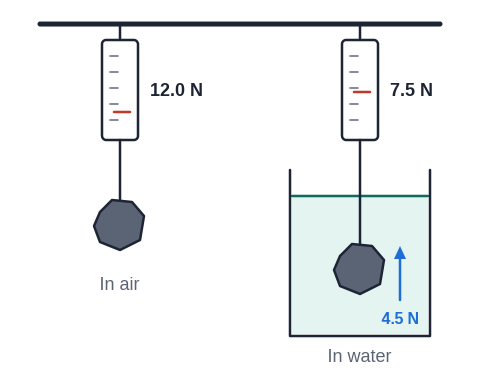
- buoyant force = 12.0 − 7.5 = 4.5 Nthe water supports part of the weight
- weight of water displaced = 4.5 NArchimedes' principle
- mass of water = 4.5 ÷ 9.8 ≈ 0.46 kgmass = weight ÷ g
- 0.46 kg of fresh water is about 0.46 L1 kg of fresh water fills 1 L
- buoyant force 4.5 N; rock volume about 0.46 L (460 cm³)fully underwater, so it displaced its own volume
Float or sink: compare two forces
- Two forces matter: the object's weight pulling down and the buoyant force pushing up.
- If the buoyant force equals the weight, the forces are balanced and the object floats.
- If the buoyant force is less than the weight, even when the object is completely underwater, there is a net downward force and it sinks.
- If an object is held underwater and the buoyant force is bigger than its weight, it rises until enough of it is out of the water for the forces to balance.
- A floating object always sits so that the water it displaces weighs exactly as much as it does.
| Comparison | Net force | What happens |
|---|---|---|
| Buoyant force = weight | Zero | Floats (or hovers if fully under, like a submarine) |
| Buoyant force < weight | Downward | Sinks |
| Buoyant force > weight (held under) | Upward | Rises, then floats partly out of the water |
Try it: float or sink?
Example: will this block float?
- A sealed block has a volume of 2.0 L and a mass of 1.5 kg. It is placed in fresh water.
- Will it float, and how much of it will be underwater?
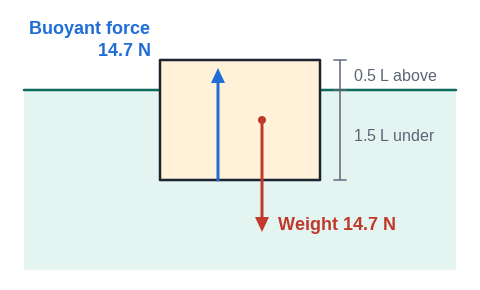
- weight = 1.5 × 9.8 = 14.7 NW = mg
- fully under: displaces 2.0 L = 2.0 kg of waterfresh water is 1 kg per litre
- biggest buoyant force = 2.0 × 9.8 = 19.6 Nweight of that water
- 19.6 N > 14.7 N, so it rises and floatsmore push up than pull down
- it floats when it displaces 1.5 kg = 1.5 L of waterdisplaced water must weigh 14.7 N
- floats with 1.5 L of its 2.0 L, three quarters, underwater
Density predicts floating
- Density is mass divided by volume, so it tells you how tightly packed a material is.
- A solid object that is less dense than the fluid floats, and one that is denser sinks.
- A steel ship floats even though steel is nearly eight times denser than water, because its hull holds a lot of air. The ship's average density is less than that of seawater.
- Pumice from Taupō eruptions is full of gas bubbles, so many pieces are less dense than water and float.
| Material | Approximate density (kg/m³) | In fresh water |
|---|---|---|
| Air | 1.2 | Rises (bubbles) |
| Pumice | often below 1000 | Usually floats |
| Ice | 920 | Floats, mostly underwater |
| Fresh water | 1000 | The comparison point |
| Seawater | 1025 | Settles under fresh water where rivers meet the sea |
| Steel | 7850 | Sinks (unless shaped to hold air) |
Denser fluids push up harder
- If two objects displace the same volume, the one in the denser fluid gets the bigger buoyant force, because that volume of fluid weighs more.
- Seawater is denser than river water because of the dissolved salt.
- So a boat floats a little higher in the sea than in the Waikato River: it needs to displace less seawater to equal its weight.
- Ships carry a load line painted on the hull with separate marks for fresh water and seawater, so they are never loaded too low.
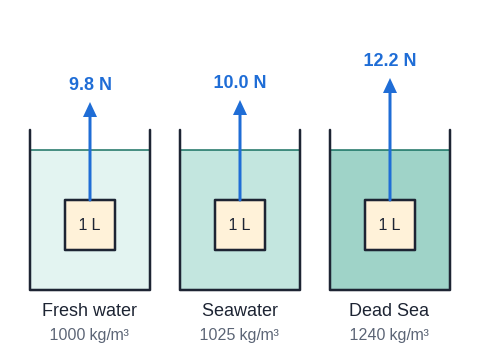
- In the very salty Dead Sea, people float with much of their body above the surface.
| Fluid | Density (kg/m³) | Buoyant force for 1 L displaced |
|---|---|---|
| Fresh water | 1000 | 1.000 kg × 9.8 = 9.8 N |
| Seawater | 1025 | 1.025 kg × 9.8 ≈ 10.0 N |
| Dead Sea water | about 1240 | 1.24 kg × 9.8 ≈ 12.2 N |
Try it: the dunk test
Example: the egg that floats in salty water
- A raw egg sinks in a glass of tap water.
- Salt is stirred in, a spoonful at a time, and eventually the egg rises and floats.
- Explain this using forces.
- in tap water: buoyant force < weightthe egg is slightly denser than fresh water
- egg's weight and volume do not changeonly the liquid changes
- adding salt makes the water densermore mass in each litre
- same volume displaced now weighs moreArchimedes' principle
- buoyant force grows until it is bigger than the weight, so the egg rises and floats
Planning a fair test on buoyancy
- Question: how does the density of a liquid affect the buoyant force on an object?
- Independent variable (what you change): the liquid's density, made by dissolving different amounts of salt and checking each with a hydrometer or by weighing 100 mL.
- Dependent variable (what you measure): the buoyant force, found as weight in air minus the spring balance reading in the liquid.
- Controlled variables (kept the same): the same object, fully underwater, not touching the bottom or sides, the same spring balance and liquids at the same temperature.
- Repeat each reading three times and average, so one misread does not decide the result.
| Variable | Type | How |
|---|---|---|
| Liquid density | Changed | Different amounts of salt in the same volume of water |
| Buoyant force | Measured | Weight in air − reading in liquid |
| Object | Kept the same | One object, fully submerged every time |
| Temperature | Kept the same | All liquids left to reach room temperature |
Example: reading the results
- A 200 cm³ metal cylinder weighs 5.0 N in air. It is hung fully underwater in four liquids.
- Find the buoyant force in each and draw a conclusion.
| Liquid density (kg/m³) | Mean balance reading (N) | Buoyant force (N) |
|---|---|---|
| 1000 | 3.0 | 2.0 |
| 1050 | 2.9 | 2.1 |
| 1100 | 2.8 | 2.2 |
| 1150 | 2.7 | 2.3 |
- buoyant force = 5.0 − readingweight in air minus weight in liquid
- density up by 50 each time, force up by 0.1 N each timea steady pattern
- predicted for 1000: 0.2 kg displaced × 9.8 ≈ 2.0 N200 cm³ of water is 0.2 kg
- the denser the liquid, the bigger the buoyant force on the same object
Common mistakes
- Heavy things sink and light things float.What matters is whether the buoyant force can balance the weight, which depends on density, so a huge steel ship floats while a small pebble sinks.
- The buoyant force is always equal to the object's weight.That is only true when it floats; the buoyant force always equals the weight of fluid displaced, which for a sinking object is less than its own weight.
- The spring balance reading in water is the buoyant force.The reading in water is what the balance still has to hold up, so the buoyant force is the weight in air minus that reading.
- 0.46 kg of water is displaced, so the buoyant force is 0.46 N.Mass must be turned into weight, so the force is 0.46 × 9.8 ≈ 4.5 N; kilograms are not newtons.
A floating cup displaces its own weight of water
You need: kitchen scales, a measuring jug, 1 L or bigger, a light plastic cup that fits inside the jug with room to spare, coins or dry rice, a tea towel
- Put the plastic cup on the kitchen scales and add coins or rice until the cup and its load have a mass of about 100 g; write the mass down.
- Fill the jug to the 500 mL mark, set it on a flat bench, and read the level with your eye level with the water surface.
- Gently lower the loaded cup into the jug so it floats upright without touching the sides, and read the new water level.
- Lift the cup out, dry it on the tea towel, add more load to bring it to about 200 g, weigh it, and float it again.
- Look for: each time, the rise in millilitres is close to the cup's mass in grams, because 1 mL of water has a mass of 1 g, so the floating cup has pushed aside its own weight of water and the buoyant force equals its weight.
Safety: Keep the coins away from small children, who can choke on them, and keep the scales dry and wipe up spills straight away so nobody slips.
Your turn
A block weighs 20 N in air and 14 N when completely underwater. What is the buoyant force?
A fishing float has a weight of 0.5 N and floats on a lake. What is the buoyant force on it, and why?
An object is fully underwater in the sea and displaces 0.003 m³ of seawater (density 1025 kg/m³). Find the buoyant force, using g = 9.8 N/kg.
A kayaker paddles from the Waikato River out into the sea at Port Waikato. Does the kayak sit higher or lower in the water at sea? Explain.
A student tests whether shape affects floating, using a different amount of plasticine for each shape. What is wrong with this test, and how would you fix it?
A piece of pumice from a Taupō eruption floats on the lake, while a pebble of the same size sinks. Which statement explains this?
A jug of water reads 500 mL. A loaded plastic cup with a mass of 150 g is floated in it. About what will the water level now read?
A sealed box has a volume of 3.0 L and a mass of 3.6 kg. It is let go under fresh water. Use g = 9.8 N/kg. Does it float or sink?
Show answer
1. 20 − 14 = 6 N. 2. 0.5 N, because a floating object has balanced forces, so the buoyant force equals its weight. 3. Mass of seawater = 1025 × 0.003 = 3.075 kg; buoyant force = 3.075 × 9.8 ≈ 30 N. 4. Higher: seawater is denser, so the kayak needs to displace a smaller volume to get a buoyant force equal to its weight. 5. Mass (and so weight) is not controlled, so any difference could be due to mass instead of shape; use the same mass of plasticine for every shape and change only the shape. 6. Pumice is full of gas bubbles, so it is less dense than water and floats, while the pebble is denser than water and sinks. 7. A floating object displaces its own weight of water, and 150 g of water is 150 mL, so the level rises by 150 mL to about 650 mL. 8. Its weight is 3.6 × 9.8 = 35.28 N. Fully under, it displaces 3.0 kg of water, so the biggest buoyant force is 3.0 × 9.8 = 29.4 N, which is less than its weight, so it sinks.
Buoyancy
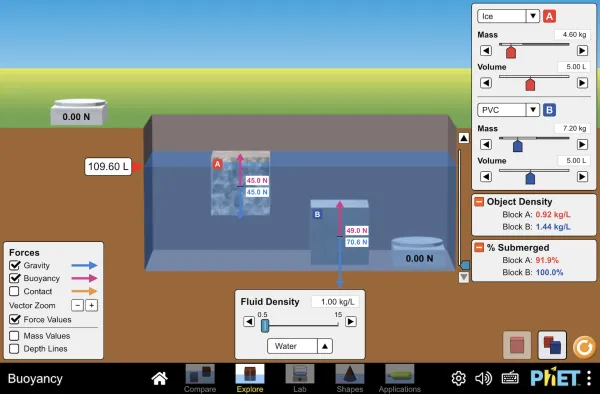
Full screen · PhET Interactive Simulations, University of Colorado Boulder, CC BY 4.0
Recap
- Buoyancy is the upward force from a fluid, caused by pressure being greater underneath than on top.
- The buoyant force equals the weight of the fluid displaced.
- Floating means buoyant force equals weight; sinking means buoyant force is less than weight.
- For the same volume displaced, a denser fluid gives a bigger buoyant force.
- A fair test changes one variable, measures one, and keeps the rest the same.
| Idea | Key fact |
|---|---|
| Buoyant force | weight of fluid displaced |
| Spring balance | weight in air − reading in fluid |
| Floats | buoyant force = weight |
| Sinks | buoyant force < weight |
| Denser fluid | bigger buoyant force for the same volume |
Challenge
A block of wood floats in a fresh-water lake with 60% of its volume underwater. (a) What is the density of the wood? (b) The block is carried out to sea, where the water has a density of 1025 kg per m³. What percentage of the block is underwater now?
Hint
A floating block displaces its own weight of water. If 60% of its volume of water weighs the same as the whole block, how does the block's density compare with the water's?
Answer
(a) 600 kg per m³ (b) about 59% (58.5%) underwater
Step by step
- A floating object displaces water that weighs exactly as much as it does.
- The block's mass equals the mass of fresh water filling 60% of its volume, so its density is 60% of 1000 kg per m³, which is 600 kg per m³.
- At sea the block's weight is the same, but each cubic metre of seawater has more mass.
- The fraction underwater is now 600 ÷ 1025 ≈ 0.585, so about 58.5% is underwater.
- The block floats a little higher in the sea, because it needs to displace less of the denser water.
Full working
- mass of block = mass of water displacedfloating, forces balanced
- density of wood = 0.60 × 1000 = 600 kg per m³60% of its volume of water
- at sea: fraction under = 600 ÷ 1025same mass, denser water
- 600 ÷ 1025 ≈ 0.585about 58.5%
- (a) 600 kg per m³ (b) about 59% underwater
A metal object weighs 6.0 N in air. Hung from a spring balance fully underwater in fresh water, it reads 4.0 N. Fully under in a sugar syrup, it reads 3.6 N. Using g = 9.8 N per kg, find (a) the volume of the object, (b) the density of the syrup and (c) the density of the metal.
Hint
The same object displaces the same volume in both liquids, so the buoyant forces compare the densities of the two liquids directly.
Answer
(a) about 204 cm³ (b) 1200 kg per m³ (c) 3000 kg per m³
Step by step
- Buoyant force in water is 6.0 − 4.0 = 2.0 N. In syrup it is 6.0 − 3.6 = 2.4 N.
- In water, 2.0 N is the weight of the displaced water: 2.0 ÷ 9.8 ≈ 0.204 kg, which is about 204 cm³, the object's volume.
- The syrup gives 2.4 ÷ 2.0 = 1.2 times the force from the same volume, so it is 1.2 times as dense as water: 1200 kg per m³.
- The object's weight (6.0 N) is 3 times the weight of the same volume of water (2.0 N), so the metal is 3 times as dense as water: 3000 kg per m³.
Full working
- water: 6.0 − 4.0 = 2.0 Nbuoyant force
- syrup: 6.0 − 3.6 = 2.4 Nbuoyant force
- 2.0 ÷ 9.8 ≈ 0.204 kg of water ≈ 204 cm³1 kg of water fills 1000 cm³
- 2.4 ÷ 2.0 = 1.2, so 1.2 × 1000 = 1200 kg per m³same volume displaced
- 6.0 ÷ 2.0 = 3, so 3 × 1000 = 3000 kg per m³object vs same volume of water
- (a) about 204 cm³ (b) 1200 kg per m³ (c) 3000 kg per m³
Students build a raft for Lake Taupō from 8 pine logs. Each log has a volume of 0.05 m³ and the pine has a density of 500 kg per m³. Ignore the rope. (a) What is the greatest mass of people the raft can carry before the logs are completely under the fresh water? (b) The same raft is used at sea (water density 1025 kg per m³). How much extra mass can it carry there, and why?
Hint
The most buoyant force the raft can get is when all its volume is under. Turn that into the greatest total mass it can hold up, then subtract the raft's own mass.
Answer
(a) 200 kg (b) 10 kg more, 210 kg in total, because seawater is denser
Step by step
- The raft's volume is 8 × 0.05 = 0.4 m³, and its own mass is 0.4 × 500 = 200 kg.
- Fully under in fresh water it displaces 0.4 × 1000 = 400 kg of water, so it can hold up a total of 400 kg.
- Take off the raft's own 200 kg: it can carry 200 kg of people before it goes under.
- At sea, 0.4 m³ of seawater has a mass of 0.4 × 1025 = 410 kg, so it can hold up 410 − 200 = 210 kg of people.
- That is 10 kg more, because the same volume of denser water weighs more and gives a bigger buoyant force.
Full working
- volume = 8 × 0.05 = 0.4 m³all the logs
- raft mass = 0.4 × 500 = 200 kgdensity × volume
- fresh water: 0.4 × 1000 = 400 kg displacedfully under
- load = 400 − 200 = 200 kgbuoyancy minus raft
- sea: 0.4 × 1025 = 410 kg, load = 410 − 200 = 210 kgdenser water
- (a) 200 kg (b) 10 kg more at sea (210 kg)