
Ratios, rates, speed and percentage change
What this lesson covers
- Ratios can be scaled up or down or simplified.
- A rate proportionally compares two quantities that have different units of measure; when working with rates, ‘per’ means ‘for every’ in day-to-day contexts.
A ratio and a rate are not the same thing
- A ratio compares two amounts of the same kind. No units.
- A rate compares two different kinds. Kilometres and hours.
- That difference decides what you are allowed to do with it.
Simplifying a ratio
- Twelve to eighteen. Both divide by six.
- Two to three. Same relationship, smaller numbers.
- Whatever you do to one side, do to the other.
| Ratio | Working | Simplified |
|---|---|---|
| 12 : 18 | both divide by 6 | 2 : 3 |
| 24 : 36 | both divide by 12 | 2 : 3 |
| 50 : 30 : 20 | all divide by 10 | 5 : 3 : 2 |
| The relationship | has not changed | only the numbers |
Scaling one up
- A recipe for four uses two to three.
- For eight, double both sides: four to six.
- It is the same ratio. Only the serving changed.
| Ratio | Scaled | Serves |
|---|---|---|
| 2 : 3 | for four people | |
| Double it | 4 : 6 | for eight |
| Triple it | 6 : 9 | for twelve |
| All the same ratio | written differently |
Which mix is stronger?
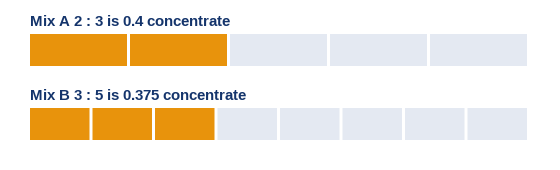
- Two to three against three to five. You cannot tell by looking.
- Turn each into a fraction of the whole: two fifths, three eighths.
- Nought point four beats nought point three seven five.
| Mix | Of the whole | Value |
|---|---|---|
| Mix A, 2 : 3 | 2 parts in 5 | 0.4 |
| Mix B, 3 : 5 | 3 parts in 8 | 0.375 |
| So A is stronger | by a little | |
| Compare fractions | not the raw numbers |
Rates, and the word "per"
- Kilometres per hour. Dollars per kilogram. Words per minute.
- Two different units, and the units carry the meaning.
- Read "per" as "for every" and rates get much easier.
| Rate | Read it as | Measuring |
|---|---|---|
| 80 km/h | kilometres per hour | speed |
| $18.00/kg | dollars per kilogram | price |
| 45 words/min | words per minute | typing |
| "per" | means "for every" |
For every
- Eighty kilometres per hour means eighty for every hour.
- So two hours is two lots of eighty.
- Said that way, you do not need a formula to work it out.
Which pack is cheaper?
- Three for four fifty, or five for seven dollars.
- Different sizes, so put both on the same basis: price each.
- One fifty against one forty. The bigger pack wins here.
| Offer | Working | Each |
|---|---|---|
| 3 for $4.50 | 4.50 ÷ 3 | $1.50 each |
| 5 for $7.00 | 7.00 ÷ 5 | $1.40 each |
| The five-pack wins | by ten cents each | |
| Same basis | is the whole trick |
Speed, distance and time
- A hundred and twenty kilometres in an hour and a half.
- Speed is the distance for every hour: eighty kilometres an hour.
- Going back the other way, multiply the speed by the time.
| Given | Working | Answer |
|---|---|---|
| 120 km in 1.5 h | 120 ÷ 1.5 | 80 km/h |
| 80 km/h for 2.5 h | 80 × 2.5 | 200 km |
| 300 km at 80 km/h | 300 ÷ 80 | 3.75 h |
| 3.75 hours | is 3 h 45 min | not 3 h 75 |
Try it: speed from the graph
Try it: put them on the same basis
Three point seven five hours
- That is three hours and three quarters of an hour.
- Three quarters of sixty minutes is forty-five.
- So three hours forty-five, and never three hours seventy-five.
Applying a change to a number
- Up fifteen percent means a hundred and fifteen percent of it.
- So multiply by one point one five. Two hundred and forty becomes 276.
- Down eight percent leaves ninety-two percent. Multiply by 0.92.
| Change | Working | Result |
|---|---|---|
| 240 up 15% | 240 × 1.15 | 276 |
| 340 up 12% | 340 × 1.12 | 380.8 |
| 500 down 8% | 500 × 0.92 | 460 |
| One multiply | not an add-on |
Percentage change between two numbers
- Fifty goes up to seventy-five. The change is twenty-five.
- Now divide by where you started, which is fifty.
- Nought point five, so it is a fifty percent increase.
| From, to | Change and base | Answer |
|---|---|---|
| 50 to 75 | change 25, base 50 | +50% |
| 80 to 60 | change 20, base 80 | −25% |
| 250 to 200 | change 50, base 250 | −20% |
| Divide by | where you started |
Why the starting point decides
- Fifty up to seventy-five is a fifty percent increase.
- Seventy-five back down to fifty is a thirty-three percent decrease.
- Same two numbers, same gap. Different base, different percent.
| Direction | Change on base | Percent |
|---|---|---|
| 50 up to 75 | 25 on a base of 50 | +50% |
| 75 back to 50 | 25 on a base of 75 | −33% |
| Same two numbers | same gap | |
| Different starting point | different percentage |
One question to ask yourself
- Where did this start? That is what you divide by.
- Not the bigger number, and not the one you finished on.
- Get the base right and the rest is a division.
What to take away
- Seven lines, and the last one is where the marks are.
| A ratio has no units | so it can be scaled |
| Simplify | divide both sides by the same |
| To compare ratios | turn them into fractions |
| A rate has two units | "per" means "for every" |
| Speed | is distance divided by time |
| To apply a change | multiply once |
| Percentage change | divide by where you started |
Common mistakes
- A price falls from 250 to 200: 50 ÷ 200 = a 25% decrease.Divide by where it started: 50 ÷ 250 = 0.2, a 20% decrease.
- 300 km at 80 km/h takes 3.75 h, which is 3 h 75 min.0.75 of an hour is 0.75 × 60 = 45 minutes, so it is 3 h 45 min.
- Increase 340 by 12%: 340 × 0.12 = 40.840.8 is only the increase; a 12% rise is 112% of it, so 340 × 1.12 = 380.8.
- 3 : 5 is stronger than 2 : 3 because 3 is bigger than 2.Compare fractions of the whole: 2/5 = 0.4 beats 3/8 = 0.375, so 2 : 3 is stronger.
Your turn: eight questions
- Work all eight.
- Question 3 is one multiplication, not two steps.
- Question 4 is asking you which number is the base.
Simplify the ratio 24 : 36.
A car does 210 km in 2.5 hours. Speed?
Increase 340 by 12%.
A price falls from 250 to 200. By what %?
A cordial mix is 2 : 7 cordial to water. How much water goes with 6 cups of cordial?
A recipe uses flour and sugar in the ratio 5 : 2. Which of these mixes keeps the same ratio?
Feijoas cost $6.30 for a 1.5 kg bag or $8.80 for a 2 kg bag. Which is cheaper per kilogram?
A bus travels 99 km at 36 km/h. How long does the trip take, in hours and minutes?
Show answer
1. 2 : 3. Twelve divides into both, and dividing both sides by the same number leaves the relationship untouched. 2. 84 km/h. Speed is distance over time, so 210 divided by 2.5. 3. 380.8. A 12% increase means 112% of it, so multiply by 1.12 in one step. 4. 20%. The change is 50, and the base is where it started, which is 250. 50 over 250 is 0.2. Dividing by 200 would give 25%, and that is the answer to a different question: it is the rise from 200 back up to 250. 5. 21 cups. 2 cups became 6, so the ratio is tripled: 7 × 3 = 21 cups of water. 6. 750 g : 300 g. Both parts are multiplied by 150, and 750 ÷ 300 = 2.5, the same as 5 ÷ 2. 7. The 1.5 kg bag. 6.30 ÷ 1.5 = $4.20/kg and 8.80 ÷ 2 = $4.40/kg, so the smaller bag wins. 8. 2 h 45 min. 99 ÷ 36 = 2.75 hours, and 0.75 of an hour is 45 minutes.
The answers
- Twenty-four to thirty-six is two to three.
- Two hundred and ten over two point five is eighty-four km an hour.
- 340 times 1.12 is 380 point 8.
- Fifty over two hundred and fifty is twenty percent.
Ratio and Proportion
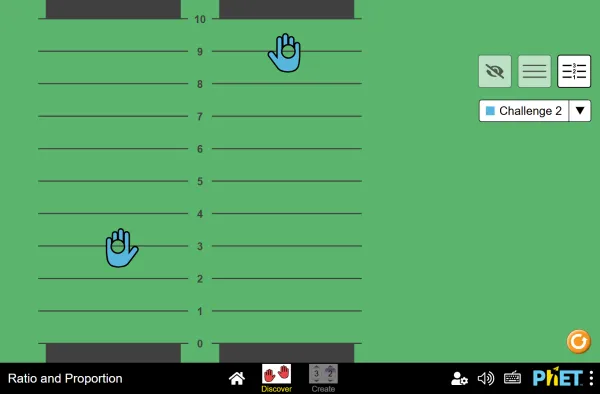
Full screen · PhET Interactive Simulations, University of Colorado Boulder, CC BY 4.0
Challenge
Car A uses 6.5 L of petrol per 100 km. Car B goes 16 km on each litre of petrol. Petrol costs $2.50 per litre. (a) Which car uses less petrol? Put both rates on the same basis to show it. (b) How much cheaper is car B for a 480 km trip? (c) Car C is even more economical. How many kilometres per litre must car C go, to make the 480 km trip $18 cheaper than in car A?
Hint
The two rates are written upside down compared with each other. Turn car B's rate into litres per 100 km, then find the litres each car needs for 480 km.
Answer
(a) Car B: it uses 6.25 L per 100 km, less than car A's 6.5 L. (b) $3 cheaper ($75 against $78). (c) 20 km per litre.
Step by step
- Car B goes 16 km on 1 L, so 100 km takes 100 ÷ 16 = 6.25 L, which is less than 6.5 L.
- For 480 km car A needs 4.8 × 6.5 = 31.2 L, costing $78.
- Car B needs 480 ÷ 16 = 30 L, costing $75, so it is $3 cheaper.
- Car C must cost $78 − $18 = $60, which buys 60 ÷ 2.50 = 24 L.
- Going 480 km on 24 L is 480 ÷ 24 = 20 km per litre.
Full working
- car B: 100 ÷ 16 = 6.25 L per 100 kmsame basis as car A
- 6.25 < 6.5, so car B uses lesspart (a)
- car A: 480 ÷ 100 × 6.5 = 31.2 L, 31.2 × 2.50 = $78480 km
- car B: 480 ÷ 16 = 30 L, 30 × 2.50 = $75480 km
- 78 − 75 = $3part (b)
- car C: 78 − 18 = $60, 60 ÷ 2.50 = 24 Lfuel it may use
- 480 ÷ 24 = 20 km per litrepart (c)
- (a) car B (b) $3 cheaper (c) 20 km per litre
A jar holds red and blue marbles in the ratio 3 : 5. Tama adds 12 more red marbles and nothing else, and the ratio of red to blue becomes 9 : 10. How many marbles were in the jar to begin with?
Hint
The number of blue marbles never changes. Write both ratios with the same number of blue parts, then see what the 12 new red marbles are worth.
Answer
64 marbles
Step by step
- Only the red marbles change, so make the blue part the same in both ratios.
- 3 : 5 is the same as 6 : 10, so the blue part is 10 in both ratios.
- Red goes from 6 parts to 9 parts, so the 12 new red marbles are 3 parts, and one part is 4 marbles.
- At the start there were 6 + 10 = 16 parts, which is 16 × 4 = 64 marbles.
- Check: 24 red and 40 blue is 3 : 5, and 36 red with 40 blue is 9 : 10.
Full working
- 3 : 5 = 6 : 10scale so blue is 10 parts in both
- red 6 parts → 9 partsblue stays at 10 parts
- 3 parts = 12 marbles, so 1 part = 4the added reds
- start: 24 red, 40 blue6 × 4 and 10 × 4
- check: 36 : 40 = 9 : 10after adding 12 red
- 64 marbles
A town's population grew by 25% from 2020 to 2022. From 2022 to 2024 it fell by p%. In 2024 the population was 10% higher than in 2020. Find p.
Hint
Each change is one multiplication. Write the whole trip from 2020 to 2024 as a chain of multipliers, starting from 100 people if it helps.
Answer
p = 12, a 12% fall
Step by step
- Start with 100 people in 2020 to keep the numbers simple.
- Up 25% means multiply by 1.25, so 2022 had 125 people.
- 10% higher than 2020 means 2024 had 110 people.
- The fall is 125 − 110 = 15 people, and the base is where that fall started: 125.
- 15 ÷ 125 = 0.12, so the population fell by 12%, not 15%.
Full working
- 2020: 100a handy starting value
- 2022: 100 × 1.25 = 125up 25%
- 2024: 100 × 1.10 = 11010% above 2020
- fall = 125 − 110 = 15the change from 2022
- 15 ÷ 125 = 0.12divide by where it started
- p = 12
Where science uses this
Practise this
Report a mistake
More in Number
 Rational, irrational, and scientific notation7 min
 Exponent rules and working with roots7 min
 Significant figures, rounding and estimating7 min
 Order of operations, signs and reciprocals7 min
 Percentages as multipliers, and ratios7 minRatios, rates, speed and percentage change7 min
 Exchange rates, unit prices and compound interest7 min