
Rational, irrational, and scientific notation
What this lesson covers
- Non-repeating, infinite decimals are irrational numbers; some of them are represented by special symbols, such as √2 and π.
- The terms index, power, and exponent are used interchangeably.
- For the number aⁿ, a represents the base, and n represents the exponent.
One question, asked of every number
- Can this number be written as a fraction of two whole numbers?
- Yes, and it is rational. No, and it is irrational.
- That one question sorts everything in this lesson.
Fractions, decimals and percentages are one number
- Three eighths, nought point three seven five, 37.5 percent.
- Nothing changed between those. Only the costume did.
- Divide for the decimal, multiply by a hundred for the percent.
| Fraction | Decimal | Percentage |
|---|---|---|
| 3/8 | 0.375 | 37.5% |
| 2/5 | 0.4 | 40% |
| 7/20 | 0.35 | 35% |
| 1/3 | 0.333… | 33.3% |
Divide it out and watch what happens
- A quarter stops dead at nought point two five.
- A third never stops, but it repeats forever.
- Every fraction does one or the other. There is no third option.
| Fraction | Dividing gives | So it is |
|---|---|---|
| 1/4 | 0.25, it stops | rational |
| 1/3 | 0.333…, it repeats | rational |
| 5/11 | 0.4545…, it repeats | rational |
| √2 | 1.41421…, neither | irrational |
Try it: decimals, order and size
The numbers that do neither
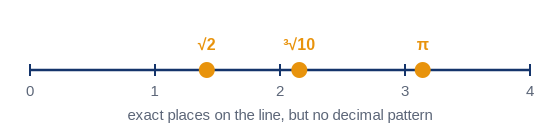
- The square root of two runs forever with no repeating block.
- So does pi. So does the cube root of ten.
- No fraction of whole numbers will ever equal them.
| Number | Its decimal |
|---|---|
| √2 | 1.414213562… no pattern |
| π | 3.141592653… no pattern |
| ³√10 | 2.154434690… no pattern |
| As a fraction? | None of them can be |
Telling them apart in practice
- A root sign does not make a number irrational.
- The square root of 25 is 5, and 5 is a whole number.
- 22 over 7 looks like pi and is an ordinary fraction.
| Number | Written out | Which is it |
|---|---|---|
| √25 | exactly 5 | rational |
| √26 | 5.0990195… | irrational |
| 22/7 | 3.142857142857… | rational |
| π | 3.14159265… | irrational |
Try it: rational or irrational?
Putting a mixed bag in order
- A third, three eighths, 38 percent and two fifths.
- You cannot compare those as they are written.
- Turn them all into decimals first, then it is easy.
| Number | As a decimal | Order |
|---|---|---|
| 1/3 | 0.3333… | smallest |
| 3/8 | 0.375 | second |
| 38% | 0.38 | third |
| 2/5 | 0.4 | largest |
Base, exponent, and three words for the same thing
- In two to the fifth, the 2 is the base.
- The 5 is the exponent: how many twos are multiplied.
- Index, power and exponent all mean that same 5.
| In 2⁵ | Its name | What it does |
|---|---|---|
| 2 | the base | the number multiplied |
| 5 | the exponent | how many of them |
| 2⁵ | the power | 2 × 2 × 2 × 2 × 2 = 32 |
| Index, power, exponent | one idea | three words for n |
Scientific notation, and its one rule
- Every number gets written as something times a power of ten.
- That something has to be at least 1 and under 10.
- The power of ten says how far the decimal point moved.
| The form | What it means |
|---|---|
| Written a × 10ᵏ | a is at least 1 and under 10 |
| k | how far the point moves |
| Numbers above 10 | k is positive |
| Numbers under 1 | k is negative |
Try it: scientific notation
Writing a big number down
- 384 400 kilometres to the moon. Move the point left.
- Five places, landing on 3.844.
- So it is 3.844 times ten to the fifth.
| Number | Point moves | Written as |
|---|---|---|
| 384 400 | 5 places left | 3.844 × 10⁵ |
| 93 000 000 | 7 places left | 9.3 × 10⁷ |
| 1 500 | 3 places left | 1.5 × 10³ |
And a very small one
- Same move, other direction, so the exponent goes negative.
- Nought point nought nought nought nought nought two five.
- Six places right, so 2.5 times ten to the minus six.
| Number | Point moves | Written as |
|---|---|---|
| 0.000 002 5 | 6 places right | 2.5 × 10⁻⁶ |
| 0.007 | 3 places right | 7 × 10⁻³ |
| 0.000 000 1 | 7 places right | 1 × 10⁻⁷ |
Which one is bigger?
- Look at the exponent before you look at anything else.
- Ten cubed beats ten squared whatever the front number is.
- Only when the exponents match does the front number decide.
| Number | Exponent | Really |
|---|---|---|
| 4.2 × 10³ | 3 | 4 200 |
| 1.1 × 10³ | 3 | 1 100 |
| 9.8 × 10² | 2 | 980 |
| Exponent first | then a | 4.2 × 10³ wins |
Multiplying and dividing them
- Front numbers with front numbers, powers with powers.
- Multiplying tens adds the exponents. Dividing subtracts them.
- Then check the front number is still under 10.
| Working | Front | Powers |
|---|---|---|
| Multiplying | 3 × 2 = 6 | 10⁴ × 10⁵ = 10⁹ |
| Dividing | 8 ÷ 4 = 2 | 10⁷ ÷ 10³ = 10⁴ |
| Another one | 5 × 4 = 20 | gives 20 × 10⁹ |
| Not finished | 20 is over 10 | so 2 × 10¹⁰ |
Why anyone bothers
- A calculator that shows 3.2E9 is speaking this language.
- It also makes the size obvious at a glance.
- Ten to the ninth is a billion, whatever the front number is.
What to take away
- Six things, and the first three are one idea.
| Rational | it can be written as a fraction |
| Its decimal | always stops or repeats |
| Irrational | never stops and never repeats |
| √2 and π are irrational | 22/7 is not, it repeats |
| In aⁿ | a is the base, n is the exponent |
| Scientific notation | a × 10ᵏ, with a under 10 |
Common mistakes
- √25 has a root sign, so it is irrational.√25 is exactly 5, a whole number, so it is rational; only roots like √26 that never end or repeat are irrational.
- 0.000 084 = 8.4 × 10⁵A number under 1 has a negative exponent: the point moves 5 places, so it is 8.4 × 10⁻⁵.
- (6 × 10⁵) × (5 × 10³) = 30 × 10⁸, finished.The front number must be at least 1 and under 10, so 30 × 10⁸ tidies to 3 × 10⁹.
- 9.8 × 10² is bigger than 4.2 × 10³ because 9.8 is bigger than 4.2.Compare the exponents first: 10³ beats 10², so 4.2 × 10³ = 4 200 is bigger than 980.
Your turn: eight questions
- Write all eight out properly.
- Question 2 has one irrational number in it, not two.
- Question 4 is not finished when you get the first answer.
Write 0.45 as a fraction and a percent.
Which is irrational: √25, √26, 22/7?
Write 0.000 084 in scientific notation.
Work out (6 × 10⁵) × (5 × 10³).
In 4³, name the base and give the value.
Which is smallest: 0.6, 5/8, 63% or 2/3?
Write 7.05 × 10⁴ as an ordinary number.
Which is largest: 9.9 × 10³, 1.2 × 10⁴, 7.5 × 10³ or 9.99 × 10²?
Show answer
1. 0.45 is 45 hundredths, so 45/100, which cancels by 5 to 9/20. As a percent it is 45%, because a percent is already a fraction of a hundred. 2. The square root of 26 is the irrational one. The square root of 25 is exactly 5, and 22/7 is a fraction, so both of those are rational however untidy 22/7 looks written out. 3. 8.4 × 10⁻⁵. The point moves five places right to get back to 0.000 084, so the exponent is negative five. 4. 6 times 5 is 30 and 10⁵ times 10³ is 10⁸, giving 30 × 10⁸. That is not finished, because 30 is not under 10: it tidies to 3 × 10⁹. 5. Base 4, value 64. The base is the number multiplied and the exponent 3 says how many: 4 × 4 × 4 = 64. 6. 0.6. As decimals they are 0.6, 0.625, 0.63 and 0.666…, so 0.6 is smallest. 7. 70 500. The exponent is positive 4, so the point moves 4 places right from 7.05. 8. 1.2 × 10⁴. Look at the exponent first: 10⁴ beats 10³ and 10², whatever the front number is. It is 12 000; 9.9 × 10³ is only 9 900.
The answers
- 0.45 is 45 hundredths, so 9 over 20, and 45 percent.
- The square root of 26 is the irrational one.
- 0.000 084 is 8.4 times ten to the minus five.
- 30 times ten to the eighth tidies to 3 times ten to the ninth.
Challenge
The fraction 47 is written as a decimal. (a) What is the 2026th digit after the decimal point? (b) What do the first 2026 digits after the decimal point add up to?
Hint
Divide it out until the digits start to repeat. How long is the repeating block, and how many whole blocks fit into 2026 digits?
Answer
(a) 4 (b) 9116
Step by step
- Dividing 4 by 7 gives 0.571428571428..., so the block 571428 repeats forever.
- The block is 6 digits long. 2026 ÷ 6 is 337 with remainder 4, so 337 whole blocks use up 2022 digits.
- The 2026th digit is the 4th digit of a fresh block: 5, 7, 1, 4. So it is 4.
- One block adds to 5 + 7 + 1 + 4 + 2 + 8 = 27, so 337 blocks add to 337 × 27 = 9099.
- The last 4 digits are 5, 7, 1, 4, which add to 17. The total is 9099 + 17 = 9116.
Full working
- 47 = 0.571428 571428 ...the block 571428 repeats
- 2026 = 6 × 337 + 4337 whole blocks, then 4 more digits
- 4th digit of 571428 is 45, 7, 1, 4
- 337 × 27 = 9099each block adds to 27
- 9099 + (5 + 7 + 1 + 4) = 9099 + 17 = 9116the last part block
- (a) 4 (b) 9116
The number 4¹⁰ × 5¹⁵ is worked out in full and written as an ordinary whole number. How many digits does it have? Give the number in scientific notation as part of your answer.
Hint
Each 4 is 2 × 2. A 2 and a 5 multiply to make 10, so pair up as many 2s and 5s as you can.
Answer
3.2 × 10¹⁶, which has 17 digits
Step by step
- 4¹⁰ is ten 4s multiplied, and each 4 is 2 × 2, so 4¹⁰ is twenty 2s multiplied: 2²⁰.
- So the number is 2²⁰ × 5¹⁵. Pair each 5 with a 2: fifteen pairs, and each pair 2 × 5 is 10.
- That leaves 2⁵ = 32 unpaired, so the number is 32 × 10¹⁵.
- 32 is not under 10, so tidy it: 32 × 10¹⁵ = 3.2 × 10¹⁶.
- 3.2 × 10¹⁶ is 32 followed by fifteen zeros: 2 + 15 = 17 digits.
Full working
- 4¹⁰ = 2²⁰each 4 is two 2s
- 2²⁰ × 5¹⁵ = 2⁵ × (2 × 5)¹⁵pair fifteen 2s with fifteen 5s
- = 32 × 10¹⁵2⁵ = 32
- = 3.2 × 10¹⁶front number must be under 10
- 32 000 000 000 000 0002 digits then 15 zeros
- 3.2 × 10¹⁶, so 17 digits
For how many whole numbers n from 1 to 50 does the decimal for 1n stop (rather than repeat forever)? Explain how you can tell without dividing every one out.
Hint
A decimal that stops can be written as a fraction over 10, 100, 1000 and so on. What are those numbers made of when you break them into prime factors?
Answer
12 of them: n = 1, 2, 4, 5, 8, 10, 16, 20, 25, 32, 40, 50
Step by step
- A decimal that stops, like 0.125, is a whole number over 10, 100, 1000 or another power of ten: 0.125 = 1251000.
- Every power of ten is made only of 2s and 5s, because 10 = 2 × 5.
- So 1n stops exactly when n is made only of 2s and 5s: then you can multiply top and bottom to make a power of ten, like 18 = 1251000.
- If n has any other prime factor, like 3 or 7, no power of ten is a multiple of n, so the decimal can never stop. It repeats instead.
- List the numbers up to 50 made only of 2s and 5s: 1, 2, 4, 8, 16, 32, then 5, 10, 20, 40, then 25, 50. That is 12.
Full working
- 1n stops only if 1n = k10ᵐa stopping decimal is over a power of ten
- 10ᵐ = 2ᵐ × 5ᵐonly 2s and 5s
- n must be made only of 2s and 5sotherwise n cannot divide 10ᵐ
- 1, 2, 4, 8, 16, 32powers of 2 up to 50
- 5, 10, 20, 40, 25, 50with one or two 5s
- 12 values of n
Where science uses this
Practise this
Report a mistake
More in Number
Rational, irrational, and scientific notation7 min Exponent rules and working with roots7 min
 Significant figures, rounding and estimating7 min
 Order of operations, signs and reciprocals7 min
 Percentages as multipliers, and ratios7 min
 Ratios, rates, speed and percentage change7 min
 Exchange rates, unit prices and compound interest7 min