Adding fractions, and fractions of amounts
What this lesson covers
- Addition and subtraction of fractions with the same denominator follow the same principles as whole numbers and can result in improper fractions or whole numbers.
- Scaling changes quantities proportionally, using multiplication and division.
Adding fractions is just counting
- 3 apples plus 3 apples is 6 apples.
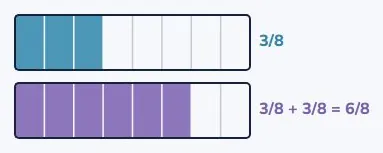
- 3 eighths plus 3 eighths is 6 eighths.
- Same sum. The eighths are just what you are counting.
| the sum | you say | you get |
|---|---|---|
| 3 apples + 3 apples | three and three | 6 apples |
| 3/8 + 3/8 | three eighths and three eighths | 6/8 |
| 0.3 + 0.2 | three tenths and two tenths | 0.5 |
The bottom number does not get added
- Six eighths, not six sixteenths.
- The bottom number is the NAME of the piece.
- Counting apples does not change what an apple is.
Try it: add the pieces
Decimals add the same way
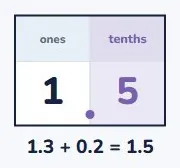
- 1.3 + 0.2. Three tenths plus two tenths is five tenths.
- So the answer is 1.5.
- The columns already lined the pieces up for you.
You can count past a whole
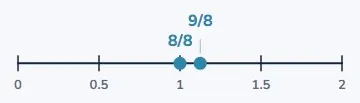
- 3/8 three times is 9 eighths.
- Eight of them made a whole, and one is left over.
- So 9/8 is 1 and 1/8: the two spellings again.
Tidying up afterwards
- Add first, then see how many wholes you made.
- 8/4 is exactly 2 wholes. Nothing left over.
- Do the counting first. Tidy up second.
| the sum | gives | which is |
|---|---|---|
| 3/8 + 3/8 + 3/8 | 9/8 | 1 1/8 |
| 5/4 + 3/4 | 8/4 | 2 |
| 7/10 + 6/10 | 13/10 | 1 3/10 |
Taking away works the same
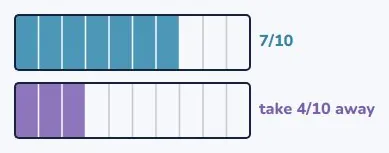
- 7/10 take away 4/10 is 3/10.
- Seven tenths, take away four of them, leaves three.
- Still counting. Still the same-sized pieces.
Scaling: everything moves together
- Double a recipe and every ingredient doubles.
- 2 cups becomes 4. 3 eggs becomes 6.
- Not "add the same". Multiply the same.
| ingredient | for 4 people | doubled, for 8 |
|---|---|---|
| flour | 2 cups | 4 cups |
| eggs | 3 | 6 |
| milk | 300 ml | 600 ml |
"Of" means share it out
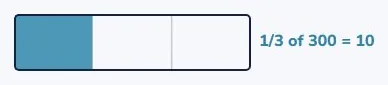
- 1/3 of 300. Cut 300 into 3 equal parts.
- That is 300 ÷ 3, which is 100.
- Finding a fraction of an amount is dividing.
Try it: share it out
And it runs backwards
- A quarter of a set is 7. How big is the whole set?
- A quarter means 4 equal parts, and one of them is 7.
- So the whole is 7 × 4 = 28. Same fact, reversed.
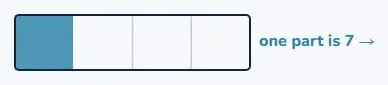
One division fact, two questions
- Every row here is a fact you already know.
- Read it left to right, or right to left.
- That is why memorising the tables was worth it.
| forwards | backwards | the fact behind both |
|---|---|---|
| 1/4 of 28 is 7 | a quarter is 7, so the whole is 28 | 28 ÷ 4 = 7 |
| 1/3 of 300 is 100 | a third is 100, so the whole is 300 | 300 ÷ 3 = 100 |
| 1/5 of 45 is 9 | a fifth is 9, so the whole is 45 | 45 ÷ 5 = 9 |
Common mistakes
- 3/8 + 3/8 = 6/16The bottom number is the name of the piece, so it stays the same: three eighths and three eighths make 6/8.
- 1/4 of a set is 7, so the whole set is 7 ÷ 4.A quarter is one of 4 equal parts, so the whole set is 7 × 4 = 28.
- To double the recipe, add 2 to everything: 2 cups becomes 4, and 3 eggs becomes 5.Doubling multiplies every amount by 2, so 3 eggs becomes 6, not 5.
- 1.3 + 0.2 = 1.32Add tenths to tenths: three tenths and two tenths make five tenths, so 1.3 + 0.2 = 1.5.
Your turn
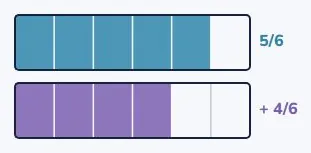
Count first, tidy after: 5/6 + 4/6.
What is 1/5 of 40?
A third of a box is 6. How many are in the whole box?
Ana has 1.6 m of ribbon and uses 0.4 m. How much is left?
Kai's pikelets for 4 people use 3 eggs and 250 ml milk. He doubles it for 8. What does he need?
Show answer
1. 9/6, which is 1 and 3/6: six sixths make a whole and three are left. 2. 8: 1/5 of 40 means share 40 into 5 equal parts, and 40 ÷ 5 = 8. 3. 18: a third means three equal parts and one is 6, so the whole is 6 × 3 = 18. 4. 1.2 m: six tenths take away four tenths leaves two tenths, so 1.6 − 0.4 = 1.2. 5. 6 eggs and 500 ml milk: doubling means every ingredient × 2, so 3 × 2 = 6 and 250 × 2 = 500.
Build a Fraction
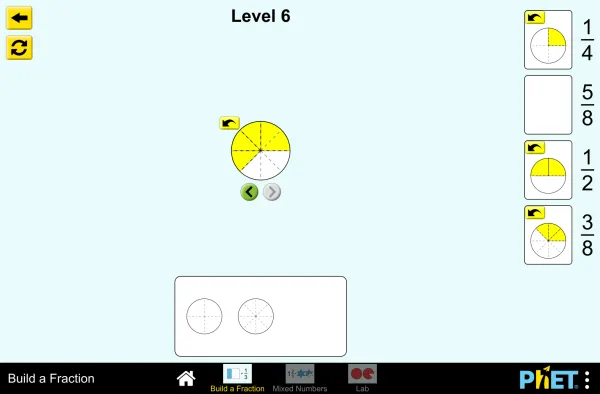
Full screen · PhET Interactive Simulations, University of Colorado Boulder, CC BY 4.0
Counting pieces, and sharing them out
- Same-sized pieces can simply be counted.
- The bottom number is a name, so it stays put.
- "Of" means divide, and it runs backwards too.
| idea | what to remember |
|---|---|
| 3/8 + 3/8 | count the eighths: 6/8 |
| the bottom number | a name, not a quantity |
| 1.3 + 0.2 | counting tenths, same idea |
| 9/8 | count past the whole, tidy up after |
| scaling | everything multiplies together |
| 1/3 of 300 | share it into 3 → 100 |
| backwards | one part is 7, so four parts is 28 |
Challenge
A pancake recipe for 4 people uses 2 eggs and 300 ml of milk. Nana is cooking for 6 people. How many eggs and how much milk does she need?
Hint
You cannot just double. Work out the recipe for 2 people first.
Answer
3 eggs and 450 ml of milk
Step by step
- 6 is not double 4, so first find the recipe for 2 people.
- 2 people is half of 4 people: 1 egg and 150 ml of milk.
- 6 people is 3 lots of 2 people.
- 3 × 1 egg = 3 eggs and 3 × 150 ml = 450 ml.
Full working
- 2 ÷ 2 = 1 egghalf the recipe, for 2 people
- 300 ÷ 2 = 150 mlhalf the milk, for 2 people
- 6 = 3 × 26 people is 3 lots of 2
- 3 × 1 = 3 eggsscale up the eggs
- 3 × 150 = 450 mlscale up the milk
- 3 eggs and 450 ml of milk
Kiri walks 34 km to the dairy, then 24 km to her nan's house, then 34 km to school. Sam walks 2 14 km to school. Who walks further, and by how much?
Hint
Add Kiri's walks by counting quarters. Then change 2 14 into quarters too.
Answer
Sam walks further, by 14 km. Kiri walks 2 km.
Step by step
- All of Kiri's walks are in quarters, so count the quarters: 3 + 2 + 3 = 8 quarters.
- 84 is exactly 2 km.
- 2 14 km is 8 quarters and 1 more, which is 94 km.
- 9 quarters is 1 quarter more than 8 quarters, so Sam walks 14 km further.
Full working
- 34 + 24 + 34 = 84Kiri, counting quarters
- 84 = 2 km4 quarters in each km
- 2 14 = 94Sam, in quarters
- 94 − 84 = 14the difference
- Sam, by 14 km
Nine cards show 18, 28, 38, 48, 58, 68, 78, 88 and 98. Put them into three groups of three cards, so that every group adds up to the same amount. What does each group add up to? Write it as a mixed number, and give one way to make the groups.
Hint
Add all nine cards first. Then share the total equally between the three groups.
Answer
Each group makes 158, which is 1 78. One way: 18 + 58 + 98, 28 + 68 + 78, and 38 + 48 + 88.
Step by step
- All the cards are eighths, so just count the eighths: 1 + 2 + ... + 9 = 45 eighths.
- Three equal groups means 45 ÷ 3 = 15 eighths each.
- 15 eighths is 8 eighths (one whole) and 7 more eighths, so 1 78.
- Now find three cards making 15 eighths each, using every card once: 1, 5, 9 and 2, 6, 7 and 3, 4, 8.
Full working
- 1 + 2 + 3 + 4 + 5 + 6 + 7 + 8 + 9 = 45total, in eighths
- 45 ÷ 3 = 15eighths in each group
- 158 = 88 + 78 = 1 78tidy up into a whole
- 18 + 58 + 98 = 158group 1
- 28 + 68 + 78 = 158group 2
- 38 + 48 + 88 = 158group 3
- Each group is 1 78