Tenths: the columns keep going
What this lesson covers
- The base 10 number system continues past the ones column, to the right, to create decimals such as tenths.
- Decimals are fractions that have powers of 10 as their denominators, and they can be written as numbers using a decimal point.
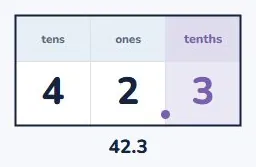
- A decimal point marks the column immediately to the right of the ones column as the tenths column.
The rule does not say to stop
- Every column is ten times the one on its right.
- So every column is a tenth of the one on its left.
- Nothing in that says to stop at the ones column.
| column | worth | as a fraction |
|---|---|---|
| hundreds | 100 | not needed |
| tens | 10 | not needed |
| ones | 1 | not needed |
| tenths | 0.1 | 1/10 |
Tenths are the next column along
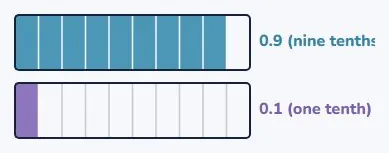
- One whole, split into ten equal parts.
- Each part is one tenth.
- Not a new kind of number. The next column.

What the decimal point is for
- The point does not separate two numbers.
- It marks where the ones column ends.
- That is its whole job: telling you which column is which.
Try it: tenths are the next column
So 0.9 is bigger than 0.15 would be
- If the point separated two numbers, 15 would beat 9.
- It does not. 0.9 is nine tenths, nearly a whole.
- Read the column, not the digits after the dot.
Fraction or decimal, same amount
- 3/10 and 0.3 are the same quantity.
- Two ways of writing it, not two numbers.
- And 5/10 is 0.5, which you already know as a half.
| fraction | decimal | you say |
|---|---|---|
| 1/10 | 0.1 | one tenth |
| 3/10 | 0.3 | three tenths |
| 5/10 | 0.5 | five tenths, or a half |
| 9/10 | 0.9 | nine tenths |
A half is five tenths
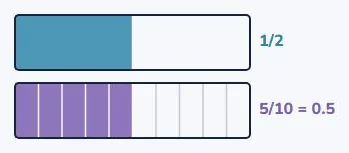
- Cut a whole into ten. Take five of them.
- That is exactly half.
- So 1/2, 5/10 and 0.5 are all the same thing.
Tenths live between the whole numbers
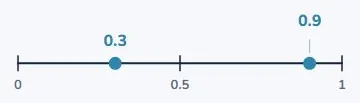
- Between 0 and 1 there are nine tenths marks.
- 0.3 sits three of them along.
- Ordering decimals is just reading along the line.
Try it: hop in tenths
Dividing by 10 moves the digit right
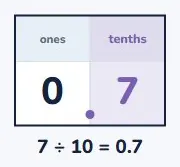
- 7 ÷ 10. The 7 does not change into something else.
- It moves one column right, into the tenths.
- Now it is worth a tenth of what it was: 0.7.
Every digit shifts one place
- 40 ÷ 10 is 4. The 4 moved from tens into ones.
- 23 ÷ 10 is 2.3. Both digits moved right.
- Same move every time, whatever the number.
| divide by 10 | gives | what happened |
|---|---|---|
| 7 | 0.7 | the 7 moved into the tenths column |
| 40 | 4 | the 4 moved from tens into ones |
| 23 | 2.3 | both digits moved one column right |
Common mistakes
- 0.15 is bigger than 0.9, because 15 is bigger than 9.Read the columns: 0.9 is nine tenths, nearly a whole, and 0.15 is only one tenth and a bit, so 0.9 is bigger.
- 1/2 has a 2 in it, so 1/2 = 0.2A half is five tenths, so 1/2 = 5/10 = 0.5.
- 7 ÷ 10 = 70Dividing by 10 moves the 7 one column right, into the tenths, so 7 ÷ 10 = 0.7.
- 3/10 written as a decimal is 3.10Three tenths goes in the tenths column, just after the point: 3/10 = 0.3.
Your turn
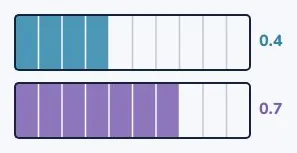
Write 7/10 as a decimal.
Which is bigger: 0.4 or 0.7?
What is 56 ÷ 10?
Mere eats half a pizza. Which decimal is the same as 1/2?
Put these in order, smallest first: 1/2, 0.8, 0.3.
Show answer
1. 0.7: seven tenths, so the 7 goes in the first column after the point. 2. 0.7 is bigger. Both are tenths, so compare 7 and 4 in the same column. 3. 5.6: both digits move one column right, so the 5 goes into the ones and the 6 into the tenths. 4. 0.5: a half is 5/10, which is five tenths. 5. 0.3, 1/2, 0.8: 1/2 is 0.5, so compare three, five and eight tenths.
Area Model Decimals
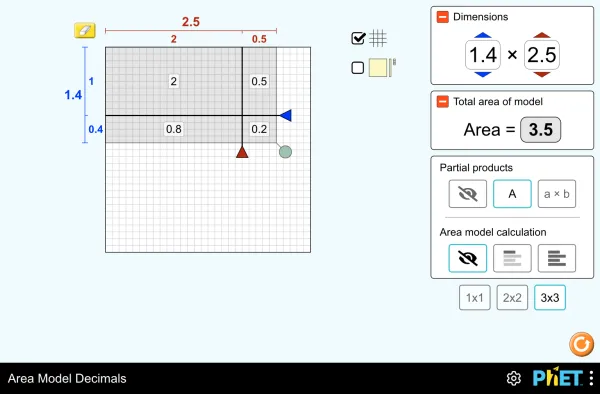
Full screen · PhET Interactive Simulations, University of Colorado Boulder, CC BY 4.0
Tenths and the point
- The columns keep going past the ones.
- The point marks where the ones end.
- Dividing by 10 moves the digits, never the point.
| idea | what to remember |
|---|---|
| tenths | the next column right of the ones |
| the point | a marker, not a separator |
| 3/10 | the same as 0.3 |
| a half | 5/10, which is 0.5 |
| ÷ 10 | every digit moves one column right |
Challenge
Here are five numbers: 0.8, 1310, 12, 1.2 and 910. Which two are the same distance from 1? Which one is furthest from 1?
Hint
Change them all into tenths. Then count how many tenths each one is away from 1, which is 10 tenths.
Answer
0.8 and 1.2 are both 2 tenths from 1. 12 is furthest from 1 (5 tenths away).
Step by step
- 1 is 10 tenths. Write every number in tenths.
- 0.8 is 8 tenths, 1310 is 13 tenths, 12 is 5 tenths, 1.2 is 12 tenths, 910 is 9 tenths.
- Distances from 10 tenths: 2, 3, 5, 2 and 1 tenths.
- 0.8 and 1.2 are both 2 tenths away, one below 1 and one above.
- 12 is 5 tenths away, the furthest.
Full working
- 1 = 10 tenthsthe target
- 0.8 = 8, 1310 = 13, 12 = 5, 1.2 = 12, 910 = 9all in tenths
- 2, 3, 5, 2, 1tenths away from 10
- 0.8 and 1.2 are both 2 tenths awaythe same distance
- 0.8 and 1.2 are the same distance; 12 is furthest
A frog starts at 0 on a number line and hops forwards 0.3 each time. Does it ever land exactly on 2? What is the first whole number it lands on exactly, and after how many hops?
Hint
Count in tenths. How many tenths is each hop, and how many tenths is each whole number?
Answer
It never lands on 2. The first whole number it lands on is 3, after 10 hops.
Step by step
- Each hop is 3 tenths.
- Near 2 it lands on 1.8, then 2.1, so it jumps over 2.
- A whole number is 10 tenths, 20 tenths, 30 tenths and so on.
- Counting in 3s: 3, 6, 9, ... 30. The first one that is a multiple of 10 is 30.
- 30 tenths is 3, and 30 ÷ 3 = 10 hops.
Full working
- one hop = 3 tenths0.3
- 6 hops = 18 tenths = 1.8just before 2
- 7 hops = 21 tenths = 2.1jumped past 2
- 10 hops = 30 tenths = 3first multiple of 10 tenths
- Never on 2; first whole number is 3, after 10 hops
Hana stacks 10 identical blocks and the tower is 46 cm tall. Rua stacks 10 identical blocks of a different kind, and his tower is 3 cm shorter than Hana's. How much thicker is one of Hana's blocks than one of Rua's?
Hint
Find how thick one of each block is by dividing by 10. Or think about where the 3 cm difference goes when it is shared between 10 blocks.
Answer
0.3 cm
Step by step
- One of Hana's blocks is 46 ÷ 10 = 4.6 cm.
- Rua's tower is 46 − 3 = 43 cm, so one of his blocks is 43 ÷ 10 = 4.3 cm.
- 4.6 is 46 tenths and 4.3 is 43 tenths. The difference is 3 tenths.
- Quicker: the 3 cm difference is shared over 10 blocks, so each block is 3 ÷ 10 = 0.3 cm thicker.
Full working
- 46 ÷ 10 = 4.6one of Hana's blocks, in cm
- 46 − 3 = 43Rua's tower, in cm
- 43 ÷ 10 = 4.3one of Rua's blocks, in cm
- 46 tenths − 43 tenths = 3 tenthscompare in the tenths column
- 3 ÷ 10 = 0.3the same answer, the quick way
- 0.3 cm