Rounding, and counting in steps
What this lesson covers
- Rounding can support predicting or estimating the result of a calculation.
- Rounding is based on identifying the nearest place value or unit (ten, hundred, thousand) for a given number; a number line supports this.
Rounding is a question, not a rule
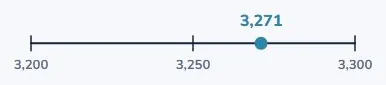
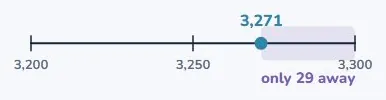
- Round 3,271 to the nearest hundred.
- There are only two answers it could be: 3,200 or 3,300.
- The only question is which one is nearer.
So look at it
- 3,271 sits closer to 3,300 than to 3,200.
- So it rounds to 3,300.
- You did not need a rule. You could see it.
The place you round to picks the two ends
- Nearest ten? The ends are 3,270 and 3,280.
- Nearest hundred? The ends are 3,200 and 3,300.
- Same number, different question, different answer.
| number | round to | between | answer |
|---|---|---|---|
| 4,700 | nearest thousand | 4,000 or 5,000 | 5,000 |
| 3,271 | nearest hundred | 3,200 or 3,300 | 3,300 |
| 3,271 | nearest ten | 3,270 or 3,280 | 3,270 |
Try it: round a number
The one case you cannot look at
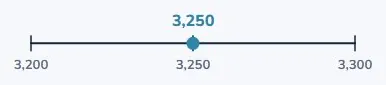
- 3,250 is exactly halfway between 3,200 and 3,300.
- Neither is nearer. Looking cannot settle it.
- So somebody chose: exactly halfway rounds up.
What rounding is for
- 3,271 add 4,850 is hard in your head.
- 3,300 add 4,900 is not. That is about 8,200.
- A rounded answer tells you what to expect.
| the real sum | the rounded sum | so expect |
|---|---|---|
| 3,271 + 4,850 | 3,300 + 4,900 | about 8,200 |
| 6,120 − 2,890 | 6,100 − 2,900 | about 3,200 |
Tenths work the same way
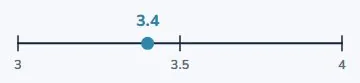
- 3.4 sits between 3 and 4.
- It is nearer 3, so it rounds to 3.
- Same question. Nothing new to learn.
Counting in steps is the same line
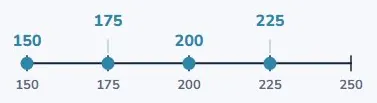
- Counting in 25s is jumping along in equal hops.
- 150, 175, 200, 225.
- Same number line. Bigger jumps.
Counting in 100s moves one column
- Start at 2,340 and count in 100s.
- 2,440, 2,540, 2,640. Only the hundreds digit moves.
- That is place value doing the work again.
| start at | count in | and you get |
|---|---|---|
| 2,340 | 100s | 2,440 · 2,540 · 2,640 |
| 2,340 | 1,000s | 3,340 · 4,340 · 5,340 |
| 150 | 25s | 175 · 200 · 225 |
Try it: count in steps
Until the column runs out
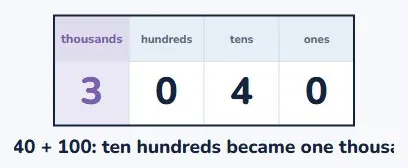
- 2,640, then 2,740, then 2,840, then 2,940.
- Next hop needs a tenth hundred. There is no such digit.
- So it becomes 3,040; the thousands column takes it.
Common mistakes
- 3,271 to the nearest hundred is 3,200, because I just drop the end.Ask which is nearer: 3,271 is closer to 3,300 than to 3,200, so it rounds to 3,300.
- 3,271 to the nearest hundred is 300.Rounding keeps the number about the same size: the two choices are 3,200 and 3,300, so the answer is 3,300.
- Counting in 100s from 2,940, the next number is 2,1040.Ten hundreds make a thousand, so the thousands column takes it: 2,940, then 3,040.
- 3,250 to the nearest hundred is 3,200.3,250 is exactly halfway, and halfway always rounds up, so it is 3,300.
Your turn
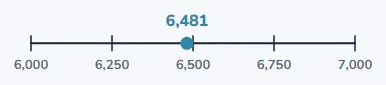
Round 6,481 to the nearest hundred.
Round 6,481 to the nearest thousand.
Count on in 50s from 6,450. What are the next three numbers?
Round 2,350 to the nearest hundred.
Count on in 100s from 4,870. What comes after 4,970?
Show answer
1. 6,500. It sits between 6,400 and 6,500, and 81 is past halfway. 2. 6,000. It sits between 6,000 and 7,000, and 481 is short of halfway. 3. 6,500, 6,550, 6,600. Each hop adds 50, so two hops make 100. 4. 2,400. 2,350 is exactly halfway between 2,300 and 2,400, and exactly halfway rounds up. 5. 5,070. The hundreds column runs out, so the thousands column takes it: 4,970 + 100 = 5,070.
Rounding and counting
- Find the two ends, then see which is nearer.
- Exactly halfway is the only time you need the rule.
- Counting in steps is the same line, jumped along.
| idea | what to remember |
|---|---|
| rounding | which of the two ends is nearer? |
| the two ends | the place you round to picks them |
| exactly halfway | rounds up: the one real rule |
| what it is for | knowing what to expect before you work it out |
| counting in steps | equal hops along the same line |
Challenge
Mia works out 2,890 + 3,140 and gets 4,030. Without doing the real sum, use rounding to show that her answer must be wrong.
Hint
Round each number to the nearest hundred. About how big should the answer be?
Answer
2,900 + 3,100 is about 6,000, so 4,030 is far too small. (The real answer is 6,030.)
Step by step
- 2,890 rounds to 2,900 and 3,140 rounds to 3,100.
- 2,900 + 3,100 = 6,000, so the answer should be about 6,000.
- Rounding only moved each number by a little, so the real answer is close to 6,000.
- 4,030 is about 2,000 too small, so Mia has made a mistake.
- She probably lost a thousand when the hundreds added up to more than ten.
Full working
- 2,890 ≈ 2,900nearest hundred
- 3,140 ≈ 3,100nearest hundred
- 2,900 + 3,100 = 6,000the estimate
- 4,030 is about 2,000 less than 6,000too far away
- Mia is wrong: the answer is about 6,000
Use the cards 2, 5, 7 and 9 once each to make a four-digit number. Which numbers can you make that round to 7,000 to the nearest thousand? Which one is closest to 7,000?
Hint
Which numbers round to 7,000? Find where they start and stop first. Then see which cards can go at the front.
Answer
Only 7,259 and 7,295. 7,259 is closer to 7,000.
Step by step
- A number rounds to 7,000 if it is from 6,500 up to 7,499.
- There is no 6 card, so the number must start with 7.
- It must be less than 7,500, so the hundreds digit must be less than 5. Only the 2 fits.
- That leaves 5 and 9 for the tens and ones: 7,259 or 7,295.
- 7,259 is 259 past 7,000 and 7,295 is 295 past, so 7,259 is closer.
Full working
- 6,500 to 7,499 round to 7,000halfway rounds up
- thousands digit = 7no 6 card
- hundreds digit = 25, 7 or 9 would make 7,500 or more
- 7,259 and 7,295the 5 and 9 either way round
- 7,259 − 7,000 = 259; 7,295 − 7,000 = 295how far from 7,000
- 7,259 and 7,295; 7,259 is closer
Tama rounds 2,449 to the nearest ten. Then he rounds his answer to the nearest hundred. Then he rounds that answer to the nearest thousand. Ana rounds 2,449 straight to the nearest thousand. Do they get the same answer? Who is right?
Hint
Do Tama's steps one at a time. Watch for a number that lands exactly halfway.
Answer
No. Tama gets 3,000 and Ana gets 2,000. Ana is right.
Step by step
- 2,449 to the nearest ten: between 2,440 and 2,450, and 9 is past halfway, so 2,450.
- 2,450 to the nearest hundred is exactly halfway, so it rounds up to 2,500.
- 2,500 to the nearest thousand is exactly halfway again, so it rounds up to 3,000.
- But 2,449 is between 2,000 and 3,000 and is short of the halfway point 2,500, so it really rounds to 2,000.
- Tama's early rounding pushed the number up past halfway. Always round the real number.
Full working
- 2,449 → 2,450nearest ten
- 2,450 → 2,500nearest hundred, halfway rounds up
- 2,500 → 3,000nearest thousand, halfway rounds up
- 2,449 < 2,500short of halfway between 2,000 and 3,000
- 2,449 → 2,000Ana's way
- Tama 3,000, Ana 2,000; Ana is right