Turns, angles and telling the time
What this lesson covers
- Angles are a measure of turn and can be measured using the unit of degrees; a full turn is 360 degrees, a half turn is 180 degrees, and a quarter turn is 90 degrees.
- Rectangles and squares have four right angles.
- A point in time is typically measured in hours and minutes past midnight.
- Clocks relate seconds to minutes and minutes to hours according to a system based on 60.
An angle is an amount of turn
- Not a corner you point at. An amount of turning.
- Stand up and spin all the way round. That is a turn.
- Do half of it and you face the other way.
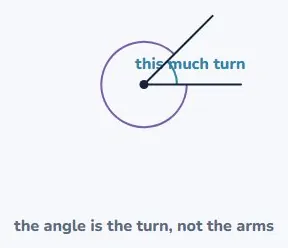
All the way round is 360°
- Turn until you face where you started. That is a full turn.
- A full turn is 360 degrees.
- People picked 360 a very long time ago, and it stuck.
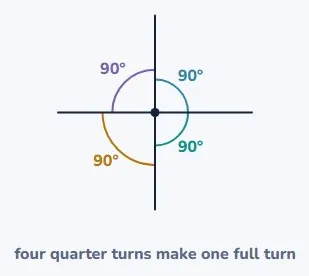
Halve it, then halve it again
- Half a turn is 180°: you face the opposite way.
- Half of that is a quarter turn: 90°.
- One fact, halved twice. Not three facts.
| turn | degrees | what it looks like |
|---|---|---|
| a full turn | 360 degrees | all the way round, back where you started |
| a half turn | 180 degrees | facing the opposite way |
| a quarter turn | 90 degrees | a right angle, the corner of a square |
A quarter turn is a right angle
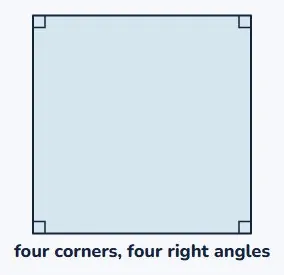
- A quarter turn has its own name: a right angle.
- You mark it with a little square, not a curve.
- Every rectangle and every square has four of them.
Try it: measure the turn
Common mistakes
- A half turn is 90°.A full turn is 360°, so a half turn is 180° and a quarter turn is 90°.
- 1 hour 30 minutes is 1.30 hours, or 130 minutes.Clocks count in sixties: 1 hour is 60 minutes, so 1 hour 30 minutes is 60 + 30 = 90 minutes.
- The long hand points at the 3, so it is 3 minutes past.The long hand shows minutes, and each number is 5 minutes, so pointing at the 3 means 15 minutes past.
- The film lasts 1 hour 42 minutes, so it starts at 1:42.1 hour 42 minutes is how long it takes (a duration), not a time on the clock.
Your turn: estimate this one
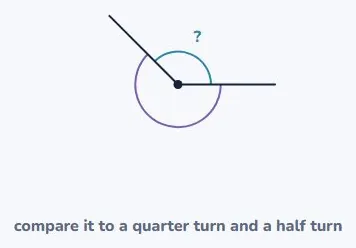
A clock's long hand turns from the 12 to halfway between the 4 and the 5. Is that bigger or smaller than a quarter turn?
A clock's long hand turns from the 12 to halfway between the 4 and the 5. Is that bigger or smaller than a half turn?
A clock's long hand turns from the 12 to halfway between the 4 and the 5. Roughly how many degrees is that turn?
Show answer
1. Bigger than a quarter turn. A quarter turn of the long hand only reaches the 3, and this turn goes past it. 2. Smaller than a half turn. A half turn takes the long hand to the 6, and this turn stops before it. 3. About 135°. It is more than a quarter turn (90°) and less than a half turn (180°), about halfway between.
A clock is a turning machine
- The hands do one thing. They turn.
- So everything about turns is about to tell you the time.
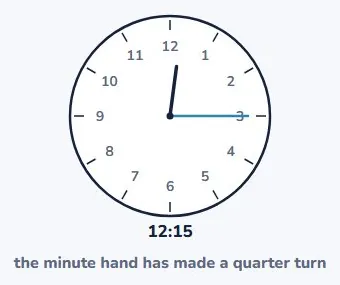
- A quarter turn of the long hand: 90° AND 15 minutes.
Clocks count in sixties
- Almost everything you measure counts in tens.
- Clocks do not. Sixty, then sixty, then twenty-four.
- Nobody is being difficult; clocks are just old.
| how many | of these | make |
|---|---|---|
| 60 | seconds | a minute |
| 60 | minutes | an hour |
| 24 | hours | a day |
Reading the hands
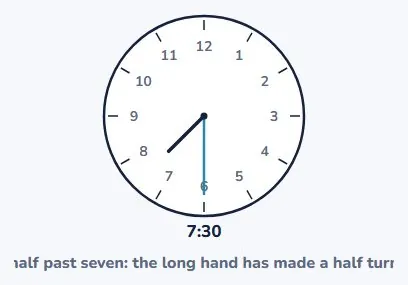
- Short hand: the hour. Long hand: the minutes.
- The long hand moving one small mark is one minute.
- A digital clock has already done that reading for you.
Try it: read the clock
A time is a point
- A time says how far past midnight you are.
- 7:30 in the morning is 7 hours and 30 minutes since midnight.
- It is the moment you arrive at. Not how long anything took.
| the clock says | how far past midnight |
|---|---|
| 7:30 in the morning | 7 hours and 30 minutes |
| 12:00 noon | 12 hours |
| 9:45 in the morning | 9 hours and 45 minutes |
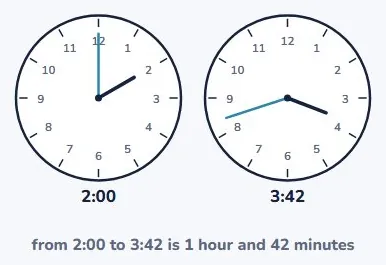
How long is a different number
- How long something takes is called a duration.
- A film lasting 1 hour 42 minutes does not start at 1:42.
- That is a length, not a place on the clock.
Your turn: fill in the other side
90 seconds is how many minutes? (60 seconds make a minute)
48 hours is how many days? (24 hours make a day)
3 weeks is how many days?
Show answer
1. 1½ minutes: 60 seconds is 1 minute and the other 30 seconds is half a minute. 2. 2 days, because 24 + 24 = 48. 3. 21 days: a week is 7 days, and 3 × 7 = 21.
Turns, angles and time
- One fact about turns, halved twice.
- A clock turns too, and counts in sixties.
- A point in time is not how long something took.
| thing | what to remember |
|---|---|
| an angle | an amount of turn, not a corner |
| a full turn | 360° |
| a half turn | 180°, facing the opposite way |
| a quarter turn | 90°, a right angle |
| estimating | compare it to 90° and 180° |
| a clock | a turning machine that counts in 60s |
| a time | how far past midnight (a point) |
| a duration | how long it took (a length) |
Challenge
A robot faces the door. It turns 90° clockwise. Then it turns 180° clockwise. Then it turns 180° clockwise again. How far has it turned altogether? How much more must it turn clockwise to face the door again?
Hint
Add up the turns. Then take away a full turn of 360°. Where does that leave the robot?
Answer
450° altogether. It must turn 270° more clockwise.
Step by step
- Add the three turns: 90 and 180 and 180 is 450°.
- A full turn is 360°, which brings it back to the door.
- 450° is one full turn and 90° more.
- So the robot is a quarter turn clockwise from the door.
- To get back round to the door, it needs the rest of a full turn: 360 − 90 = 270°.
Full working
- 90 + 180 + 180 = 450°add the turns
- 450 − 360 = 90°take off one full turn
- the robot is a quarter turn past the door90° is a right angle
- 360 − 90 = 270°the rest of the turn
- 450° altogether; 270° more
Mere runs 3 laps of the field. Each lap takes her 1 minute 40 seconds. She starts when the clock says 9:58. What does the clock say when she finishes?
Hint
Add up the seconds first. How many seconds make a minute?
Answer
10:03 (she runs for 5 minutes)
Step by step
- Three laps is 3 minutes and 3 lots of 40 seconds.
- 3 lots of 40 seconds is 120 seconds.
- 60 seconds is a minute, so 120 seconds is 2 minutes.
- So she runs for 3 + 2 = 5 minutes.
- 2 minutes after 9:58 is 10:00, then 3 more minutes is 10:03.
Full working
- 3 × 1 minute = 3 minutesthe minutes
- 3 × 40 = 120 secondsthe seconds
- 120 seconds = 2 minutes60 seconds in a minute
- 3 + 2 = 5 minutesthe whole run
- 9:58 + 2 minutes = 10:00count on to the hour
- 10:00 + 3 minutes = 10:03the rest
- 10:03
At 12 o'clock both hands of a clock point at the 12. Later, the short hand points exactly at the 3. How far has the short hand turned? How far has the long hand turned in the same time?
Hint
How long does the short hand take to move from 12 to 3? What does the long hand do every hour?
Answer
The short hand turned 90°. The long hand turned 1080° (3 full turns).
Step by step
- 12 to 3 is a quarter of the way round, so the short hand turned 90°, a right angle.
- The short hand takes 1 hour to move from one number to the next, so 12 to 3 takes 3 hours.
- The long hand goes all the way round once every hour.
- So in 3 hours it makes 3 full turns.
- 3 full turns is 360 + 360 + 360 = 1080°.
Full working
- 12 to 3 = a quarter turn = 90°the short hand
- 12 to 3 on the short hand = 3 hoursone number each hour
- 1 hour = 1 full turn of the long hand360°
- 3 × 360 = 1080°3 hours
- short hand 90°; long hand 1080°