Perimeter, area and volume
What this lesson covers
- Volume is a measure of regions in three-dimensional space.
- The areas of rectangles (including squares) can be calculated by multiplication of side lengths.
Three questions, one shape
- How far is it around the edge? That is perimeter.
- How much would cover it? That is area.
- How much would fill it? That is volume.
| the question | its name | what you count |
|---|---|---|
| how far around the edge? | perimeter | lengths (cm) |
| how much to cover it? | area | squares |
| how much to fill it? | volume | cubes |
Perimeter: walk around the edge
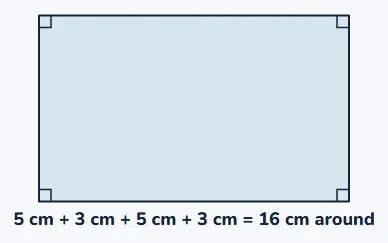
- Start at a corner and walk all the way round.
- Add up every side you walk along.
- 5 and 3 and 5 and 3 is 16 cm.
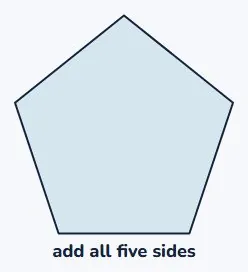
It works for any shape
- Perimeter is not a rectangle rule.
- Any shape at all: add up all the sides.
- Five sides, six sides, it does not matter.
Area: cover it and count
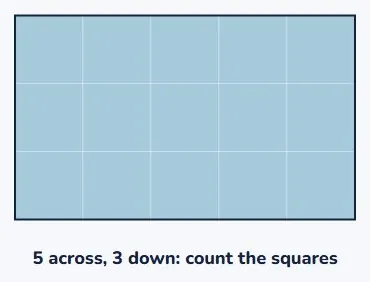
- Area asks how much it takes to cover the shape.
- So cover it in squares and count them.
- This one holds 15 squares.
Multiplying counts them faster
- There are 3 rows, and 5 squares in each row.
- 3 rows of 5 is exactly what 3 × 5 means.
- So multiplying is not a new rule. It is faster counting.
| step | what you do |
|---|---|
| cover it | 3 rows of 5 squares |
| count them | 5, 10, 15 |
| or just multiply | 3 × 5 = 15 squares |
Wobbly shapes: count half squares too
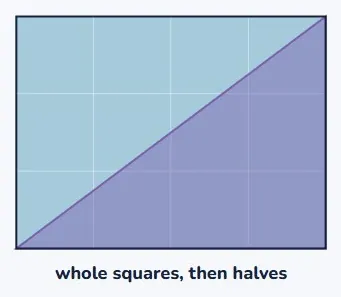
- Not everything is a rectangle.
- Count the whole squares first.
- Then pair up the half squares: two halves make one.
Same perimeter, different area
- All three of these have a perimeter of 16 cm.
- But their areas are 15, 12 and 16 squares.
- So they really are different questions.
| rectangle | perimeter | area |
|---|---|---|
| 5 cm by 3 cm | 16 cm | 15 squares |
| 6 cm by 2 cm | 16 cm | 12 squares |
| 4 cm by 4 cm | 16 cm | 16 squares |
Try it: same area, different fence
Volume: fill it with cubes
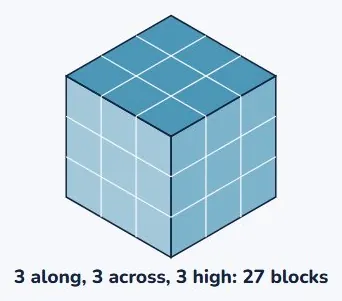
- Volume is about space inside, not surface.
- Fill the box with identical blocks and count them.
- Same idea as area, one dimension further.
Count it in layers
- Do the bottom layer first: 3 by 3 is 9 blocks.
- Then see how many layers high it is. Three.
- 9 in a layer, 3 layers, so 27 blocks.
| step | count |
|---|---|
| one layer | 3 × 3 = 9 blocks |
| how many layers | 3 |
| altogether | 27 blocks |
Try it: count it in layers
Try it: round, cover or fill?
Common mistakes
- The perimeter of a 5 cm by 3 cm rectangle is 5 + 3 = 8 cm.Walk all the way round and add every side: 5 + 3 + 5 + 3 = 16 cm.
- These two rectangles have the same perimeter, so they have the same area.5 cm by 3 cm and 6 cm by 2 cm both have a 16 cm perimeter, but their areas are 15 and 12 squares.
- The wobbly shape has 10 whole squares and 4 half squares, so its area is 14 squares.Two halves make one whole, so 4 half squares are 2 squares: the area is 10 + 2 = 12 squares.
- The box is 3 by 3 by 3, so it holds 9 blocks.9 blocks is just one layer; there are 3 layers, so it holds 9 × 3 = 27 blocks.
Your turn
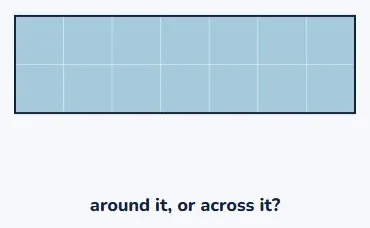
A rectangle is 7 cm by 2 cm. What is its perimeter?
A rectangle is 7 cm by 2 cm. What is its area?
A box holds 5 blocks in each layer and is 3 layers high. How many blocks fill it?
A triangle has sides of 5 cm, 4 cm and 6 cm. What is its perimeter?
A wobbly shape covers 6 whole squares and 4 half squares. What is its area?
Show answer
1. 18 cm: walk all the way round, 7 + 2 + 7 + 2 = 18. 2. 14 squares: 2 rows of 7 squares, and 7 × 2 = 14. 3. 15 blocks: 5 in a layer and 3 layers, so 5 × 3 = 15. 4. 15 cm: add up every side, 5 + 4 + 6 = 15. 5. 8 squares: the 4 halves pair up into 2 wholes, and 6 + 2 = 8.
Area Builder
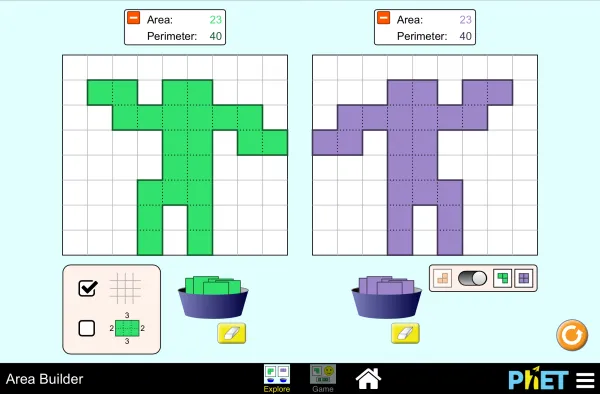
Full screen · PhET Interactive Simulations, University of Colorado Boulder, CC BY 4.0
Around, across, inside
- Perimeter goes round the edge: add the sides.
- Area covers it: count squares, or multiply.
- Volume fills it: count cubes, layer by layer.
| question | what to do |
|---|---|
| how far around? | perimeter: add every side |
| how much to cover? | area: count the squares |
| a rectangle | area = rows × squares in a row |
| a wobbly shape | count wholes, then pair the halves |
| how much to fill? | volume: count the cubes |
| a box | one layer, then how many layers |
Challenge
Kiri has a card 6 cm long and 4 cm wide. She cuts a 2 cm by 2 cm square out of one corner. Does the perimeter get bigger, smaller or stay the same? What about the area?
Hint
Draw it. Walk round the new shape and add up every side, even the two new short ones.
Answer
The perimeter stays 20 cm. The area goes down from 24 squares to 20 squares.
Step by step
- Before the cut, the perimeter is 6 + 4 + 6 + 4 = 20 cm and the area is 6 × 4 = 24 squares.
- The cut takes 2 cm off the top edge and 2 cm off the side edge.
- But it makes two new edges inside the notch, each 2 cm long.
- So 4 cm is lost and 4 cm is gained: the perimeter is still 20 cm.
- The area loses the 4 squares that were cut out, so it is 20 squares.
Full working
- 6 + 4 + 6 + 4 = 20 cmperimeter before
- 6 × 4 = 24 squaresarea before
- 6 + 2 + 2 + 2 + 4 + 4 = 20 cmwalk round the new shape
- 2 × 2 = 4 squares cut outthe corner square
- 24 − 4 = 20 squaresarea after
- Perimeter stays 20 cm; area goes down to 20 squares
A garden is a rectangle 4 m long and 3 m wide. Hemi lays a path all the way round it, 1 m wide, using square paving stones that are 1 m on each side. The corners of the path are filled in too. How many paving stones does he need?
Hint
Think of the garden and the path together as one big rectangle. How long and wide is it?
Answer
18 paving stones
Step by step
- The path adds 1 m on every side.
- So the garden and path together make a rectangle 6 m long and 5 m wide.
- That big rectangle holds 6 × 5 = 30 squares.
- The garden in the middle holds 4 × 3 = 12 squares.
- The path is what is left: 30 − 12 = 18 stones.
Full working
- 4 + 1 + 1 = 6 mlong side with the path at both ends
- 3 + 1 + 1 = 5 mshort side with the path at both ends
- 6 × 5 = 30 squaresgarden and path together
- 4 × 3 = 12 squaresthe garden only
- 30 − 12 = 18the path
- 18 paving stones
Tama builds a big cube from small blocks. It is 4 blocks long, 4 blocks wide and 4 blocks high. He dips the whole big cube in paint. Then he pulls it apart. How many small blocks have no paint on them at all?
Hint
Paint only touches blocks on the outside. Take away the outside layer all round. What shape is left in the middle?
Answer
8 blocks
Step by step
- A block with no paint is not on the top, bottom or any side.
- Take away the outside blocks: one from each end of every row.
- That leaves 2 blocks long, 2 blocks wide and 2 blocks high in the middle.
- Count it in layers: 2 × 2 = 4 in a layer, and 2 layers.
- So 8 blocks have no paint.
Full working
- 4 × 4 = 16 blocks in a layer, 4 layers64 blocks in all
- 4 − 1 − 1 = 2take off the outside at each end
- inside cube: 2 by 2 by 2hidden from the paint
- 2 × 2 = 4 blocks in a layerbottom layer of the inside
- 4 × 2 = 82 layers
- 8 blocks have no paint