Regular shapes and lines of symmetry
What this lesson covers
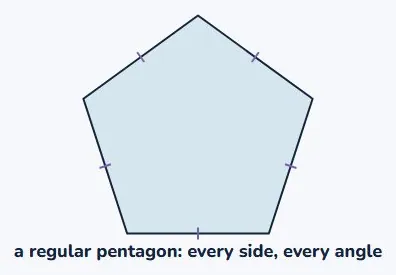
- A regular polygon is a two-dimensional shape with all sides of equal length and all interior angles of equal measure.
- Circles have an infinite number of lines of symmetry.
- Shapes may appear different when viewed from a different perspective.
What "regular" means
- All the sides the same length.
- AND all the angles the same size.
- Both. Miss either one and it is irregular.
Irregular does not mean messy
- A rectangle is perfectly tidy. It is still irregular.
- Its angles all match, but its sides do not.
- You need both to be regular.
| shape | what it has | so it is |
|---|---|---|
| square | 4 equal sides, 4 equal angles | regular |
| rectangle | 4 equal angles, but 2 long and 2 short | irregular |
| equilateral triangle | 3 equal sides, 3 equal angles | regular |
| isosceles triangle | only 2 sides equal | irregular |
Counting edges, corners and angles
- Edges are the straight sides.
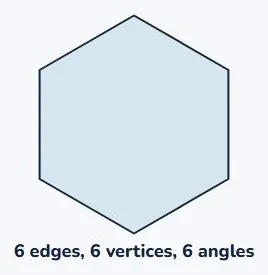
- Vertices are the corners where two edges meet.
- A polygon always has the same number of each.
A line of symmetry is a fold
- Imagine folding the shape along a line.
- If the two halves land exactly on each other, it is a mirror line.
- If anything sticks out, it is not.
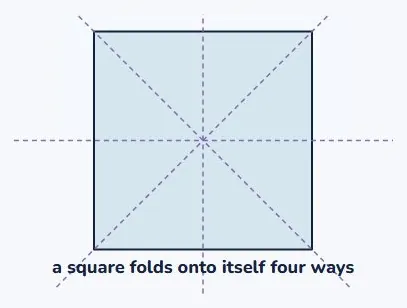
A regular shape: as many lines as sides
- Every side and every corner is interchangeable.
- So you can fold through any corner, and any side middle.
- Triangle 3, square 4, pentagon 5. Count the sides.
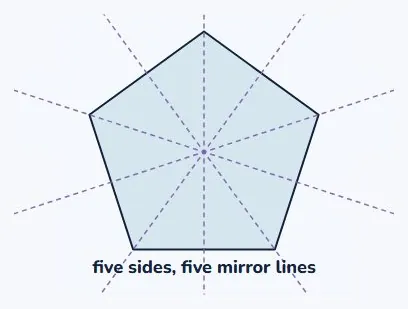
Try it: count the mirror lines
Six sides, six lines
- Three go corner to corner.
- Three go through the middles of opposite sides.
- Six sides, six lines. The rule keeps working.
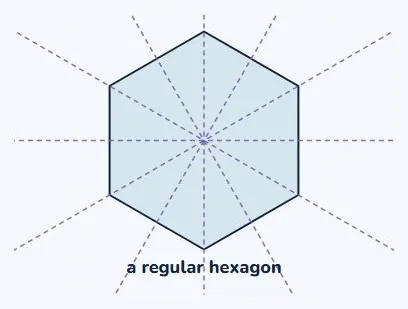
The pattern, and where it ends up
- More sides, more mirror lines. Always equal.
- So what about a circle, which has no straight sides?
- It never runs out. Infinitely many.
| shape | sides | lines of symmetry |
|---|---|---|
| equilateral triangle | 3 | 3 |
| square | 4 | 4 |
| regular pentagon | 5 | 5 |
| regular hexagon | 6 | 6 |
| circle | no straight sides at all | infinitely many |
An irregular shape has fewer
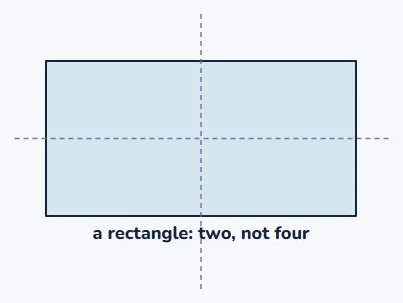
- A rectangle has only 2, not 4.
- Across the middle each way, and that is all.
- Fold it along a diagonal and the corners miss.
And some have none at all
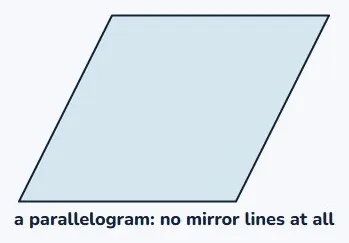
- A parallelogram looks like it should be symmetrical.
- It is not. There is no fold that works.
- Looking symmetrical and being symmetrical are different.
Try it: regular or irregular?
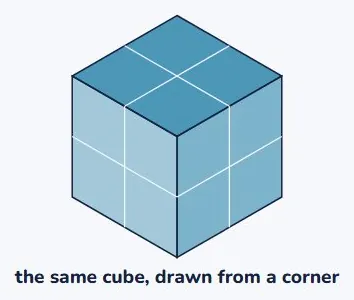
A drawing of a solid is always a bit of a lie
- Look at a cube straight on and you see a square.
- Turn it slightly and you see three faces at once.
- Same cube. Completely different drawing.
Common mistakes
- A rectangle is neat and tidy, so it is regular.Regular needs all sides the same AND all angles the same; a rectangle has 2 long and 2 short sides, so it is irregular.
- A rectangle has 4 lines of symmetry, like a square.A rectangle has only 2: across the middle each way. Fold it along a diagonal and the corners miss.
- A parallelogram has a line of symmetry down the middle.Try folding it: no fold makes the halves land on each other, so a parallelogram has none.
- A regular hexagon has 3 lines of symmetry, corner to corner.It has 6: three go corner to corner and three go through the middles of opposite sides.
Your turn
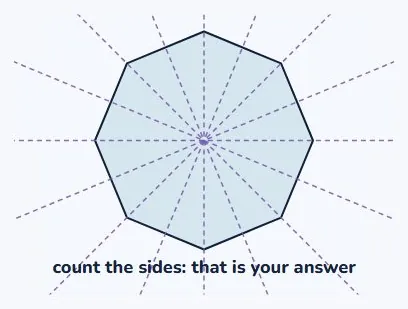
How many lines of symmetry does a regular octagon have?
A rhombus has 4 equal sides but is not a square. Is it a regular shape?
How many lines of symmetry does an equilateral triangle have?
How many lines of symmetry does a rectangle that is not a square have?
Which of these shapes is always regular?
Show answer
1. 8 lines. A regular shape has as many lines of symmetry as it has sides, and an octagon has 8 sides. 2. No. Its sides all match but its angles do not, and regular needs both. 3. 3 lines. It is regular with 3 sides, so it has 3 mirror lines, one through each corner. 4. 2 lines, across the middle each way. Fold it along a diagonal and the corners miss. 5. A square: all 4 sides are equal and all 4 angles are equal.
Regular shapes and mirrors
- Regular means all sides AND all angles equal.
- A regular shape has as many mirror lines as sides.
- A circle never runs out of either.
| idea | what to remember |
|---|---|
| regular | all sides equal AND all angles equal |
| irregular | tidy is not the same as regular |
| a mirror line | a fold where the halves match exactly |
| a regular n-gon | n sides, n lines of symmetry |
| a rectangle | only 2, not the diagonals |
| a circle | infinitely many |
Challenge
Tia has a paper regular hexagon. She folds it along every one of its lines of symmetry, opening it out after each fold, so the fold lines all cross in the middle. Then she cuts along every fold line. How many pieces does she get?
Hint
First work out how many lines of symmetry a regular hexagon has. Each fold line goes right across the shape, so it makes two spokes from the middle.
Answer
12 pieces
Step by step
- A regular hexagon has 6 sides, so it has 6 lines of symmetry.
- Every line goes through the middle and right across the shape.
- So each line makes 2 spokes from the middle, one on each side.
- 6 lines make 12 spokes, and the spokes cut the hexagon into 12 pieces, like slices of a pizza.
Full working
- 6 sides → 6 lines of symmetrya regular shape has as many lines as sides
- each line = 2 spokes from the middlea line goes right across
- 6 × 2 = 12 spokesall the fold lines
- 12 spokes → 12 slicesone slice between each pair of spokes
- 12 pieces
Mere puts 3 equal squares in a row to make a long rectangle. How many lines of symmetry does it have? She moves the end square so the shape makes an L, with the squares still touching side to side. How many lines of symmetry now? Where can she add a 4th square to get a shape with 4 lines of symmetry?
Hint
For the L, try folding along a line that goes through the corner square from corner to corner.
Answer
The row has 2 lines. The L has 1 line. Adding the 4th square in the gap of the L makes a big square with 4 lines.
Step by step
- The row of 3 squares is a rectangle, so it has 2 lines: one across the middle each way.
- The L has two arms of the same length, one going up and one going across.
- Fold along the diagonal of the corner square and the two arms land on each other. That is its only line.
- Put the 4th square in the gap inside the L. Now there are 2 rows of 2 squares, which is a big square.
- A square is regular with 4 sides, so it has 4 lines of symmetry.
Full working
- row of 3 squares = rectangle2 lines, across the middle each way
- L shape: arms of equal lengththey match when folded
- fold on the diagonal of the corner squarethe only fold that works
- add the 4th square in the gap of the L2 rows of 2
- big square: 4 linesa regular shape with 4 sides
- row 2, L 1, add the 4th square in the gap to get 4
Kahu and Hemi each hold a solid. Looking straight down from above, the outline of Kahu's solid is a circle, and looking at it from the front, its outline is a triangle. Looking straight down from above, the outline of Hemi's solid is a square, and from the front and from the side its outline is a triangle. Name each solid. How many lines of symmetry does each top view have?
Hint
Think of a party hat, and the roof of a tent with a square floor.
Answer
Kahu has a cone, and its top view (a circle) has infinitely many lines. Hemi has a square-based pyramid, and its top view (a square) has 4 lines.
Step by step
- A solid with a round base that comes up to a point looks like a circle from the top.
- From the front its sloping sides make a triangle. That is a cone, like a party hat.
- A solid with a square base that comes up to a point looks like a square from the top.
- From the front and from the side it looks like a triangle. That is a square-based pyramid.
- A circle has infinitely many lines of symmetry. A square, a regular shape with 4 sides, has 4.
Full working
- top: circle, front: triangleround base, comes to a point
- Kahu: conelike a party hat
- top: square, front and side: trianglessquare base, comes to a point
- Hemi: square-based pyramidlike a tent with a square floor
- circle → infinitely many lines, square → 4 linestop views
- cone (infinitely many), square-based pyramid (4)