Flips, slides, turns and grid maps
What this lesson covers
- A reflection is when a shape is flipped over a line, creating a mirror image.
- A translation is when a shape is slid from one place to another without being turned.
- A rotation is when a shape is turned around a fixed point.
- An alphanumeric grid reference is a system that divides a map into labelled rows (letters) and columns (numbers), so that each square can be identified by combining a letter and a number (e.g. A1, B2).
Three ways to move a shape
- You can flip it over a line.
- You can slide it somewhere else.
- Or you can turn it around a point.
| everyday word | proper word | what happens |
|---|---|---|
| flip | reflection | mirrored over a line |
| slide | translation | moved, still facing the same way |
| turn | rotation | turned about a fixed point |
The shape itself never changes
- Same side lengths. Same angles. Same size.
- Only where it is, or which way it faces.
- If your answer is bigger or squashed, something went wrong.
| does this change? | |
|---|---|
| the side lengths | never |
| the angles | never |
| where it is | yes |
| which way it faces | for a flip or a turn |
A flip is a mirror
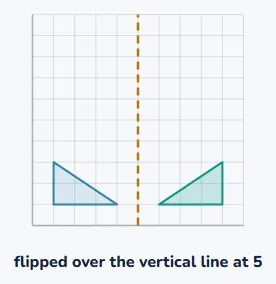
- Put a mirror line down the middle.
- Every corner hops to the other side, the same distance.
- The triangle is now facing the other way.
Look at which way it points
- The long leg pointed right. Now it points left.
- That is how you know it was flipped and not slid.
- A flip turns the shape back to front.
A slide keeps it facing the same way
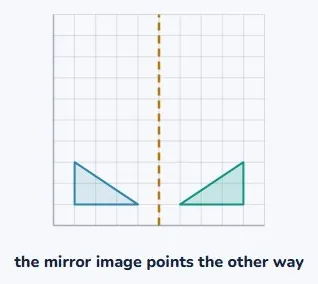
- Move every corner the same distance, the same direction.
- Here: 4 squares right and 3 up.
- It still points exactly the way it did before.
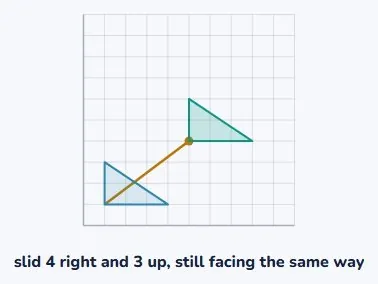
So a flip and a slide are different
- Both moved the triangle. Only one turned it around.
- Check which way the long side points.
- Same way: a slide. Other way: a flip.
| after a... | the shape faces |
|---|---|
| slide | exactly the same way |
| flip | back to front |
| turn | a different way round |
A turn goes around a fixed point
- Pick a point and pin the shape there.
- Turn it a quarter turn (90 degrees).
- The pin stays still. Everything else swings round.
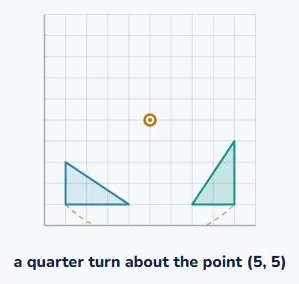
Try it: flip, slide and turn
Saying where something is
- One direction is labelled with letters, the other with numbers.
- Every square then has its own name.
- Letter first, then number. Always.
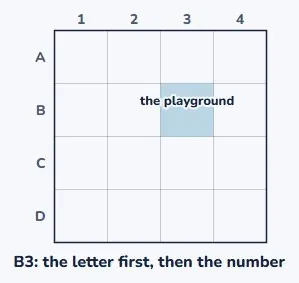
Why the order matters
- B3 and 3B would be different squares.
- Everyone has agreed: the letter comes first.
- A rule only helps if we all use the same one.
| reference | means |
|---|---|
| A1 | the letter A, then the number 1 |
| B3 | the letter B, then the number 3 |
| D2 | the letter D, then the number 2 |
Try it: find the point
Common mistakes
- The shape moved and now it points the other way, so it was a slide.A slide keeps the shape facing the same way; if it is back to front, it was a flip.
- I flipped the triangle and it came out a bit bigger.Flips, slides and turns never change the size, sides or angles; only where the shape is, or which way it faces.
- The square in column B, row 3 is called 3B.Say the letter first, then the number: B3. Everyone uses the same order so we all mean the same square.
- When I flip a shape, each corner goes 1 square past the mirror line.Each corner lands the same distance from the mirror line on the other side as it started.
Your turn
A shape is slid 3 squares to the right. Does it now face a new way?
What is a flip properly called?
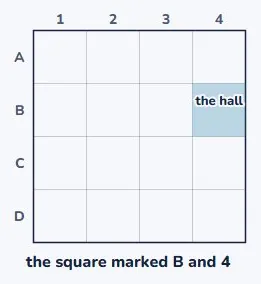
The hall is in the square with the letter B and the number 4. What is its grid reference?
Mia slides a square 2 squares left and 1 up. Which is true?
A triangle is pinned at one corner and turned a quarter turn. What is this move called?
Show answer
1. No, a slide keeps it facing the same way. Facing a new way is what a flip or a turn does. 2. A reflection: the shape is mirrored over a line. 3. B4: the letter is always written first, then the number. 4. Its sides and angles stay the same. A slide only changes where the shape is. 5. A rotation: the shape turns around a fixed point and the pin stays still.
Moving shapes, and finding places
- Flip, slide and turn never change the shape itself.
- Which way it points tells you which one happened.
- On a grid map, the letter always comes first.
| idea | what to remember |
|---|---|
| a flip | a reflection (mirrored over a line) |
| a slide | a translation (same way up) |
| a turn | a rotation (around a fixed point) |
| all three | same size, same angles, every time |
| telling them apart | look at which way it points |
| a grid reference | letter first, then number |
Challenge
On a grid map the columns are A to F from left to right, and the rows are 1 to 6 from bottom to top. A toy robot starts in square B2. It slides 3 squares right and 2 squares up. Then it slides 1 square left and 1 square up. Which square is it in now? What one slide would have taken it straight there?
Hint
Move the letter for the left and right slides, and the number for the up and down slides.
Answer
D5. One slide of 2 squares right and 3 squares up.
Step by step
- 3 squares right from column B is column E. 2 squares up from row 2 is row 4. The robot is in E4.
- 1 square left from E is D. 1 square up from 4 is 5. The robot is in D5.
- Altogether it went 3 right and 1 left, which is 2 right.
- It went 2 up and 1 up, which is 3 up.
- So one slide of 2 right and 3 up goes from B2 straight to D5.
Full working
- B2 → E43 right (B, C, D, E) and 2 up (2, 3, 4)
- E4 → D51 left and 1 up
- 3 − 1 = 2 rightleft and right together
- 2 + 1 = 3 upup together
- check: B2, 2 right is D, 3 up is 5D5
- D5, one slide of 2 right and 3 up
Use the same grid: columns A to F from left to right, rows 1 to 6 from bottom to top. A mirror line runs up the grid between columns C and D. A counter in square A3 is flipped in this mirror line. Then the new counter is flipped in a second mirror line that runs across the grid between rows 4 and 5. Which square does it end up in?
Hint
Count how many squares the counter is from the mirror line. Its reflection lands the same number of squares away on the other side.
Answer
F6
Step by step
- A3 is 3 columns away from the first mirror line: A, B and C.
- Its reflection is 3 columns away on the other side: D, E and F. So it lands in F3.
- F3 is 2 rows below the second mirror line: rows 3 and 4.
- Its reflection is 2 rows above that line: rows 5 and 6. So it lands in F6.
Full working
- A3: 3 columns left of the line (A, B, C)first flip
- 3 columns right of the line (D, E, F) → F3same distance on the other side
- F3: 2 rows below the line (3, 4)second flip
- 2 rows above the line (5, 6) → F6same distance on the other side
- F6
An arrow on a card points up. Mia gives the card a quarter turn clockwise. Then she flips it in a mirror line that runs straight up and down. Then she gives it a half turn. Which way does the arrow point now? What is the smallest single turn that would make the arrow point the same way?
Hint
Follow the arrow one move at a time. A mirror that runs up and down swaps left and right.
Answer
It points right. A quarter turn clockwise makes it point the same way.
Step by step
- It starts pointing up.
- A quarter turn clockwise makes it point right.
- A mirror line that runs up and down swaps right and left, so now it points left.
- A half turn turns it to face the opposite way, so now it points right.
- From up to right is one quarter turn clockwise.
Full working
- start: upthe arrow on the card
- quarter turn clockwise: up → righta turn
- flip in an up and down mirror: right → lefta flip swaps left and right
- half turn: left → rightopposite way
- up → right in one movea quarter turn clockwise
- points right; a quarter turn clockwise