Variables: sorting, counting and measuring
What this lesson covers
- A variable is an attribute or measurement of the people or objects being studied: categorical variables classify objects or individuals into groups discrete numerical variables are counted continuous numerical variables are measured.
A variable is a question you ask everyone
- Go round the class: "what is your favourite fruit?"
- That question is the variable.
- The answers VARY from person to person. Hence the name.
| person | favourite fruit |
|---|---|
| Aria | apple |
| Tane | feijoa |
| Sam | apple |
| Mia | banana |
Sort, count, or measure?
- Favourite fruit: you sort people into groups.
- Number of pets: you count.
- How tall you are: you measure.
| the question | what you do | what it is called |
|---|---|---|
| what is your favourite fruit? | sort into groups | categorical |
| how many pets have you got? | count them | discrete |
| how tall are you? | measure it | continuous |
Try it: sort, count or measure?
The proper names
- Sorting into groups: categorical.
- Counting: discrete. Measuring: continuous.
- But the action is what matters, not the word.
| if you... | the variable is |
|---|---|
| sort into groups | categorical |
| count whole things | discrete |
| measure with a tool | continuous |
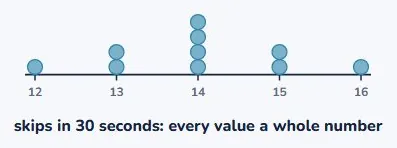
Counting gives an exact answer
- You did 14 skips. Exactly 14.
- There is no such thing as 14 and a half skips.
- Counted things land on whole numbers.
Measuring never quite does
- How long did the 1000 m run take?
- It depends entirely on your stopwatch.
- A better one would give you more digits. Forever.
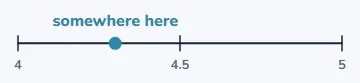
So a measurement gets rounded
- You have to stop somewhere and write a number down.
- Where you stop depends on what you are measuring.
- That choice is part of collecting the data properly.
| data | counted or measured? | how exact |
|---|---|---|
| 14 skips | counted | exactly 14, no halves |
| 3 pets | counted | exactly 3 |
| 132 cm tall | measured | to the nearest cm |
| 4 minutes 12 s | measured | to the nearest second |
Round to something sensible
- Heights to the nearest centimetre. Not millimetre.
- A run to the nearest second, not the nearest minute.
- Too rough loses information. Too fine is pretending.
| measuring | round to | but not |
|---|---|---|
| your height | the nearest cm | not the nearest mm |
| a 1000 m run | the nearest second | not tenths of a second |
| a walk to school | the nearest minute | not the nearest second |
Collecting it properly
- Ask everyone the same question, the same way.
- Use the same tool and the same rounding for everyone.
- Otherwise you are not comparing like with like.
| do this | not this |
|---|---|
| same question for everyone | changing the wording halfway |
| same tool every time | a ruler for some, a tape for others |
| same rounding | some to the cm, some to the mm |
Try it: turn counts into a graph
Common mistakes
- Number of pets is measured, so it is continuous.You count pets in whole numbers, so number of pets is discrete; you measure height, so height is continuous.
- Tane is 132.47 cm tall.Round heights to the nearest centimetre, 132 cm; tiny parts of a centimetre are just pretending to be exact.
- I timed some runs to the nearest second and some to the nearest minute.Use the same tool and the same rounding for everyone, or you are not comparing like with like.
- Favourite fruit is a number, because I counted how many said apple.Favourite fruit sorts people into groups, so it is categorical; the count comes after you sort them.
Your turn: sort, count or measure?
"How many brothers and sisters have you got?" Do you sort, count or measure?
"What colour are your eyes?" Do you sort, count or measure?
"How heavy is your school bag?" Do you sort, count or measure?
Wiremu measures how tall everyone in his class is. What should he round each height to?
Aroha counts how many skips she does in 30 seconds. Which answer could she get?
Show answer
1. Count (discrete): the answer is always a whole number. 2. Sort (categorical): you put people into groups, with no counting or measuring. 3. Measure (continuous): it needs rounding, sensibly to the nearest hundred grams. 4. The nearest centimetre. The nearest millimetre is too fine and the nearest metre loses information. 5. 21 skips. Counting gives an exact whole number; there is no such thing as half a skip.
Variables and data
- A variable is the question you ask everyone.
- Sort, count, or measure: that tells you the kind.
- Counting is exact. Measuring always needs rounding.
| idea | what to remember |
|---|---|
| a variable | the question you ask everybody |
| sorting | categorical (groups) |
| counting | discrete (exact whole numbers) |
| measuring | continuous (needs rounding) |
| how much rounding | whatever suits what you are measuring |
| fair data | same question, same tool, same rounding |
Challenge
Are these questions sort, count or measure? (a) How many letters are in your first name? (b) How long is your hair? (c) What number is on the back of your sports team shirt? Be careful: (c) has a number for an answer.
Hint
Ask what you actually DO to get each answer. For (c), does the shirt number tell you how many of anything there are?
Answer
(a) Count, so discrete. (b) Measure, so continuous. (c) Sort, so categorical: the shirt number is just a name for a player.
Step by step
- (a) You count the letters, and you always get a whole number. That is discrete.
- (b) You measure hair with a ruler, so it needs rounding. That is continuous.
- (c) Nobody counts or measures anything. The number on a shirt is a label, like a name.
- Player 10 is not twice as much as player 5, so the numbers are just names for groups.
- So shirt number is categorical, even though the answers look like numbers.
Full working
- letters in your name: countdiscrete
- length of hair: measurecontinuous
- shirt number: a label, sort into groupscategorical
- (a) discrete, (b) continuous, (c) categorical
Room 7 measures heights. Aria uses a tape and writes 134 cm, to the nearest centimetre. Mia uses a tape and writes 131 cm, to the nearest centimetre. Sam uses a strip marked every 10 cm and writes 130 cm, to the nearest 10 cm. Who is the tallest? Can you be sure?
Hint
If Sam's height is 130 cm to the nearest 10 cm, what is the shortest he could be? The tallest?
Answer
You cannot be sure. Aria is taller than Mia, but Sam could be anywhere from 125 cm up to just under 135 cm, so he might be the tallest or the shortest. Sam must be measured again with a tape to the nearest centimetre.
Step by step
- Aria 134 cm and Mia 131 cm were measured the same way, so Aria is taller than Mia.
- Sam was rounded to the nearest 10 cm, which is much rougher.
- Any height from 125 cm up to just under 135 cm rounds to 130 cm.
- That range is shorter than Mia and also could be taller than Aria.
- The data was not collected the same way, so it cannot be compared fairly until Sam is measured again.
Full working
- Aria 134 cm > Mia 131 cmsame tool, same rounding
- Sam: 130 cm to the nearest 10 cmrougher rounding
- 125 cm up to just under 135 cm rounds to 130 cmthe possible heights
- 125 < 131 and 134 < 135he could be shortest or tallest
- Not sure: measure Sam again to the nearest cm
Kiri has two lists about the same 6 pea pods. List P: 5, 7, 6, 8, 6, 7. List Q: 6, 8, 7, 9, 7, 8. One list is the number of peas in each pod. The other is the length of each pod in cm, rounded to the nearest cm. Can you tell which is which from the numbers? Then Kiri measures again to the nearest half centimetre, and one list changes to 6, 7½, 7, 8½, 7, 8. Which list was it? Explain why the other list could never change like that.
Hint
Can a rounded measurement look like a whole number? Can you count half a pea?
Answer
From the first lists you cannot tell, because lengths rounded to the nearest cm are whole numbers too. The list that changed is Q, so Q is the pod lengths. List P is the number of peas: counting is exact, so recounting more carefully gives the same whole numbers.
Step by step
- Counted data is always a whole number.
- Measured data rounded to the nearest cm also looks like whole numbers, so both lists look alike.
- Measuring more finely can give halves, and only measured data can change that way.
- So the list that changed, Q, is the lengths.
- P is the count of peas: a pod has exactly 5 or 6 peas, never 5 and a half.
Full working
- P and Q are both whole numbersrounding hides the measuring
- cannot tell yetcounts and rounded lengths look the same
- new list has 7½ and 8½only measuring gives halves
- Q was 6, 8, 7, 9, 7, 8 and became 6, 7½, 7, 8½, 7, 8each rounds back to the old list
- P stays the samecounting is exact
- Q is the pod lengths; P is the number of peas