
Probability: when to add and when to multiply
What this lesson covers
- Probabilities are multiplied for "and" along a path, and added for "or" across outcomes that cannot happen together.
- A probability is always between 0 and 1, which is a check on every answer.
Add or multiply?
- The examiner's first reason for Not Achieved.
- Mixing up adding and multiplying.
- One picture sorts it out.
The words decide
- "And" usually means multiply.
- "Or" usually means add.
- "Not" and "at least one" use 1 minus.
| Event | Do | When |
|---|---|---|
| A and B | multiply | if independent |
| A or B | add | if they cannot both happen |
| Not A | 1 − P(A) | the complement |
| At least one | 1 − P(none) |
Try it: or, and, and the overlap
Probability as area
- Bus late: 0.2 of the width.
- Train late: 0.1 of the height.
- Both late: the corner, 0.2 × 0.1 = 0.02.
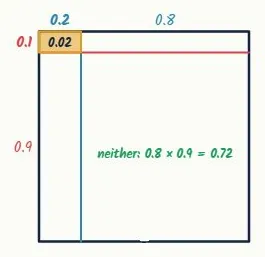
Try it: probability as area
"Exactly one": add two separate cells
- Bus late, train on time: 0.2 × 0.9 = 0.18.
- Bus on time, train late: 0.8 × 0.1 = 0.08.
- Separate cells, so add: 0.26.
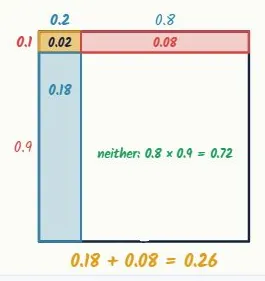
All the working
- Not: 1 minus.
- And: multiply. Or: add.
- bus on time: 1 − 0.2 = 0.8not late
- train on time: 1 − 0.1 = 0.9not late
- both: 0.2 × 0.1 = 0.02and: multiply
- neither: 0.8 × 0.9 = 0.72and: multiply
- at least one: 1 − 0.72 = 0.28
- exactly one: 0.2 × 0.9 + 0.8 × 0.1
- = 0.18 + 0.08 = 0.26or: add
- check: 0.02 + 0.26 + 0.72 = 1
Independent and mutually exclusive
- Independent: one does not affect the other.
- Mutually exclusive: they cannot both happen.
- Different ideas, different operations.
| Word | Means | So |
|---|---|---|
| Independent | no effect on each other | multiply |
| Mutually exclusive | cannot happen together | add |
The "at least one" shortcut
- Three cells, or one.
- Use the complement.
- long way: 0.02 + 0.18 + 0.08three cells
- = 0.28
- short way: 1 − 0.72one cell: neither
- = 0.28the same
Try it: at least one
Every answer between 0 and 1
- Adding when you should multiply can pass 1.
- A probability above 1 is always wrong.
- The examiner lists this for Not Achieved.
Keep four decimal places
- Rounding early spreads error through a question.
- Keep at least four decimal places in working.
- Round only the final answer.
Where the marks are
- Achieved: know when to multiply and when to add.
- Merit: several steps, like exactly one.
- Every answer in context.
What to take away
- And multiplies, or adds, not subtracts from 1.
| And | multiply (independent events) |
| Or | add (separate outcomes) |
| Not | 1 minus |
| At least one | 1 − P(none) |
| Check | 0 ≤ p ≤ 1, and totals add to 1 |
| Accuracy | 4 decimal places in working |
Common mistakes
- P(at least one of bus or train late) = 0.2 + 0.1 = 0.3They can both be late, so use the complement: 1 − P(neither) = 1 − 0.8 × 0.9 = 0.28.
- P(exactly one late) = 0.2 × 0.1 = 0.020.02 is both late. Exactly one is two separate cells, added: 0.2 × 0.9 + 0.8 × 0.1 = 0.26.
- Independent and mutually exclusive mean the same thing.Independent means one does not affect the other, so multiply; mutually exclusive means they cannot both happen, so add.
- P(rain on both days) = 0.3 + 0.3 = 0.6"Both" is "and", so multiply: 0.3 × 0.3 = 0.09. Adding where you should multiply can even give answers above 1.
Your turn: eight questions
- Draw the square if it helps.
- Check your answers add to 1.
P(rain) = 0.3 each day, independent. P(rain on both days)?
P(no rain on either day)?
P(rain on at least one day)?
P(rain on exactly one day)?
Which pair of events is mutually exclusive?
A spinner lands on red with probability 0.35 and on blue with probability 0.25. P(red or blue) on one spin?
Mere passes her driving theory test with probability 0.8 and her practical with 0.6, independently. P(she passes exactly one)?
A Wellington ferry is late with probability 0.1 each day, independently. P(it is late on at least one of 3 days)?
Show answer
1. 0.3 × 0.3 = 0.09. 2. 0.7 × 0.7 = 0.49. 3. 1 − 0.49 = 0.51. 4. 0.3 × 0.7 + 0.7 × 0.3 = 0.42. Check: 0.09 + 0.42 + 0.49 = 1. 5. Rolling a 2 and rolling a 5 on the same roll of a die: they cannot both happen. 6. 0.6. Red and blue cannot both happen, so add: 0.35 + 0.25 = 0.6. 7. 0.44. Theory only: 0.8 × 0.4 = 0.32; practical only: 0.2 × 0.6 = 0.12; separate outcomes, so add: 0.44. 8. 0.271. P(none late) = 0.9 × 0.9 × 0.9 = 0.729, so 1 − 0.729 = 0.271.
The answers: questions 1 and 2
- 1. P(rain and rain) = 0.3 × 0.3and: multiply
- = 0.09
- 2. P(dry) = 1 − 0.3 = 0.7complement
- P(dry and dry) = 0.7 × 0.7and: multiply
- = 0.49
The answers: questions 3 and 4
- 3. P(at least one) = 1 − P(none)
- = 1 − 0.49
- = 0.51
- 4. rain, dry or dry, raintwo separate ways
- 0.3 × 0.7 + 0.7 × 0.3
- = 0.21 + 0.21 = 0.42or: add
- check: 0.09 + 0.42 + 0.49 = 1
Sample question: Achieved
In Taupō, the probability of rain on a Saturday is 0.3 and on a Sunday is 0.4, independently. Find the probability that it rains on both days, and the probability that it rains on neither day.
Hint
"Both" is an and, so multiply. For "neither", first find the chance of no rain on each day.
Answer
P(both) = 0.12; P(neither) = 0.42
Step by step
- Independent means one day's weather does not change the chance for the other day. So for "and" we multiply.
- Both days: 0.3 × 0.4 = 0.12.
- For neither, we need dry and dry. Use the complement for each day first.
- P(dry Saturday) = 1 − 0.3 = 0.7 and P(dry Sunday) = 1 − 0.4 = 0.6.
- Neither: 0.7 × 0.6 = 0.42.
- The classic mistake is to add 0.3 + 0.4 = 0.7 for both days. Adding is for "or" across outcomes that cannot happen together.
- Check: both 0.12 and neither 0.42 are between 0 and 1, and both is smaller than either day alone, as it should be.
Full working
- P(both) = 0.3 × 0.4 = 0.12and, independent: multiply
- P(dry Sat) = 0.7, P(dry Sun) = 0.61 − P
- P(neither) = 0.7 × 0.6 = 0.42
- P(both) = 0.12, P(neither) = 0.42
Sample questions: Merit
A rugby goal-kicker succeeds with probability 0.8 on each kick, independently. In a match she takes 4 kicks. Find the probability that she misses at least one, and the probability that she misses exactly one.
Hint
"At least one miss" is 1 − P(no misses). "Exactly one miss" can happen in 4 different positions.
Answer
P(at least one miss) = 0.5904; P(exactly one miss) = 0.4096
Step by step
- Start with "at least one". Listing every case is long, so use the complement: at least one miss = 1 − P(no misses).
- No misses means 4 successes in a row. Independent, so multiply: 0.8 × 0.8 × 0.8 × 0.8 = 0.4096.
- So P(at least one miss) = 1 − 0.4096 = 0.5904.
- Now exactly one miss. One order is miss, hit, hit, hit: 0.2 × 0.8 × 0.8 × 0.8 = 0.1024.
- The miss could be the first, second, third or fourth kick. Each order has the same probability, 0.1024.
- These four orders cannot happen together, so add them: 4 × 0.1024 = 0.4096.
- It is a coincidence that this matches P(no misses). Both happen to equal 0.4096.
- The classic mistake is to forget the 4 orders and give 0.1024.
- Check: exactly one miss (0.4096) must be less than at least one miss (0.5904), and it is.
Full working
- P(no misses) = 0.8⁴ = 0.4096independent: multiply
- P(at least one miss) = 1 − 0.4096 = 0.5904complement
- one order: 0.2 × 0.8³ = 0.1024
- P(exactly one) = 4 × 0.1024 = 0.40964 positions for the miss, so add
- 0.5904 and 0.4096
In a Year 12 class, the probability a student plays a sport is 0.45, plays a musical instrument is 0.3, and does both is 0.12. Find the probability that a student does at least one of them, and that a student does neither. Are the two activities independent? Are they mutually exclusive? Explain.
Hint
For "or", add the two and take away the overlap once. Independent would need P(both) = P(sport) × P(music).
Answer
P(sport or music) = 0.63; P(neither) = 0.37; not independent, because 0.45 × 0.3 = 0.135 ≠ 0.12; not mutually exclusive, because P(both) is not 0
Step by step
- Picture a square: a sport strip and a music strip that overlap in a corner of size 0.12.
- If we add 0.45 + 0.3, the overlap is counted twice. So take it away once: P(sport or music) = 0.45 + 0.3 − 0.12 = 0.63.
- Neither is the complement of "at least one": 1 − 0.63 = 0.37.
- Recall: A and B are independent when P(A and B) = P(A) × P(B).
- 0.45 × 0.3 = 0.135, but P(both) is 0.12. They are not equal, so the activities are not independent.
- In words: knowing a student plays sport changes the chance they play music. P(music given sport) = 0.12 ÷ 0.45 = 0.2667, not 0.3.
- Mutually exclusive means they cannot both happen, so P(both) would be 0. Here it is 0.12, so they are not mutually exclusive.
- The classic mistake is to think "not independent" means "mutually exclusive". They are different ideas.
- Check the pieces add to 1: sport only 0.33, music only 0.18, both 0.12, neither 0.37. 0.33 + 0.18 + 0.12 + 0.37 = 1.
Full working
- P(S or M) = 0.45 + 0.3 − 0.12 = 0.63take the overlap off once
- P(neither) = 1 − 0.63 = 0.37complement
- 0.45 × 0.3 = 0.135 ≠ 0.12so not independent
- P(both) = 0.12 ≠ 0so not mutually exclusive
- 0.63; 0.37; not independent; not mutually exclusive
Sample questions: Excellence
The goal-kicker in a rugby team succeeds with probability 0.8 on each kick, independently. Find the smallest number of kicks n for which the probability she misses at least one is more than 0.95. Explain why the probability of at least one miss gets closer to 1 but never reaches it.
Hint
Write P(at least one miss) = 1 − 0.8ⁿ, then find when 0.8ⁿ drops below 0.05.
Answer
n = 14
Step by step
- "At least one miss" in n kicks is the complement of n successes in a row.
- Independent kicks multiply, so P(no misses) = 0.8 × 0.8 × ... × 0.8 = 0.8ⁿ.
- So P(at least one miss) = 1 − 0.8ⁿ. We need 1 − 0.8ⁿ > 0.95.
- Rearrange: 0.8ⁿ < 0.05.
- Try values. 0.8¹³ = 0.0550, which is still more than 0.05. 0.8¹⁴ = 0.0440, which is less.
- So n = 13 gives 1 − 0.0550 = 0.9450, not enough, and n = 14 gives 1 − 0.0440 = 0.9560, more than 0.95.
- The smallest number of kicks is n = 14.
- Why it never reaches 1: 0.8ⁿ is a positive number for every n. Each extra kick multiplies it by 0.8, so it gets smaller but never becomes 0.
- In words: however many kicks she takes, there is always a tiny chance she lands every one.
- The classic mistake is to stop at n = 13 because 0.9450 rounds to 0.95. The question says more than 0.95.
- If you know logs, n > log 0.05 ÷ log 0.8 = 13.4 gives the same answer, n = 14.
Full working
- P(at least one miss) = 1 − 0.8ⁿcomplement of all successes
- 1 − 0.8ⁿ > 0.95, so 0.8ⁿ < 0.05
- 0.8¹³ = 0.0550 > 0.05not enough
- 0.8¹⁴ = 0.0440 < 0.051 − 0.0440 = 0.9560
- 0.8ⁿ > 0 for every nso the probability never reaches 1
- n = 14
A and B are independent events with P(A) = p and P(B) = 2p. Given that P(A or B) = 0.52, find p. Explain why only one of the solutions can be used.
Hint
Use P(A or B) = P(A) + P(B) − P(A and B), and for independent events P(A and B) = P(A) × P(B). That gives a quadratic in p.
Answer
p = 0.2
Step by step
- Recall the addition rule: P(A or B) = P(A) + P(B) − P(A and B). We take away the overlap so it is not counted twice.
- Independent means P(A and B) = P(A) × P(B) = p × 2p = 2p².
- Substitute: p + 2p − 2p² = 0.52, so 3p − 2p² = 0.52.
- Rearrange into a quadratic: 2p² − 3p + 0.52 = 0.
- Use the quadratic formula: p = 3 ± √(9 − 4 × 2 × 0.52)4 = 3 ± √4.844 = 3 ± 2.24.
- So p = 0.8 ÷ 4 = 0.2 or p = 5.2 ÷ 4 = 1.3.
- A probability is never more than 1, so p = 1.3 is impossible. Also P(B) = 2p must be at most 1, so p ≤ 0.5.
- That leaves p = 0.2, so P(A) = 0.2 and P(B) = 0.4.
- Check: P(A and B) = 0.2 × 0.4 = 0.08, and 0.2 + 0.4 − 0.08 = 0.52. Correct.
- The classic mistake is to write P(A or B) = p + 2p = 0.52. That would only be right if A and B could not happen together.
Full working
- P(A and B) = p × 2p = 2p²independent
- p + 2p − 2p² = 0.52addition rule
- 2p² − 3p + 0.52 = 0
- p = 3 ± √4.844 = 3 ± 2.24quadratic formula
- p = 0.2 or 1.3; reject 1.3a probability cannot exceed 1
- p = 0.2
Challenge
A farm shed in the Waikato has three smoke sensors that work independently. They detect a fire with probabilities 0.9, 0.8 and p. The insurer needs the probability that at least one sensor detects a fire to be at least 0.995. Find the smallest value of p that works. Using that value, find the probability that exactly two sensors detect the fire.
Hint
At least one detects is 1 − P(none detect). Write P(none) with (1 − p) in it. For exactly two, there are three different ways to choose the sensor that misses.
Answer
p = 0.75; P(exactly two) = 0.375
Step by step
- At least one sensor detects is the complement of all three missing.
- The miss probabilities are 0.1, 0.2 and 1 − p. Independent, so P(none) = 0.1 × 0.2 × (1 − p) = 0.02(1 − p).
- We need 1 − 0.02(1 − p) ≥ 0.995, so 0.02(1 − p) ≤ 0.005, giving 1 − p ≤ 0.25 and p ≥ 0.75.
- For exactly two, one sensor misses and the other two detect. The missing sensor can be the first, second or third, and these cases cannot happen together, so add them.
- 0.9 × 0.8 × 0.25 + 0.9 × 0.2 × 0.75 + 0.1 × 0.8 × 0.75 = 0.18 + 0.135 + 0.06 = 0.375.
- Check: none 0.005, exactly one 0.08, exactly two 0.375, all three 0.54. These add to 1.
Full working
- P(none) = 0.1 × 0.2 × (1 − p) = 0.02(1 − p)independent misses: multiply
- 1 − 0.02(1 − p) ≥ 0.995at least one = 1 − P(none)
- 0.02(1 − p) ≤ 0.005, so 1 − p ≤ 0.25, p ≥ 0.75
- P(exactly two) = 0.9 × 0.8 × 0.25 + 0.9 × 0.2 × 0.75 + 0.1 × 0.8 × 0.75three separate cases: add
- = 0.18 + 0.135 + 0.06 = 0.375
- check: 0.005 + 0.08 + 0.375 + 0.54 = 1all four cases
- p = 0.75; P(exactly two) = 0.375
Events A and B have P(A) = 0.6 and P(B) = 0.5. Find the smallest and the largest possible values of P(A and B), and the range of possible values of P(A or B). Explain why A and B cannot be mutually exclusive. Find P(A or B) if A and B are independent, and check it lies in your range.
Hint
Draw a Venn diagram. The overlap cannot be bigger than the smaller circle, and P(A or B) can never be more than 1. Then use P(A or B) = P(A) + P(B) − P(A and B).
Answer
0.1 ≤ P(A and B) ≤ 0.5 and 0.6 ≤ P(A or B) ≤ 1. They cannot be mutually exclusive because P(A) + P(B) = 1.1 > 1. Independent: P(A or B) = 0.8, which is inside the range.
Step by step
- The addition rule: P(A or B) = 0.6 + 0.5 − P(A and B) = 1.1 − P(A and B).
- Largest overlap: A and B is part of B, so it is at most 0.5. That happens when B sits entirely inside A, and then P(A or B) = 0.6.
- Smallest overlap: P(A or B) is a probability, so 1.1 − P(A and B) ≤ 1, which gives P(A and B) ≥ 0.1. Then P(A or B) = 1.
- So 0.1 ≤ P(A and B) ≤ 0.5 and 0.6 ≤ P(A or B) ≤ 1.
- Mutually exclusive would need P(A and B) = 0, but the overlap is at least 0.1. The two probabilities add to 1.1, more than the whole sample space, so the events must share some outcomes.
- Independent: P(A and B) = 0.6 × 0.5 = 0.3, so P(A or B) = 1.1 − 0.3 = 0.8. Both 0.3 and 0.8 are inside the ranges.
Full working
- P(A or B) = 0.6 + 0.5 − P(A and B) = 1.1 − P(A and B)addition rule
- P(A and B) ≤ P(B) = 0.5, so P(A or B) ≥ 0.6B inside A
- 1.1 − P(A and B) ≤ 1, so P(A and B) ≥ 0.1P(A or B) ≤ 1
- 0.1 ≤ P(A and B) ≤ 0.5; 0.6 ≤ P(A or B) ≤ 1
- P(A and B) ≥ 0.1 > 0, so not mutually exclusive
- independent: P(A and B) = 0.3, P(A or B) = 1.1 − 0.3 = 0.8inside the range
- 0.1 to 0.5; 0.6 to 1; not mutually exclusive; 0.8 if independent
Aroha and Mere take turns shooting at a netball hoop, Aroha first. Each shot is independent. Aroha scores with probability 0.4 and Mere with probability 0.5. They keep going, Aroha, Mere, Aroha, Mere, and so on, until someone scores, and the first to score wins. Find the probability that Aroha wins. What scoring probability would Mere need for the game to be fair?
Hint
Think of one round as Aroha's shot then Mere's shot. If nobody scores in a round, the game starts again exactly as before. So compare only the two ways a round can end with a winner.
Answer
P(Aroha wins) = 47 ≈ 0.5714; Mere would need a scoring probability of 23 ≈ 0.6667
Step by step
- In one round, Aroha wins if she scores: 0.4.
- Mere wins the round if Aroha misses and Mere scores: 0.6 × 0.5 = 0.3.
- Nobody wins the round with probability 0.6 × 0.5 = 0.3, and then the game starts again from scratch, with the same chances.
- So the game always ends in a round where someone wins, and in such a round Aroha's chance compared with Mere's is 0.4 to 0.3.
- P(Aroha wins) = 0.4 ÷ (0.4 + 0.3) = 47 ≈ 0.5714.
- For a fair game, Mere's round chance must equal Aroha's: 0.6m = 0.4, so m = 23. Going second costs Mere, so she must be a better shooter to make it even.
Full working
- P(Aroha wins a round) = 0.4
- P(Mere wins a round) = 0.6 × 0.5 = 0.3Aroha misses and Mere scores
- P(nobody wins a round) = 0.6 × 0.5 = 0.3the game restarts unchanged
- P(Aroha wins) = 0.4 ÷ (0.4 + 0.3) = 47only rounds with a winner matter
- fair: 0.6m = 0.4, so m = 23equal chances in a round
- P(Aroha wins) = 47 ≈ 0.5714; Mere needs 23
Where science uses this
Practise this
Report a mistake
More in AS 91267
Probability: when to add and when to multiply7 min Two-way tables and conditional probability6 min
 Probability trees from written information, forwards and backwards8 min
 Expected value and expected numbers7 min
 Relative risk: above 1, below 1, and evaluating a claim7 min
 The normal distribution: probabilities and z-values8 min
 Inverse normal: finding a value, the mean or the standard deviation8 min
 Comparing distributions: shape, centre and spread7 min
 Probability rules: 7 exam questions solved step by step10 min
 Two-way tables: 7 exam questions solved step by step10 min
 Probability trees: 7 exam questions solved step by step10 min
 Expected value: 7 exam questions solved step by step10 min
 Relative risk: 7 exam questions solved step by step9 min
 Normal distribution: 7 exam questions solved step by step10 min
 Inverse normal: 7 exam questions solved step by step10 min
 Comparing distributions: 7 exam questions solved step by step10 min