
Inverse normal: 7 exam questions solved step by step
What this lesson covers
- An inverse normal problem starts from a probability and works back to a value.
- The z-value for a known probability links the unknown mean or standard deviation to the data.
Working back from a probability
- Sketch the curve and shade the known area.
- Make it an area to the left, then find z.
- Solve z = (x − μ) ÷ σ for the unknown.
- Check which side of the mean, then round.
Question 1 · Achieved
- Hauraki Gulf snapper lengths are
- Normal: mean 34 cm, sd 5 cm.
- Find the length that 80% are shorter than.
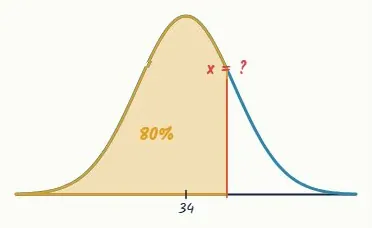
Q1: 80% shorter than x
- Area to the left: 0.8.
- Then x = μ + zσ.
- μ = 34, σ = 5given
- P(X < x) = 0.880% shorter
- z = 0.8416area 0.8 to the left
- x = μ + zσfrom z = (x − μ) ÷ σ
- x = 34 + 0.8416 × 5substitute
- = 34 + 4.208
- = 38.208
- x = 38.2 cm1 d.p.
- 38.2 > 34above the mean
Try it: 80% are shorter
Question 2 · Achieved
- The same snapper: mean 34 cm, sd 5 cm.
- Find the length that marks off
- The shortest 25%.
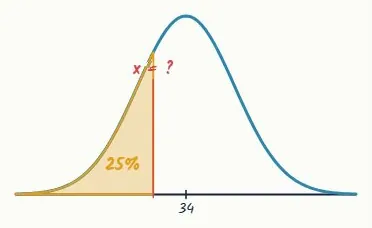
Q2: the shortest 25%
- Below the mean: z < 0.
- Check the side.
- μ = 34, σ = 5given
- P(X < x) = 0.25shortest 25%
- z = −0.6745below the mean
- x = 34 + (−0.6745) × 5
- = 34 − 3.3725
- = 30.6275 ≈ 30.6 cm1 d.p.
- 30.6 < 34below the mean
- z = +0.6745 gives 37.4 cmwrong side
Question 3 · Merit
- The same snapper: mean 34 cm, sd 5 cm.
- Find the limits of the middle 90%
- Of lengths.
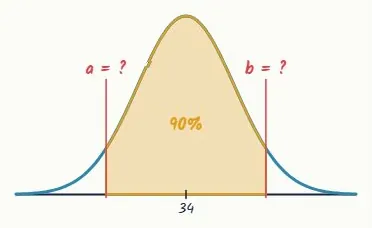
Q3: the middle 90%
- Split the 10%: 5% each end.
- Symmetric about 34.
- μ = 34, σ = 5given
- outside: 5% in each tail10% ÷ 2
- P(X < a) = 0.05: z = −1.6449
- a = 34 − 1.6449 × 5
- = 34 − 8.2245 = 25.7755
- P(X < b) = 0.95: z = 1.6449
- b = 34 + 8.2245 = 42.2245
- 25.78 cm to 42.22 cm2 d.p.
- 42.22 − 34 = 34 − 25.78symmetric
Question 4 · Merit
- The Days Bay ferry: crossing times are
- Normal with mean 25 min.
- 15% of crossings take over 28 min.
- Find the standard deviation.
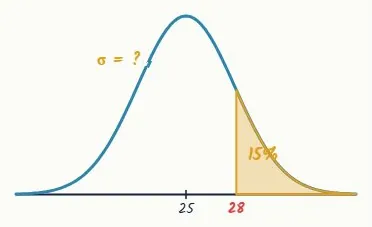
Q4: an unknown σ
- Over 28: left area 0.85.
- Substitute, solve for σ.
- μ = 25, P(X > 28) = 0.15given
- P(X < 28) = 0.85area to the left
- z = 1.036428 is above 25
- z = (x − μ) ÷ σ
- 1.0364 = (28 − 25) ÷ σsubstitute
- 1.0364σ = 3× σ
- σ = 3 ÷ 1.0364÷ 1.0364
- = 2.8946 ≈ 2.89 min2 d.p.
- σ > 0as it must be
Try it: change σ
Question 5 · Merit, in context
- Kiwifruit trays: weights normal, sd 150 g.
- At most 2% may be under 3500 g.
- The mean is set in whole grams.
- Find the smallest mean to set.
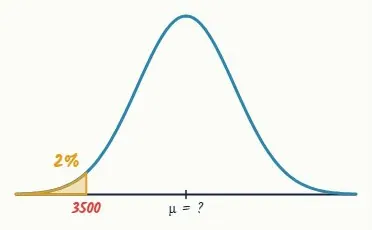
Q5: an unknown μ
- Solve for μ.
- Then round the safe way.
- σ = 150, P(X < 3500) = 0.02given
- z = −2.05373500 is below μ
- −2.0537 = (3500 − μ) ÷ 150substitute
- −308.055 = 3500 − μ× 150
- μ = 3500 + 308.055rearrange
- = 3808.055 g
- 3808 g: P = 0.020020over 2%
- 3809 g: P = 0.019699under 2%
- set the mean to 3809 g
Question 6 · Excellence
- Rangitoto summit walk times are normal.
- 10% take under 40 min.
- 20% take over 65 min.
- Find the mean and standard deviation.
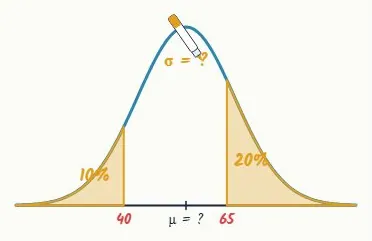
Q6: two equations
- One equation per fact.
- Two unknowns: μ and σ.
- P(X < 40) = 0.1: z = −1.2816
- −1.2816 = (40 − μ) ÷ σsubstitute
- μ − 1.2816σ = 40× σ, rearrange
- P(X > 65) = 0.2given
- P(X < 65) = 0.8: z = 0.8416
- 0.8416 = (65 − μ) ÷ σsubstitute
- μ + 0.8416σ = 65× σ, rearrange
Q6: solve them together
- Subtract to lose μ.
- Check in the second.
- μ − 1.2816σ = 40
- μ + 0.8416σ = 65
- 2.1232σ = 25second − first
- σ = 25 ÷ 2.1232 = 11.7747
- μ = 40 + 1.2816 × 11.7747
- = 40 + 15.0904
- = 55.0904
- μ ≈ 55.09 min, σ ≈ 11.77 min
- 55.09 + 0.8416 × 11.77 ≈ 65
Question 7 · Excellence
- Flour bags: normal, mean 1012 g, sd 8 g.
- At most 3% may be under 1000 g.
- Does the machine meet the rule?
- If not, keep the mean: largest sd?
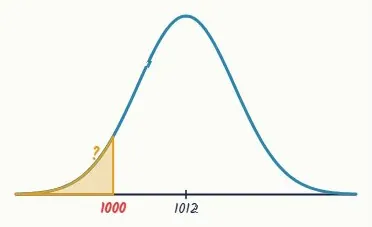
Q7: does it pass now?
- A forward question first.
- Compare with 3%.
- μ = 1012, σ = 8now
- z = (1000 − 1012) ÷ 8 = −1.5
- P(X < 1000) = 0.066807
- 0.0668 > 0.03over 3%
- No: about 6.7% are under
Q7: the largest σ
- Exactly 3% under 1000 g.
- Round down: the safe side.
- P(X < 1000) = 0.03the limit
- z = −1.8808below the mean
- −1.8808 = (1000 − 1012) ÷ σsubstitute
- −1.8808σ = −12× σ
- σ = −12 ÷ −1.8808÷ −1.8808
- = 6.3803
- σ = 6.38 g at mostround down
- 6.38: P = 0.029994under 3%
Try it: cut, pick z, round safe
Common mistakes
- Shortest 25%: z = 0.6745, so 34 + 0.6745 × 5 = 37.4 cmThe shortest 25% are below the mean, so z = −0.6745 and the length is 34 − 0.6745 × 5 = 30.6 cm.
- 15% take over 28 min, so z = −1.036 and σ = −2.89The area to the left of 28 is 0.85, so z = +1.036 and σ = 3 ÷ 1.036 = 2.89 min.
- Middle 90%: the area to the left is 0.90.The middle 90% leaves 5% in each tail, so use 0.05 and 0.95: z = ±1.645, giving 25.78 cm to 42.22 cm.
- μ = 3808.055 g, so set the mean to 3808 g.3808 g gives slightly more than 2% under 3500 g, so round up to 3809 g.
The method that solved all seven
- Area to the left, z with its sign, solve, round safely.
| Step | How |
|---|---|
| Left area | turn "above" into "below" |
| Find z | negative below the mean |
| A value | x = μ + zσ |
| μ or σ | substitute into z, then solve |
| Both | two equations, subtract |
| Round | to the side the rule needs |
Challenge
The times for a Rotorua mountain bike trail are normal. The median time is 60 min, and 90% of riders finish in under 72 min. Find the standard deviation, then find the percentage of riders who finish in under 50 min.
Hint
For a normal distribution the median and the mean are the same. Use the 90% fact to find the z-value for 72 min, and solve for σ.
Answer
σ ≈ 9.36 min, and about 14.3% of riders finish in under 50 min.
Step by step
- The curve is symmetric, so the mean equals the median: μ = 60.
- Area 0.9 to the left of 72 gives z = 1.2816.
- Solve 1.2816 = (72 − 60) ÷ σ, so σ = 9.3636.
- For 50 min: z = (50 − 60) ÷ 9.3636 = −1.0680.
- The area to the left is 0.1428, about 14.3%.
Full working
- μ = 60median = mean for a normal curve
- P(X < 72) = 0.9, so z = 1.2816inverse normal
- 1.2816 = (72 − 60) ÷ σsubstitute
- σ = 12 ÷ 1.2816 = 9.3636 minsolve
- z = (50 − 60) ÷ 9.3636 = −1.0680below the mean
- P(X < 50) = 0.1428full σ kept
- σ ≈ 9.36 min; about 14.3% under 50 min
An Auckland bus route has trip times that are normal with mean 42 min and standard deviation 5 min. Trips over 45 min are called 'late'. The company investigates the slowest 10% of late trips. Find the time above which a trip is investigated.
Hint
This is 10% of the late trips, not 10% of all trips. Find P(X > 45) first; the cut-off c has P(X > c) equal to 10% of that.
Answer
Trips over about 51.6 min are investigated.
Step by step
- P(X > 45) = 0.2743, so late trips are 27.43% of all trips.
- The slowest 10% of these are 0.1 × 0.2743 = 0.02743 of all trips.
- So P(X > c) = 0.02743, which means an area of 0.97257 to the left.
- That area gives z = 1.9201, so c = 42 + 1.9201 × 5 = 51.60.
- Check: P(X > 51.60) ÷ P(X > 45) = 0.1.
Full working
- z = (45 − 42) ÷ 5 = 0.6, P(X > 45) = 0.274253late trips
- P(X > c) = 0.1 × 0.274253 = 0.02742510% of late trips
- P(X < c) = 1 − 0.027425 = 0.972575area to the left
- z = 1.9201inverse normal
- c = 42 + 1.9201 × 5 = 51.60x = μ + zσ
- check: 0.027425 ÷ 0.274253 = 0.1
- investigate trips over about 51.6 min
A machine fills bags of flour. The weights are normal, and the standard deviation is always 2% of the mean. The law says at most 1% of bags may be under 500 g. The mean is set in whole grams. Find the smallest mean that meets the law, and show that one gram less does not.
Hint
Write σ = 0.02μ. Then the 1% rule gives one equation with only μ in it. Watch which way to round.
Answer
Set the mean to 525 g (exact limit 524.40 g; 524 g gives 1.10% under 500 g, too many).
Step by step
- 1% under 500 g gives z = −2.3263, below the mean.
- So 500 = μ + (−2.3263) × 0.02μ = μ(1 − 0.046527).
- Solve: μ = 500 ÷ 0.953473 = 524.40 g.
- A smaller mean puts more bags under 500 g, so round up to 525 g.
- Check: μ = 524 gives σ = 10.48 and 1.10% under 500 g, which breaks the law; μ = 525 gives 0.86%.
Full working
- P(X < 500) = 0.01, so z = −2.3263inverse normal
- σ = 0.02μ2% of the mean
- 500 = μ − 2.3263 × 0.02μ = 0.953473μx = μ + zσ
- μ = 500 ÷ 0.953473 = 524.40 gsolve
- μ = 524: σ = 10.48, P(X < 500) = 0.0110over 1%
- μ = 525: σ = 10.5, P(X < 500) = 0.0086under 1%
- set the mean to 525 g
Practise this
Report a mistake
More in AS 91267
 Probability: when to add and when to multiply7 min
 Two-way tables and conditional probability6 min
 Probability trees from written information, forwards and backwards8 min
 Expected value and expected numbers7 min
 Relative risk: above 1, below 1, and evaluating a claim7 min
 The normal distribution: probabilities and z-values8 min
 Inverse normal: finding a value, the mean or the standard deviation8 min
 Comparing distributions: shape, centre and spread7 min
 Probability rules: 7 exam questions solved step by step10 min
 Two-way tables: 7 exam questions solved step by step10 min
 Probability trees: 7 exam questions solved step by step10 min
 Expected value: 7 exam questions solved step by step10 min
 Relative risk: 7 exam questions solved step by step9 min
 Normal distribution: 7 exam questions solved step by step10 minInverse normal: 7 exam questions solved step by step10 min
 Comparing distributions: 7 exam questions solved step by step10 min