
Normal distribution: 7 exam questions solved step by step
What this lesson covers
- A normal distribution is symmetric about its mean, and its spread is measured by the standard deviation.
- A z-value counts how many standard deviations a value is from the mean.
Finding a normal probability
- Sketch the curve and shade the area.
- z = (x − μ) ÷ σ, keeping its sign.
- Find the probability; round at the end.
- Check it against the sketch.
Question 1 · Achieved
- Kiwifruit weights at a packhouse are
- Normal: mean 110 g, sd 9 g.
- Find P(a kiwifruit is under 122 g).
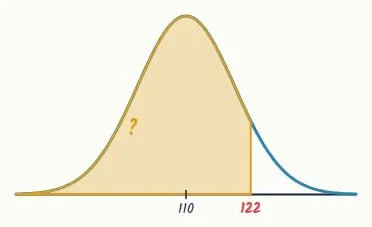
Q1: P(X < 122)
- Shaded left of 122.
- z first, then the area.
- μ = 110, σ = 9given
- P(X < 122)
- z = (122 − 110) ÷ 9
- = 12 ÷ 9 = 1.3333above: positive
- P(X < 122) = 0.908789
- = 0.90884 d.p.
- 0.9088 > 0.5over half is shaded
Try it: shade the area
Question 2 · Achieved
- Same kiwifruit: mean 110 g, sd 9 g.
- Find P(a kiwifruit is over 100 g).
- Careful: 100 g is below the mean.
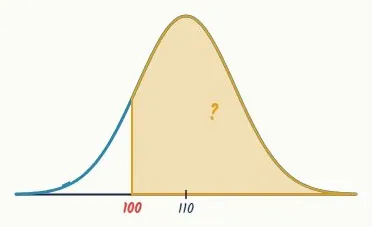
Q2: P(X > 100)
- Below the mean: z < 0.
- Shaded right: most of it.
- μ = 110, σ = 9given
- P(X > 100)
- z = (100 − 110) ÷ 9
- = −10 ÷ 9 = −1.1111below: negative
- P(X < 100) = 0.1333wrong side
- P(X > 100) = 0.866740
- = 0.86674 d.p.
- 0.8667 > 0.5most of the curve
Question 3 · Merit
- An Auckland bus route: trip times are
- Normal, mean 42 min, sd 5 min.
- Find P(a trip takes 35 to 50 min).
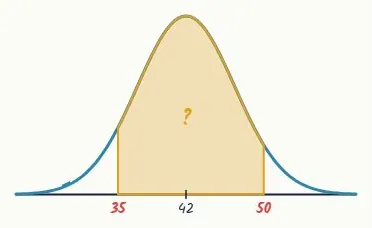
Q3: P(35 < X < 50)
- Two values: two z-values.
- One below, one above.
- μ = 42, σ = 5given
- P(35 < X < 50)
- z = (35 − 42) ÷ 5 = −1.4
- z = (50 − 42) ÷ 5 = 1.6
- P(−1.4 < Z < 1.6)same area
- P(35 < X < 50) = 0.864444
- = 0.86444 d.p.
- about 86% of trips35 to 50 min
Question 4 · Merit, in context
- Wellington ferry crossings are normal,
- Mean 55 min, sd 4 min.
- Of 400 crossings, how many are
- Expected to take over 61 min?
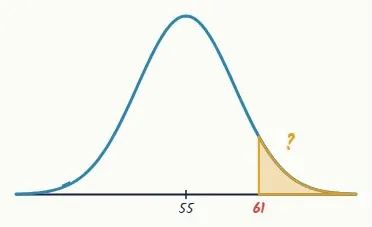
Q4: how many over 61 min?
- Probability first.
- Then n × probability.
- μ = 55, σ = 4given
- P(X > 61)
- z = (61 − 55) ÷ 4 = 1.5
- P(X > 61) = 0.066807
- expected = 400 × 0.066807
- = 26.72
- about 27 of 400 crossingscrossings are whole
Question 5 · Merit, in context
- Honey jars for a school fundraiser:
- Normal, mean 508 g, sd 5 g.
- Rejected if under 500 g or over 520 g.
- What proportion are rejected?
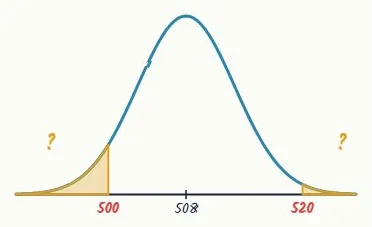
Q5: two tails
- Not symmetric: no doubling.
- Each tail, then add.
- μ = 508, σ = 5given
- P(X < 500) + P(X > 520)
- z = (500 − 508) ÷ 5 = −1.6
- z = (520 − 508) ÷ 5 = 2.4
- P(X < 500) = 0.054799
- P(X > 520) = 0.008198
- 0.054799 + 0.008198
- = 0.062997 ≈ 0.06304 d.p.
- about 6.3% of jars rejected
Try it: why the bell shape
Question 6 · Excellence
- The bus route again: mean 42, sd 5 min.
- A trip has already taken over 45 min.
- Find P(it takes over 50 min).
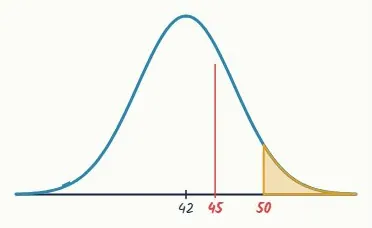
Q6: set it up
- "Given" shrinks the total.
- Over 50 is over 45.
- μ = 42, σ = 5given
- P(X > 50 | X > 45)given over 45
- P(A | B) = P(A and B) ÷ P(B)
- A: X > 50, B: X > 45
- A and B: X > 50over 50 is over 45
- = P(X > 50) ÷ P(X > 45)
Q6: the two areas
- P(X > 45) is the new total.
- Round only at the end.
- P(X > 50) ÷ P(X > 45)
- z = (50 − 42) ÷ 5 = 1.6
- P(X > 50) = 0.054799
- z = (45 − 42) ÷ 5 = 0.6
- P(X > 45) = 0.274253the reduced total
- 0.054799 ÷ 0.274253
- = 0.199812
- = 0.19984 d.p.
- about 1 in 5 of those tripsover 45 min
Question 7 · Excellence
- Girls' 100 m: mean 13.8 s, sd 0.5 s.
- Boys' 100 m: mean 12.5 s, sd 0.4 s.
- Aroha runs 13.1 s. Tama runs 11.9 s.
- Whose time is more impressive?
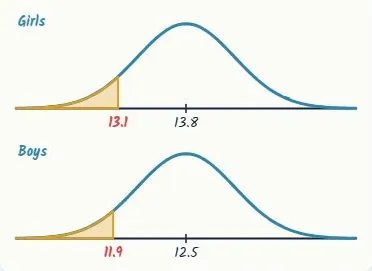
Q7: compare with z
- Different spreads.
- Faster is below: z < 0.
- Aroha 0.7 s, Tama 0.6 sspreads differ
- Aroha: z = (13.1 − 13.8) ÷ 0.5
- = −0.7 ÷ 0.5 = −1.4
- Tama: z = (11.9 − 12.5) ÷ 0.4
- = −0.6 ÷ 0.4 = −1.5
- −1.5 < −1.4further below
- Tama is 1.5 sd under his mean
Try it: three exam moves
Q7: back it with areas
- Who is faster than them?
- Smaller area: rarer time.
- girls: μ = 13.8, σ = 0.5
- P(X < 13.1) = 0.080757
- = 0.08084 d.p.
- boys: μ = 12.5, σ = 0.4
- P(X < 11.9) = 0.066807
- = 0.06684 d.p.
- 0.0668 < 0.0808fewer are faster
- Tama's time is more impressive
Common mistakes
- P(X > 100) = 0.1333100 g is below the mean, so most kiwifruit are heavier: P(X > 100) = 1 − 0.1333 = 0.8667.
- Expected crossings over 61 min: P(X > 61) = 0.0668Multiply by the number of crossings: 400 × 0.0668 ≈ 27 crossings.
- P(X > 50 | X > 45) = P(X > 50) = 0.0548Given it is already over 45, divide: P(X > 50) ÷ P(X > 45) = 0.0548 ÷ 0.2743 = 0.1998.
- Aroha is 0.7 s under her mean and Tama only 0.6 s, so Aroha did better.The spreads differ, so compare z-scores: Tama's z = −1.5 beats Aroha's z = −1.4.
The method that solved all seven
- Sketch, find z, find the area, check, say it in context.
| Step | How |
|---|---|
| Sketch | shade the area you want |
| z-value | (x − μ) ÷ σ, sign and all |
| Probability | calculator, round at the end |
| Two tails | find each one, then add |
| Given that | divide by the reduced total |
| Compare | use z, not raw units |
Challenge
Snapper lengths in the Hauraki Gulf are normal with mean 34 cm and standard deviation 5 cm. A snapper is legal to keep if it is over 30 cm. A fisher catches 4 snapper, independently. Find P(at least 3 of them are legal).
Hint
First find p = P(one snapper is legal) from the normal distribution. Then 'at least 3' is 'exactly 3' or 'all 4'. For exactly 3, count which fish is the undersized one.
Answer
P(legal) = 0.7881, so P(at least 3 legal) ≈ 0.8007.
Step by step
- P(X > 30): z = (30 − 34) ÷ 5 = −0.8, which gives p = 0.7881.
- All 4 legal: p⁴.
- Exactly 3 legal: any one of the 4 fish could be the short one, so 4 paths, each p³(1 − p).
- Add the two cases: 0.3859 + 0.4149 = 0.8007.
- Keep full calculator values until the end.
Full working
- z = (30 − 34) ÷ 5 = −0.8below the mean
- p = P(X > 30) = 0.788145most of the curve
- P(all 4) = 0.788145⁴ = 0.385855and: multiply
- P(exactly 3) = 4 × 0.788145³ × 0.211855 = 0.4148754 paths
- P(at least 3) = 0.385855 + 0.414875 = 0.800730or: add
- P(at least 3 legal) ≈ 0.8007
A Hawke's Bay juice factory has two filling machines. Machine A fills 60% of bottles, with volumes normal: mean 500 mL, standard deviation 4 mL. Machine B fills the rest: mean 503 mL, standard deviation 6 mL. A bottle chosen at random holds under 495 mL. Find P(it was filled by machine B).
Hint
Build a tree: machine first, then 'under 495 mL' or not. Each 'under 495' branch is a normal probability with that machine's mean and standard deviation. Then go backwards: B's path ÷ the total.
Answer
P(machine B | under 495 mL) ≈ 0.3653.
Step by step
- Machine A: z = (495 − 500) ÷ 4 = −1.25, so P(under 495) = 0.1056.
- Machine B: z = (495 − 503) ÷ 6 = −1.3333, so P(under 495) = 0.0912.
- Multiply along: A path 0.6 × 0.1056 = 0.0634, B path 0.4 × 0.0912 = 0.0365.
- Add across: P(under 495) = 0.0999.
- Backwards: 0.0365 ÷ 0.0999 ≈ 0.3653. B fills 40% of bottles but only about 37% of the short ones.
Full working
- A: z = (495 − 500) ÷ 4 = −1.25, P = 0.105650normal
- B: z = (495 − 503) ÷ 6 = −1.3333, P = 0.091211normal
- P(A and short) = 0.6 × 0.105650 = 0.063390multiply along
- P(B and short) = 0.4 × 0.091211 = 0.036484multiply along
- P(short) = 0.063390 + 0.036484 = 0.099874add across
- P(B given short) = 0.036484 ÷ 0.099874 ≈ 0.3653
Aroha can drive to work by route A or route B. Route A times are normal with mean 30 min and standard deviation 3 min. Route B times are normal with mean 28 min and standard deviation 6 min. She must arrive within t minutes. Which route should she take if t = 35, and which if t = 31? Find the value of t where the two routes are equally good, and explain the pattern.
Hint
The better route is the one with the bigger P(time < t). Compare z-values: the bigger z gives the bigger area. Set the two z-values equal to find where they swap.
Answer
t = 35: route A (0.9522 against 0.8783). t = 31: route B (0.6915 against 0.6306). They are equally good at t = 32 min. With more than 32 min to spare, the steady route A is better; with less, the faster but more variable route B is better.
Step by step
- For each route find z = (t − μ) ÷ σ; the larger z means a larger area to the left.
- t = 35: A gives z = 1.6667 (0.9522), B gives z = 1.1667 (0.8783). Take A.
- t = 31: A gives z = 0.3333 (0.6306), B gives z = 0.5 (0.6915). Take B.
- Equal chances when (t − 30) ÷ 3 = (t − 28) ÷ 6, which gives t = 32.
- Above 32 min the small spread of A matters most; below 32 min the lower mean of B matters most.
Full working
- t = 35: z_A = (35 − 30) ÷ 3 = 1.6667, P = 0.9522route A
- t = 35: z_B = (35 − 28) ÷ 6 = 1.1667, P = 0.8783A is better
- t = 31: z_A = 0.3333, P = 0.6306; z_B = 0.5, P = 0.6915B is better
- (t − 30) ÷ 3 = (t − 28) ÷ 6equal z, equal area
- 2(t − 30) = t − 28, so t = 32× 6
- check t = 32: both z = 0.6667, both P = 0.7475
- A for t = 35, B for t = 31; equal at t = 32 min
Practise this
Report a mistake
More in AS 91267
 Probability: when to add and when to multiply7 min
 Two-way tables and conditional probability6 min
 Probability trees from written information, forwards and backwards8 min
 Expected value and expected numbers7 min
 Relative risk: above 1, below 1, and evaluating a claim7 min
 The normal distribution: probabilities and z-values8 min
 Inverse normal: finding a value, the mean or the standard deviation8 min
 Comparing distributions: shape, centre and spread7 min
 Probability rules: 7 exam questions solved step by step10 min
 Two-way tables: 7 exam questions solved step by step10 min
 Probability trees: 7 exam questions solved step by step10 min
 Expected value: 7 exam questions solved step by step10 min
 Relative risk: 7 exam questions solved step by step9 minNormal distribution: 7 exam questions solved step by step10 min
 Inverse normal: 7 exam questions solved step by step10 min
 Comparing distributions: 7 exam questions solved step by step10 min