
Ratios, and finding the whole from a part
What this lesson covers
- Ratios, fractions, and percentages can all represent proportional relationships between two quantities.
Try both of these
- 45% of 20. That is 9.
- Now 20% of 45. That is also 9.
- Same answer, and not because of these particular numbers.
| Calculation | Working | Answer |
|---|---|---|
| 45% of 20 | 0.45 × 20 | 9 |
| 20% of 45 | 0.2 × 45 | 9 |
Why the swap always works
- 45% of 20 means 45 × 20, then divide by 100.
- 20% of 45 means 20 × 45, then divide by 100.
- Identical. So a% of b is always b% of a.
| Calculation | Working | Answer |
|---|---|---|
| 45% of 20 | 0.45 × 20 | 9 |
| 20% of 45 | 0.2 × 45 | 9 |
| Both are | 45 × 20 ÷ 100 | 9 |
Which lets you pick the easier one
- 4% of 75 is unpleasant to work out.
- But 75% of 4 is three quarters of 4, which is 3.
- Same question. Always check whether the flip is kinder.
| Version | How it feels | Answer |
|---|---|---|
| 4% of 75 | awkward | |
| 75% of 4 | three quarters of 4 | 3 |
| Same question | much easier version | 3 |
Now the other direction
- Every percentage question so far gave you the whole.
- This time you are given a slice and asked for the whole.
- 20% of a number is 60. What is the number?
| Given | Asked for |
|---|---|
| the whole, and a percentage | the part |
| a part, and its percentage | the whole |
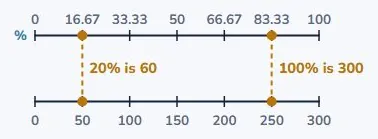
Two scales, side by side
- Percentages on one scale, the actual amount on the other.
- 20% lines up with 60.
- So 100% lines up with 300. Read it straight off.
The method behind that picture
- Get down to 1% first, then scale up to 100.
- 3% is 27, so 1% is 27 ÷ 3, which is 9.
- Then 100% is 9 × 100, which is 900.
| Step | Working | Gives |
|---|---|---|
| 3% is | 27 | |
| So 1% is | 27 ÷ 3 | 9 |
| So 100% is | 9 × 100 | 900 |
Check it, and do one more
- 3% of 900 is 27, so 900 is right.
- Another: 15% is 45. So 1% is 45 ÷ 15, which is 3.
- 100% is 300. The whole is always bigger than the part.
| Step | Working | Gives |
|---|---|---|
| 15% is | 45 | |
| 1% is | 45 ÷ 15 | 3 |
| 100% is | 3 × 100 | 300 |
Ratios: an unequal split
- A ratio says how a whole is shared out unevenly.
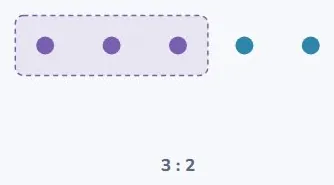
- 3 : 2 means three for every two.
- Read it aloud as "three to two".
Count the parts first. Always
- 3 : 2 is three parts and two parts.
- Which is five parts altogether.
- Not three. Not two. Five. This is the whole trick.
| Step | Working | Gives |
|---|---|---|
| Ratio 3 : 2 | 3 parts and 2 parts | 5 parts in total |
Splitting 60 in the ratio 3 : 2
- Five parts, and 60 to share, so 60 ÷ 5 = 12 per part.
- One share gets three parts: 3 × 12 = 36.
- The other gets two: 2 × 12 = 24.
| Step | Working | Gives |
|---|---|---|
| Ratio 3 : 2 | 3 parts and 2 parts | 5 parts in total |
| 60 ÷ 5 | what one part is worth | 12 |
| 3 parts | 3 × 12 | 36 |
| 2 parts | 2 × 12 | 24 |
Try it: split it in a ratio
Two checks, and you need both
- Do they add to 60? 36 + 24 does. Good.
- But 30 and 30 also add to 60, and that is wrong.
- So also check the shape: 36 : 24 divides down to 3 : 2.
| Check | Working | Result |
|---|---|---|
| Do they add up? | 36 + 24 | 60 |
| Is it the right shape? | 36 : 24, both ÷ 12 | 3 : 2 |
| Both pass | so the split is right |
When the ratio is given against the whole
- "3 out of 8 of the 32" is not a part-to-part ratio.
- It is a fraction. 3/8 of 32 is 12.
- The rest is 20, and as a ratio that split is 3 : 5.
| Step | Working | Gives |
|---|---|---|
| 3 out of 8 of 32 | that is 3/8 | 12 |
| The rest | 32 − 12 | 20 |
| As a ratio | 12 : 20, both ÷ 4 | 3 : 5 |
Telling the two kinds apart
- 3 : 2 compares one part with the other part.
- 3 out of 5 compares one part with the whole.
- Same split. Read which comparison you were given.
| Written | Compares | Total |
|---|---|---|
| 3 : 2 | part with part | 5 parts |
| 3 out of 5 | part with whole | 5 parts |
| 3/5 | the same thing again | 5 parts |
Writing a split as a ratio
- Two people got 36 and 24. What is the ratio?
- Write 36 : 24, then divide both by anything you can.
- Both by 12 gives 3 : 2. Simplify, same as a fraction.
| Step | Working | Gives |
|---|---|---|
| Start with | 36 : 24 | |
| Both ÷ 4 | 9 : 6 | |
| Both ÷ 3 | 3 : 2 | |
| Or ÷ 12 at once | 3 : 2 |
One split, every notation you know
- That 3 : 2 split is also 3/5 and 2/5.
- Which is 0.6 and 0.4.
- Which is 60% and 40%. Four notations, one relationship.
| Notation | Compares | The split |
|---|---|---|
| Ratio | part to part | 3 : 2 |
| Fractions | part to whole | 3/5 and 2/5 |
| Decimals | 0.6 and 0.4 | |
| Percentages | 60% and 40% |
Common mistakes
- Split 60 in the ratio 3 : 2: 60 ÷ 3 = 20 and 60 ÷ 2 = 30.Count the parts first: 3 + 2 = 5 parts, so one part is 60 ÷ 5 = 12, giving 36 and 24.
- 20% of a number is 60, so the number is 20% of 60, which is 12.60 is the part, not the whole: 1% is 60 ÷ 20 = 3, so 100% is 300. The whole is always bigger than the part.
- 30 and 30 add to 60, so that split is right.Adding to 60 is not enough; the shares must also simplify to the ratio, and 36 : 24 = 3 : 2 does.
- Boys to girls is 3 : 2 in a class of 60, so there are 24 boys.The first number goes with the first group named, so boys get 3 parts: 3 × 12 = 36 boys.
Your turn: eight questions
- Try all eight.
- Question 2 wants the swap. Do not multiply anything hard.
- For question 3, count the parts before you divide.
If 5% of a number is 35, what is the number?
Work out 8% of 25 the easy way.
Divide 72 in the ratio 5 : 3.
Write 40 : 16 in its simplest form.
Which calculation gives the same answer as 36% of 25?
A prize is split in the ratio 1 : 4. Write the two shares as percentages of the prize.
A bag of 40 lollies has 15 red and the rest green. Write red : green in simplest form.
Two friends share money in the ratio 4 : 3. The larger share is $28. How much was shared altogether?
Show answer
1. 700. 1% is 35 ÷ 5 = 7, and 100% is 700. 2. 2. Swap it to 25% of 8, which is a quarter of 8. 3. 45 and 27. That is 8 parts, 72 ÷ 8 = 9 per part, then 5 × 9 and 3 × 9. Check: 45 + 27 = 72. 4. 5 : 2. Both numbers divide by 8. 5. 25% of 36. a% of b is always b% of a, and both give 9. 6. 20% and 80%. That is 5 parts, so the shares are 1/5 and 4/5, which are 20% and 80%. 7. 3 : 5. Green is 40 − 15 = 25, so red : green is 15 : 25, and both divide by 5. 8. $49. 4 parts are $28, so one part is $7. There are 7 parts in total, and 7 × $7 = $49.
The answers
- 1% is 7, so the number is 700.
- 8% of 25 is 25% of 8, a quarter of 8, which is 2.
- 72 in 5 : 3 is 45 and 27. And 40 : 16 is 5 : 2.
| Answer | |
|---|---|
| 1 | 700 |
| 2 | 2 |
| 3 | 45 and 27 |
| 4 | 5 : 2 |
Ratio and Proportion
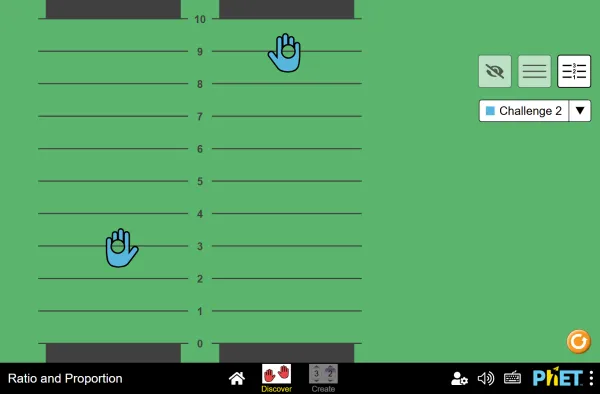
Full screen · PhET Interactive Simulations, University of Colorado Boulder, CC BY 4.0
What to take away
- a% of b is always b% of a. Pick whichever is easier.
- To get back to the whole, find 1% and multiply by 100.
- And with a ratio, count the parts before dividing anything.
| Remember | |
|---|---|
| a% of b | equals b% of a, always |
| Back to 100% | find 1% first, then times 100 |
| A ratio | count the parts before you divide |
| 3 : 2 | is 5 parts, not 3 and not 2 |
| Check | the two parts must add to the whole |
Challenge
A number x is hidden. You are told that 36% of x is 27. Without finding x first, work out x% of 48. Then find x to check.
Hint
x% of 48 is the same as 48% of x. How does 48% of x compare with 36% of x?
Answer
x% of 48 is 36. (x is 75, and 75% of 48 is 36.)
Step by step
- Swap it: x% of 48 equals 48% of x.
- 36% of x is 27, so 12% of x is a third of that, 9.
- 48% is 4 lots of 12%, so 48% of x is 4 × 9 = 36.
- Check: 1% of x is 27 ÷ 36 = 0.75, so x = 75, and 75% of 48 is three quarters of 48, which is 36.
Full working
- x% of 48 = 48% of xa% of b is b% of a
- 36% of x = 27, so 12% of x = 27 ÷ 3 = 936 is 3 lots of 12
- 48% of x = 4 × 9 = 3648 is 4 lots of 12
- 1% of x = 27 ÷ 36 = 0.75, x = 75check by finding 1%
- 75% of 48 = 34 × 48 = 36same answer
- x% of 48 = 36
Green paint is mixed from blue and yellow paint in the ratio 2 : 5. Tama has 1.2 L of blue and 2.5 L of yellow. (a) What is the most green paint he can mix in the right ratio, and how much of which colour is left over? (b) How much more yellow must he buy to use up all his blue, and how much green paint will he then make altogether?
Hint
If Tama used all of his blue, how much yellow would he need? Does he have that much?
Answer
(a) 3.5 L of green, with 0.2 L of blue left over. (b) He must buy 0.5 L more yellow, and then he makes 4.2 L of green.
Step by step
- Using all 1.2 L of blue: 2 parts is 1.2 L, so 1 part is 0.6 L, and 5 parts of yellow would be 3.0 L. He has only 2.5 L.
- So the yellow runs out first. 5 parts is 2.5 L, so 1 part is 0.5 L and he uses 2 × 0.5 = 1.0 L of blue.
- Green made: 1.0 + 2.5 = 3.5 L. Blue left over: 1.2 − 1.0 = 0.2 L.
- To use all the blue he needs 3.0 L of yellow, so he buys 3.0 − 2.5 = 0.5 L more.
- Then the green is 1.2 + 3.0 = 4.2 L. Check: 1.2 : 3.0 = 12 : 30 = 2 : 5.
Full working
- 1.2 ÷ 2 = 0.6, 0.6 × 5 = 3.0 Lyellow needed for all the blue
- 3.0 L > 2.5 Lthe yellow runs out first
- 2.5 ÷ 5 = 0.5, 0.5 × 2 = 1.0 Lone part, and the blue used
- 1.0 + 2.5 = 3.5 L, 1.2 − 1.0 = 0.2 Lgreen made, blue left over
- 3.0 − 2.5 = 0.5 L(b) yellow to buy
- 1.2 + 3.0 = 4.2 L(b) green made
- (a) 3.5 L of green, 0.2 L of blue left (b) buy 0.5 L of yellow, 4.2 L of green
A 900 g jar of mixed nuts has almonds, cashews and peanuts in the ratio 2 : 3 : 4. How many grams of cashews must be added so that cashews make up exactly 40% of the jar? What is the ratio of almonds to cashews to peanuts after that, in simplest form?
Hint
Adding cashews does not change the almonds and peanuts. If cashews are 40%, what percentage are the almonds and peanuts together?
Answer
Add 100 g of cashews. The new ratio is 1 : 2 : 2.
Step by step
- 9 parts in 900 g, so one part is 100 g: 200 g almonds, 300 g cashews, 400 g peanuts.
- The almonds and peanuts stay at 200 + 400 = 600 g.
- If cashews are 40%, those 600 g are the other 60%.
- 60% is 600 g, so 1% is 10 g and the new jar is 1000 g.
- So 1000 − 900 = 100 g of cashews are added, and 200 : 400 : 400 simplifies to 1 : 2 : 2.
Full working
- 900 ÷ (2 + 3 + 4) = 100 gone part
- 200 g, 300 g, 400 galmonds, cashews, peanuts
- 200 + 400 = 600 gdoes not change
- 100% − 40% = 60%, so 60% = 600 gthe non-cashews
- 1% = 600 ÷ 60 = 10 g, 100% = 1000 gthe new jar
- 1000 − 900 = 100 gcashews added
- Check: 400 ÷ 1000 = 40%, and 200 : 400 : 400 = 1 : 2 : 2both ÷ 200
- Add 100 g of cashews; new ratio 1 : 2 : 2
Where science uses this
Practise this
Report a mistake
More in Number
 Powers of ten, in both directions7 min
 Powers, roots and prime factors7 min
 Integers: below zero and back again7 min
 Order of operations, estimating and remainders8 min
 Fractions, decimals and percentages7 min
 Decimals, fractions of amounts, and working backwards7 minRatios, and finding the whole from a part7 min
 Comparing money plans, and taking a discount off7 min