Parallelograms, trapeziums and prisms
What this lesson covers
- The area of a parallelogram is given by A = bh.
- The area of a trapezium is given by A = 1/2(a + b)h or A = ((a+b)h)/2.
- The volume of a triangular prism is given by V = 1/2bhl.
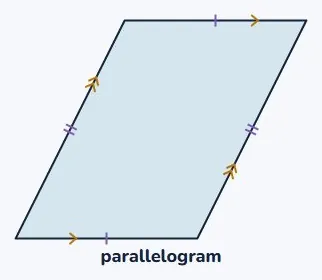
A parallelogram is a leaning rectangle
- Two pairs of parallel sides, but no right angles.
- It looks like a rectangle that has been pushed over.
- And its area turns out to be exactly the same.
Cut the end off and slide it round
- Cut straight down from the top left corner.
- That gives you a triangle. Slide it to the right end.
- It fits exactly, and now you are holding a rectangle.
| Step | Gives | |
|---|---|---|
| Cut the triangle off the left end | ||
| Slide it round to the right end | ||
| Now it is a rectangle | same area | A = bh |
Try it: cut and slide
So the area is base times height
- Nothing was added or thrown away, so the area did not change.
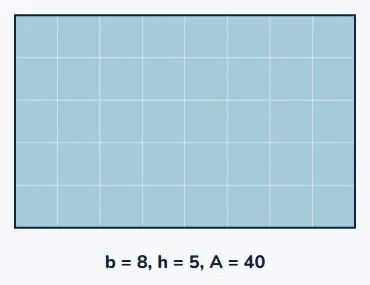
- The rectangle is b across and h up.
- A = bh. The same formula as a rectangle, because it is one.
But which length is h?
- Not the sloping side. That went into the triangle you moved.
- h is the straight-up distance between the parallel sides.
- If it is not at right angles to the base, it is not h.
| The length | Which is | Verdict |
|---|---|---|
| The slanting side | is longer | not h |
| The straight-up distance | between the parallel sides | this is h |
| If it is not at 90° | to the base | it is not h |
One worked through
- Base 8 centimetres, perpendicular height 5 centimetres.
- A = 8 × 5.
- 40 square centimetres. The slant side never appears.
| Quantity | Working | Value |
|---|---|---|
| Base | 8 cm | |
| Perpendicular height | 5 cm | |
| A = bh | 8 × 5 | 40 cm² |
Now a trapezium
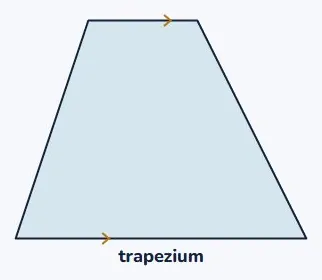
- Only one pair of parallel sides this time.
- So the top and the bottom are different lengths.
- Call them a and b, and the height between them h.
Use the average of the two
- The width changes from 10 at the bottom to 6 at the top.
- On average it is 8.
- So treat it as a rectangle 8 wide: 8 × 4 = 32.
| Step | Working | Gives |
|---|---|---|
| Parallel sides | 6 and 10 | |
| Average width | (6 + 10) ÷ 2 | 8 |
| Times the height | 8 × 4 | 32 cm² |
And that is what the formula says
- A = ½(a + b)h. Add the parallel sides, halve, times the height.
- The half and the bracket together are just "the average".
- Write ½a + bh instead and you have halved only the a.
| Written | Does | Verdict |
|---|---|---|
| A = ½(a + b)h | add first, then halve | right |
| A = ½a + bh | halves only the a | wrong |
| The bracket | is doing real work |
And h means the same thing again
- Perpendicular distance between the two parallel sides.
- Not either of the slanting edges.
- Same trap, same test: is it at right angles to the base?
| The length | Which is | Verdict |
|---|---|---|
| The slanting side | is longer | not h |
| The straight-up distance | between the parallel sides | this is h |
| If it is not at 90° | to the base | it is not h |
Every prism works the same way
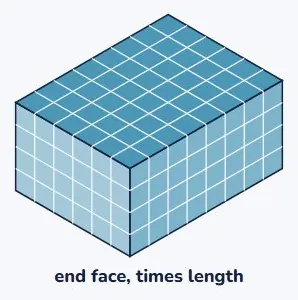
- Find the area of the end face.
- Multiply by how long the prism is.
- That is it. For every prism there is.
Shapes and nets
A triangular prism
- The end is a triangle with base 6 and height 4.
- Its area is ½ × 6 × 4, which is 12.
- The prism is 10 long, so 12 × 10 = 120 cubic centimetres.
| Step | Working | Gives |
|---|---|---|
| End face | ½ × 6 × 4 | 12 cm² |
| Length of the prism | 10 cm | |
| Volume | 12 × 10 | 120 cm³ |
Try it: a triangular prism
So V = ½bhl is not a new formula
- The ½bh part is the triangle at the end.
- The l is the length you multiply by.
- End face, times length, written out in symbols.
| Part | Is | |
|---|---|---|
| ½bh | the triangular end face | |
| l | how long the prism is | |
| ½bhl | the two multiplied |
Two shapes stuck together
- A box with a wedge on top. Split it into the two pieces.
- The box is 5 by 4 by 3, so 60 cubic centimetres.
- The wedge is ½ × 4 × 3 × 5, which is 30. Total 90.
| Part | Working | Volume |
|---|---|---|
| Rectangular part | 5 × 4 × 3 | 60 cm³ |
| Triangular part | ½ × 4 × 3 × 5 | 30 cm³ |
| Together | 60 + 30 | 90 cm³ |
Composite solids are not harder
- Split, do each piece, add. There is no fourth formula.
- They only look hard if you are carrying formulae you cannot place.
- Every piece is still end face times length.
| Step | ||
|---|---|---|
| 1. Split it into pieces you recognise | ||
| 2. Find each volume separately | ||
| 3. Add them |
Now backwards: given the area, find a length
- A parallelogram has area 40 and base 8. What is h?
- 8h = 40. That is an equation.
- Divide both sides by 8. h = 5.
| Step | Working | Gives |
|---|---|---|
| A = 40, b = 8 | so 8h = 40 | |
| Divide both sides by 8 | h = 5 | |
| Same move | as rearranging an equation |
Or given the perimeter, find the area
- A rectangle has perimeter 20 and width 4.
- Half the perimeter is one length plus one width: 10.
- So the length is 6, and the area is 24.
| Step | Working | Gives |
|---|---|---|
| Perimeter 20, width 4 | half of 20 is one length + one width | 10 |
| So the length is | 10 − 4 | 6 |
| Area | 6 × 4 | 24 cm² |
Read what was actually asked for
- These questions have two or three steps in them.
- It is easy to find the length and stop, when it wanted the area.
- Underline the last few words of the question.
| Found | Asked for | Verdict |
|---|---|---|
| the length, 6 | the area | not finished |
| the area, 24 | the area | finished |
Common mistakes
- Parallelogram base 8 cm, slanted side 6 cm, so the area is 8 × 6 = 48 cm².h must be the perpendicular height between the parallel sides, never the slanted side, so use the 5 cm height: 8 × 5 = 40 cm².
- Trapezium with a = 5, b = 9, h = 6: A = ½ × 5 + 9 × 6 = 56.5.The bracket matters: A = ½(a + b)h = ½ × 14 × 6 = 42, the average of the parallel sides times h.
- Triangular prism, triangle base 6, height 4, length 10: V = 6 × 4 × 10 = 240 cm³.The end face is a triangle, so halve it: ½ × 6 × 4 = 12, then 12 × 10 = 120 cm³.
- Perimeter 20, width 4, so the length is 16.Half the perimeter is one length plus one width, so 10 − 4 = 6 is the length, and the area is 6 × 4 = 24.
Your turn: eight questions
- Try all eight.
- Check you are using the perpendicular height in 1 and 2.
- Question 4 asks for the perimeter, not the length.
A parallelogram has base 12 cm and height 5 cm. Find its area.
A trapezium has parallel sides 5 cm and 9 cm, height 6 cm. Find its area.
A triangular prism: base 8 cm, height 3 cm, length 10 cm. Find its volume.
A rectangle has area 36 cm² and width 4 cm. Find its perimeter.
A trapezium has parallel sides a and b and perpendicular height h. Which formula gives its area?
A parallelogram has area 54 cm² and base 9 cm. What is its perpendicular height?
A garden bed in Hamilton is a trapezium with parallel sides 3 m and 5 m and area 12 m². What is its height?
A box 6 cm by 4 cm by 2 cm has a triangular prism on top: end face base 4 cm, height 3 cm, length 6 cm. Total volume?
Show answer
1. 60 cm². Base times perpendicular height. 2. 42 cm². The average of 5 and 9 is 7, and 7 × 6 = 42. 3. 120 cm³. The end face is ½ × 8 × 3 = 12, then times the length of 10. 4. 26 cm. The length is 36 ÷ 4 = 9, so the perimeter is 2 × (9 + 4). Note the question asked for the perimeter, not the length. 5. A = ½(a + b)h. Add the parallel sides, halve to get the average width, then multiply by h. 6. 6 cm. A = bh gives 9h = 54, and dividing both sides by 9 gives h = 6. 7. 3 m. The average of 3 and 5 is 4, so 4h = 12 and h = 3. 8. 84 cm³. The box is 6 × 4 × 2 = 48 and the prism is ½ × 4 × 3 × 6 = 36, so 48 + 36 = 84.
The answers
- 12 × 5 is 60 square centimetres.
- The average of 5 and 9 is 7, and 7 × 6 is 42.
- The prism is 120 cubic centimetres. And the perimeter is 26.
| Answer | |
|---|---|
| 1 | 60 cm² |
| 2 | 42 cm² |
| 3 | 120 cm³ |
| 4 | 26 cm |
What to take away
- h is always the perpendicular height, never the slanting side.
- A trapezium is the average of its parallel sides, times h.
- And every prism is its end face area, times its length.
| Remember | |
|---|---|
| h | is always the perpendicular height |
| Parallelogram | A = bh, a rectangle rearranged |
| Trapezium | average the parallel sides, times h |
| Any prism | end face area, times length |
| Composite | split it, do each part, add |
Challenge
A parallelogram has sides of 10 cm and 6 cm. The perpendicular distance between its two 10 cm sides is 4.8 cm. (a) Find the perpendicular distance between its two 6 cm sides. (b) Explain why no parallelogram with sides 10 cm and 6 cm can have an area bigger than 60 cm².
Hint
The area is the same whichever side you call the base. For (b), compare the height with the slanting side it sits beside.
Answer
(a) 8 cm. (b) The height between the 10 cm sides can never be more than the 6 cm slanting side, so the area is at most 10 × 6 = 60 cm², reached only when the shape is a rectangle.
Step by step
- Using the 10 cm side as the base, the area is 10 × 4.8 = 48 cm².
- Using a 6 cm side as the base gives the same area, so 6 × h = 48.
- That gives h = 8 cm.
- The perpendicular height is the straight-up distance, and the 6 cm side leans, so the height is never longer than 6 cm.
- So the area with base 10 is at most 10 × 6 = 60 cm², and only a rectangle (no lean) reaches it.
Full working
- A = 10 × 4.8 = 48 cm²base 10, height 4.8
- 6 × h = 48same area with base 6
- h = 48 ÷ 6 = 8 cmdivide both sides by 6
- height between 10 cm sides ≤ 6 cmthe slant side is the longest way across
- A ≤ 10 × 6 = 60 cm²equal only for a rectangle
- (a) 8 cm; (b) the height is at most 6 cm, so the area is at most 60 cm²
A trapezium ABCD has AD parallel to BC. The top side AD is 4 cm, the bottom side BC is 12 cm, and the height is 6 cm. A straight cut is made from A to a point P on BC, so that the trapezium is split into two pieces of equal area. How far is P from B? What kind of shape is the piece APCD?
Hint
Find the area of the whole trapezium, then halve it. The piece ABP is a triangle with its base on BC.
Answer
BP = 8 cm. APCD is a parallelogram (AD and PC are both 4 cm and parallel), with area 24 cm².
Step by step
- The trapezium's area is the average of 4 and 12, times 6: 8 × 6 = 48 cm².
- Each piece must be 24 cm².
- Triangle ABP has base BP and the same height, 6 cm, so ½ × BP × 6 = 24, giving BP = 8 cm.
- Then PC = 12 − 8 = 4 cm, the same as AD, and PC is parallel to AD.
- A shape with one pair of sides both equal and parallel is a parallelogram; check its area: 4 × 6 = 24 cm².
Full working
- A = ½(4 + 12) × 6 = 48 cm²trapezium formula
- 48 ÷ 2 = 24 cm²each piece
- ½ × BP × 6 = 24, so 3 × BP = 24triangle ABP
- BP = 8 cmdivide by 3
- PC = 12 − 8 = 4 = AD, and PC is parallel to ADso APCD is a parallelogram
- 4 × 6 = 24 cm²check
- BP = 8 cm; APCD is a parallelogram
A water trough is a triangular prism 2 m long. Its end is an upside-down triangle, 40 cm wide across the top and 30 cm deep at the middle. (a) How many litres does the full trough hold? (b) The water is only half as deep as the trough, 15 cm. How many litres are in it, and how many more litres are needed to fill it?
Hint
The water's end face is a smaller triangle of exactly the same shape. If its depth is half, what is its width?
Answer
(a) 120 L. (b) 30 L, so 90 L more is needed. Half the depth holds only a quarter of the water.
Step by step
- The end triangle has area ½ × 40 × 30 = 600 cm², and the trough is 200 cm long.
- Full volume: 600 × 200 = 120 000 cm³, which is 120 L.
- The water's end is the same shape scaled by ½, so it is 20 cm wide and 15 cm deep.
- Its area is ½ × 20 × 15 = 150 cm², and 150 × 200 = 30 000 cm³ = 30 L.
- To fill it, 120 − 30 = 90 L more is needed. Halving both the width and the depth makes the end face a quarter of the size.
Full working
- ½ × 40 × 30 = 600 cm²end face of the trough
- 600 × 200 = 120 000 cm³ = 120 L2 m = 200 cm, 1000 cm³ = 1 L
- scale factor ½: width 20 cm, depth 15 cmsame shape, half the size
- ½ × 20 × 15 = 150 cm²water's end face
- 150 × 200 = 30 000 cm³ = 30 Lwater in the trough
- 120 − 30 = 90 Lstill needed
- (a) 120 L; (b) 30 L in it, 90 L more to fill