Volume, capacity and converting units
What this lesson covers
- Liquids can be measured by capacity and by volume; there are standard conversions between measurements, in particular 1 mL = 1 cm³, 1L = 1000 cm³, and 1 m³ = 1000 L.
Two words that sound like one thing
- Volume is how much space something takes up.
- Capacity is how much a container can hold.
- Related, and measured in different units. Usually.
| Word | Means | Measured in |
|---|---|---|
| Volume | space a thing takes up | cm³, m³ |
| Capacity | what a container holds | mL, L |
And the bridge between them
- One millilitre is exactly one cubic centimetre.
- Not roughly. Exactly, by definition.
- So capacity and volume are the same quantity, relabelled.
| Word | Means | Measured in |
|---|---|---|
| Volume | space a thing takes up | cm³, m³ |
| Capacity | what a container holds | mL, L |
| Bridge | 1 mL is exactly 1 cm³ |
Start with lengths, which you know
- A centimetre is 10 millimetres.
- A metre is 100 centimetres.
- A kilometre is 1000 metres. Nothing new yet.
| Unit | Equals | |
|---|---|---|
| 1 cm | 10 mm | |
| 1 m | 100 cm | |
| 1 km | 1000 m |
So is a square centimetre 10 square millimetres?
- It is the obvious guess, and it is wrong.
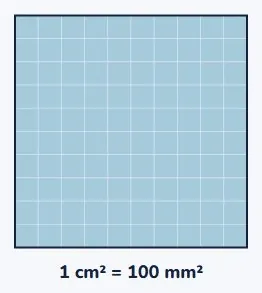
- Draw the square centimetre and cut it into millimetre squares.
- Count them. There are a hundred.
Because a square has two directions
- It is 10 millimetres across and 10 millimetres down.
- 10 times 10 is 100.
- The factor got used twice, because area has two dimensions.
| Question | Working | Answer |
|---|---|---|
| 1 cm is 10 mm | so is 1 cm² = 10 mm²? | no |
| Count the grid | 10 rows of 10 | 100 |
| 1 cm² | 100 mm² |
One rule for everything that follows
- For lengths, use the factor once.
- For areas, twice. For volumes, three times.
- The little 2 or 3 in the unit tells you how many.
| Measuring | Then | Factor |
|---|---|---|
| Length | use the factor once | × 10 |
| Area | use it twice | × 10 × 10 = 100 |
| Volume | use it three times | × 10 × 10 × 10 = 1000 |
Try it: why it is 100, not 10
Which gives you every area conversion
- Cm² to mm²: 10 squared, so times 100.
- m² to cm²: 100 squared, so times 10 000.
- Km² to m²: 1000 squared, so times a million.
| Going from | Because | Multiply by |
|---|---|---|
| cm² to mm² | 10² | × 100 |
| m² to cm² | 100² | × 10 000 |
| km² to m² | 1000² | × 1 000 000 |
And every volume one
- Cm³ to mm³: 10 cubed, so times 1000.
- m³ to cm³: 100 cubed, which is a million.
- Nothing memorised. All of it rebuilt from 10, 100 and 1000.
| Going from | Because | Multiply by |
|---|---|---|
| cm³ to mm³ | 10³ | × 1000 |
| m³ to cm³ | 100³ | × 1 000 000 |
Going back, you divide by the same number
- Mm² to cm² is dividing by 100, not by 10.
- The factor does not change direction. Only the operation does.
- 300 mm² is 3 cm². Not 30.
| Conversion | Do | Example |
|---|---|---|
| cm² to mm² | × 100 | 3 cm² = 300 mm² |
| mm² to cm² | ÷ 100 | 300 mm² = 3 cm² |
Now build a cube
- Start with a square 10 centimetres each way.
- That face is 100 square centimetres.
- Now stack ten of those layers on top of each other.
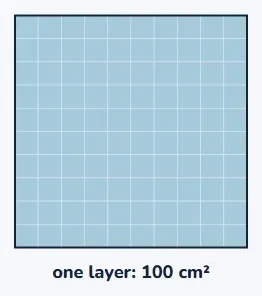
That cube holds exactly one litre
- 10 × 10 × 10 is 1000 cubic centimetres.
- And a cubic centimetre is a millilitre, so 1000 millilitres.
- Which is one litre. Check it against a milk bottle.
| Step | Working | Gives |
|---|---|---|
| A cube 10 cm each way | 10 × 10 × 10 | 1000 cm³ |
| And 1 cm³ is 1 mL | so that is | 1000 mL |
| Which is | 1 litre |
Try it: litres and millilitres
And a cubic metre holds a thousand
- A metre is 100 centimetres, so 100 cubed is a million cm³.
- A million cubic centimetres is a million millilitres.
- Divide by 1000 and that is 1000 litres.
| Step | Working | Gives |
|---|---|---|
| 1 m³ | in cubic centimetres | 1 000 000 cm³ |
| That is | in millilitres | 1 000 000 mL |
| So 1 m³ | 1000 L |
Three conversions, start to finish
- 5 m² to cm²: the factor is 100 squared, so 50 000.
- 2.5 litres to cm³: times 1000, so 2500.
- 3 m³ to litres: times 1000, so 3000.
| Convert | Working | Answer |
|---|---|---|
| 5 m² to cm² | 5 × 10 000 | 50 000 cm² |
| 2.5 L to cm³ | 2.5 × 1000 | 2500 cm³ |
| 3 m³ to L | 3 × 1000 | 3000 L |
One going the other way
- 250 cubic centimetres. That is 250 millilitres.
- To get litres, divide by 1000.
- 0.25 litres. A small glass of something.
| Step | Working | Gives |
|---|---|---|
| 250 cm³ | same as | 250 mL |
| 250 mL | ÷ 1000 | 0.25 L |
Picking a unit that fits
- A swimming pool in millilitres is a silly number.
- A dose of medicine in litres is worse.
- Choose the unit that gives a number you can say out loud.
| Measuring | Not | Use |
|---|---|---|
| A swimming pool | not litres | m³ |
| A dose of medicine | not litres | mL |
| A farm | not m² | hectares or km² |
| A pencil lead | not cm | mm |
And having something to compare against
- A litre is that ten centimetre cube. A milk bottle.
- A square metre is about a small table top.
- If your answer is wildly off those, check the factor.
| Unit | Roughly | |
|---|---|---|
| 1 litre | a milk bottle | |
| 1 m² | a small table top | |
| 1 m³ | a large fridge |
Common mistakes
- 1 cm = 10 mm, so 1 cm² = 10 mm².Area uses the factor twice: 10 × 10 = 100, so 1 cm² = 100 mm².
- 300 mm² = 30 cm².Going from mm² to cm² divides by 10² = 100, not by 10, so 300 mm² = 3 cm².
- 1 m³ = 100 cm³, so 2 m³ is 200 mL.Volume uses the factor three times: 100³ = 1 000 000 cm³ in 1 m³, which is 1000 L, so 2 m³ = 2000 L.
- 4 m² = 400 cm².1 m² is 100 × 100 = 10 000 cm², so 4 m² = 40 000 cm².
Your turn: eight questions
- Try all eight.
- For each one, ask whether it is area or volume first.
- Question 4 goes backwards, so you will be dividing.
Convert 4 m² into cm².
Convert 1.5 L into cm³.
Convert 2 m³ into litres.
Convert 300 mm² into cm².
Which unit best suits the amount of water in a backyard swimming pool?
Convert 2 cm³ into mm³.
A bottle of feijoa juice holds 750 cm³. How many litres is that?
A fish tank is 50 cm long, 30 cm wide and 20 cm high. How many litres does it hold when full?
Show answer
1. 40 000 cm². The factor is 100 squared, which is 10 000. 2. 1500 cm³. A litre is 1000 cm³. 3. 2000 L. A cubic metre is 1000 litres. 4. 3 cm². Going the other way you divide, and the factor is still 100, not 10. The commonest wrong answer is 30. 5. m³. A backyard pool holds tens of cubic metres; mL, cm³ and mm³ would give numbers in the millions or more. 6. 2000 mm³. For volume the factor 10 is used three times, 10 × 10 × 10 = 1000, and 2 × 1000 = 2000. 7. 0.75 L. 750 cm³ is 750 mL, and dividing by 1000 gives 0.75 litres. 8. 30 L. The volume is 50 × 30 × 20 = 30 000 cm³, which is 30 000 mL, and dividing by 1000 gives 30 litres.
The answers
- 4 m² is 40 000 cm². And 1.5 litres is 1500 cm³.
- 2 m³ is 2000 litres.
- 300 mm² is 3 cm². Dividing by 100, not by 10.
| Answer | |
|---|---|
| 1 | 40 000 cm² |
| 2 | 1500 cm³ |
| 3 | 2000 L |
| 4 | 3 cm² |
What to take away
- Square the length factor for area, cube it for volume.
- A millilitre is exactly a cubic centimetre.
- And a ten centimetre cube holds exactly one litre.
| Remember | |
|---|---|
| Area | square the length factor |
| Volume | cube it |
| 1 mL | is exactly 1 cm³ |
| A 10 cm cube | holds exactly 1 litre |
| 1 m³ | is 1000 litres |
Challenge
A solid cube with edges of 1 m is cut up into tiny cubes with edges of 1 mm. (a) How many tiny cubes are there? (b) If every tiny cube were placed in one straight line, touching end to end, how long would the line be in km? (c) If instead they were laid flat in a single layer, with no gaps, what area would they cover in m²?
Hint
1 m is 1000 mm. For (b), each cube adds 1 mm to the line. For (c), each cube covers 1 mm².
Answer
(a) 1 000 000 000 (a thousand million) cubes. (b) 1000 km. (c) 1000 m².
Step by step
- 1 m is 1000 mm, so the cube is 1000 tiny cubes long, 1000 wide and 1000 high.
- That is 1000 × 1000 × 1000 = 1 000 000 000 tiny cubes.
- In a line, each one adds 1 mm, so the line is 1 000 000 000 mm. Divide by 1000 for metres and by 1000 again for km: 1000 km.
- In a layer, each one covers 1 mm². 1 m² is 1000 × 1000 = 1 000 000 mm².
- So 1 000 000 000 mm² is 1000 m².
Full working
- 1 m = 1000 mmlength factor
- 1000 × 1000 × 1000 = 1 000 000 000volume uses the factor three times
- 1 000 000 000 mm ÷ 1000 = 1 000 000 mmm to m
- 1 000 000 m ÷ 1000 = 1000 kmm to km
- 1 m² = 1000 × 1000 = 1 000 000 mm²area uses the factor twice
- 1 000 000 000 ÷ 1 000 000 = 1000 m²mm² to m²
- (a) 1 000 000 000 cubes; (b) 1000 km; (c) 1000 m²
Hemi buys 24 bags of concrete mix. Each bag makes 15 L of concrete. He uses all of it to lay a flat path that is 8 m long and 60 cm wide. How thick is the path, in mm?
Hint
Change everything into metres and cubic metres first. Volume of a flat slab is length × width × thickness.
Answer
75 mm.
Step by step
- The bags make 24 × 15 = 360 L of concrete.
- 1 m³ is 1000 L, so 360 L is 0.36 m³.
- The top of the path is 8 m by 0.6 m, which is 4.8 m².
- Volume = area of the top × thickness, so the thickness is 0.36 ÷ 4.8 = 0.075 m.
- 0.075 m is 75 mm.
Full working
- 24 × 15 = 360 Ltotal concrete
- 360 ÷ 1000 = 0.36 m³1 m³ = 1000 L
- 60 cm = 0.6 m; 8 × 0.6 = 4.8 m²top of the path
- thickness = 0.36 ÷ 4.8 = 0.075 mvolume ÷ area
- 0.075 × 1000 = 75 mmm to mm
- The path is 75 mm thick
A cube is built so that its volume, measured in mL, is exactly the same number as its total surface area, measured in mm². How long is each edge of the cube? Give the edge in metres, and the cube's capacity in litres.
Hint
Call the edge s cm. Write the volume in mL and the surface area in mm², both using s. Then compare s × s × s with the other expression.
Answer
Each edge is 6 m, and the cube holds 216 000 L.
Step by step
- Let each edge be s cm. The volume is s × s × s cm³, which is the same number of mL.
- A cube has 6 square faces, so its surface area is 6 × s × s cm².
- Each cm² is 100 mm², so the surface area is 600 × s × s mm².
- We need s × s × s = 600 × s × s. Both sides share s × s, so s = 600 cm, which is 6 m.
- The volume is 600 × 600 × 600 = 216 000 000 cm³ = 216 000 000 mL, which is 216 000 L.
Full working
- volume = s × s × s cm³ = s × s × s mL1 cm³ = 1 mL
- surface area = 6 × s × s cm²six square faces
- 6 × s × s cm² = 600 × s × s mm²1 cm² = 100 mm²
- s × s × s = 600 × s × s, so s = 600divide both sides by s × s
- 600 cm = 6 medge
- 600³ = 216 000 000 mL; ÷ 1000 = 216 000 Lcapacity
- Edge 6 m; capacity 216 000 L