Volume, formulae and working with time
What this lesson covers
- Measurement formulae for perimeter are: for a square P = 4l, for a rectangle P = 2(l + w).
- Measurement formulae for area are: for a triangle A = bh/2, for a square A = l², for a rectangle A = lw.
- Measurement formulae for volume are: for a cube V = l³, for a rectangular prism V = lwh.
- Duration questions can involve fractions of time and converting between units of time.
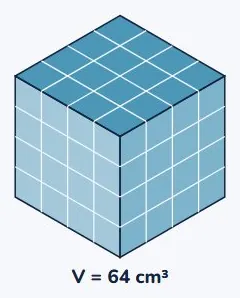
A cube holds 64 cm³. How long is one edge?
- Not 64 ÷ 3. That is not what cubing does.
- You need a number that times itself three times gives 64.
- And there is a short list of those.
Every formula, in one place
- Perimeter, area and volume for the shapes you need.
- Worth copying out once and keeping.
- Notice volume only appears for the 3D ones.
| Shape | Perimeter | Area or volume |
|---|---|---|
| Square | P = 4l | A = l² |
| Rectangle | P = 2(l + w) | A = lw |
| Triangle | Add the sides | A = bh ÷ 2 |
| Cube | Not needed | V = l³ |
| Rectangular prism | Not needed | V = lwh |
Volume of a rectangular prism
- Length times width gives the base.
- Times the height stacks it up.
- V = lwh: all three, multiplied.
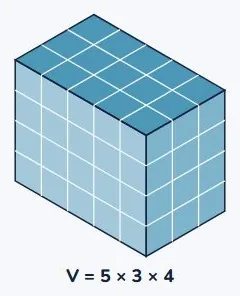
5 by 3 by 4
- The base layer is 5 × 3 = 15 cubes.
- Four layers of those.
- 60 cm³.
| Step | Working | Answer |
|---|---|---|
| Formula | V = lwh | |
| Put in | 5 × 3 × 4 | |
| Volume | 60 cm³ |
Try it: length × width × height
Backwards: find the height
- Volume 60, base 5 by 3.
- The base is 15, so 60 = 15h.
- Divide both sides by 15. h = 4 cm.
| Step | Working | Answer |
|---|---|---|
| Known | 60 = 5 × 3 × h | |
| The base is | 5 × 3 = 15 | |
| So | 60 = 15h | |
| Divide both by 15 | h = 4 | 4 cm |
A cube is the easy case and the hard one
- All three edges are the same, so V = l³.
- Forwards that is very easy.
- Backwards there is no single step to undo it.
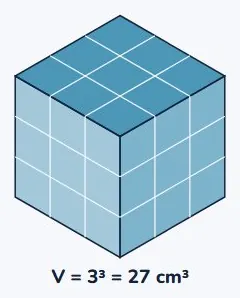
The cube numbers
- Six of them cover almost every question you will meet.
- 1, 8, 27, 64, 125, 216.
- Recognise 64 and the answer is 4.
| Written | Means | Value |
|---|---|---|
| 1³ | 1 × 1 × 1 | 1 |
| 2³ | 2 × 2 × 2 | 8 |
| 3³ | 3 × 3 × 3 | 27 |
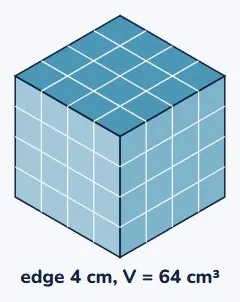
| 4³ | 4 × 4 × 4 | 64 |
| 5³ | 5 × 5 × 5 | 125 |
| 6³ | 6 × 6 × 6 | 216 |
So the opening question
- Volume 64. Look it up: 64 is 4³.
- So each edge is 4 cm.
- Check: 4 × 4 × 4 = 64.
Now the strange one: time
- Every other unit this year has worked in tens.
- 1000 m in a km. 100 cm in a metre.
- Time does none of that.
| One | Is |
|---|---|
| 1 minute | 60 seconds |
| 1 hour | 60 minutes |
| 1 day | 24 hours |
| 1 week | 7 days |
Sixty, and twenty-four, and seven
- 60 seconds. 60 minutes. 24 hours. 7 days.
- No shifting digits. No cancelling zeros.
- So every conversion has to be done properly.
| One | Is |
|---|---|
| 1 minute | 60 seconds |
| 1 hour | 60 minutes |
| 1 day | 24 hours |
| 1 week | 7 days |
2.5 hours is not 2 hours 50 minutes
- With kilometres, 2.5 km really is 2 km and 500 m.
- With hours, 0.5 of an hour is 30 minutes.
- So 2.5 hours is 2 h 30 min. That is 150 minutes.
| This | That | |
|---|---|---|
| 2.5 hours | is NOT | 2 h 50 min |
| 0.5 of an hour | is | 30 minutes |
| So 2.5 hours | is | 2 h 30 min = 150 min |
Fractions of an hour
- Half an hour is 30 minutes.
- A quarter is 15. So three quarters is 45.
- And a third of an hour is 20 minutes.
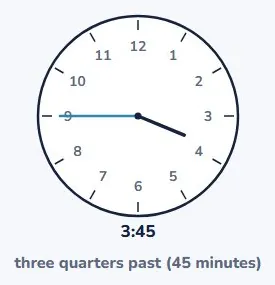
The ones that come up
- Divide 60 by the bottom, times by the top.
- The same rule as any fraction of an amount.
- The amount just happens to be 60.
| Fraction | Working | Minutes |
|---|---|---|
| 1/2 hour | 60 ÷ 2 | 30 min |
| 1/4 hour | 60 ÷ 4 | 15 min |
| 3/4 hour | 15 × 3 | 45 min |
| 1/3 hour | 60 ÷ 3 | 20 min |
How long from 9:45 to 13:20?
- Do not try to subtract in columns.
- Borrowing sixty instead of ten goes wrong constantly.
- Count up instead, the same way you did change.
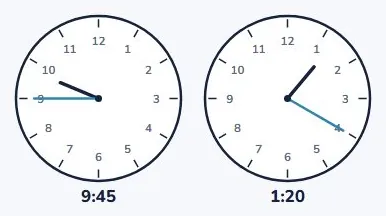
Counting up in chunks
- 9:45 to 10:00 is 15 minutes.
- 10:00 to 13:00 is 3 hours.
- 13:00 to 13:20 is 20 minutes. Total 3 h 35 min.
| From, to | Working | Adds |
|---|---|---|
| 9:45 to 10:00 | 15 min | |
| 10:00 to 13:00 | 3 hours | |
| 13:00 to 13:20 | 20 min | |
| Total | 3 h + 35 min | 3 h 35 min |
Try it: count up in chunks
Reading a timetable
- Rows are stops. Columns are buses.
- Read down a column to follow one bus.
- Read across a row to compare buses at one stop.
| Stop | Bus A | Bus B |
|---|---|---|
| Avondale | 7:52 | 8:22 |
| New Lynn | 8:09 | 8:39 |
| Henderson | 8:37 | 9:07 |
How long does Bus A take?
- Avondale at 7:52, Henderson at 8:37.
- 7:52 to 8:00 is 8 minutes.
- 8:00 to 8:37 is 37. Total 45 minutes.
| Stop | Bus A | Bus B |
|---|---|---|
| Avondale | 7:52 | 8:22 |
| New Lynn | 8:09 | 8:39 |
| Henderson | 8:37 | 9:07 |
Common mistakes
- A cube holds 64 cm³, so each edge is 64 ÷ 3 ≈ 21.3 cm.V = l³ means l × l × l, so find the number that cubes to 64: 4 × 4 × 4 = 64, so the edge is 4 cm.
- 2.5 hours is 2 hours 50 minutes.0.5 of an hour is half of 60 minutes, so 2.5 hours is 2 h 30 min, which is 150 minutes.
- 13:20 − 9:45 in columns gives 3 h 75 min, so 4 h 15 min.Hours borrow 60, not 100, so count up instead: 15 min to 10:00, 3 h to 13:00, 20 min more is 3 h 35 min.
- Volume 60, base 5 by 3, so the base is 5 + 3 = 8 and the height is 60 ÷ 8 = 7.5 cm.The base area is 5 × 3 = 15, not 5 + 3, so 60 = 15h and h = 4 cm.
Your turn: eight questions
- Try all eight.
- On question 1, use the cube number list.
- On question 4, count up. Do not subtract.
A cube has volume 125 cm³. How long is one edge?
A prism is 6 cm by 4 cm by h, and holds 96 cm³. Find h.
Convert 3.25 hours to minutes.
A train leaves at 10:48 and arrives at 13:15. How long is the trip?
Convert 1 3/4 hours to minutes.
A movie at a Hamilton cinema runs for 200 minutes. Write that in hours and minutes.
A ferry leaves at 9:35 and arrives at 10:20. A later ferry takes just as long and leaves at 11:50. When does it arrive?
A cube-shaped box has edges of 6 cm. How many 2 cm cubes fit inside it?
Show answer
1. 5 cm, because 5 × 5 × 5 = 125. 2. 4 cm. The base is 6 × 4 = 24, and 96 ÷ 24 = 4. 3. 195 minutes. 3 hours is 180, and 0.25 of an hour is 15. 4. 2 hours 27 minutes. 12 minutes to 11:00, then 2 hours to 13:00, then 15 minutes. 5. 105 minutes. 1 hour is 60 minutes and 3/4 of an hour is 60 ÷ 4 × 3 = 45 minutes, so 60 + 45 = 105. 6. 3 h 20 min. 3 hours is 180 minutes, and 200 − 180 leaves 20 minutes. 7. 12:35. Count up: 9:35 to 10:00 is 25 minutes, then 20 more, so the trip is 45 minutes, and 11:50 plus 45 minutes is 12:35. 8. 27. The box holds 6 × 6 × 6 = 216 cm³ and each small cube is 2 × 2 × 2 = 8 cm³, so 216 ÷ 8 = 27 (3 along each edge, and 3³ = 27).
The answers
- 125 is 5³, so the edge is 5 cm. And h is 4 cm.
- 3.25 hours is 180 + 15 = 195 minutes.
- The train takes 2 hours 27 minutes.
| Answer | |
|---|---|
| 1 | 5 cm |
| 2 | 4 cm |
| 3 | 195 minutes |
| 4 | 2 h 27 min |
What to take away
- Volume backwards: divide by the other two, or use a cube number.
- Time does not work in tens. 2.5 hours is 150 minutes.
- For elapsed time, count up in chunks.
| Remember | |
|---|---|
| V = lwh | and backwards, divide by the other two |
| V = l³ | backwards needs a cube root |
| Cube numbers | 1, 8, 27, 64, 125, 216 |
| Time | does not work in tens |
| Elapsed time | count up, never subtract |
Challenge
Hine has two solid cubes of candle wax. The edge of the big cube is 2 cm longer than the edge of the small cube, and the big cube holds 98 cm³ more wax than the small one. Both edges are whole numbers of centimetres. She melts both cubes and pours all the wax into a mould shaped like a rectangular prism with a square base 4 cm by 4 cm. How deep is the wax in the mould?
Hint
Write out the cube numbers 1, 8, 27, 64, 125, 216 and look for two that are two places apart in the list and differ by 98.
Answer
9.5 cm (the cubes have edges 3 cm and 5 cm)
Step by step
- The edges are two apart, so look at cube numbers two places apart in the list.
- 1 and 27 differ by 26, 8 and 64 by 56, 27 and 125 by 98, 64 and 216 by 152. Only 27 and 125 work.
- So the cubes have edges 3 cm and 5 cm, and together they hold 27 + 125 = 152 cm³ of wax.
- The mould's base is 4 × 4 = 16 cm², so 152 = 16 × depth.
- Divide by 16 to get the depth: 9.5 cm.
Full working
- 27 − 1 = 26, 64 − 8 = 56, 125 − 27 = 98, 216 − 64 = 152cube numbers two places apart
- edges 3 cm and 5 cm3³ = 27 and 5³ = 125
- 27 + 125 = 152 cm³total wax
- base = 4 × 4 = 16 cm²square base
- 152 = 16 × hV = lwh
- h = 152 ÷ 16 = 9.5divide by the base
- depth = 9.5 cm
Aroha, Ben and Chen share the driving from Auckland to Wellington. They leave at 6:40 am and arrive at 3:35 pm the same day. They make three stops that take 55 minutes altogether, and someone is driving the whole of the rest of the time. Aroha drives for 13 of the driving time and Chen drives for 0.4 of the driving time. Ben drives the rest. How long does Ben drive? Chen says he drove for 3.12 hours. Explain what is wrong with that, and give the correct number of hours as a decimal.
Hint
First find the whole trip time by counting up, then take off the stops. A tenth of an hour is 6 minutes.
Answer
Ben drives 2 hours 8 minutes. Chen drove 3 h 12 min, which is 3.2 hours, not 3.12 hours.
Step by step
- Count up from 6:40 am to 3:35 pm: 20 minutes to 7:00, 8 hours to 3:00 pm, then 35 minutes. That is 8 h 55 min, or 535 minutes.
- Take off the 55 minutes of stops: 480 minutes of driving, which is exactly 8 hours.
- Aroha drives 13 of 480 = 160 minutes. Chen drives 0.4 of 480 = 192 minutes.
- Ben drives 480 − 160 − 192 = 128 minutes, which is 2 h 8 min.
- Chen's 192 minutes is 3 h 12 min. He has written the 12 minutes as .12, but hours do not work in hundredths. 12 minutes is 1260 = 0.2 of an hour, so he drove 3.2 hours.
Full working
- 6:40 to 7:00 = 20 min, 7:00 to 15:00 = 8 h, 15:00 to 15:35 = 35 mincount up in chunks
- 8 h 55 min = 480 + 55 = 535 minwhole trip
- 535 − 55 = 480 mindriving time
- Aroha: 480 ÷ 3 = 160 min13 of the driving
- Chen: 0.4 × 480 = 192 min = 3 h 12 min0.4 of the driving
- Ben: 480 − 160 − 192 = 128 minthe rest
- 12 min = 1260 h = 0.2 h, so 3 h 12 min = 3.2 hhours are sixtieths, not hundredths
- Ben drives 2 h 8 min; Chen drove 3.2 hours
A farm's rainwater tank is a rectangular prism. Its top has an area of 4800 cm², its front has an area of 3000 cm² and its side has an area of 4000 cm². Every edge is a whole number of centimetres. Find the length, width and height of the tank and its volume. The tank starts empty at 11:50 am and a pump fills it at 2.4 litres per minute (1 litre is 1000 cm³). At what time is it full?
Hint
Each of the three areas is a product of two of the three edges, and every pair of areas shares one edge. Try factor pairs of 3000 and check them against the other two areas.
Answer
80 cm by 60 cm by 50 cm, volume 240,000 cm³ (240 L); full at 1:30 pm
Step by step
- The top is length × width, the front is length × height and the side is width × height, so every edge appears in exactly two of the areas.
- Try factor pairs of 3000 for length × height. With length 60 and height 50, the side needs width × 50 = 4000, so the width is 80. Then the top is 60 × 80 = 4800, which matches. Other pairs, such as 75 and 40, fail one of the checks.
- So the edges are 80 cm, 60 cm and 50 cm, and the volume is 80 × 60 × 50 = 240,000 cm³.
- A quick check: 4800 × 3000 × 4000 is the same as the volume times itself, and 240,000 × 240,000 does give that.
- 240,000 cm³ is 240 litres. At 2.4 litres per minute, that takes 240 ÷ 2.4 = 100 minutes, which is 1 h 40 min.
- Count up from 11:50 am: 10 minutes to 12:00, then 1 h 30 min more. It is full at 1:30 pm.
Full working
- front: 60 × 50 = 3000try length 60, height 50
- side: 80 × 50 = 4000so the width is 80
- top: 80 × 60 = 4800matches, so the edges are 80, 60 and 50 cm
- V = 80 × 60 × 50 = 240,000 cm³V = lwh
- check: 4800 × 3000 × 4000 = 57,600,000,000 = 240,000 × 240,000each edge used twice
- 240,000 ÷ 1000 = 240 L1 L = 1000 cm³
- 240 ÷ 2.4 = 100 min = 1 h 40 mintime to fill
- 11:50 + 10 min = 12:00, + 1 h 30 min = 13:30count up
- 80 cm × 60 cm × 50 cm, 240,000 cm³, full at 1:30 pm