Classifying triangles by angles and sides
What this lesson covers
- Triangles can be categorised by their angles. An acute triangle has three acute angles. A right triangle has one right angle. An obtuse triangle has one obtuse angle.
- Triangles can also be categorised by their sides. An equilateral triangle has three equal-length sides. An isosceles triangle has at least two equal-length sides. A scalene triangle has different measures for each side length.
- All angles in an equilateral triangle are 60°.
- The base angles (opposite the equal sides) of an isosceles triangle are equal.
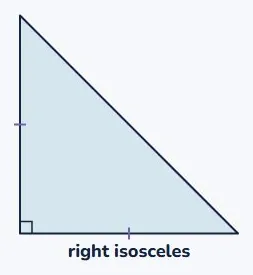
This triangle has two names
- One right angle, so it is a right triangle.
- Two equal sides, so it is also isosceles.
- Both at once, and neither one cancels the other.
Two separate questions
- What are its angles like?
- What are its sides like?
- You answer both, every time.
| Question | Possible answers |
|---|---|
| About the angles | acute, right, obtuse |
| About the sides | equilateral, isosceles, scalene |
The three angle names
- Acute: every angle under 90°.
- Right: exactly one angle of 90°.
- Obtuse: one angle over 90°.
| Name | Means |
|---|---|
| Acute | all three angles under 90° |
| Right | exactly one angle of 90° |
| Obtuse | one angle over 90° |
Only one angle can be 90 or more
- The three angles have to total 180°.
- Two 90s would use all of it, leaving nothing.
- So right and obtuse are never both true.
Try it: drag the corners
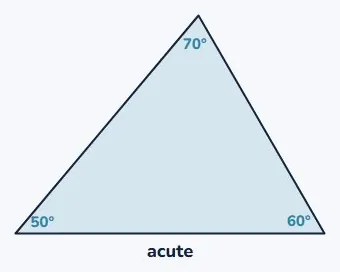
Acute: all three under 90
- 50, 60 and 70: every one of them under 90.
- They still add to 180.
- So this is an acute triangle.
The three side names
- Equilateral: all three sides equal.
- Isosceles: at least two equal.
- Scalene: all three different.
| Name | Means |
|---|---|
| Equilateral | all three sides equal |
| Isosceles | at least two sides equal |
| Scalene | all three sides different |
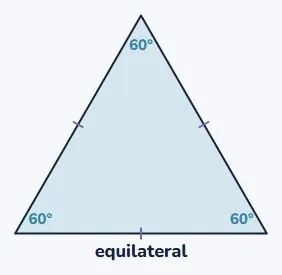
Equilateral
- Three equal sides, marked with matching ticks.
- And every angle is 60°.
- Because 180 shared equally three ways is 60.
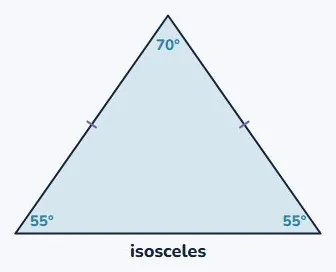
Isosceles, and its equal base angles
- Two equal sides, marked with ticks.
- The angles opposite them are equal too.
- 55 and 55, with 70 at the top.
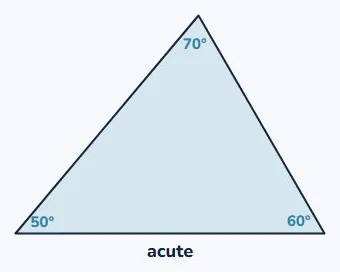
The same triangle, marked for angles
- Here are its angles: 50, 60, 70.
- All under 90, so it is acute.
- That is the angle answer.
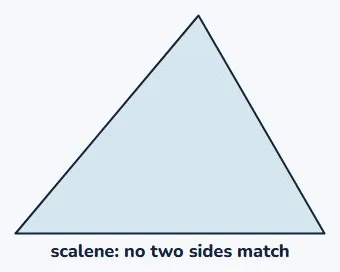
And now marked for sides
- Same triangle. No ticks anywhere.
- Because no two sides are the same length.
- Scalene. So the full name is acute scalene.
Three by three
- Three angle names across, three side names down.
- Nine possible combinations.
- Seven of them exist.
| Equilateral | Isosceles | Scalene | |
|---|---|---|---|
| Acute | yes (60/60/60) | yes (55/55/70) | yes (50/60/70) |
| Right | IMPOSSIBLE | yes (90/45/45) | yes (90/60/30) |
| Obtuse | IMPOSSIBLE | yes (100/40/40) | yes (100/50/30) |
Two boxes are empty
- There is no right equilateral triangle.
- And no obtuse equilateral triangle either.
- Not rare. Impossible.
| Equilateral | Isosceles | Scalene | |
|---|---|---|---|
| Acute | yes (60/60/60) | yes (55/55/70) | yes (50/60/70) |
| Right | IMPOSSIBLE | yes (90/45/45) | yes (90/60/30) |
| Obtuse | IMPOSSIBLE | yes (100/40/40) | yes (100/50/30) |
Why they cannot exist
- Three equal sides force three equal angles.
- They must total 180, so each is 60.
- 60 is under 90, so it is always acute.
| Because | It follows | |
|---|---|---|
| Three equal sides | means three equal angles | |
| They must total | 180° | |
| So each is | 180 ÷ 3 | 60° |
| 60 is under 90 | so always acute |
Geometry board
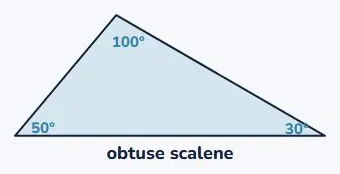
Name this one
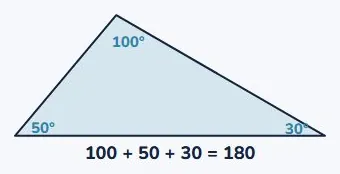
- One angle of 100, over 90, so obtuse.
- Three different angles mean three different sides.
- Obtuse scalene.
Try it: name it twice
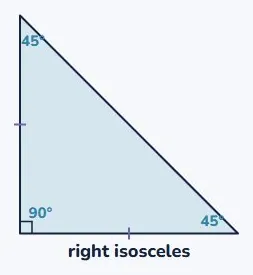
And this one
- A 90° angle, so right.
- Two ticks, so two equal sides. Isosceles.
- Right isosceles, the one we started with.
Try it: fill the grid
Common mistakes
- It has a right angle, so the answer is "right triangle". Done.Every triangle needs two names, one for its angles and one for its sides, so this one might be right isosceles.
- An isosceles triangle can't also be equilateral, because isosceles means exactly two equal sides.Isosceles means at least two equal sides, so an equilateral triangle counts as isosceles too.
- This triangle has a 90° angle and a 100° angle, so it is right and obtuse.Only one angle can be 90° or more, because 90 + 100 is already over the 180° the three angles must share.
- I can draw a right equilateral triangle if I make it big enough.It is impossible at any size: three equal sides force three 60° angles, so an equilateral triangle is always acute.
Your turn: eight questions
- Try all eight.
- Give both names wherever the question asks for them.
- Question 3 wants a reason, not just yes or no.
A triangle has sides 5, 5 and 8 cm. What is its side name?
A triangle has angles 90°, 45°, 45°. Give both its names.
Can a triangle be obtuse and equilateral? Say why.
A triangle has angles 100°, 50°, 30°. Give both its names.
An isosceles triangle has a top angle of 40°. How big is each base angle?
A triangle has angles of 35° and 55°. Give both its names.
Which statement about triangles is true?
An isosceles triangle has a base angle of 30°. Give both its names.
Show answer
1. Isosceles. Two of its sides are equal. 2. Right isosceles. One 90° angle, and two equal angles mean two equal sides. 3. No. Equilateral means three equal sides, so three equal angles, so 180 ÷ 3 = 60° each. Every angle is 60, so none can be over 90. 4. Obtuse scalene. One angle over 90, and three different angles mean three different sides. 5. 70°. The base angles are equal and share 180 − 40 = 140°, so each is 140 ÷ 2 = 70°. 6. Right scalene. The third angle is 180 − 35 − 55 = 90°, and three different angles mean three different sides. 7. A right triangle can be isosceles: 90°, 45°, 45° is one. Only one angle can be 90° or more, and equilateral is always 60/60/60. 8. Obtuse isosceles. The other base angle is also 30°, so the top angle is 180 − 60 = 120°, which is over 90°.
The answers
- 5, 5, 8 is isosceles. 90, 45, 45 is right isosceles.
- No obtuse equilateral: every angle would have to be 60.
- 100, 50, 30 is obtuse scalene.
| Answer | |
|---|---|
| 1 | isosceles |
| 2 | right isosceles |
| 3 | no, equilateral is always 60/60/60 |
| 4 | obtuse scalene |
What to take away
- Ask two questions: about the angles, about the sides.
- Equal sides always mean equal opposite angles.
- Equilateral is 60/60/60, so it can only ever be acute.
| Remember | |
|---|---|
| Two questions | what are the angles like, what are the sides like |
| By angle | acute, right, or obtuse |
| By side | equilateral, isosceles, or scalene |
| Equilateral | is always 60/60/60, so always acute |
| Isosceles | base angles are equal |
Challenge
An isosceles triangle has one angle that is exactly 4 times the size of another of its angles. Find every possible set of three angles, and give both names (by angles and by sides) for each triangle.
Hint
The two equal angles could be the smaller of the two angles in the question, or the bigger one. Try each case and use the 180° total.
Answer
Two triangles: 30°, 30°, 120° (obtuse isosceles) and 20°, 80°, 80° (acute isosceles).
Step by step
- Call the smaller angle a, so the bigger one is 4a. The third angle must match one of them.
- Case 1: the third angle is a. Then a + a + 4a = 6a = 180, so a = 30: angles 30°, 30°, 120°.
- 120° is over 90°, so that one is obtuse isosceles.
- Case 2: the third angle is 4a. Then a + 4a + 4a = 9a = 180, so a = 20: angles 20°, 80°, 80°.
- All three are under 90°, so that one is acute isosceles. It cannot be equilateral, because a and 4a are different.
Full working
- a + a + 4a = 180equal pair is the small angle
- 6a = 180, a = 30divide by 6
- 30°, 30°, 120°obtuse isosceles
- a + 4a + 4a = 180equal pair is the big angle
- 9a = 180, a = 20divide by 9
- 20°, 80°, 80°acute isosceles
- 30°, 30°, 120° obtuse isosceles; 20°, 80°, 80° acute isosceles
The sides of a triangle, in centimetres, are x + 4, 2x − 3 and 3x − 6, where x is a whole number. The triangle is isosceles. Find every possible perimeter, and say whether each triangle is equilateral or not. (Three lengths make a triangle only when the two shorter ones add to more than the longest.)
Hint
There are three ways to choose which two sides are equal. Solve each one, then check the lengths really make a triangle.
Answer
Two perimeters are possible: 37 cm (sides 11, 11, 15) and 25 cm (sides 9, 7, 9). Neither is equilateral. The third case (x = 3) gives 7, 3, 3, which is not a triangle.
Step by step
- Set each pair of sides equal and solve, like a balance.
- x + 4 = 2x − 3 gives x = 7: sides 11, 11, 15. 11 + 11 = 22 is more than 15, so it works.
- x + 4 = 3x − 6 gives 2x = 10, x = 5: sides 9, 7, 9. 9 + 7 = 16 is more than 9, so it works.
- 2x − 3 = 3x − 6 gives x = 3: sides 7, 3, 3. But 3 + 3 = 6 is less than 7, so the short sides cannot meet.
- In each working case the third side is different, so neither triangle is equilateral.
Full working
- x + 4 = 2x − 3 → x = 7take x off, add 3
- 11, 11, 15: 11 + 11 = 22 > 15a triangle; perimeter 37 cm
- x + 4 = 3x − 6 → 2x = 10, x = 5take x off, add 6
- 9, 7, 9: 7 + 9 = 16 > 9a triangle; perimeter 25 cm
- 2x − 3 = 3x − 6 → x = 3take 2x off, add 6
- 7, 3, 3: 3 + 3 = 6 < 7not a triangle
- perimeters 37 cm and 25 cm, both isosceles but not equilateral
In triangle ABC, point D lies on side BC so that DA, DB and DC are all the same length. Angle ABC is 34°. Find angle BAC and give both names for triangle ABC. Then explain why angle BAC would come out the same size whatever angle ABC was.
Hint
The line AD splits the big triangle into two smaller triangles. Each of them has two equal sides: which angles does that make equal?
Answer
Angle BAC = 90°, so ABC is a right scalene triangle (its angles are 34°, 56° and 90°). In general the four small base angles add to 180°, and angle BAC is two of them, one from each pair, so it is always half of 180°, which is 90°.
Step by step
- Triangle ABD has DA = DB, so its base angles are equal: angle BAD = angle ABD = 34°.
- Triangle ADC has DA = DC, so angle DAC = angle DCA. Call each of them c.
- In the big triangle ABC: 34 + (34 + c) + c = 180, so 2c = 112 and c = 56°.
- So angle BAC = 34 + 56 = 90°. The angles 34°, 56°, 90° are all different, so the sides are all different: right scalene.
- With any angle b at B: b + b + c + c = 180, so b + c = 90, and angle BAC is exactly b + c.
Full working
- DA = DB → angle BAD = 34°isosceles base angles
- DA = DC → angle DAC = angle C = cisosceles base angles
- 34 + 34 + c + c = 180angles of triangle ABC
- 2c = 112, c = 56°solve
- angle BAC = 34 + 56 = 90°the two parts at A
- b + b + c + c = 180 → b + c = 90true for any b
- angle BAC = 90°, a right scalene triangle