Transformations, tessellation and maps
What this lesson covers
- A tessellation is a pattern made from a repeated shape or combination of shapes that can be rotated or reflected to fit together with no gaps or overlaps.
- A reflection is when a shape is flipped over a line, creating a mirror image.
- A translation is when a shape is slid from one place to another without being turned.
- A rotation is when a shape is turned around a fixed point.
- An alphanumeric grid reference is a system that divides a map into labelled rows (letters) and columns (numbers), so that each square can be identified by combining a letter and a number (e.g. A1, B2).
Three ways to move a shape
- Slide it, flip it, or turn it.
- Afterwards every side is the same length.
- And every angle is the same size.
- Only where it sits has changed.
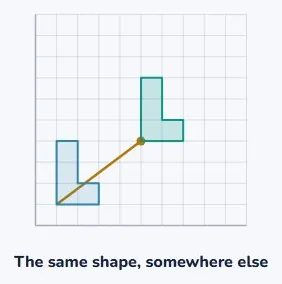
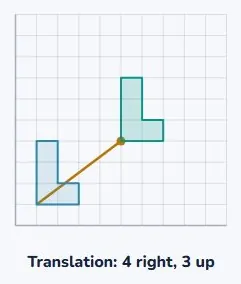
Translation: a slide
- Every corner moves the same way by the same amount.
- Here: 4 squares right and 3 squares up.
- Nothing turns. It faces exactly the way it did.
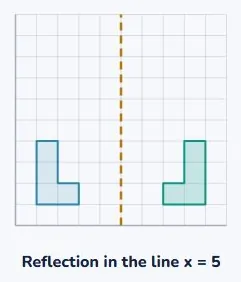
Reflection: a flip over a line
- The gold dashes are the mirror line.
- Each corner lands the same distance the other side of it.
- The shape is a mirror image: it faces the other way.
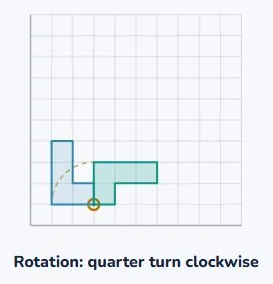
Rotation: a turn about a point
- The ringed dot is the fixed point.
- A quarter turn clockwise (90°).
- The dashed curve is the path one corner travels.
What never changes
- Lengths, angles and area survive all three moves.
- The shape is congruent: identical, just relocated.
- This is the reason tiles fit together.
| Property | Under a slide, flip or turn |
|---|---|
| Side lengths | never change |
| Angles | never change |
| Area | never changes |
| Position | changes |
| Which way it faces | changes, except in a slide |
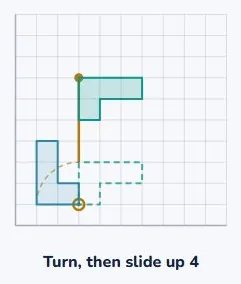
Two steps: turn, then slide
- Quarter turn clockwise first: the dashed shape.
- Then slide that one up 4 squares.
- It ends up at x 3 to 6, y 5 to 7.
- Worked out, not tried out.
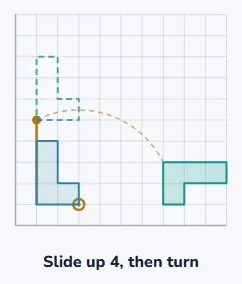
The other way round lands elsewhere
- The same two moves. Slide up 4 first, then turn.
- This time it ends up at x 7 to 10, y 1 to 3.
- A completely different place.
- So the order is part of the instruction.
Try it: two moves, in either order
Tessellation
- A repeated shape that fits with no gaps and no overlaps.
- The copies may be slid, flipped or turned.
- Six equilateral triangles round one point: 6 × 60 = 360.
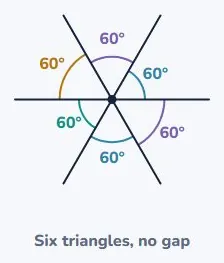
It is an angle question
- The shapes meeting at a point must total exactly 360°.
- So the interior angle has to divide into 360.
- 60 goes 6 times, 90 goes 4, 120 goes 3.
| Regular shape | Interior angle | 360 ÷ angle | Tiles? |
|---|---|---|---|
| Equilateral triangle | 60° | 6 | yes |
| Square | 90° | 4 | yes |
| Regular pentagon | 108° | 3.33… | no |
| Regular hexagon | 120° | 3 | yes |
| Regular octagon | 135° | 2.67… | no |
Why a pentagon cannot
- A regular pentagon has 108° corners.
- Three of them make 324°.
- That leaves a 36° gap, and a fourth will not fit.
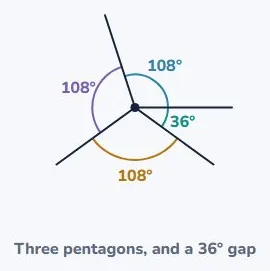
Try it: does it tessellate?
But every triangle and quadrilateral does
- Any triangle at all tessellates. So does any quadrilateral.
- A triangle holds 180°, so six fit round a point.
- A quadrilateral holds 360°, so four do.
- That is last lesson’s angle sum, doing work.
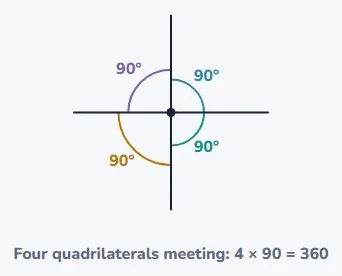
Grid references
- Rows get letters. Columns get numbers.
- Combine them and you have named one square.
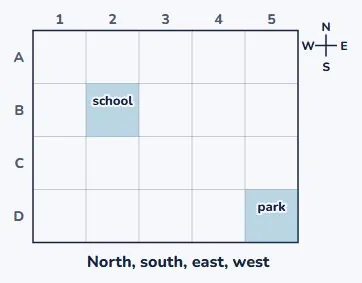
- The school is at B2. The park is at D5.
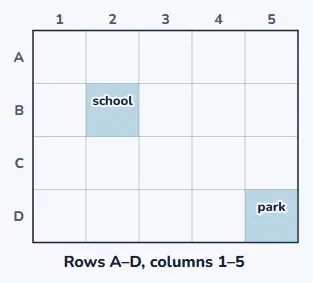
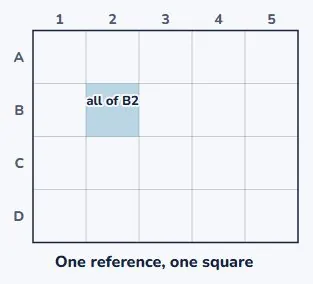
A reference names a square
- Not a point, a whole square.
- B2 is everything inside that one cell.
- Which is why a map reference is enough to find a building.
The four compass points
- North is up the map, south is down.
- East is right, west is left.
- Going on a letter (B to C) is south. Up a number is east.
Turns, in degrees
- A quarter turn is 90°. A half turn is 180°.
- Face east, turn 90° clockwise, and you face south.
- The same 90° as the rotation earlier.
| Turn | Degrees |
|---|---|
| Quarter turn | 90° |
| Half turn | 180° |
| Three-quarter turn | 270° |
| Full turn | 360° |
Scale turns squares into metres
- On this map, one square is 100 m.
- So three squares is 300 m.
- Ten squares is 1000 m: a kilometre.
| On the map | On the ground |
|---|---|
| 1 square | 100 m |
| 3 squares | 300 m |
| 10 squares | 1000 m, which is 1 km |
| 1 km | 1000 m |
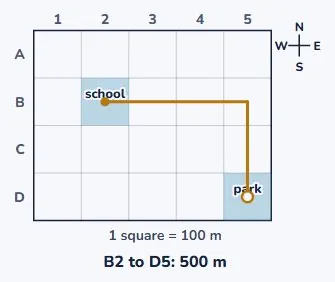
School to park
- From B2, go east 3 squares to B5.
- Turn 90° clockwise, then south 2 squares to D5.
- 300 m then 200 m.
- 500 m altogether.
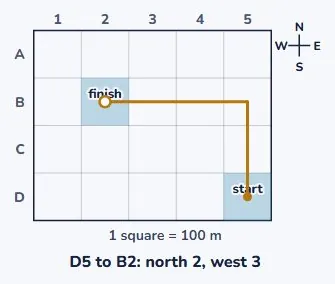
And the way home
- Same distance: 500 m.
- But every direction is the opposite one.
- And in the opposite order: north 2, then west 3.
Describing a route properly
- A direction. A distance. In order.
- "East 300 m, then south 200 m" is complete.
- "Towards the park" is not; it needs the map.
| A route needs | Example |
|---|---|
| A starting point | B2, the school |
| A direction | east |
| A distance | 300 m |
| Then the next leg | south 200 m |
Common mistakes
- Turn then slide, or slide then turn: it lands in the same place either way.The order is part of the instruction. Doing the same two moves the other way round can land the shape somewhere else.
- Regular pentagons will tessellate, because all their corners are the same.Three 108° corners make 324°, leaving a 36° gap that no fourth corner fits. The angles must make exactly 360°.
- I faced east and turned 90° clockwise, so now I face north.Clockwise goes east to south. Turning to north from east would be 90° anticlockwise.
- The park is 5 squares away on the map, so it is 5 m away.Use the scale. If one square is 100 m, then 5 squares is 500 m.
Your turn
A shape is reflected in a line, then reflected in it again. Where is it?
Which square is directly north of D5?
A shape slides 3 right and 2 up. What slide undoes it?
If one square is 100 m, how far is 7 squares?
A triangle with angles 40°, 60° and 80° is turned a quarter turn (90°). What is its smallest angle now?
You face east and make a three-quarter turn (270°) clockwise. Which way do you face now?
Rows A to F run from north to south; columns 1 to 6 run west to east. From C1, go east 4 squares, then south 1. Where are you?
A regular octagon has 135° corners. Can regular octagons tessellate on their own, and why?
Show answer
1. Exactly where it started: reflecting twice in the same line undoes itself. 2. C5; north is up the map, so the row letter goes back one. 3. Three left and two down. 4. 700 m. 5. 40°. A turn changes where the shape sits, never its angles, so the smallest angle is still 40°. 6. North. Clockwise from east: 90° is south, 180° is west, 270° is north. 7. D5. East 4 squares moves the number from 1 to 5, then south 1 moves the letter from C to D. 8. No: 360 ÷ 135 = 2.67, so 135° does not divide into 360° exactly. Two leave a gap and three overlap.
What to take away
- Slide, flip, turn: lengths and angles never change.
- Two steps in the other order can land somewhere else.
- Shapes tile when their angles make 360° at a point.
- A route is a direction and a distance, in order.
Challenge
A map has rows lettered A to J from the top (north) to the bottom (south), and columns numbered 1 to 10 from west to east. One square is 100 m. Ana followed these instructions: face east and walk 400 m, turn 90° clockwise and walk 300 m, turn 90° anticlockwise and walk 200 m. She ended in square F9. Which square did she start in, and what two-leg route takes her straight back?
Hint
Work out which way she faced on each leg first. Then undo the whole trip from F9, one direction at a time.
Answer
She started at C3. Route back: west 600 m, then north 300 m (or north 300 m, then west 600 m).
Step by step
- Facing east, a 90° clockwise turn makes her face south. A 90° anticlockwise turn then brings her back to east.
- So she walked east 4 squares, south 3 squares, then east 2 squares.
- Altogether that is 6 squares east and 3 squares south.
- Undo it from F9: 6 columns west gives column 3, and 3 rows north (F, E, D, C) gives row C.
- Going back she must walk 600 m west and 300 m north.
Full working
- east, then clockwise 90° = south, then anticlockwise 90° = eastturns change the facing
- 400 m = 4 squares, 300 m = 3 squares, 200 m = 2 squares1 square is 100 m
- east 4 + 2 = 6 squares, south 3 squarestotal movement
- column 9 − 6 = 3undo the east movement
- row F, 3 rows north: E, D, Cnorth is up the map
- start C3; back: west 600 m, then north 300 m
Mere has tiles that are regular octagons (corners 135°), squares (90°) and equilateral triangles (60°), all with the same side length. She wants tiles to fit round one point with no gaps or overlaps, and at least one of them must be an octagon. Find every possible mix of tiles, and explain why there are no others.
Hint
The corners at the point must total exactly 360°. Try one octagon, then two, then three. Squares and triangles only ever add 90s and 60s.
Answer
Only one mix works: two octagons and one square (135° + 135° + 90° = 360°).
Step by step
- Three octagons make 405°, which is too much, so there are one or two octagons.
- With two octagons, 360 − 270 = 90° is left. One square fills it exactly; triangles cannot (60° leaves 30°).
- With one octagon, 360 − 135 = 225° is left for squares and triangles.
- Any mix of 90s and 60s is a multiple of 30, but 225 is not (30 × 7 = 210, 30 × 8 = 240).
- So one octagon can never work, and two octagons with one square is the only mix.
Full working
- 3 × 135 = 405 > 360three octagons overlap
- 360 − 2 × 135 = 90room left with two octagons
- 90 = one square; 60 leaves 30only a square fits
- 360 − 135 = 225room left with one octagon
- 90 and 60 are both multiples of 30; 225 ÷ 30 = 7.5225 cannot be made
- only mix: 2 octagons + 1 square
On the same kind of map (rows A to J from north to south, columns 1 to 10 from west to east, one square is 100 m), a robot starts in D4 facing east. Its program is: move forward 2 squares, turn 90° clockwise, move forward 1 square. It runs the program 50 times in a row. Which square does it finish in, which way is it facing, and how far has it travelled in kilometres?
Hint
Follow the program 4 times, writing down the square and the facing after each run. Notice where it ends up. Then think about 50 runs as groups of 4.
Answer
It finishes in G5, facing west, after travelling 15 km.
Step by step
- Each run turns the robot a quarter turn clockwise, so after 4 runs it faces east again.
- Run 1 ends at E6 facing south, run 2 at G5 facing west, run 3 at F3 facing north, run 4 back at D4 facing east.
- So every 4 runs it is back where it began.
- 50 = 12 × 4 + 2, so 50 runs end where 2 runs end: G5, facing west.
- Each run is 3 squares, so 50 runs is 150 squares, which is 15 000 m.
Full working
- run 1: east 2 to D6, turn to south, 1 to E6facing south
- run 2: south 2 to G6, turn to west, 1 to G5facing west
- run 3: west 2 to G3, turn to north, 1 to F3facing north
- run 4: north 2 to D3, turn to east, 1 to D4back at the start, facing east
- 50 = 12 × 4 + 2same as after run 2
- 50 × 3 = 150 squares = 150 × 100 m = 15 000 mscale
- G5, facing west, 15 km travelled