Quadrilaterals, angles and symmetry
What this lesson covers
- Quadrilaterals can be categorised into one or more of the following categories: a trapezium, which has one pair of parallel sides a parallelogram, which has two pairs of parallel sides a kite, which has two pairs of equal-length adjacent sides a rectangle, which has four right angles a rhombus, which has four equal-length sides a square, which has four right-angles and four equal-length sides.
- The order of rotational symmetry for a given shape is the number of times it appears in an identical orientation when completing a full turn (360°).
- The order of rotational symmetry for a circle is infinite.
Is a square a rectangle?
- Most people say no: a square is a square.
- The answer is yes.
- And the reason matters more than the answer.
The definition decides, not the look
- A shape is in a category if it fits the definition.
- There are six categories for four-sided shapes.
- And a shape can be in more than one at once.
| Category | Needs |
|---|---|
| Trapezium | one pair of parallel sides |
| Parallelogram | two pairs of parallel sides |
| Kite | two pairs of equal-length adjacent sides |
| Rectangle | four right angles |
| Rhombus | four equal-length sides |
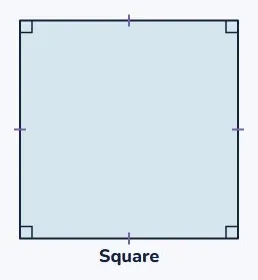
| Square | four right angles and four equal sides |
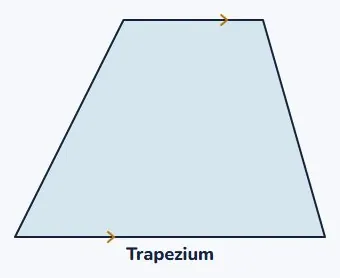
Trapezium: one pair of parallel sides
- The arrows mark the pair that is parallel.
- The other two sides can be anything at all.
- Here they are different lengths, still a trapezium.
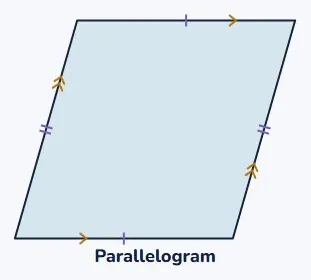
Parallelogram: two pairs of parallel sides
- Two sets of arrows, one for each parallel pair.
- The opposite sides came out equal as well.
- That follows from being parallel; it is not a second rule.
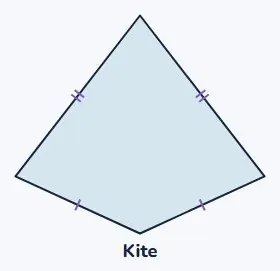
Kite: two pairs of equal adjacent sides
- Two short sides, two long sides.
- The equal ones sit next to each other, not opposite.
- "Adjacent" is the whole difference from a parallelogram.
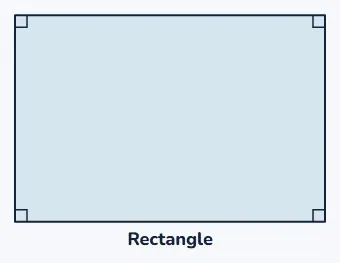
Rectangle: four right angles
- That is the entire definition.
- Nothing at all about how long the sides are.
- Long and thin counts. So does something that looks square.
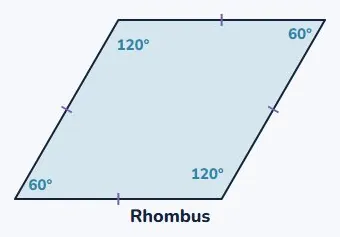
Rhombus: four equal-length sides
- Again, that is all of it.
- Nothing about the angles.
- These are 60° and 120°, and it is still a rhombus.
Square: both conditions at once
- Four right angles, like a rectangle.
- And four equal sides, like a rhombus.
- Which is why the opening question has the answer it does.
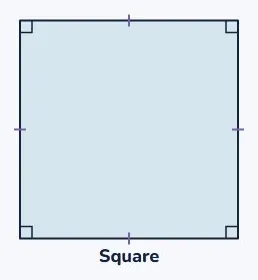
So a square is both
- Four right angles, so it is a rectangle.
- Four equal sides, so it is a rhombus.
- It ticks both boxes, so it is both.
- And a parallelogram too: both pairs come out parallel.
| Shape | 4 right angles | 4 equal sides | Also is a… |
|---|---|---|---|
| Square | yes | yes | rectangle, rhombus |
| Rectangle | yes | no | parallelogram |
| Rhombus | no | yes | parallelogram |
| Kite | no | no | None |
But it only works one way
- Every square is a rectangle.
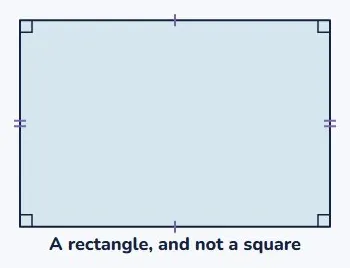
- Most rectangles are not squares.
- This one has four right angles but two side lengths.
Triangles get sorted twice over
- By sides: equilateral, isosceles, scalene.
- By angles: right-angled, and the rest.
- A triangle can take a name from each list.
| Triangle | Sides | Angles |
|---|---|---|
| Equilateral | all three equal | all 60° |
| Isosceles | two equal | two equal |
| Scalene | all different | all different |
| Right-angled | any | one is 90° |
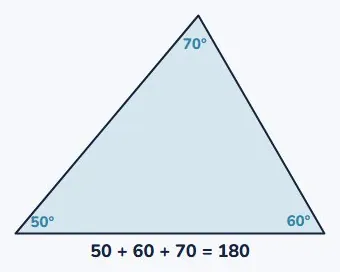
Angles in a triangle make 180°
- 50 + 60 + 70 = 180.
- True for every triangle there is.
- Stretch it however you like; the total does not move.
Try it: drag the corners
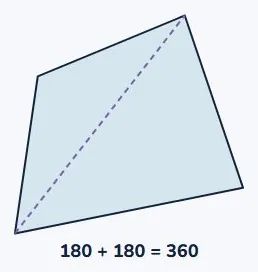
And in a quadrilateral, 360°
- Not a separate fact to remember.
- Draw one diagonal and you have two triangles.
- 180 in each.
- So 180 + 180 = 360, every time.
Geometry board
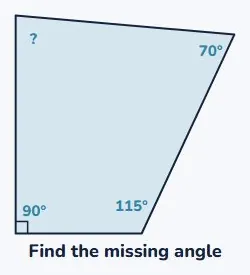
Finding a missing angle
- Three angles known: 90°, 115° and 70°.
- Add them: 90 + 115 + 70 = 275.
- The four must make 360.
- 360 − 275 = 85°.
Rotational symmetry
- Turn a shape all the way round: a full 360°.
- Count how many times it looks exactly as it did at the start.
- That count is called the order.
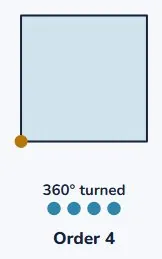
A square has order 4
- The gold dot marks one corner, so you can see it move.
- A quarter turn, and the outline matches again.
- Another quarter. And another. And home.
- Four matches in a full turn.
Every shape has an order
- Square 4. Equilateral triangle 3.
- Rectangle 2: only the half turn works.
- Rhombus and parallelogram, 2 as well.
| Shape | Order |
|---|---|
| Square | 4 |
| Equilateral triangle | 3 |
| Rectangle | 2 |
| Rhombus | 2 |
| Parallelogram | 2 |
| Trapezium | 1 |
| Kite | 1 |
| Circle | infinite |
Try it: rotational symmetry
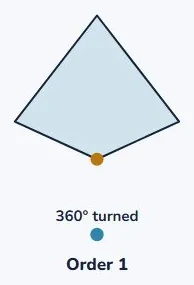
Order 1 means none at all
- The kite matches nowhere until it is all the way home.
- One match in a full turn, so order 1.
- Which is how we say it has no rotational symmetry.
- A circle is the other extreme: every turn matches. Infinite.
Prisms and pyramids
- A prism has two identical ends, joined by rectangles.
- A pyramid has one base and triangles meeting at a point.
- Both are named after the shape of the base.
| Prism | Pyramid | |
|---|---|---|
| Ends | two identical, parallel | one base |
| Other faces | rectangles | triangles |
| Meet at a point? | no | yes, at the apex |
| Cross-section | the same all along | shrinks to the apex |
Counting faces, edges and vertices
- A triangular prism: 2 triangles and 3 rectangles.
- So 5 faces, 9 edges, 6 vertices.
- Count them; do not try to remember them.
| Solid | Faces | Edges | Vertices |
|---|---|---|---|
| Cube | 6 | 12 | 8 |
| Triangular prism | 5 | 9 | 6 |
| Square-based pyramid | 5 | 8 | 5 |
| Triangular pyramid | 4 | 6 | 4 |
Common mistakes
- A square is not a rectangle, because a rectangle is long and thin.A rectangle only needs four right angles. A square has them, so every square is a rectangle (and a rhombus too).
- A triangle has angles 40° and 75°, so the third is 360 − 115 = 245°.The angles in a triangle add to 180°, so the third is 180 − 115 = 65°. 360° is for quadrilaterals.
- A rectangle has rotational symmetry of order 4, like a square.A quarter turn does not match a rectangle. Only the half turn and the full turn do, so its order is 2.
- A kite has no rotational symmetry, so its order is 0.Every shape matches itself after a full turn, so the order is at least 1. A kite has order 1.
Your turn
Is a rhombus always a parallelogram?
A triangle has angles 40° and 75°. Find the third.
What is the order of rotational symmetry of a rectangle?
How many faces has a square-based pyramid?
Which quadrilateral is defined by having one pair of parallel sides?
A solid has two identical triangle ends joined by three rectangles. What is it?
A triangle has two equal sides and one angle of 90°. Give both its names.
Tama says a quadrilateral can have angles of 90°, 90°, 90° and 100°. Is he right?
Show answer
1. Yes. Four equal sides forces both pairs of opposite sides parallel, which is the definition of a parallelogram. 2. 180 − 40 − 75 = 65°. 3. 2: only the half turn brings it back onto itself. 4. Five: one square base and four triangles. 5. Trapezium. A parallelogram and a rhombus have two pairs of parallel sides; a kite is defined by its equal adjacent sides. 6. A triangular prism: two identical parallel ends make it a prism, and it is named after the shape of its ends. 7. Right-angled isosceles: two equal sides make it isosceles, and the 90° angle makes it right-angled. 8. No: 90 + 90 + 90 + 100 = 370°, and the angles of every quadrilateral add to exactly 360°.
Quadrilateral
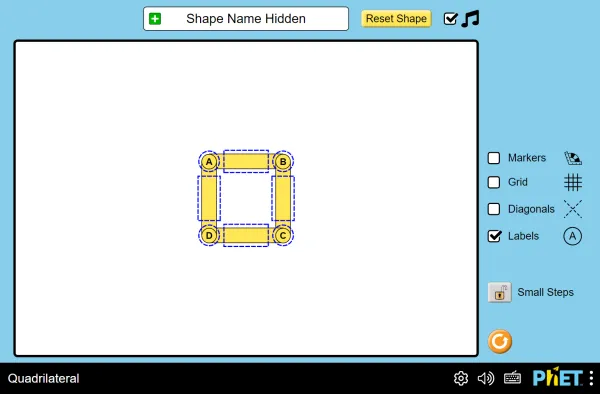
Full screen · PhET Interactive Simulations, University of Colorado Boulder, CC BY 4.0
What to take away
- Definitions decide, not appearances.
- A square is a rectangle and a rhombus at the same time.
- Triangle 180°, quadrilateral 360°; a diagonal shows why.
- Order counts the matches in one full turn.
Challenge
Quadrilateral A is both a kite and a parallelogram. Quadrilateral B is both a kite and a rectangle. Name the most exact shape each one must be, and explain why using only the definitions.
Hint
Label the corners P, Q, R, S in order. Write which sides are equal for a kite (two pairs next to each other) and for a parallelogram (opposite sides come out equal). What happens when both are true?
Answer
A must be a rhombus: all four sides are equal. B must be a square: it has four equal sides and four right angles.
Step by step
- Label the sides in order PQ, QR, RS, SP. A kite has two pairs of equal sides next to each other, say PQ = QR and RS = SP.
- A parallelogram's opposite sides are equal, so PQ = RS and QR = SP.
- Put them together: PQ = QR, QR = SP, SP = RS. All four sides are equal, so A is a rhombus.
- B is a kite with four right angles. A rectangle is a parallelogram, so B is a kite and a parallelogram: all four sides equal, just like A.
- Four equal sides and four right angles is the definition of a square.
Full working
- kite: PQ = QR and RS = SPequal sides next to each other
- parallelogram: PQ = RS and QR = SPopposite sides equal
- PQ = QR = SP = RSjoin the two lists
- A has four equal sidesA is a rhombus
- B: four equal sides and four right anglesB is a square
- A is a rhombus, B is a square
A regular pentagon has five equal sides and five equal angles. By drawing diagonals from one corner, find the size of each angle. What is its order of rotational symmetry, and through what angle must you turn it for the first match?
Hint
From one corner you can draw two diagonals. Count the triangles they make, just as one diagonal splits a quadrilateral into two.
Answer
Each angle is 108°. Its order of rotational symmetry is 5, and the first match is after a turn of 72°.
Step by step
- Two diagonals from one corner split the pentagon into 3 triangles.
- The angles of the 3 triangles together make up the pentagon's angles, so they add to 3 × 180 = 540°.
- The five angles are equal, so each is 540 ÷ 5 = 108°.
- Each corner can move round to where the next one was, so it matches 5 times in a full turn: order 5.
- Five equal turns make 360°, so each is 360 ÷ 5 = 72°.
Full working
- 2 diagonals make 3 trianglesfrom one corner
- 3 × 180° = 540°angle sum of a pentagon
- 540° ÷ 5 = 108°five equal angles
- 5 matches in one full turnorder 5
- 360° ÷ 5 = 72°smallest turn that matches
- 108° each, order 5, first match at 72°
Aroha and Ben each build a solid using exactly 12 straws for its edges. One builds a prism and the other builds a pyramid. Aroha's solid has more vertices than Ben's. Who built which, what shape is each base, and how many faces and vertices does each solid have?
Hint
Count the edges of a triangular prism, then a square-based one. Then do the same for a triangular pyramid and a square-based one. What does each extra side on the base add?
Answer
Aroha built a prism with a 4-sided (square or rectangle) base: 6 faces and 8 vertices. Ben built a hexagon-based pyramid: 7 faces and 7 vertices.
Step by step
- A prism has a top edge and a bottom edge for each side of the base, plus one upright edge per side: 3 edges per side of the base. A triangular prism has 9, a square one has 12.
- So a 12-edge prism has a 4-sided base. It has 2 ends + 4 sides = 6 faces and 4 + 4 = 8 vertices.
- A pyramid has one base edge and one sloping edge for each side of the base: 2 edges per side. 12 edges means a 6-sided (hexagon) base.
- The hexagonal pyramid has 1 base + 6 triangles = 7 faces and 6 + 1 apex = 7 vertices.
- 8 is more than 7, so Aroha built the prism and Ben built the pyramid.
Full working
- prism: 3 edges per side of the basetriangular prism 9, square prism 12
- 12 ÷ 3 = 4 sidesprism base is a quadrilateral
- prism: 4 + 2 = 6 faces, 4 + 4 = 8 verticessides plus two ends
- pyramid: 2 edges per side of the base, 12 ÷ 2 = 6hexagon base
- pyramid: 6 + 1 = 7 faces, 6 + 1 = 7 verticestriangles plus base, corners plus apex
- Aroha: 4-sided prism, 6 faces, 8 vertices. Ben: hexagonal pyramid, 7 faces, 7 vertices