
Skeletons, shells and stems: how living things are held up
What this lesson covers
- Vertebrates have a backbone; invertebrates do not
- Most animals are small invertebrates, and water holds up some sea animals
- Skeletons and muscles work together to protect organs and to move
- The human skeleton: skull, ribcage, spine, pelvis, and arms and legs built on one pattern
- Exoskeletons, shells, and soft bodies with no hard skeleton
- How trunks and stems hold plants up
Backbone or no backbone
- A vertebrate is an animal with a backbone, also called a spine. The backbone is a chain of small bones called vertebrae.
- Fish, frogs, reptiles, birds and mammals are vertebrates.
- An invertebrate is an animal with no backbone. Insects, spiders, worms, snails and jellyfish are invertebrates.
- Most kinds of animals on Earth are invertebrates, and most of them are small.
Try it: backbone or not?
Held up by water
- Some sea invertebrates have soft bodies that the water holds up.
- A jellyfish floats open and wide in the sea.
- Washed up on the beach, with no water around it, it slumps into a flat blob.
Skeletons and muscles work together
- A vertebrate's skeleton is inside its body. It is an internal skeleton.
- It holds the body up, protects soft organs, and gives muscles something to pull on.
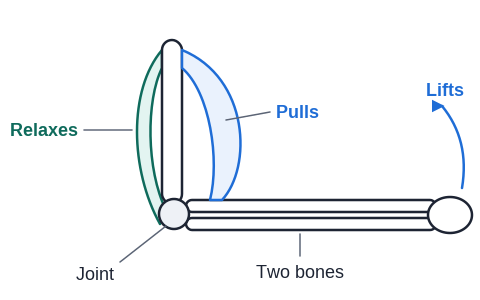
- Muscles are joined to bones. A muscle can only pull, by getting shorter.
- So muscles work in pairs. To bend your arm, the front muscle pulls while the back one relaxes. To straighten it, they swap.
Your skeleton
- Your skull protects your brain.
- Your ribcage protects your heart and lungs.
- Your spine holds you upright and protects the spinal cord, the main nerve running down your back.
- Your pelvis holds up your body and joins your legs to it.
Example: arms and legs share a pattern
- Compare the bones of your arm and your leg, from the top down. What pattern do they share?
| Part | Arm | Leg |
|---|---|---|
| Top | Upper arm: 1 bone | Thigh: 1 bone |
| Middle | Forearm: 2 bones | Lower leg: 2 bones |
| Joint | Wrist: small bones | Ankle: small bones |
| End | Hand: 5 fingers | Foot: 5 toes |
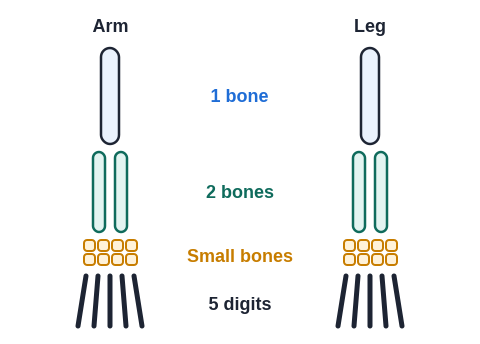
- Arm: 1 bone, then 2 bones, then small bones, then 5 fingers
- Leg: 1 bone, then 2 bones, then small bones, then 5 toes
- Both follow the same pattern: 1 bone, 2 bones, small bones, then 5 digits
Skeletons on the outside, or none
- Some invertebrates have a hard skeleton on the outside, called an exoskeleton. Wētā, beetles and crabs have one.
- An exoskeleton protects the animal like armour, and its muscles pull on it from the inside.
- An exoskeleton cannot grow. A growing wētā sheds its old one and grows a bigger one. This is called moulting.
- Snails and pāua grow a shell that gets bigger as they do.
- Slugs, worms and jellyfish have no hard skeleton at all.
Example: sort by skeleton
- Sort these animals by whether they have a backbone, and what kind of support they have.
| Animal | Backbone? | Support |
|---|---|---|
| Kererū | Yes | Internal skeleton |
| Tuna (eel) | Yes | Internal skeleton |
| Wētā | No | Exoskeleton |
| Pāua | No | Shell |
| Slug | No | No hard skeleton |
| Jellyfish | No | Held up by water |
- Backbone means vertebrate: kererū and tuna
- No backbone means invertebrate: wētā, pāua, slug, jellyfish
- Vertebrates have internal skeletons; invertebrates have exoskeletons, shells, or no hard skeleton
Try it: what holds it up?
How plants stand up
- Plants have no bones, but they still need support.
- Woody plants have stiff wood in their trunks and branches, so they can grow very tall, like kauri and tōtara.
- Non-woody plants have soft, green stems. They stay small or lean on other plants.
- Water inside a soft stem pushes outwards and keeps it firm. Without enough water, the stem droops.
Common mistakes
- Insects and spiders have backbones.Insects and spiders are invertebrates with no backbone; their support is an exoskeleton on the outside.
- Muscles push bones to move them.Muscles can only pull, so they work in pairs: one pulls to bend a joint and the other pulls to straighten it.
- A wētā's skeleton grows with it, like ours.An exoskeleton cannot grow, so a wētā moults: it sheds the old one and grows a bigger one.
The floppy stem test
You need: 2 sticks of celery with leaves, 2 glasses, water, a ruler
- Put one celery stick in a glass of water. Put the other in an empty glass.
- Leave them both for one day.
- Hold each stick flat by its bottom end, over the table. Measure how far the leafy end droops down.
- Now put the floppy stick in water too, and test it again after a few hours.
- Look for this: the stick with water stays firm and straight, and the dry one droops. Water inside a soft stem is what holds it up.
Safety: Ask an adult before taking celery from the kitchen, and put the glasses where they will not get knocked over.
Your turn
A tuatara has a backbone. Is it a vertebrate or an invertebrate?
Which part of your skeleton protects your brain?
How many bones are in your forearm?
What kind of skeleton does a crab have?
Why does a jellyfish slump on the beach?
Why can a kauri grow much taller than a daisy?
Show answer
1. A vertebrate. 2. The skull. 3. 2 bones. 4. An exoskeleton. 5. There is no water to hold its soft body up. 6. Its trunk is made of stiff wood, which can hold up a tall plant.
Recap
- Vertebrates have a backbone; invertebrates do not, and most animals are invertebrates.
- Internal skeletons hold up, protect and, with muscles, move the body.
- Muscles only pull, so they work in pairs.
- Arms and legs share one pattern: 1 bone, 2 bones, small bones, 5 digits.
- Some invertebrates have exoskeletons or shells; some have no hard skeleton.
- Wood holds up tall plants; water keeps soft stems firm.
Challenge
Liam makes a model arm from two strips of card joined by a split pin at the elbow. It lies flat on the table. He tapes one string to the front of the lower strip, just past the elbow. Pulling the string bends the arm. But pushing the string will not straighten it again. Why not? Where should he put a second string?
Hint
A string is like a muscle. What can a string do, and what can it not do?
Answer
A string, like a muscle, can only pull. Pushing it just makes it go floppy. He needs a second string on the back of the arm, joined just past the elbow, to pull the arm straight.
Step by step
- The string acts like a muscle joined to a bone.
- A string can pull, but if you push it, it just bends and goes slack.
- Muscles are the same: they can only pull by getting shorter.
- So the arm needs a second string on the other side, at the back.
- Pulling the back string straightens the arm, just as the back muscle of your arm does.
Full working
- front string pullsthe arm bends
- push the stringit goes slack and does nothing
- muscles only pullso they work in pairs
- second string at the back, past the elbowpulls the other way
- Strings only pull; add one on the back to straighten the arm
Kiri says two things. "Only animals with no backbone have a shell." "Every animal with no backbone has something hard to hold it up." Use this list to show that both are wrong: tuatara, wētā, turtle, snail, crab, slug. Which animal proves each one wrong?
Hint
For each animal, ask two questions: does it have a backbone? Does it have a hard shell or a hard skeleton on the outside?
Answer
The turtle proves the first one wrong: it has a backbone and a shell. The slug proves the second one wrong: it has no backbone and no hard skeleton at all.
Step by step
- Tuatara: backbone, and no shell. It fits both of Kiri's ideas.
- Wētā and crab: no backbone, with a hard exoskeleton. Snail: no backbone, with a shell. These fit too.
- Turtle: it is a reptile, so it has a backbone, but it also has a hard shell. So animals with a backbone can have a shell too.
- Slug: no backbone, and no shell or exoskeleton. Its soft body has nothing hard to hold it up.
- So the turtle breaks the first idea and the slug breaks the second.
Full working
- tuatara: backbone, no shellfits both ideas
- wētā, crab: no backbone, exoskeletonfits
- snail: no backbone, shellfits
- turtle: backbone and shellbreaks idea 1
- slug: no backbone, nothing hardbreaks idea 2
- Turtle proves the first wrong; slug proves the second wrong
On a beach, Mia finds a whole crab skeleton with every leg still on it, but nothing inside. Ben finds an empty pāua shell. Which one most likely came from an animal that is still alive? Explain both finds.
Hint
Can an exoskeleton grow? Can a pāua shell grow? What does each animal do as it gets bigger?
Answer
Mia's crab skeleton. A crab's exoskeleton cannot grow, so the crab climbs out of it (moults) and grows a bigger one, leaving the old one behind. A pāua's shell grows with it and is never left behind, so an empty pāua shell means the pāua has died.
Step by step
- An exoskeleton cannot grow.
- To get bigger, a crab sheds its old exoskeleton whole and grows a new, bigger one. This is moulting.
- So a whole, empty crab skeleton is most likely an old one the crab left behind. The crab is still alive, and bigger now.
- A pāua's shell gets bigger as the pāua grows, so it never needs to leave it.
- A pāua only leaves its shell empty when it has died.
Full working
- exoskeleton cannot growcrab must moult
- moult leaves a whole empty skeletoncrab walks away bigger
- pāua shell grows with the pāuanever shed
- empty pāua shellthe pāua has died
- The crab is most likely still alive; the pāua is not