
Flowers, fruits and seeds, and how seeds travel
What this lesson covers
- Some living things have many young at a time; others have only a few
- Some plants can grow a new plant from a piece of themselves
- Flowers are where pollination and fertilisation happen, so seeds can form
- After fertilisation a fruit grows from the flower and holds the seeds
- Seeds store food, need water to sprout, and have parts that help them spread
- Sorting seeds by how they are spread
Lots of young, or just a few
- Some living things have lots of young. A mouse can have a litter of many babies, several times a year.
- The wētāpunga, our giant wētā, lays lots of eggs.
- Others have only a few young and look after them for a long time.
- People usually have one baby at a time. A kiwi lays just one or two very big eggs.
New plants from a piece
- Some plants can make a new plant without seeds.
- Plant a piece of potato that has an 'eye' (a bud), and a new potato plant grows from it.
- Put a cut stem of mint in a glass of water, and it grows roots.
- A plant grown from a piece is the same as the parent plant.
Pollination and fertilisation
- Flowers are the parts of a plant made for reproduction.
- Pollination is when pollen moves from an anther to a stigma. Bees, birds, wind and other animals carry it.
- Tūī and korimako (bellbirds) carry pollen between harakeke (flax) and kōwhai flowers while they drink nectar.
- Fertilisation comes next. Inside the flower, the pollen joins with an egg cell in the ovary. Now a seed can form.
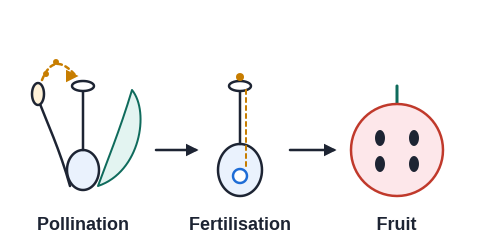
From flower to fruit
- After fertilisation, the petals fall off and the ovary grows into a fruit.
- The fruit holds and protects the seeds.
- In science, a fruit is any part that grows from a flower and holds seeds. So tomatoes, capsicums and pumpkins are fruits too.
Try it: pollination, fertilisation or fruit?
What is inside a seed
- A seed has a tough coat, a tiny baby plant, and a store of food.
- A dry seed waits. When it gets water, it swells up and germinates.
- The stored food feeds the young plant until its leaves can make food from sunlight.
Spreading seeds
- Young plants need their own light, water and space, so seeds must get away from the parent plant. Spreading seeds is called dispersal.
- Wings or fluff: the wind carries them, like dandelion and thistle seeds.
- Hooks: they catch on fur, feathers or socks, like bidibids.
- Fleshy fruit: animals eat it and drop the seeds far away in their droppings. Kererū spread the big seeds of taraire and tawa.
- Pods that burst: gorse pods dry out, pop open and flick their seeds away.
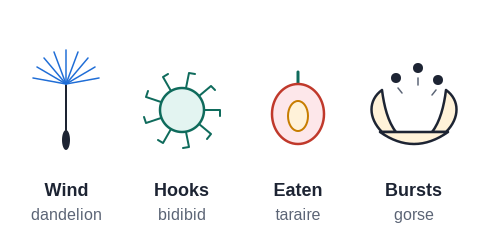
Example: how does each seed travel?
- Look at the structure of each seed or fruit, then decide how it is spread.
| Seed or fruit | Structure | Spread by |
|---|---|---|
| Maple seed | A flat wing | Wind |
| Bidibid | Tiny hooks | Animals' fur |
| Blackberry | Juicy flesh | Animals eating it |
| Coconut | Light, air-filled husk | Floating on water |
- A wing or fluff catches the airwind
- Hooks grab onto furanimals carry it
- Sweet flesh is foodanimals eat it
- Maple: wind. Bidibid: fur. Blackberry: eaten. Coconut: water
Try it: how does each seed travel?
Common mistakes
- Pollination and fertilisation are the same thing.Pollination moves pollen to the stigma; fertilisation happens after, when pollen joins an egg cell in the ovary.
- Fruits are only sweet things like apples and oranges.Any part grown from a flower that holds seeds is a fruit, so tomatoes and pumpkins count.
- A seed needs soil to start growing.A seed needs water to germinate; its stored food feeds it at first, so it can sprout on a wet paper towel.
Sprout seeds without soil
You need: 8 dried beans or chickpeas from the pantry, paper towels, 2 clear jars, water, a ruler, a pen and paper
- Fold a paper towel into each jar so it lines the side. Wet the towel in the first jar. Leave the second one dry.
- Push 4 beans between the towel and the glass in each jar, so you can see them.
- Keep the first towel damp. Put both jars on a windowsill.
- Each day for 5 days, look at the beans and measure any roots. Write it down.
- Look for this: only the wet beans germinate. They grow roots and shoots with no soil, using the food stored inside the seed.
Safety: Raw dried beans can make you sick, so do not eat them, and wash your hands after handling them.
Your turn
Which usually has more young at a time: a mouse or a kiwi?
How can you grow a new potato plant without a seed?
What is it called when pollen moves from an anther to a stigma?
Which part of a flower grows into the fruit?
A seed is covered in tiny hooks. How is it spread?
What does a seed need first, to germinate?
Show answer
1. A mouse. 2. Plant a piece of potato that has an eye. 3. Pollination. 4. The ovary. 5. By catching on animals' fur or feathers. 6. Water.
Recap
- Some living things have many young; others have a few and care for them.
- Some plants can grow from a piece, like a potato eye or a stem cutting.
- Pollination moves pollen to the stigma; fertilisation in the ovary starts a seed.
- The ovary grows into a fruit that holds the seeds.
- Seeds store food and need water to germinate.
- Wings, hooks, fleshy fruit and bursting pods help seeds spread.
Challenge
Mia sets up two jars, each with 6 dried beans. Jar A: wet paper towel, kept in the fridge. Jar B: dry paper towel, kept on a warm windowsill. After a week, no beans have sprouted in either jar. Mia says, "So beans do not need water to germinate." Explain why her test does not show that. How should she change it?
Hint
Count how many things are different between Jar A and Jar B. Did either jar give the beans everything a seed needs to germinate?
Answer
Her test is not fair: she changed two things at once (water and warmth), and neither jar had both water and warmth, so of course nothing sprouted. She should keep both jars on the warm windowsill and change only the water: one wet towel, one dry towel.
Step by step
- Jar A and Jar B differ in two ways: wet or dry, and cold or warm.
- When two things change, you cannot tell which one made the difference.
- Jar A had water but was too cold. Jar B was warm but had no water.
- A seed needs water and warmth to germinate, so neither jar could work.
- A fair test changes only one thing: two jars on the warm sill, one wet and one dry.
Full working
- Jar A: water yes, warmth notoo cold
- Jar B: water no, warmth yestoo dry
- two things changednot a fair test
- neither jar had water and warmthno beans could sprout
- Not fair: put both jars somewhere warm and change only the water
Taraire and tawa are New Zealand forest trees with fruit about 3 cm long, each holding one big seed. Kererū swallow the whole fruit and drop the seed somewhere else in their droppings. Today kererū are the only forest birds left in New Zealand with a beak and throat wide enough to swallow these fruit. Suppose all the kererū left one forest. What would happen to young taraire trees there over many years? Explain each step.
Hint
Without a kererū, where does a taraire fruit end up? What does a young tree need that it cannot get there?
Answer
The fruit would just fall under the parent trees. The seedlings there would be crowded together in deep shade, without enough light, water and space, so few would grow into big trees. No seeds would reach new parts of the forest, so over many years there would be fewer and fewer young taraire, and they would stay bunched under old trees.
Step by step
- Only kererū can swallow the big fruit and carry the seeds away.
- With no kererū, the fruit drops straight down under the parent tree.
- Lots of seedlings would start in the same small patch, in the shade of the big tree.
- They would compete for light, water and space, so most would not grow well.
- No seeds would reach new places, so the taraire would not spread and could slowly become rarer.
Full working
- kererū gonenothing else can swallow the fruit
- fruit falls under the parentno dispersal
- seedlings crowd in deep shadetoo little light, water and space
- few seedlings surviveand none start in new places
- Fewer young taraire over the years, all bunched under the old trees
A potato plant flowers, and later grows small green berries that look like tiny tomatoes (they are poisonous, so never eat them). Each berry has seeds inside. Hemi plants a seed from a berry. Ana plants a piece of potato with an eye. (a) Is the green berry a fruit? (b) Is the potato a fruit? (c) Whose new plant is sure to be just like the parent plant? Explain each answer.
Hint
In science, a fruit is a part that grows from a flower and holds seeds. Think about where each part grows. A seed starts when pollen joins an egg cell, and the pollen could come from a different potato plant.
Answer
(a) Yes: the berry grows from the flower and holds seeds. (b) No: the potato grows underground, not from a flower, and has no seeds inside. (c) Ana's: a plant grown from a piece is the same as the parent. Hemi's seed plant may be different, because the seed's pollen could have come from another potato plant.
Step by step
- A fruit grows from a flower after fertilisation and holds the seeds.
- The green berry grows where the flower was and has seeds inside, so it is a fruit.
- The potato grows under the ground, not from a flower, and holds no seeds, so it is not a fruit.
- A plant grown from a piece of the parent, like a potato eye, is the same as the parent.
- A seed forms when pollen joins an egg cell. The pollen may come from another plant, so the new plant can be a bit different.
Full working
- berry: grows from the flower, holds seedsa fruit
- potato: grows underground, no flower, no seedsnot a fruit
- eye piecea new plant from a piece of the parent, so the same
- seedpollen plus egg cell, pollen maybe from another plant
- (a) yes (b) no (c) Ana's plant from the eye is sure to match the parent