
Habitats: where living things find what they need
What this lesson covers
- A habitat gives living things water, food, air and shelter
- Most habitats are home to many kinds of living things
- Living things in one habitat often share the same resources
- Living things in a habitat affect each other, such as hunter and hunted
- Jane Goodall's long, patient observing changed what we know about chimpanzees
- Gathering information about a habitat and showing it in maps and pictographs
What a habitat is
- A habitat is the place where a living thing lives.
- A good habitat gives it what it needs: water, food, air and shelter.
- Shelter means a safe place to hide, rest and raise young.
- A rock pool, a rotting log, a pond and a school garden are all habitats.
Lots of living things together
- Most habitats have many kinds of living things in them.
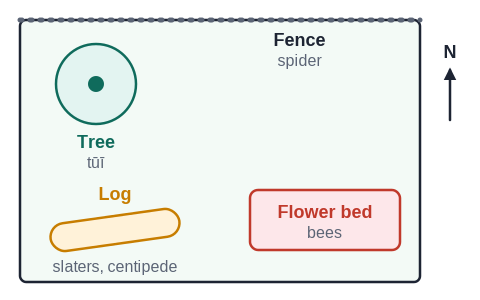
- A garden might hold tūī in the trees, bees on the flowers, worms in the soil and slaters under the pots.
- Plants, insects, birds and fungi can all share one small patch.
Sharing resources
- Resources are the things living things use, such as food, water and shelter.
- Living things in one habitat often use the same resources.
- Birds and insects drink from the same puddle or stream. Many small animals shelter under the same log.
- Kawakawa leaves are food for the kawakawa looper caterpillar. That is why kawakawa leaves are often full of holes.
Try it: food, water or shelter?
Living things affect each other
- Living things in a habitat interact. That means they affect one another.
- A spider catches flies in its web. The spider gets food, and the flies are eaten.
- Bees drink nectar from flowers and carry pollen, which helps the plants make seeds.
- Two birds may chase each other away from the same feeding tree.
Example: life under a log
- Room 4 gently rolled over a log in the school garden, counted what was under it, then rolled it back.
- What does the log give these animals, and how do they interact?
| Living thing | How many | What it uses the log for |
|---|---|---|
| Slaters | 12 | Damp shelter, and rotting wood to eat |
| Earthworms | 6 | Damp, dark soil |
| Spiders | 2 | Shelter, and small insects to catch |
| Centipede | 1 | Shelter, and slaters to hunt |
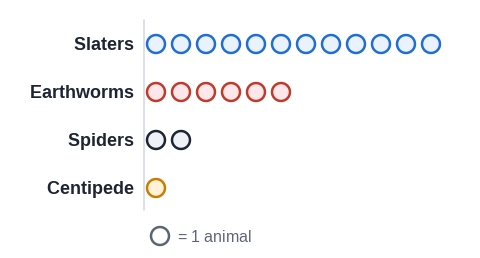
- Under the log it is damp and darkshelter
- Rotting wood is food for the slatersfood
- The centipede hunts slaters; the spiders catch insectsthey interact
- The log gives shelter, damp and food, and the animals under it are hunters and hunted
Try it: life under the log
Example: predict how a tree wētā uses a tree
- A tree wētā lives in a hole in a tree trunk. It comes out at night.
- Predict how it uses the tree.
- By day the hole is dark and safe from birdsshelter
- At night it climbs out onto the branches to chew leavesfood
- The tree gives the wētā shelter by day and food by night
Jane Goodall and the chimpanzees
- The English scientist Jane Goodall began studying wild chimpanzees in Gombe, Tanzania, in 1960.
- She sat quietly near them for months, until they got used to her, and wrote down everything she saw.
- She saw a chimpanzee strip the leaves off a twig and poke it into a termite mound to fish out termites. People had thought only humans made tools.
- She also found that chimpanzees hunt and eat meat, and that each one has its own personality and family bonds.
Finding out and showing it
- Observe for yourself: sit still, look closely, count, and write or draw what you see.
- Read and listen too: books, school journal articles and stories such as pūrākau can tell you what other people have noticed over a long time.
- Show what you found with a map, a drawing, a table or a pictograph.
Common mistakes
- A habitat is just an animal's nest or burrow.A habitat is the whole place it lives, including where it finds food, water and shelter.
- Each animal in a habitat has its own food and water that nothing else uses.Living things in one habitat often share the same resources, such as one stream or one log.
- After looking under a log, you can leave it turned over.Roll it back gently the way it was, because it is the animals' shelter.
Survey a patch of garden
You need: 4 sticks or pegs, a piece of string about 4 m long, a notebook and pencil, a magnifying glass, if you have one
- Mark out a square of garden about 1 m on each side with the sticks and string.
- Sit still beside it for 10 minutes. Make a tally of every living thing you see in or above the square.
- With an adult, gently lift one stone or pot inside the square, count what is under it, then put it back exactly as it was.
- Draw a pictograph of your counts, with one symbol for each animal.
- Look for this: which living things share your square, and what each one seems to be using it for.
Safety: Lift stones only with an adult and keep your fingers out of holes, because a spider or wasp could bite or sting; wash your hands afterwards.
Your turn
What four things does a good habitat give a living thing?
A slater lives under a damp log and eats rotting wood. What does the log give it?
A fantail and a spider both catch flies in the same garden. What resource do they share?
In Room 4's survey, how many more slaters than earthworms were there?
What did Jane Goodall see a chimpanzee use a twig for?
Why should you roll a log back after looking underneath it?
Show answer
1. Water, food, air and shelter. 2. Shelter and food. 3. Flies, which are food for both. 4. 6 more, because 12 − 6 = 6. 5. To fish termites out of a termite mound. 6. It is the shelter of the animals that live there.
Recap
- A habitat gives living things water, food, air and shelter.
- Most habitats hold many kinds of living things, and they share resources.
- Living things in a habitat affect each other, as hunters, hunted, helpers or rivals.
- Jane Goodall's patient observing showed chimpanzees make tools and hunt.
- Gather information by observing and reading, and show it with maps and pictographs.
Challenge
Room 8 wants to keep a garden snail in a big jar for one week, then let it go. They put in soil, a piece of bark and some fresh lettuce. They screw on a lid with no holes and put the jar on a sunny windowsill. Find two things wrong with this habitat, and say what the snail needs that it is missing.
Hint
Go through the four things a good habitat gives: water, food, air and shelter. Which ones does this jar not give?
Answer
The lid has no holes, so fresh air cannot get in: the snail needs air. The sunny windowsill makes the jar hot and dry, and nothing keeps it damp: the snail needs water and a cool, damp, shady place. Food (lettuce) and shelter (bark) are fine.
Step by step
- Check each need in turn: water, food, air and shelter.
- Food: the lettuce is food, so that need is met.
- Shelter: the bark gives the snail somewhere to hide, so that need is met.
- Air: a lid with no holes stops fresh air getting in, so the snail is missing air.
- Water: nothing wets the soil, and a sunny window dries it out and makes it hot, so the snail is missing water and dampness.
Full working
- lettucefood: met
- barkshelter: met
- lid with no holesair: missing
- dry soil on a hot, sunny sillwater and damp: missing
- Fix it: make holes in the lid, keep the soil damp, and move the jar to a cool, shady place
Room 2 counted the animals in a rock pool and made a pictograph. Each shell picture stands for 2 animals. Pūpū (sea snails): 7 pictures. Limpets: 4 pictures. Starfish: half a picture. Crabs: the row got smudged. They counted 27 animals in all. How many pictures should be in the crab row? This kind of starfish hunts pūpū and limpets. Why do you think there are so few starfish?
Hint
First turn each row into a number of animals. Half a picture is half of 2. Then work out how many animals are left for the crabs.
Answer
2 pictures (4 crabs). There is only 1 starfish. A hunter needs to eat lots of animals to stay alive, so a habitat usually has far fewer hunters than animals that are hunted.
Step by step
- Pūpū: 7 pictures, each worth 2, makes 14 animals.
- Limpets: 4 pictures makes 8 animals.
- Starfish: half a picture is half of 2, which is 1 starfish.
- That is 14 + 8 + 1 = 23, so 27 − 23 = 4 crabs, which is 2 pictures.
- One starfish eats many pūpū and limpets, so the pool can feed only a few starfish.
Full working
- 7 × 2 = 14pūpū
- 4 × 2 = 8limpets
- half of 2 = 1starfish
- 14 + 8 + 1 = 23all but the crabs
- 27 − 23 = 4crabs
- 4 ÷ 2 = 2pictures for the crabs
- 2 pictures (4 crabs); few starfish because each hunter needs many animals to eat
Caterpillars are chewing the leaves of a pumpkin plant. Bees also visit its flowers. The gardener sprays the garden with a spray that kills every kind of insect. The caterpillars die, and the leaves stop getting holes. But the plant now grows hardly any pumpkins. Use what you know about how living things in a habitat affect each other to explain why.
Hint
What do the bees carry from flower to flower, and what does a pumpkin flower need before a pumpkin can grow?
Answer
The spray also killed the bees. Bees carry pollen between pumpkin flowers while they drink nectar, and a pumpkin flower needs that pollen to grow a pumpkin with seeds. With no bees, few flowers get pollen, so few pumpkins grow.
Step by step
- The spray kills every kind of insect, not just caterpillars.
- Bees are insects, so the bees die too.
- Bees visit pumpkin flowers for nectar and carry pollen from flower to flower.
- A pumpkin is the part that grows from the flower to hold the seeds, and it needs that pollen.
- No bees means little pollen moved, so hardly any pumpkins grow.
Full working
- spray kills all insectsbees die as well as caterpillars
- bees drink nectar and carry pollenthey help the plant
- pollen must reach the flowerbefore seeds and a pumpkin can grow
- no bees, little pollenfew pumpkins
- Hardly any pumpkins grow because the spray killed the bees that carry pollen between the flowers