
Functional groups, naming and isomers
What this lesson covers
- The ten functional groups, from alkenes and haloalkanes to esters, acyl chlorides and amides, and how to recognise each.
- IUPAC names for chains of up to eight carbons, including which group sets the suffix and which become prefixes.
- Constitutional isomers: the same molecular formula with the atoms joined differently (chain, position or functional group).
- Geometric (cis-trans) isomers from a C=C with two different groups on each carbon, and optical isomers from an asymmetric carbon.
- Using boiling point, solubility and the rotation of plane-polarised light to tell compounds apart, with reasons.
The ten functional groups
- A functional group is the part of a molecule that reacts; the rest is a hydrocarbon chain that mostly goes along for the ride.
- Level 3 uses ten groups. Learn each one's structure, its suffix or prefix, and whether it makes the molecule polar or able to hydrogen bond.
- Alcohols are primary, secondary or tertiary by how many carbons are bonded to the C carrying the OH; haloalkanes are classed the same way, and amines by how many carbons are bonded to the N.
| Group | Structure | Name ending | Example |
|---|---|---|---|
| Alkene | C=C | -ene | but-2-ene |
| Haloalkane | C-X (X = Cl, Br, I) | chloro-, bromo-, iodo- | 2-bromopropane |
| Amine | C-NH₂ | -amine | ethanamine |
| Alcohol | C-OH | -ol | propan-2-ol |
| Aldehyde | -CHO, at the end of a chain | -al | butanal |
| Ketone | C=O inside the chain | -one | pentan-3-one |
| Carboxylic acid | -COOH | -oic acid | ethanoic acid |
| Ester | -COO- between two chains | alkyl -oate | methyl propanoate |
| Acyl chloride | -COCl | -oyl chloride | ethanoyl chloride |
| Amide | -CONH₂ | -amide | propanamide |
IUPAC names, step by step
- Find the longest carbon chain that contains the main functional group; its length gives the stem (meth, eth, prop, but, pent, hex, hept, oct).
- The highest-priority group gives the suffix: carboxylic acid, then acyl chloride and ester, then amide, aldehyde, ketone, alcohol, amine. Any other group becomes a prefix, such as hydroxy- for OH, oxo- for C=O, amino- for NH₂ and methyl- for a branch.
- Number from the end that gives the suffix group the lowest number. The carbon of -COOH, -CHO, -COCl and -CONH₂ is always carbon 1, so it needs no number.
- Esters are named in two words: the alkyl group from the alcohol first, then the acid part ending in -oate. CH₃COOCH₂CH₃ is ethyl ethanoate.
- On an amide or amine, a group on the nitrogen is shown with N-, so CH₃CONHCH₃ is N-methylethanamide.
Try it: build and name a molecule
Example: naming four compounds
- Name: (a) CH₃CH(CH₃)CH₂COOH, (b) CH₃CH₂COOCH₂CH₂CH₃, (c) CH₃CH(OH)CH₂CHO, (d) CH₃COCHO, the main antibacterial compound in mānuka honey, measured by its MGO rating.
- (a) 4 C in the chain with COOH; C1 is the COOH carbon, the CH₃ branch is on C3the acid carbon is always C1
- (a) 3-methylbutanoic acid
- (b) acid part CH₃CH₂COO- is propanoate; alcohol part -CH₂CH₂CH₃ is propylsplit at the single-bonded O
- (b) propyl propanoate
- (c) the aldehyde outranks the alcohol, so -al is the suffix and OH is hydroxy- on C3
- (c) 3-hydroxybutanal
- (d) the aldehyde is C1, the ketone C=O is on C2 and becomes oxo-
- (d) 2-oxopropanal (methylglyoxal)
Constitutional isomers
- Isomers have the same molecular formula but different structures. Constitutional (structural) isomers have their atoms joined in a different order.
- Chain isomers have a different carbon skeleton: butan-1-ol and 2-methylpropan-1-ol.
- Position isomers have the same group in a different place: propan-1-ol and propan-2-ol.
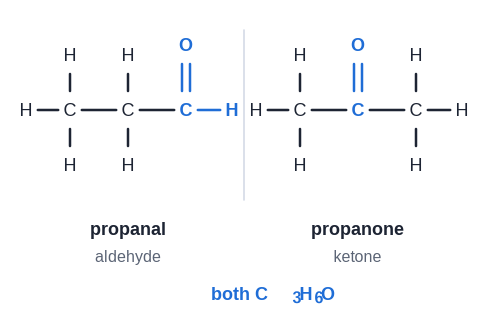
- Functional group isomers belong to different families: propanal and propanone are both C₃H₆O, and so are an acid and an ester of the same size, such as propanoic acid and methyl ethanoate (C₃H₆O₂).
- Because the groups differ, functional group isomers have different chemical reactions as well as different physical properties.
Geometric (cis-trans) isomers
- A C=C double bond cannot rotate, so groups on each end are locked on one side or the other.
- Geometric isomers need two different groups on each carbon of the C=C. But-2-ene (CH₃CH=CHCH₃) qualifies; but-1-ene does not, because one carbon carries two H atoms.
- In the cis isomer the matching groups are on the same side; in the trans isomer they are on opposite sides.
- Cis and trans isomers have slightly different boiling and melting points. Cis-but-2-ene is slightly polar and boils at about 4 °C, while trans-but-2-ene, whose bond dipoles cancel, boils at about 1 °C.
Optical isomers (enantiomers)
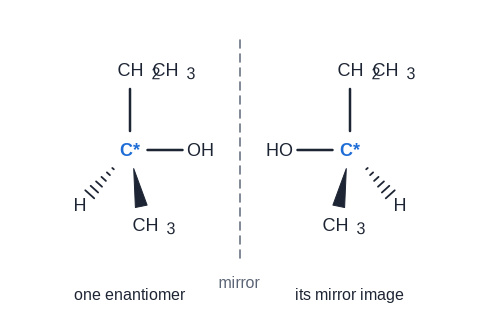
- A carbon bonded to four different groups is an asymmetric (chiral) carbon, marked with an asterisk. A molecule with one has two forms that are mirror images and cannot be superimposed, like left and right hands.
- Draw enantiomers in 3D: two bonds in the plane, one wedge coming out and one dashed going back, then reflect the whole molecule in a mirror line.
- Enantiomers have identical boiling points, solubility and reactions with ordinary reagents. The one difference is that they rotate plane-polarised light by the same angle in opposite directions.
- A 50:50 mixture of the two (a racemic mixture) shows no rotation, because the two effects cancel.
- Living things often treat enantiomers differently: one carvone enantiomer smells of spearmint and the other of caraway, because our smell receptors are chiral too.
Example: which kind of isomerism?
- For each compound, say whether it has geometric isomers, optical isomers, or neither: (a) 2-chlorobutane, (b) pent-2-ene, (c) 2-methylbut-2-ene, (d) 2-aminopropanoic acid (alanine).
- (a) C2 carries H, Cl, CH₃ and CH₂CH₃: four different groupsan asymmetric carbon
- (a) optical isomers
- (b) CH₃CH=CHCH₂CH₃: C2 has H and CH₃, C3 has H and CH₂CH₃two different groups on each end
- (b) geometric isomers (cis and trans)
- (c) (CH₃)₂C=CHCH₃: C2 carries two identical CH₃ groupsswapping them gives the same molecule
- (c) neither
- (d) C2 carries H, NH₂, CH₃ and COOHfour different groups
- (d) optical isomers
Try it: which kind of isomerism?
Physical properties come from the groups
- Molecules of similar size have similar dispersion forces, so differences in boiling point come mostly from the functional group.
- Alcohols, carboxylic acids, primary amines and amides have O-H or N-H bonds, so their molecules hydrogen bond to each other and boil higher. Carboxylic acids form pairs held by two hydrogen bonds; amides hydrogen bond through both N-H and C=O, so propanamide is a solid at room temperature.
- Aldehydes, ketones, esters, acyl chlorides and haloalkanes are polar but have no O-H or N-H, so only permanent dipole attractions add to their dispersion forces.
- Small molecules that can hydrogen bond with water dissolve in it; as the hydrocarbon chain gets longer, solubility falls because the non-polar part cannot.
- Acyl chlorides react with water rather than dissolving, giving off steamy HCl fumes.
| Compound | Group | Boiling point (°C) |
|---|---|---|
| Propane | none | −42 |
| 1-chloropropane | haloalkane | 47 |
| Propanal | aldehyde | 48 |
| Propan-1-amine | amine | 48 |
| Propanone | ketone | 56 |
| Propanoyl chloride | acyl chloride | 80 |
| Propan-1-ol | alcohol | 97 |
| Propanoic acid | carboxylic acid | 141 |
| Propanamide | amide | 213 |
Try it: chiral carbons, light and boiling points
Example: telling three isomers apart
- Three unlabelled liquids are butan-1-ol, butan-2-ol and 2-methylpropan-2-ol, all C₄H₁₀O. The butan-2-ol was made as a single enantiomer.
- Explain which property picks out butan-2-ol, and why the other two cannot show it.
- butan-2-ol: C2 carries H, OH, CH₃ and CH₂CH₃the only one with four different groups on a carbon
- butan-1-ol: C1 carries two H atoms; 2-methylpropan-2-ol: C2 carries three CH₃ groupsno asymmetric carbon, so no enantiomers
- shine plane-polarised light through each: only a single enantiomer of butan-2-ol rotates it
- a racemic sample of butan-2-ol would not rotate the light, so the test needs one enantiomer
What Achieved, Merit and Excellence look like
- Achieved names or draws correctly and states a property. Merit explains the property from the structure. Excellence compares the compounds, links each structure to its forces or its isomerism, and justifies every conclusion.
| Grade | A model answer |
|---|---|
| Achieved | Propanoic acid can form hydrogen bonds and methyl ethanoate cannot, so propanoic acid has the higher boiling point. |
| Merit | Both are C₃H₆O₂, so their dispersion forces are similar. Propanoic acid has an O-H bond, so its molecules hydrogen bond to each other; methyl ethanoate has no O-H, so it has only weaker permanent dipole attractions. More energy is needed to separate the acid molecules. |
| Excellence | Both are C₃H₆O₂ with similar shape and electron number, so their dispersion forces are similar and cannot explain an 84 °C gap. In propanoic acid the O-H hydrogen is strongly positive and bonds to the C=O oxygen of a neighbour, so pairs of molecules are held by two hydrogen bonds. Methyl ethanoate is polar, with C=O and C-O dipoles, but its H atoms are all on carbon, so it has only permanent dipole attractions. Hydrogen bonds are much stronger, so far more heat energy is needed to boil the acid. |
Common mistakes
- But-1-ene has cis and trans isomers because it has a C=C bond.Each carbon of the C=C needs two different groups; C1 of but-1-ene has two H atoms, so it has no geometric isomers.
- CH₃COOCH₂CH₃ is ethanoyl ethyl, or ethyl ester ethanoate.Name an ester alkyl first, then the acid part: ethyl ethanoate.
- Enantiomers have different boiling points because they are different compounds.Enantiomers have identical physical properties; only the direction they rotate plane-polarised light differs.
- The carbon in a C=O or CH₃ group can be an asymmetric carbon.An asymmetric carbon has four single bonds to four different groups, so a C=O carbon or a CH₃ carbon never qualifies.
See sugar twist polarised light
You need: white sugar, hot tap water, a clear glass jar, a laptop, tablet or phone screen showing a white page, polarised sunglasses, a spoon
- Fill the jar two-thirds with sugar, add hot tap water, and stir until the syrup is clear.
- Turn the screen to a plain white page. Its light is already polarised. Look at it through the sunglasses and turn them until the screen looks darkest.
- Hold the jar of syrup between the screen and the sunglasses, looking through the syrup.
- Slowly turn the sunglasses while you look, then compare with a jar of plain water.
- Look for: through the syrup, the screen is no longer dark and colours appear that change as you turn the glasses. Sucrose molecules contain asymmetric carbons, so the syrup rotates the plane of polarised light, and different colours are turned by different amounts. Plain water does nothing.
Safety: Use hot tap water only, not boiled water, because a full jar of hot syrup can scald, and keep the syrup well away from the screen and keyboard.
Your turn
Name CH₃CH₂CH₂COCl.
Name CH₃CH(CH₃)CH₂CHO.
Which of these has optical isomers: propan-2-ol, butan-2-ol, butanone or but-1-ene?
Which of these has geometric isomers: pent-1-ene, pent-2-ene, 2-methylbut-2-ene or pentane?
How many aldehydes and ketones have the formula C₄H₈O?
Show answer
1. Butanoyl chloride. 2. 3-methylbutanal: the CHO carbon is C1 and the branch is on C3. 3. Butan-2-ol: C2 carries H, OH, CH₃ and CH₂CH₃. 4. Pent-2-ene: each C of the C=C has an H and a different alkyl group. 5. Three: butanal, 2-methylpropanal and butanone.
Exam-style question: isomers of C₄H₈O₂
- Butanoic acid, ethyl ethanoate and 3-hydroxybutanal all have the formula C₄H₈O₂.
Name the ester CH₃CH₂COOCH₃, another isomer of C₄H₈O₂.
Name the branched carboxylic acid with this formula.
Which of the three compounds above exists as enantiomers?
Explain why butanoic acid boils at 164 °C and ethyl ethanoate at 77 °C.
Give a test that tells butanoic acid from ethyl ethanoate, with the observation.
Show answer
1. Methyl propanoate (Achieved). 2. 2-methylpropanoic acid, (CH₃)₂CHCOOH (Achieved). 3. 3-hydroxybutanal: C3 carries H, OH, CH₃ and CH₂CHO, four different groups, so it has two non-superimposable mirror images that rotate plane-polarised light in opposite directions (Merit with the reason). 4. Both are C₄H₈O₂, so dispersion forces are similar. Butanoic acid has an O-H group, so its molecules hydrogen bond to each other; ethyl ethanoate has no O-H, so it has only permanent dipole attractions, which are weaker. More energy is needed to separate the acid molecules (Merit; Excellence also notes the acid forms hydrogen-bonded pairs and that size cannot explain the gap). 5. Add sodium carbonate solution: butanoic acid fizzes, giving CO₂, because it is an acid; ethyl ethanoate does not react (Achieved for the observation, Merit for the reason).
Build a Molecule
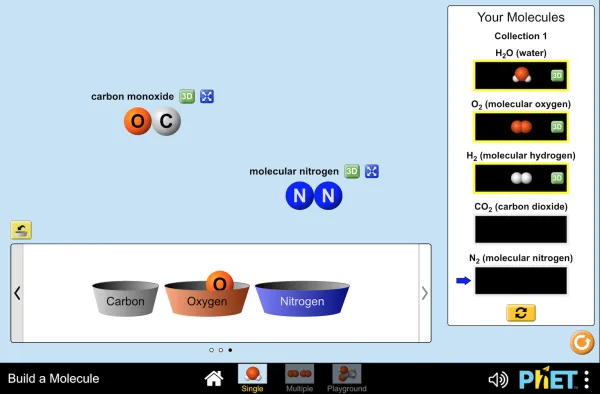
Full screen · PhET Interactive Simulations, University of Colorado Boulder, CC BY 4.0
Recap
- Ten groups, ten name endings: the highest-priority group sets the suffix and the others become prefixes.
- Constitutional isomers join the atoms differently; geometric isomers need a C=C with two different groups on each carbon; optical isomers need a carbon with four different groups.
- Enantiomers differ only in the direction they rotate plane-polarised light; a racemic mixture shows no rotation.
- O-H and N-H groups mean hydrogen bonding, higher boiling points and better solubility in water.
| Isomer type | What to look for |
|---|---|
| Constitutional | Same formula, atoms joined in a different order |
| Geometric (cis-trans) | C=C with two different groups on each carbon |
| Optical (enantiomers) | A carbon with four different groups |
Challenge
Find every aldehyde and every ketone with the molecular formula C₅H₁₀O (no rings). Name each one, and say which of them exists as a pair of enantiomers.
Hint
Do the aldehydes first: the CHO carbon is always C1, so draw the four different C₄ skeletons that can hang off it. Then place a C=O inside each possible five-carbon skeleton for the ketones. For enantiomers, look for a carbon with four different groups.
Answer
Seven: pentanal, 2-methylbutanal, 3-methylbutanal, 2,2-dimethylpropanal, pentan-2-one, pentan-3-one and 3-methylbutan-2-one. Only 2-methylbutanal has enantiomers.
Step by step
- For aldehydes, the CHO carbon is C1 and the other four carbons can form a straight chain, a chain with a branch on C2 or C3, or two branches on C2.
- For ketones, the C=O must be inside the chain: on C2 or C3 of a straight five-carbon chain, or on C2 of a four-carbon chain with a methyl on C3.
- A carbonyl, CH₂ or CH₃ carbon can never be asymmetric, so check only the CH carbons.
- In 2-methylbutanal, C2 carries H, CH₃, CH₂CH₃ and CHO, four different groups; every other compound has no such carbon.
Full working
- CH₃CH₂CH₂CH₂CHOpentanal
- CH₃CH₂CH(CH₃)CHO2-methylbutanal, C2 asymmetric
- (CH₃)₂CHCH₂CHO3-methylbutanal, C3 carries two CH₃
- (CH₃)₃CCHO2,2-dimethylpropanal
- CH₃COCH₂CH₂CH₃ and CH₃CH₂COCH₂CH₃pentan-2-one and pentan-3-one
- CH₃COCH(CH₃)₂3-methylbutan-2-one, C3 carries two CH₃
- Seven compounds; only 2-methylbutanal has enantiomers
Four amines have the formula C₃H₉N: propan-1-amine (boils at 48 °C), propan-2-amine (32 °C), N-methylethanamine (37 °C) and N,N-dimethylmethanamine, (CH₃)₃N (3 °C). (a) Draw each as a condensed formula and classify it as primary, secondary or tertiary. (b) Explain why (CH₃)₃N boils so much lower than the other three, even though all four have the same number of electrons. (c) Explain why propan-1-amine boils higher than propan-2-amine. (d) Predict whether (CH₃)₃N is soluble in water, and justify.
Hint
Count the H atoms on nitrogen in each. For (d), a molecule does not need its own N–H to form a hydrogen bond with water: think about what water's O–H can bond to.
Answer
(a) CH₃CH₂CH₂NH₂ primary; CH₃CH(NH₂)CH₃ primary; CH₃CH₂NHCH₃ secondary; (CH₃)₃N tertiary. (b) (CH₃)₃N has no H on N, so it cannot hydrogen bond to itself; it has only TD and PD attractions. (c) Same groups, but the straight chain of propan-1-amine has more surface contact, so stronger TD attractions. (d) Soluble: the lone pair on its N accepts hydrogen bonds from water's O–H.
Step by step
- Primary, secondary and tertiary amines have one, two and three carbons bonded to the N.
- With equal electron clouds, the gap in boiling point must come from the type of attraction: the three with N–H hydrogen bond to each other, (CH₃)₃N cannot.
- Propan-1-amine and propan-2-amine are both primary with one NH₂, so hydrogen bonding is similar; the branched molecule is more compact, so TD attractions are weaker and it boils lower.
- Hydrogen bonding needs a δ+ H on N, O or F and a lone pair on N, O or F; in water, H₂O supplies the H and (CH₃)₃N supplies the lone pair.
- So (CH₃)₃N cannot hydrogen bond to itself, but it can hydrogen bond to water, and as a small molecule it dissolves.
Full working
- CH₃CH₂CH₂NH₂, CH₃CH(NH₂)CH₃primary: one C on N
- CH₃CH₂NHCH₃secondary: two C on N
- (CH₃)₃Ntertiary: three C on N, no N–H
- all C₃H₉N, 34 electronssimilar TD attractions
- (CH₃)₃N: TD + PD only; others: TD + PD + hydrogen bondslowest boiling point, 3 °C
- straight chain > branched chainmore surface contact, 48 °C against 32 °C
- H₂O O–H to lone pair on Nhydrogen bonds with water, so soluble
- (CH₃)₃N boils lowest because it has no N–H, yet it dissolves in water by accepting hydrogen bonds
An alcohol has the formula C₅H₁₀O. Its five carbons form one unbranched chain containing a C=C double bond, and its OH group is not on either carbon of the double bond. Exactly one alcohol fits these clues and also shows both geometric and optical isomerism. (a) Find and name it, showing why each of the other possible alcohols fails. (b) How many different stereoisomers of it exist? Explain.
Hint
The C=C can only start at C1 or C2 of the chain. For each, list where the OH can go, then test two things: does each end of the C=C carry two different groups, and is there a carbon with four different groups?
Answer
(a) Pent-3-en-2-ol, CH₃CH(OH)CH=CHCH₃. (b) Four: cis and trans forms of the double bond, each as a pair of enantiomers.
Step by step
- With the C=C between C1 and C2, the possible alcohols are pent-1-en-3-ol, pent-4-en-2-ol and pent-4-en-1-ol; the end CH₂= carbon has two H atoms, so none of them has geometric isomers.
- With the C=C between C2 and C3, the possible alcohols are pent-2-en-1-ol, pent-3-en-2-ol and pent-3-en-1-ol; all three have geometric isomers.
- Of those three, only pent-3-en-2-ol has a carbon with four different groups: C2 carries H, OH, CH₃ and CH=CHCH₃.
- The other two have their OH on a CH₂, which carries two identical H atoms, so they have no asymmetric carbon.
- The double bond can be cis or trans, and each of these has two mirror-image forms, so 2 × 2 = 4 stereoisomers.
Full working
- C=C at C1: pent-1-en-3-ol, pent-4-en-2-ol, pent-4-en-1-olCH₂= end, so no geometric isomers
- C=C at C2: pent-2-en-1-ol, pent-3-en-1-olgeometric only, OH on a CH₂, no asymmetric C
- CH₃CH(OH)CH=CHCH₃C3 has H and CH(OH)CH₃, C4 has H and CH₃: geometric
- C2: H, OH, CH₃, CH=CHCH₃four different groups: optical
- 2 (cis, trans) × 2 (enantiomers) = 4independent choices
- Pent-3-en-2-ol, with 4 stereoisomers