
Thermochemistry and Hess's law
What this lesson covers
- Specific heat capacity and q = mcΔT, and turning a temperature change into ΔrH = −q ÷ n.
- Standard enthalpies of combustion, formation, vaporisation, fusion and sublimation, each with its defining equation.
- Hess's law: the enthalpy change for a reaction is the same whatever the route, so equations and their ΔH values can be combined.
- ΔrH = ΣΔfH(products) − ΣΔfH(reactants), with elements in their standard states at zero.
- Exam calculations with correct signs, units and significant figures, and evaluating calorimetry results.
Specific heat capacity and q = mcΔT
- Specific heat capacity, c, is the energy needed to raise the temperature of 1 g of a substance by 1 °C; for water and dilute solutions c = 4.18 J g⁻¹ °C⁻¹.
- The heat energy absorbed or released is q = mcΔT, where m is the mass in grams of what is being heated (usually the water or solution, not the fuel), and ΔT is the temperature change.
- q comes out in joules; divide by 1000 for kilojoules before using it with ΔH values in kJ mol⁻¹.
- For a reaction, ΔrH = −q ÷ n, where n is the moles of the substance named in the question: the minus sign is there because heat released into the water means the reaction itself lost energy.
Example: heating water for a cup of tea
- How much energy does it take to heat 250 g of water from 15.0 °C to 80.0 °C?
- ΔT = 80.0 − 15.0 = 65.0 °C
- q = mcΔT = 250 × 4.18 × 65.0 = 67 925 J
- q = 67.9 kJ÷ 1000, 3 significant figures
Example: the enthalpy of combustion of ethanol
- A spirit burner loses 0.920 g of ethanol, C₂H₅OH (M = 46.0 g mol⁻¹), while heating 200 g of water in a can from 18.0 °C to 39.5 °C.
- Calculate the experimental ΔcH of ethanol and compare it with the data value, −1367 kJ mol⁻¹.
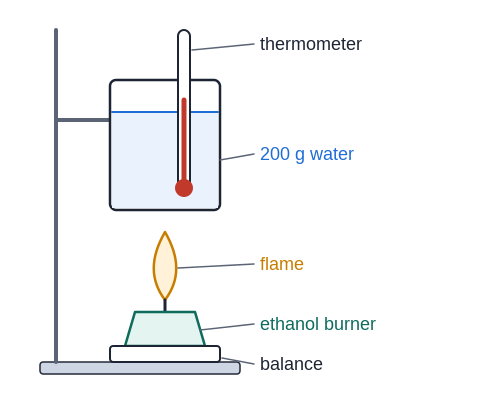
- q = 200 × 4.18 × 21.5 = 17 974 J = 17.97 kJΔT = 39.5 − 18.0 = 21.5 °C
- n(C₂H₅OH) = 0.920 ÷ 46.0 = 0.0200 mol
- ΔcH = −q ÷ n = −17.97 ÷ 0.0200 = −899 kJ mol⁻¹
- only 899 ÷ 1367 × 100 = 65.8% of the data value
- heat lost to the air and the can, incomplete combustion (soot), and water made as gas, not liquid, all make it less negativesystematic errors, so repeats do not fix them
The standard enthalpy changes
- Standard (⦵) means 25 °C (298 K), 100 kPa and every substance in its normal state at that temperature, with solutions at 1 mol L⁻¹.
- Each definition is for one mole of a named substance, so fractions such as ½O₂ are allowed in the equation.
- Elements in their standard states (C(s), H₂(g), O₂(g), N₂(g)) have ΔfH = 0, because forming them from themselves involves no change.
| Symbol | Meaning (1 mol of the substance) | Example equation |
|---|---|---|
| ΔcH | burned completely in oxygen | CH₄(g) + 2O₂(g) → CO₂(g) + 2H₂O(l) |
| ΔfH | formed from its elements in their standard states | C(s) + 2H₂(g) → CH₄(g) |
| ΔfusH | melted at its melting point | H₂O(s) → H₂O(l) |
| ΔvapH | turned from liquid to gas | H₂O(l) → H₂O(g) |
| ΔsubH | turned straight from solid to gas | I₂(s) → I₂(g) |
| ΔrH | for the reaction as written | any balanced equation |
Try it: name the enthalpy change
Phase changes
- Melting, boiling and sublimation are endothermic: energy is needed to overcome the attractions between particles, while the temperature stays constant during the change.
- Freezing, condensing and deposition are the reverse changes, exothermic by the same amounts.
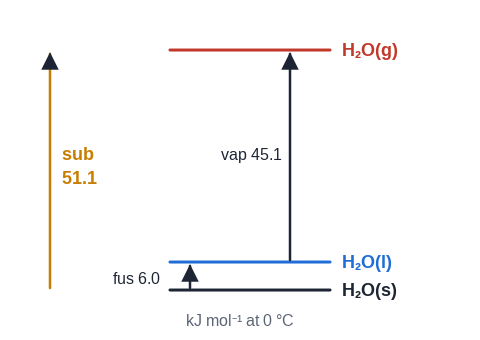
- Hess's law links them: going straight from solid to gas takes the same energy as melting and then boiling, so ΔsubH = ΔfusH + ΔvapH at the same temperature.
- For ice at 0 °C, ΔsubH = 6.0 + 45.1 = 51.1 kJ mol⁻¹; ΔvapH is much bigger than ΔfusH because boiling separates the molecules completely, overcoming nearly all of the hydrogen bonds.
Try it: heating ice to steam
Hess's law
- Hess's law: the enthalpy change for a reaction depends only on the starting and finishing substances, not on the route between them, because energy is conserved.
- So you can find ΔH for a reaction you cannot carry out (carbon and hydrogen do not react to form methane) from reactions you can measure, such as combustions.
- To combine equations: reverse an equation and change the sign of its ΔH; multiply an equation and multiply its ΔH by the same number; then add them so that everything not in the target equation cancels.
- Check by adding the equations: the left and right sides must match the target exactly, states included.
Example: ΔfH of methane from combustion data
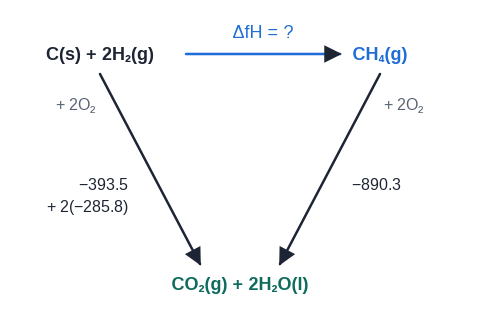
- Target: C(s) + 2H₂(g) → CH₄(g).
- Data: C(s) + O₂(g) → CO₂(g), ΔH = −393.5 kJ mol⁻¹; H₂(g) + ½O₂(g) → H₂O(l), ΔH = −285.8 kJ mol⁻¹; CH₄(g) + 2O₂(g) → CO₂(g) + 2H₂O(l), ΔH = −890.3 kJ mol⁻¹.
- C(s) + O₂(g) → CO₂(g) ΔH = −393.5C is on the left of the target: keep
- 2H₂(g) + O₂(g) → 2H₂O(l) ΔH = 2 × (−285.8) = −571.6the target needs 2H₂: multiply by 2
- CO₂(g) + 2H₂O(l) → CH₄(g) + 2O₂(g) ΔH = +890.3CH₄ is a product in the target: reverse, change the sign
- add: C(s) + 2H₂(g) → CH₄(g); the O₂, CO₂ and H₂O cancel
- ΔfH(CH₄) = −393.5 − 571.6 + 890.3 = −74.8 kJ mol⁻¹
Try it: build the target with Hess's law
ΔrH from enthalpies of formation
- Hess's law gives a shortcut when ΔfH values are known: ΔrH = ΣΔfH(products) − ΣΔfH(reactants).
- Multiply each ΔfH by the coefficient of that substance in the balanced equation.
- Use the right state: ΔfH of H₂O(l) and H₂O(g) differ by 44.0 kJ mol⁻¹, which is ΔvapH of water at 25 °C.
- Any element in its standard state, such as the O₂ in a combustion, contributes zero.
| Substance | ΔfH (kJ mol⁻¹) |
|---|---|
| CO₂(g) | −393.5 |
| CO(g) | −110.5 |
| H₂O(l) | −285.8 |
| H₂O(g) | −241.8 |
| CH₃OH(l) | −239.5 |
| C₂H₅OH(l) | −277.6 |
| C₃H₈(g) | −104.7 |
Example: burning LPG (propane)
- Calculate ΔcH of propane using the ΔfH table: C₃H₈(g) + 5O₂(g) → 3CO₂(g) + 4H₂O(l).
- ΣΔfH(products) = 3(−393.5) + 4(−285.8) = −1180.5 − 1143.2 = −2323.7
- ΣΔfH(reactants) = −104.7 + 5(0) = −104.7O₂ is an element in its standard state
- ΔcH = −2323.7 − (−104.7) = −2219.0 kJ mol⁻¹
- per gram: 2219.0 ÷ 44.0 = 50.4 kJ released per gram of propane
What Achieved, Merit and Excellence look like
- In calculations, Achieved gets one correct step (such as q, or one equation manipulated correctly); Merit has the whole method with one error; Excellence has the correct answer with sign, unit and 3 or 4 significant figures.
- In explanations, Excellence links the number to what is happening to particles and bonds.
| Grade | A model answer |
|---|---|
| Achieved | Some heat was lost to the surroundings. |
| Merit | Heat from the flame was lost to the air and used to heat the can, so less reached the water; q was too small, so ΔcH came out less negative. |
| Excellence | Much of the heat warmed the air and the can rather than the water, so q (and so ΔcH) was too small. A yellow, sooty flame shows incomplete combustion, so less energy was released per mole than in complete combustion to CO₂. The data value also has water forming as a liquid; in the flame it forms as steam, so the heat released as water condenses is missing too. All of these make the result less negative. |
Common mistakes
- q = 0.920 × 4.18 × 21.5, using the mass of ethanol burned.m is the mass of the water being heated, 200 g; the mass of fuel is used only to find n.
- ΔcH = q ÷ n = +899 kJ mol⁻¹.The water gained heat, so the reaction released it: ΔcH = −q ÷ n = −899 kJ mol⁻¹.
- ΔrH = ΣΔfH(reactants) − ΣΔfH(products).It is products minus reactants, each ΔfH multiplied by its coefficient.
- When I reversed the methane combustion equation I kept ΔH = −890.3 kJ mol⁻¹.Reversing an equation changes the sign: it becomes +890.3 kJ mol⁻¹.
Predict the temperature when hot meets cold
You need: a kitchen thermometer, a measuring jug, 2 large mugs, a bowl, hot and cold tap water
- Measure 200 mL of hot tap water into one mug and 200 mL of cold tap water into the other, and record each temperature.
- Predict the temperature after mixing: heat lost by the hot water equals heat gained by the cold, so with equal masses the final temperature is the average.
- Pour both into the bowl, stir, and read the temperature after 30 seconds.
- Repeat with 100 mL of hot and 300 mL of cold, predicting with mcΔT(lost) = mcΔT(gained) first.
- Look for: your result is close to the prediction but a little lower, because some heat also warms the bowl and the air, the same error that makes a calorimeter read low.
Safety: Hot tap water can scald, so run it into the mug on the bench and do not carry full mugs of it.
Your turn
How much energy is needed to heat 500 g of water from 18.0 °C to 100.0 °C?
50.0 mL of 1.00 mol L⁻¹ HCl and 50.0 mL of 1.00 mol L⁻¹ NaOH are mixed and warm by 6.7 °C. Take the mass as 100 g and c = 4.18 J g⁻¹ °C⁻¹. What is ΔrH per mole of water formed?
Write the equation for the standard enthalpy of formation of ethanol, C₂H₅OH(l).
A substance has ΔfusH = 15.5 kJ mol⁻¹ and ΔvapH = 41.6 kJ mol⁻¹ at the same temperature. What is ΔsubH?
Use the ΔfH table to calculate ΔcH of methanol: CH₃OH(l) + 1½O₂(g) → CO₂(g) + 2H₂O(l).
Show answer
1. q = 500 × 4.18 × 82.0 = 171 380 J = 171 kJ. 2. q = 100 × 4.18 × 6.7 = 2800.6 J = 2.80 kJ; n(H₂O) = 1.00 × 0.0500 = 0.0500 mol; ΔrH = −2.80 ÷ 0.0500 = −56 kJ mol⁻¹ (2 significant figures, set by 6.7). 3. 2C(s) + 3H₂(g) + ½O₂(g) → C₂H₅OH(l). 4. ΔsubH = 15.5 + 41.6 = 57.1 kJ mol⁻¹. 5. ΔcH = [−393.5 + 2(−285.8)] − (−239.5) = −965.1 + 239.5 = −725.6 kJ mol⁻¹.
Exam-style question: fuels from Taranaki gas
- Methanol is made from natural gas in Taranaki. Use the ΔfH table where needed.
Calculate ΔfH of ethyne, C₂H₂(g), given ΔcH(C₂H₂) = −1300 kJ mol⁻¹, ΔcH(C) = −394 kJ mol⁻¹ and ΔcH(H₂) = −286 kJ mol⁻¹.
Calculate ΔrH for making liquid methanol: CO(g) + 2H₂(g) → CH₃OH(l).
Burning 1.20 g of methanol (M = 32.0 g mol⁻¹) heats 250 g of water from 19.5 °C to 34.0 °C. Calculate the experimental ΔcH of methanol.
Explain why ΔcH of methanol is less negative when the water formed is a gas, and calculate its value, using ΔvapH(H₂O) = +44.0 kJ mol⁻¹.
Show answer
1. Target 2C(s) + H₂(g) → C₂H₂(g). Use 2 × (C + O₂ → CO₂), 1 × (H₂ + ½O₂ → H₂O), and the reversed combustion of C₂H₂: ΔfH = 2(−394) + (−286) − (−1300) = −788 − 286 + 1300 = +226 kJ mol⁻¹ (Merit for the method with one error; Excellence for +226 kJ mol⁻¹ with sign and unit). 2. ΔrH = ΔfH(CH₃OH) − [ΔfH(CO) + 2(0)] = −239.5 − (−110.5) = −129.0 kJ mol⁻¹. 3. q = 250 × 4.18 × 14.5 = 15 152.5 J = 15.15 kJ; n = 1.20 ÷ 32.0 = 0.0375 mol; ΔcH = −15.15 ÷ 0.0375 = −404 kJ mol⁻¹, far less negative than −725.6 kJ mol⁻¹ because of heat losses and incomplete combustion. 4. When water vapour condenses, hydrogen bonds form between the molecules and energy is released; if the water stays as a gas, that energy is not released, so less heat is given out overall. Each mole of methanol makes 2 mol of water: ΔcH = −725.6 + 2(44.0) = −637.6 kJ mol⁻¹ (Excellence links the energy to attractions forming between water molecules).
Recap
- q = mcΔT with m the mass of water or solution; ΔrH = −q ÷ n, in kJ mol⁻¹.
- Each standard enthalpy change is for 1 mole of the named substance at 25 °C and 100 kPa; elements in their standard states have ΔfH = 0.
- Hess's law: reverse an equation and change the sign, multiply and multiply ΔH, add so the extras cancel.
- ΔrH = ΣΔfH(products) − ΣΔfH(reactants); ΔsubH = ΔfusH + ΔvapH.
- Finish every calculation with a sign, kJ mol⁻¹ and 3 or 4 significant figures.
| Formula | Use it for |
|---|---|
| q = mcΔT | heat absorbed by water or a solution |
| ΔrH = −q ÷ n | enthalpy change per mole from calorimetry |
| n = m ÷ M, n = cV | moles of fuel or solute |
| ΔrH = ΣΔfH(products) − ΣΔfH(reactants) | ΔrH from formation data |
| ΔsubH = ΔfusH + ΔvapH | sublimation from melting and boiling |
Challenge
25.0 g of ice at 0 °C is dropped into an insulated cup holding 200 g of water at 30.0 °C. All the ice melts and the mixture reaches one final temperature. Assume no heat is lost to the cup or the air. ΔfusH(H₂O) = +6.01 kJ mol⁻¹, M(H₂O) = 18.0 g mol⁻¹, c = 4.18 J g⁻¹ °C⁻¹. Calculate the final temperature.
Hint
The warm water loses heat and that heat does two jobs: first it melts the ice at 0 °C, then it warms the melted water from 0 °C up to the final temperature. Call the final temperature T and balance heat lost against heat gained.
Answer
About 17.8 °C
Step by step
- Melting 25.0 g of ice is 1.389 mol, which takes 1.389 × 6.01 = 8.347 kJ, all at 0 °C.
- After melting, that 25.0 g of water warms from 0 °C to the final temperature T.
- The 200 g of warm water cools from 30.0 °C to T, and the heat it loses equals the heat used for both jobs.
- Solving the balance gives T = 17.8 °C, well below the 26.7 °C you would get by ignoring the melting.
Full working
- n(ice) = 25.0 ÷ 18.0 = 1.389 moln = m ÷ M
- q(melt) = 1.389 × 6.01 = 8.347 kJ = 8347 JΔfusH per mole
- q(warm melted water) = 25.0 × 4.18 × T = 104.5Tfrom 0 °C to T
- q(lost by warm water) = 200 × 4.18 × (30.0 − T) = 25 080 − 836Tfrom 30.0 °C to T
- 25 080 − 836T = 8347 + 104.5Theat lost = heat gained
- 940.5T = 16 733, so T = 17.79solve for T
- Final temperature ≈ 17.8 °C
Magnesium oxide cannot be made cleanly enough to measure ΔfH(MgO) directly, so a student uses two reactions with excess hydrochloric acid. Experiment 1: 0.243 g of Mg is added to 100 g of acid and the temperature rises by 11.2 °C. Mg(s) + 2HCl(aq) → MgCl₂(aq) + H₂(g). Experiment 2: 0.403 g of MgO is added to 100 g of acid and the temperature rises by 3.60 °C. MgO(s) + 2HCl(aq) → MgCl₂(aq) + H₂O(l). Use c = 4.18 J g⁻¹ °C⁻¹, M(Mg) = 24.3 g mol⁻¹, M(MgO) = 40.3 g mol⁻¹ and ΔfH(H₂O(l)) = −285.8 kJ mol⁻¹. Calculate ΔrH for each experiment, then ΔfH(MgO).
Hint
Find ΔrH for each experiment with −q ÷ n. Then write the target, Mg(s) + ½O₂(g) → MgO(s), and decide which equations to keep, which to reverse, and where the formation of water fits in.
Answer
ΔrH₁ = −468 kJ mol⁻¹, ΔrH₂ = −150 kJ mol⁻¹, ΔfH(MgO) ≈ −603 kJ mol⁻¹
Step by step
- Experiment 1: q = 4681.6 J for 0.0100 mol of Mg, so ΔrH₁ = −468.2 kJ mol⁻¹.
- Experiment 2: q = 1504.8 J for 0.0100 mol of MgO, so ΔrH₂ = −150.5 kJ mol⁻¹.
- To build Mg + ½O₂ → MgO: keep equation 1 (Mg on the left), reverse equation 2 (MgO on the right), and add the formation of water to use up the H₂ and supply the H₂O.
- MgCl₂, HCl, H₂ and H₂O all cancel, leaving the target, so ΔfH = ΔrH₁ − ΔrH₂ + ΔfH(H₂O).
Full working
- q₁ = 100 × 4.18 × 11.2 = 4681.6 J; n(Mg) = 0.243 ÷ 24.3 = 0.0100 molq = mcΔT, n = m ÷ M
- ΔrH₁ = −4.6816 ÷ 0.0100 = −468.2 kJ mol⁻¹ΔrH = −q ÷ n
- q₂ = 100 × 4.18 × 3.60 = 1504.8 J; n(MgO) = 0.403 ÷ 40.3 = 0.0100 molsame method
- ΔrH₂ = −1.5048 ÷ 0.0100 = −150.5 kJ mol⁻¹ΔrH = −q ÷ n
- Mg + 2HCl → MgCl₂ + H₂, −468.2keep
- MgCl₂ + H₂O → MgO + 2HCl, +150.5reverse, change sign
- H₂ + ½O₂ → H₂O, −285.8formation of water
- ΔfH(MgO) = −468.2 + 150.5 − 285.8 = −603.5add; extras cancel
- ΔfH(MgO) ≈ −603 kJ mol⁻¹
A student burns 0.600 g of propan-1-ol, C₃H₇OH (M = 60.0 g mol⁻¹), under a can holding 150 g of water, which warms by 23.1 °C. The flame is clean and blue, so combustion is complete, and the hot water vapour from the flame escapes without condensing. C₃H₇OH(l) + 4½O₂(g) → 3CO₂(g) + 4H₂O. Data (kJ mol⁻¹): ΔfH(C₃H₇OH(l)) = −302.6, ΔfH(CO₂(g)) = −393.5, ΔfH(H₂O(l)) = −285.8, ΔfH(H₂O(g)) = −241.8; c = 4.18 J g⁻¹ °C⁻¹. (a) Calculate the experimental ΔcH. (b) Calculate the data value of ΔcH with liquid water, and the value that matches what really happened in the flame. (c) Hence calculate the percentage of the heat released by the flame that was lost to the can and the air.
Hint
The fair comparison is not with the textbook value (liquid water) but with the value for water formed as a gas. Compare the experimental value with that one.
Answer
(a) −1448 kJ mol⁻¹ (b) −2021.1 kJ mol⁻¹ with liquid water; −1845.1 kJ mol⁻¹ with water as gas (c) about 21.5% of the heat was lost
Step by step
- The water gained 14 483.7 J from 0.0100 mol of propan-1-ol, so the experimental ΔcH is −1448 kJ mol⁻¹.
- Products minus reactants with liquid water gives −2021.1 kJ mol⁻¹; with water as gas it gives −1845.1 kJ mol⁻¹, 176 kJ less negative because 4 mol of water do not condense.
- Since the water left the flame as vapour and combustion was complete, the flame really released 1845.1 kJ per mole.
- Only 1448 of those 1845.1 kJ reached the water, which is 78.5%, so 21.5% was lost to the can and the air.
Full working
- q = 150 × 4.18 × 23.1 = 14 483.7 J = 14.48 kJq = mcΔT
- n = 0.600 ÷ 60.0 = 0.0100 moln = m ÷ M
- ΔcH(exp) = −14.48 ÷ 0.0100 = −1448 kJ mol⁻¹ΔrH = −q ÷ n
- ΔcH(liquid water) = 3(−393.5) + 4(−285.8) − (−302.6) = −2021.1 kJ mol⁻¹products − reactants
- ΔcH(water as gas) = 3(−393.5) + 4(−241.8) − (−302.6) = −1845.1 kJ mol⁻¹matches the flame
- 1448 ÷ 1845.1 × 100 = 78.5% reached the waterfraction captured
- Heat lost = 100 − 78.5 = 21.5%