
Substitution reactions: from haloalkanes to amides
What this lesson covers
- Substitution: one atom or group on a molecule is replaced by another, and which reagent does each swap.
- Haloalkanes to alcohols and amines; alcohols to haloalkanes; amines as bases.
- Making acyl chlorides with SOCl₂, and their fast reactions with water, alcohols, ammonia and amines.
- Making esters and amides, and hydrolysing them in acid and in base, with the different products each gives.
- Planning a reaction scheme that converts one compound into another in two or three steps.
What substitution means
- In a substitution reaction an atom or group on a carbon is replaced by another; the carbon chain itself is unchanged.
- The carbon being attacked is slightly positive (δ+) because it is bonded to a more electronegative atom such as Cl, Br or O. The attacking species has a lone pair, like OH⁻, NH₃ or the O of an alcohol.
- At Level 3, esterification, condensation, hydrolysis and condensation polymerisation all count as substitution reactions.
- Always give the reagent and the conditions with the product: 'KOH(aq), heat' and 'KOH in alcohol, heat' give different products from the same haloalkane.
| Starting group | Reagent | Product |
|---|---|---|
| Haloalkane | KOH(aq) or NaOH(aq), heat | Alcohol |
| Haloalkane | concentrated NH₃, heat | Amine |
| Alcohol | concentrated HCl or HBr, or SOCl₂ | Haloalkane |
| Alcohol | carboxylic acid with H⁺ (conc. H₂SO₄), heat | Ester |
| Carboxylic acid | SOCl₂ | Acyl chloride |
| Acyl chloride | H₂O, alcohol, NH₃ or a primary amine | Acid, ester, amide or N-substituted amide |
| Ester or amide | H₂O/H⁺ or H₂O/OH⁻, heat | Hydrolysis products |
Try it: what does the reaction make?
Haloalkanes and alcohols
- Heated with aqueous KOH or NaOH, a haloalkane becomes an alcohol: CH₃CH₂CH₂Br + OH⁻ → CH₃CH₂CH₂OH + Br⁻.
- Heated with concentrated ammonia, a haloalkane becomes a primary amine. A second NH₃ takes the H⁺ that is released: CH₃CH₂Cl + 2NH₃ → CH₃CH₂NH₂ + NH₄Cl.
- Going the other way, an alcohol becomes a haloalkane with concentrated HCl or HBr, or with thionyl chloride: CH₃CH₂OH + SOCl₂ → CH₃CH₂Cl + SO₂ + HCl. Tertiary alcohols react fastest with concentrated HCl.
- If the KOH is dissolved in alcohol instead of water, the haloalkane mostly loses a hydrogen halide, such as HBr, to form an alkene instead. That is elimination, covered in the next lesson.
Amines are bases
- The N in an amine has a lone pair that can accept a proton, so amines are weak bases, like ammonia: CH₃NH₂ + H₂O ⇌ CH₃NH₃⁺ + OH⁻.
- Small amines are soluble in water, turn damp red litmus blue, and smell fishy.
- With an acid they form a salt: CH₃NH₂ + HCl → CH₃NH₃⁺Cl⁻ (methylammonium chloride), which is ionic, odourless and soluble.
- The same lone pair lets an amine attack the δ+ carbon of an acyl chloride, which is how N-substituted amides are made.
Acyl chlorides: the fast route
- A carboxylic acid becomes an acyl chloride with thionyl chloride: CH₃COOH + SOCl₂ → CH₃COCl + SO₂ + HCl.
- The C of -COCl is bonded to both O and Cl, so it is very δ+, and acyl chlorides react quickly and completely at room temperature.
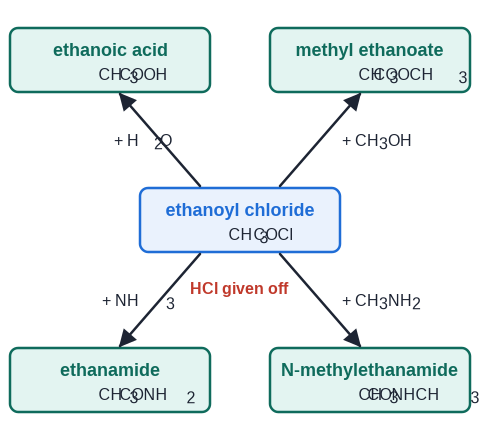
- Each reaction swaps the Cl for another group and releases HCl, seen as steamy fumes in moist air: CH₃COCl + H₂O → CH₃COOH + HCl.
- With an alcohol it makes an ester; with ammonia an amide, CH₃COCl + 2NH₃ → CH₃CONH₂ + NH₄Cl; with a primary amine an N-substituted amide, CH₃COCl + CH₃NH₂ → CH₃CONHCH₃ + HCl.
Making esters and amides
- Esterification: a carboxylic acid and an alcohol heated under reflux with a few drops of concentrated H₂SO₄ give an ester and water: CH₃CH₂CH₂COOH + CH₃CH₂OH ⇌ CH₃CH₂CH₂COOCH₂CH₃ + H₂O.
- This makes ethyl butanoate, a fruity ester found in kiwifruit. The reaction is reversible and slow, so the yield is limited; H₂SO₄ is the catalyst and also removes some of the water.
- Using the acyl chloride instead, CH₃CH₂CH₂COCl + CH₃CH₂OH → CH₃CH₂CH₂COOCH₂CH₃ + HCl, is fast and goes to completion.
- Amides are made from an acyl chloride and ammonia or an amine. The ester or amide link joins the two pieces, and a small molecule (H₂O or HCl) is lost, which is why these are called condensation reactions.
Hydrolysis in acid and in base
- Hydrolysis uses water to split an ester or amide back into its two pieces. It needs heating under reflux with dilute acid or with a base such as NaOH(aq).
- In acid, the products are the carboxylic acid plus the alcohol (from an ester) or an ammonium ion (from an amide), because the amine or NH₃ takes a proton from the acid.
- In base, the acid part comes out as its carboxylate ion, because OH⁻ removes the proton; the other product is the alcohol, or NH₃ or the amine.
- Acid hydrolysis of an ester is reversible, so it is incomplete. Base hydrolysis goes to completion because the carboxylate ion cannot react back with the alcohol.
| Compound | H₂O / H⁺, heat | H₂O / OH⁻, heat |
|---|---|---|
| Ester RCOOR' | RCOOH + R'OH | RCOO⁻ + R'OH |
| Amide RCONH₂ | RCOOH + NH₄⁺ | RCOO⁻ + NH₃ |
| N-substituted amide RCONHR' | RCOOH + R'NH₃⁺ | RCOO⁻ + R'NH₂ |
Try it: acid or base hydrolysis?
Example: hydrolysing an ester and an amide
- Give the organic products when (a) methyl propanoate and (b) N-methylethanamide are each heated under reflux with dilute HCl, and then with NaOH(aq).
- (a) CH₃CH₂COOCH₃: acid part propanoate, alcohol part methylsplit at the single-bonded O
- (a) in HCl: CH₃CH₂COOH (propanoic acid) + CH₃OH (methanol)
- (a) in NaOH: CH₃CH₂COO⁻ (propanoate ion, as sodium propanoate) + CH₃OH
- (b) CH₃CONHCH₃: acid part ethanoyl, amine part CH₃NH-split at the C-N bond
- (b) in HCl: CH₃COOH (ethanoic acid) + CH₃NH₃⁺ (methylammonium ion)
- (b) in NaOH: CH₃COO⁻ (ethanoate ion) + CH₃NH₂ (methanamine)
- acid gives the protonated amine; base gives the deprotonated acid
Planning a reaction scheme
- Start from the target and work backwards: an amide needs an acyl chloride and an amine; an acyl chloride needs a carboxylic acid; an amine can come from a haloalkane.
- Count carbons: substitution never changes the chain length, so the pieces of the product must already exist in the starting materials.
- Write every step with its reagent and conditions, and name or draw every intermediate.
- Check each step uses a reagent you are allowed: in the exam you are often given a short list and must choose from it.
Example: making N-ethylethanamide
- Plan a scheme to make N-ethylethanamide, CH₃CONHCH₂CH₃, from chloroethane and ethanoic acid. You may use SOCl₂ and concentrated NH₃.
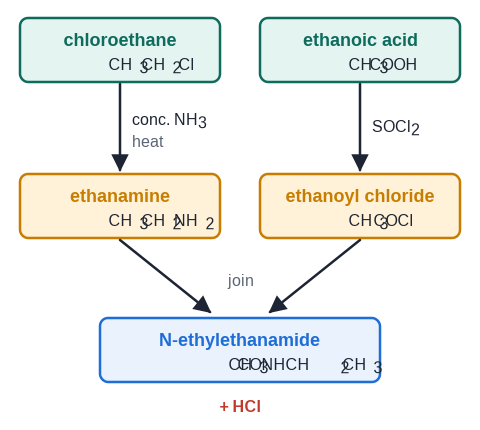
- target CH₃CO-NH-CH₂CH₃: the CH₃CO part comes from ethanoic acid, the NHCH₂CH₃ part from ethanaminesplit the amide at C-N
- step 1: CH₃CH₂Cl + 2NH₃ → CH₃CH₂NH₂ + NH₄Clconcentrated NH₃, heat
- step 2: CH₃COOH + SOCl₂ → CH₃COCl + SO₂ + HClmakes the reactive acyl chloride
- step 3: CH₃COCl + CH₃CH₂NH₂ → CH₃CONHCH₂CH₃ + HClroom temperature, fast
- three steps; every carbon in the product came from a starting material
What Achieved, Merit and Excellence look like
- Achieved gives correct products and names a reaction type. Merit explains what happens in each step and why the products form. Excellence links observations, reagents and products for every step and compares the alternatives.
| Grade | A model answer |
|---|---|
| Achieved | Both are hydrolysis. With NaOH the products are sodium ethanoate and ethanol; with H₂SO₄ they are ethanoic acid and ethanol. |
| Merit | Both are hydrolysis (substitution): water breaks the ester link into an acid part and an alcohol part. In acid the acid part stays as CH₃COOH; in base the OH⁻ removes its proton, giving CH₃COO⁻, so sodium ethanoate forms. |
| Excellence | Both reactions break the ester link, CH₃COOCH₂CH₃, into the CH₃CO- part and ethanol. In dilute H₂SO₄ the products are CH₃COOH and CH₃CH₂OH, but the reaction is reversible, so some ester remains at equilibrium. In NaOH the ethanoic acid formed is deprotonated to CH₃COO⁻, which cannot react with ethanol, so the reaction goes to completion and gives a better yield. To get ethanoic acid from the base route, acidify the sodium ethanoate afterwards. |
Common mistakes
- 1-bromopropane with KOH always gives propan-1-ol.Only KOH(aq) gives the alcohol; KOH in alcohol mostly gives propene by elimination.
- Hydrolysing an amide in acid gives the carboxylic acid and ammonia.In acid the NH₃ is protonated, so the products are the carboxylic acid and NH₄⁺.
- The ester from propanoic acid and methanol is propyl methanoate.The alcohol gives the first word and the acid the second: methyl propanoate.
- An acyl chloride dissolves in water to give a solution of the acyl chloride.It reacts with the water, giving the carboxylic acid and HCl, seen as steamy fumes.
Model esterification and hydrolysis
You need: plasticine or playdough in three colours, a box of toothpicks, paper, a pen
- Make balls for atoms: one colour for C, one for O and one for H. Use toothpicks as bonds, two side by side for a double bond.
- Build ethanoic acid (CH₃COOH) and ethanol (CH₃CH₂OH), with every atom having its right number of bonds: C four, O two, H one.
- Pull the OH off the acid and the H off the alcohol's OH. Join the H and OH to make water, then join the two pieces through the alcohol's O to make ethyl ethanoate.
- Now run it backwards: break the ester at the single-bonded O, add water back, and check you get the acid and alcohol again. Write each equation as you go.
- Look for: the same atoms rearranged each time, with water lost on joining and taken in on splitting, which is why these are called condensation and hydrolysis.
Safety: Toothpick points are sharp, so push them into the plasticine away from your fingers and keep them away from your face and eyes.
Your turn
Name the organic product when 2-bromobutane is heated with KOH(aq).
Name the organic product when propanoic acid reacts with SOCl₂.
Name the organic product when ethanoyl chloride reacts with propan-1-ol.
Give the organic products when propanamide is heated with NaOH(aq).
What is seen when water is added to ethanoyl chloride, and why?
Show answer
1. Butan-2-ol: OH⁻ replaces Br. 2. Propanoyl chloride, CH₃CH₂COCl, with SO₂ and HCl. 3. Propyl ethanoate, CH₃COOCH₂CH₂CH₃, with HCl. 4. The propanoate ion, CH₃CH₂COO⁻, and ammonia, NH₃. 5. Steamy fumes: the acyl chloride is hydrolysed to ethanoic acid and HCl gas, which forms droplets with moisture in the air.
Exam-style question: a family of propyl compounds
- 1-bromopropane is heated with concentrated NH₃ to give compound A. 1-bromopropane is also heated with KOH(aq) to give compound B. Propanoic acid reacts with SOCl₂ to give compound C.
Name compound A, and say what it does to damp red litmus paper.
Name compound B.
Compound C reacts with A. Name the organic product and the type of link it contains.
Compound C reacts with B. Name the organic product.
The product from part 3 is heated under reflux with dilute HCl. Give the two organic products and explain why one of them is an ion.
Show answer
1. A is propan-1-amine, CH₃CH₂CH₂NH₂; it turns damp red litmus blue because its N lone pair accepts a proton from water, releasing OH⁻ (Achieved; Merit with the reason). 2. B is propan-1-ol (Achieved). 3. CH₃CH₂COCl + CH₃CH₂CH₂NH₂ → CH₃CH₂CONHCH₂CH₂CH₃ + HCl: N-propylpropanamide, which contains an amide (peptide-type) link (Achieved for the name, Merit with the equation). 4. Propyl propanoate, CH₃CH₂COOCH₂CH₂CH₃ (Achieved). 5. Propanoic acid, CH₃CH₂COOH, and the propylammonium ion, CH₃CH₂CH₂NH₃⁺. Water breaks the C-N bond, and the propan-1-amine released is a base, so it accepts a proton from the excess acid and ends up as its ammonium ion (Merit; Excellence also contrasts the products in NaOH, propanoate ion and propan-1-amine, and explains the difference).
Recap
- Substitution swaps one group for another on the same carbon chain; the reagent and the conditions decide the product.
- SOCl₂ turns acids into acyl chlorides and alcohols into chloroalkanes; acyl chlorides react fast with water, alcohols, NH₃ and amines, giving HCl fumes.
- Esters and amides form by condensation and split by hydrolysis: acid hydrolysis gives the acid and the protonated amine, base hydrolysis gives the carboxylate ion and the free amine or alcohol.
- Plan schemes backwards from the target, one reagent per step.
| Make | From | With |
|---|---|---|
| Alcohol | haloalkane | KOH(aq), heat |
| Amine | haloalkane | concentrated NH₃, heat |
| Acyl chloride | carboxylic acid | SOCl₂ |
| Ester | acyl chloride or acid | alcohol (with H⁺ for the acid) |
| Amide | acyl chloride | NH₃ or a primary amine |
Challenge
Compound A, C₄H₈O₂, is an ester. Heated under reflux with NaOH(aq), A gives the sodium salt B and an alcohol C. C reacts with SOCl₂ to give D, C₃H₇Cl, and D heated with concentrated NH₃ gives E, a straight-chain amine with the NH₂ group on carbon 1. (a) Identify A to E by name and condensed formula. (b) Give the organic products if A were hydrolysed with dilute HCl instead.
Hint
Work backwards from E. Substitution never changes the carbon chain, so E, D and C all share one chain. Then count how many carbons are left over for the acid part of the ester.
Answer
(a) A propyl methanoate HCOOCH₂CH₂CH₃; B sodium methanoate HCOO⁻Na⁺; C propan-1-ol CH₃CH₂CH₂OH; D 1-chloropropane CH₃CH₂CH₂Cl; E propan-1-amine CH₃CH₂CH₂NH₂ (b) methanoic acid HCOOH and propan-1-ol
Step by step
- E is propan-1-amine, so D must be 1-chloropropane, because concentrated NH₃ swaps the Cl for NH₂ on the same carbon.
- SOCl₂ turns an alcohol into a chloroalkane on the same carbon, so C is propan-1-ol.
- The ester has four carbons and the alcohol part uses three, so the acid part has only one: it is a methanoate.
- A is propyl methanoate; base hydrolysis gives the methanoate ion, as sodium methanoate, and propan-1-ol.
- Acid hydrolysis gives the same split, but the acid part stays as methanoic acid and the reaction does not go to completion.
Full working
- E = CH₃CH₂CH₂NH₂NH₂ on carbon 1 of a three-carbon chain
- D = CH₃CH₂CH₂Clhaloalkane + conc. NH₃ → amine
- C = CH₃CH₂CH₂OHalcohol + SOCl₂ → chloroalkane
- acid part: 4 − 3 = 1 carbon, so HCOO-ester C₄H₈O₂ = HCOOC₃H₇
- A = HCOOCH₂CH₂CH₃, B = HCOO⁻Na⁺base hydrolysis gives the carboxylate
- H₂O, H⁺: HCOOCH₂CH₂CH₃ + H₂O ⇌ HCOOH + CH₃CH₂CH₂OHacid hydrolysis, reversible
- A propyl methanoate, B sodium methanoate, C propan-1-ol, D 1-chloropropane, E propan-1-amine; in acid: HCOOH + CH₃CH₂CH₂OH
Plan a reaction scheme to make N-propylpropanamide, CH₃CH₂CONHCH₂CH₂CH₃, using 1-bromopropane as the only source of carbon. You may use KOH(aq), concentrated NH₃, SOCl₂ and acidified potassium dichromate. Give each step with its reagent, conditions and product, then explain why the acyl chloride is used rather than mixing propanoic acid with the amine.
Hint
Split the target at the amide link. Both halves have three carbons, so 1-bromopropane must become both of them. One half needs a carbon with an O; oxidation of a primary alcohol, from the alcohols lesson, can supply it.
Answer
1-bromopropane with conc. NH₃, heat → propan-1-amine; 1-bromopropane with KOH(aq), heat → propan-1-ol; propan-1-ol with H⁺ and Cr₂O₇²⁻, reflux → propanoic acid; propanoic acid with SOCl₂ → propanoyl chloride; propanoyl chloride + propan-1-amine at room temperature → N-propylpropanamide. The acyl chloride reacts fast and completely; the acid and amine would only form a salt.
Step by step
- Breaking the amide at the C-N bond gives a propanoyl part, CH₃CH₂CO-, and a propylamine part, -NHCH₂CH₂CH₃.
- The amine half comes straight from 1-bromopropane by substitution with concentrated ammonia.
- The acyl half needs the end carbon to carry C=O, so go bromoalkane to primary alcohol, then oxidise it fully to the carboxylic acid.
- SOCl₂ turns the acid into propanoyl chloride, which reacts with the amine at room temperature to give the amide and HCl.
- Mixing the acid with the amine just gives an acid-base reaction: the amine takes the proton and forms propylammonium propanoate, a salt, instead of the amide.
Full working
- CH₃CH₂CH₂Br + 2NH₃ → CH₃CH₂CH₂NH₂ + NH₄Brconc. NH₃, heat
- CH₃CH₂CH₂Br + OH⁻ → CH₃CH₂CH₂OH + Br⁻KOH(aq), heat
- CH₃CH₂CH₂OH → CH₃CH₂COOHH⁺ and Cr₂O₇²⁻, reflux (oxidation)
- CH₃CH₂COOH + SOCl₂ → CH₃CH₂COCl + SO₂ + HClmakes the reactive acyl chloride
- CH₃CH₂COCl + CH₃CH₂CH₂NH₂ → CH₃CH₂CONHCH₂CH₂CH₃ + HClroom temperature, fast and complete
- CH₃CH₂COOH + CH₃CH₂CH₂NH₂ → CH₃CH₂COO⁻ ⁺H₃NCH₂CH₂CH₃why the acid alone fails: a salt forms
- five steps from 1-bromopropane: amine, alcohol, acid, acyl chloride, then N-propylpropanamide
An ester X, C₆H₁₂O₂, is analysed. 2.613 g of X is heated under reflux with 50.00 mL of 1.000 mol L⁻¹ NaOH until hydrolysis is complete. The NaOH left over needs 27.50 mL of 1.000 mol L⁻¹ HCl to neutralise it. The alcohol formed reacts with concentrated HCl to give 2-chloropropane. (a) Show that the data confirm the molar mass of X. (b) Identify X. (c) Explain why the analysis is done with NaOH rather than by heating X with dilute acid.
Hint
One ester link uses one OH⁻. The NaOH used by the ester is the NaOH added minus the NaOH left over. The alcohol's chain is the same chain as in 2-chloropropane.
Answer
(a) n(X) = 0.02250 mol, so M = 116 g mol⁻¹, matching C₆H₁₂O₂ (b) propan-2-yl propanoate (1-methylethyl propanoate), CH₃CH₂COOCH(CH₃)₂ (c) base hydrolysis goes to completion, so every mole of ester uses exactly one OH⁻; acid hydrolysis is reversible and incomplete
Step by step
- The leftover NaOH equals the HCl used; subtract it from the NaOH added to find the NaOH that reacted with the ester.
- One ester link reacts with one OH⁻, so that is also the moles of X; mass divided by moles gives about 116 g mol⁻¹.
- C₆H₁₂O₂ has M = 6(12.0) + 12(1.0) + 2(16.0) = 116 g mol⁻¹, so the data fit.
- 2-chloropropane comes from propan-2-ol, so the alcohol part has three carbons and is joined to the ester O through its middle carbon; the acid part has the other three: propanoate.
- In acid, some ester would remain at equilibrium, so the amount reacted would not tell you the amount of ester.
Full working
- n(NaOH added) = 1.000 × 0.05000 = 0.05000 moln = cV
- n(NaOH left) = n(HCl) = 1.000 × 0.02750 = 0.02750 molNaOH + HCl, 1 : 1
- n(X) = 0.05000 − 0.02750 = 0.02250 molone OH⁻ per ester link
- M(X) = 2.613 ÷ 0.02250 = 116 g mol⁻¹M = m ÷ n, matches C₆H₁₂O₂
- alcohol: (CH₃)₂CHOH, so acid part = C₆ − C₃ = C₃: CH₃CH₂COO-propan-2-ol gives 2-chloropropane
- CH₃CH₂COOCH(CH₃)₂ + OH⁻ → CH₃CH₂COO⁻ + (CH₃)₂CHOHbase hydrolysis, complete
- X = propan-2-yl propanoate, CH₃CH₂COOCH(CH₃)₂, M = 116 g mol⁻¹