Solving three equations
What this lesson covers
- Eliminate one variable from two pairs.
- Solve the resulting two equations.
- Substitute back and check.
The plan
- Each step removes one unknown, until one equation is left.
- Then work back up, finding one value at a time.
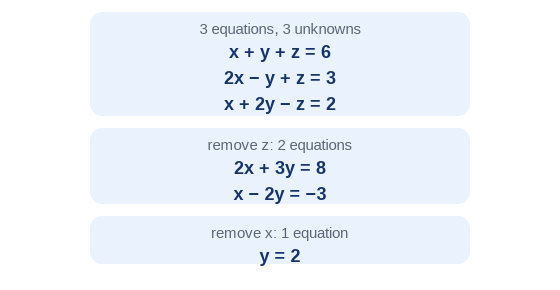
Try it: three planes
x + y + z = 6, 2x − y + z = 3, x + 2y − z = 2
- Number them (1), (2) and (3).
- (1) + (3): 2x + 3y = 8
- (2) − (1): x − 2y = −3
- so x = 2y − 3
- 2(2y − 3) + 3y = 8, so y = 2
- x = 1
- z = 6 − 1 − 2 = 3
Try it: eliminate step by step
When one equation is easy
- x + 2y + z = 8, 2x − y + z = 3, x + y − z = 0. The third gives z straight away.
- z = x + yfrom the third
- 2x + 3y = 8put into the first
- 3x = 3put into the second
- x = 1, y = 2
- z = 3
3D grapher
Common mistakes
- Eliminating different variables from each pair.Remove the same variable both times.
- Skipping the check.Test all three equations.
Try it: same letter twice
Your turn
x + y + z = 6, x = 1 and y = 2. Find z.
Add x + y + z = 6 and x − y − z = 0. What do you get?
Does (1, 2, 3) satisfy 2x + y − z = 1?
x + y = 5, y + z = 7 and x + z = 6. Find x, y and z.
(1) is x + 2y + z = 9 and (2) is 2x − y + z = 3. Find (1) − (2).
x + y + z = 12, y = 2x and z = 3x. Find x, y and z.
Solving three equations, a student eliminates z from one pair, then y from another pair. Why does this not work?
A coffee, muffin and juice cost $15. Two coffees and a muffin cost $14. A coffee and two juices cost $17. Find each price.
Show answer
1. z = 3 2. 2x = 6, so x = 3 3. Yes: 2 + 2 − 3 = 1 4. Adding gives x + y + z = 9, so x = 2, y = 3, z = 4 5. −x + 3y = 6. Subtract term by term: x − 2x = −x, 2y − (−y) = 3y, z − z = 0 and 9 − 3 = 6. 6. x = 2, y = 4, z = 6. Substituting gives x + 2x + 3x = 6x = 12, so x = 2, then y = 4 and z = 6. 7. The two new equations do not share the same two unknowns: one has x and y, the other x and z, so remove the same variable both times. 8. Coffee $5, muffin $4, juice $6. Check all three: 5 + 4 + 6 = 15, 2(5) + 4 = 14 and 5 + 2(6) = 17.
Sample question: Achieved
Solve the system x + y + z = 9, 2x − y + z = 5 and x + 2y − z = 4.
Hint
Remove z twice: add equation (3) to equation (1), and add equation (3) to equation (2).
Answer
x = 2, y = 3, z = 4
Step by step
- Number the equations (1), (2) and (3). The plan: remove one letter twice, to get two equations in two letters.
- z has +z in (1) and (2) and −z in (3), so adding (3) removes z. That makes z the easy letter to remove.
- (1) + (3): 2x + 3y = 13. Call it (4).
- (2) + (3): 3x + y = 9. Call it (5).
- From (5), y = 9 − 3x. Put that into (4): 2x + 3(9 − 3x) = 13.
- 2x + 27 − 9x = 13, so −7x = −14 and x = 2.
- Then y = 9 − 3 × 2 = 3.
- Back to (1): 2 + 3 + z = 9, so z = 4.
- Classic mistake: removing z from one pair and y from the other. Remove the same letter both times.
- Check in all three: 2 + 3 + 4 = 9, 4 − 3 + 4 = 5, 2 + 6 − 4 = 4. All correct.
Full working
- (1) + (3): 2x + 3y = 13z removed
- (2) + (3): 3x + y = 9z removed again
- y = 9 − 3x, so 2x + 27 − 9x = 13substitute
- x = 2, y = 3
- z = 9 − 2 − 3 = 4from (1)
- x = 2, y = 3, z = 4
Sample questions: Merit
Solve the system 2x + 3y − z = 0, 3x − 2y + 2z = −2 and 4x + y − 3z = −20.
Hint
No letter cancels by just adding, so multiply first. z is easiest: double (1) to match (2), and triple (1) to match (3).
Answer
x = −2, y = 3, z = 5
Step by step
- Number the equations (1), (2) and (3). Choose a letter to remove. z has coefficients −1, 2 and −3, so (1) can be scaled to match each one.
- 2 × (1): 4x + 6y − 2z = 0. Add (2): 7x + 4y = −2. Call it (4).
- 3 × (1): 6x + 9y − 3z = 0. Subtract it from (3): −2x − 8y = −20, so x + 4y = 10. Call it (5).
- Now (4) and (5) both have +4y. Subtract: (4) − (5) gives 6x = −12, so x = −2.
- Put x = −2 into (5): −2 + 4y = 10, so y = 3.
- From (1), z = 2x + 3y = −4 + 9 = 5.
- Classic mistake: when subtracting a whole equation, forgetting to change the sign of every term, including the right-hand side.
- Check (2): −6 − 6 + 10 = −2. Check (3): −8 + 3 − 15 = −20. Both correct.
Full working
- 2(1) + (2): 7x + 4y = −2remove z
- (3) − 3(1): −2x − 8y = −20, so x + 4y = 10remove z again
- 6x = −12, x = −2subtract the two
- y = 3from x + 4y = 10
- z = 2x + 3y = 5from (1)
- x = −2, y = 3, z = 5
Solve the system 6x + 4z = 7, 2x − y = 4 and 4y + 3z = −9, giving exact values.
Hint
Each equation has only two letters. Make y the subject of the second equation and substitute it into the third.
Answer
x = 12, y = −3, z = 1
Step by step
- Each equation is missing a letter, so substitution is quicker than elimination here.
- The second equation gives y easily: y = 2x − 4.
- Put it into the third: 4(2x − 4) + 3z = −9, so 8x − 16 + 3z = −9 and 8x + 3z = 7.
- Now there are two equations in x and z: 6x + 4z = 7 and 8x + 3z = 7.
- Remove x: 4 × the first gives 24x + 16z = 28, and 3 × the second gives 24x + 9z = 21.
- Subtract: 7z = 7, so z = 1.
- Then 6x + 4 = 7, so 6x = 3 and x = 12. Leave it as a fraction, as the question asks for exact values.
- y = 2 × 12 − 4 = −3.
- Check: 6 × 12 + 4 = 7, 1 + 3 = 4, −12 + 3 = −9. All correct.
Full working
- y = 2x − 4from the second equation
- 4(2x − 4) + 3z = −9, so 8x + 3z = 7substitute into the third
- 24x + 16z = 28 and 24x + 9z = 21match the x terms
- 7z = 7, z = 1
- 6x = 3, x = 12
- y = 1 − 4 = −3
- x = 12, y = −3, z = 1
Sample questions: Excellence
Solve 1x + 1y + 1z = 4, 2x + 1y − 1z = 0 and 1x − 2y + 3z = 13.
Hint
Let u = 1x, v = 1y and w = 1z. Then the system is linear in u, v and w.
Answer
x = 12, y = −1, z = 13
Step by step
- These are not linear in x, y and z, because x, y and z are in the denominators. But they are linear in 1x, 1y and 1z.
- Let u = 1x, v = 1y, w = 1z. The system becomes u + v + w = 4, 2u + v − w = 0, u − 2v + 3w = 13.
- Remove w. (1) + (2): 3u + 2v = 4. Call it (4).
- 3 × (2) + (3): 6u + 3v − 3w + u − 2v + 3w = 13, so 7u + v = 13. Call it (5).
- From (5), v = 13 − 7u. Into (4): 3u + 26 − 14u = 4, so −11u = −22 and u = 2.
- v = 13 − 14 = −1, and w = 4 − u − v = 4 − 2 + 1 = 3.
- Now undo the substitution: x = 1u = 12, y = 1v = −1, z = 1w = 13.
- Classic mistake: stopping at u, v and w. The question asks for x, y and z.
- Why it works: none of u, v, w is zero, so each one has a reciprocal. If one had been 0, there would be no solution.
- Check (3): 1x − 2y + 3z = 2 + 2 + 9 = 13. Correct.
Full working
- u = 1x, v = 1y, w = 1zmake it linear
- u + v + w = 4, 2u + v − w = 0, u − 2v + 3w = 13
- (1) + (2): 3u + 2v = 4remove w
- 3(2) + (3): 7u + v = 13remove w again
- u = 2, v = −1, w = 3
- x = 12, y = −1, z = 13take reciprocals
- x = 12, y = −1, z = 13
Show that the system x + y = a, y + z = b, x + z = c has exactly one solution for any numbers a, b and c, and find it in terms of a, b and c. Hence solve x + y = 11, y + z = 15, x + z = 14.
Hint
Add all three equations to get x + y + z. Then take each original equation away from that total.
Answer
x = a − b + c2, y = a + b − c2, z = b + c − a2; hence x = 5, y = 6, z = 9
Step by step
- Look at the shape: each letter appears in exactly two equations. Adding all three counts each letter twice.
- Add them: 2x + 2y + 2z = a + b + c, so x + y + z = a + b + c2.
- To get z, take away x + y = a: z = a + b + c2 − a = b + c − a2.
- To get x, take away y + z = b: x = a + b + c2 − b = a − b + c2.
- To get y, take away x + z = c: y = a + b + c2 − c = a + b − c2.
- These formulas work for any a, b and c, and every step was forced, so there is always exactly one solution.
- Hence: a = 11, b = 15, c = 14. x = 11 − 15 + 142 = 5.
- y = 11 + 15 − 142 = 6 and z = 15 + 14 − 112 = 9.
- Check the general answer: x + y = 2a2 = a. The other two work the same way.
- Check the numbers: 5 + 6 = 11, 6 + 9 = 15, 5 + 9 = 14. All correct.
Full working
- 2x + 2y + 2z = a + b + cadd all three
- x + y + z = a + b + c2
- z = b + c − a2subtract x + y = a
- x = a − b + c2subtract y + z = b
- y = a + b − c2subtract x + z = c
- a = 11, b = 15, c = 14: x = 5, y = 6, z = 9
- x = a − b + c2, y = a + b − c2, z = b + c − a2; x = 5, y = 6, z = 9
What to take away
- Three equations down to two, then to one.
- Check in all three.
Challenge
Solve the system 2^x × 4^y × 8^z = 2048, 25^x ÷ (5^y × 5^z) = 125 and 27^x ÷ 9^z = 3^(y + 4).
Hint
Write every number as a power of one prime: 2 in the first equation, 5 in the second, 3 in the third. Equal powers of the same base have equal indices.
Answer
x = 3, y = 1, z = 2
Step by step
- First equation: 4^y = 2^(2y), 8^z = 2^(3z) and 2048 = 2^11, so x + 2y + 3z = 11.
- Second: 25^x = 5^(2x) and 125 = 5^3, so 2x − y − z = 3.
- Third: 27^x = 3^(3x) and 9^z = 3^(2z), so 3x − 2z = y + 4, which is 3x − y − 2z = 4.
- Third minus second: x − z = 1. Twice the second plus the first: 5x + z = 17.
- Add these two: 6x = 18, so x = 3 and z = 2. Then y = 2x − z − 3 = 1.
- Check: 2^3 × 4^1 × 8^2 = 8 × 4 × 64 = 2048. Correct.
Full working
- 2^(x + 2y + 3z) = 2^11, so x + 2y + 3z = 11 (1)powers of 2
- 5^(2x − y − z) = 5^3, so 2x − y − z = 3 (2)powers of 5
- 3^(3x − 2z) = 3^(y + 4), so 3x − y − 2z = 4 (3)powers of 3
- (3) − (2): x − z = 1; 2(2) + (1): 5x + z = 17y removed twice
- 6x = 18, x = 3, z = 2
- y = 2(3) − 2 − 3 = 1from (2)
- x = 3, y = 1, z = 2
Find how many real solutions (x, y, z) the system x² + y² + z² = 14, 2x² − y² + z² = 7, x² + 2y² − z² = 0 has. Then find every solution with x + y + z = 0.
Hint
The system is linear in x², y² and z². Solve for those first, then think about signs: each square comes from two square roots.
Answer
8 real solutions, x = ±1, y = ±2, z = ±3 with any signs; those with x + y + z = 0 are (1, 2, −3) and (−1, −2, 3)
Step by step
- Let X = x², Y = y² and Z = z². Then X + Y + Z = 14, 2X − Y + Z = 7 and X + 2Y − Z = 0.
- Remove Z: the first plus the third gives 2X + 3Y = 14, and the second plus the third gives 3X + Y = 7.
- Y = 7 − 3X, so 2X + 21 − 9X = 14 and X = 1. Then Y = 4 and Z = 9. All three are positive, so real roots exist.
- x = ±1, y = ±2 and z = ±3, and the signs are free: 2 × 2 × 2 = 8 solutions.
- For x + y + z = 0 the two smaller sizes must add to the largest with the opposite sign: 1 + 2 − 3 = 0 or −1 − 2 + 3 = 0. No other sign choice gives 0.
Full working
- X + Y + Z = 14, 2X − Y + Z = 7, X + 2Y − Z = 0X = x², Y = y², Z = z²
- 2X + 3Y = 14 and 3X + Y = 7Z removed twice
- 2X + 3(7 − 3X) = 14, X = 1
- Y = 4, Z = 9all positive
- x = ±1, y = ±2, z = ±3: 2³ = 8 solutions
- x + y + z = 0: 1 + 2 − 3 = 0, −1 − 2 + 3 = 0
- 8 solutions; (1, 2, −3) and (−1, −2, 3)
Four equations are given: x + y + z = 4, 2x − y + z = 8, x + 3y − 2z = −7 and kx + y + k²z = 4, where k is a constant. Find every value of k for which all four equations are true at the same time. For one of your values the fourth equation is nothing new: explain why.
Hint
Three equations with no k already fix x, y and z. The fourth must then be true at that point, which gives an equation for k.
Answer
k = 1 or k = −53. When k = 1 the fourth equation is x + y + z = 4, the same as the first.
Step by step
- Solve the first three. Remove y: the first plus the second gives 3x + 2z = 12, and 3 × the first minus the third gives 2x + 5z = 19.
- Then 2 × (3x + 2z = 12) is 6x + 4z = 24 and 3 × (2x + 5z = 19) is 6x + 15z = 57. Subtract: 11z = 33, so z = 3, x = 2 and y = −1.
- All four are true together only if the fourth holds at (2, −1, 3): 2k − 1 + 3k² = 4, so 3k² + 2k − 5 = 0.
- (3k + 5)(k − 1) = 0, so k = 1 or k = −53.
- With k = 1 the fourth equation is x + y + z = 4, a copy of the first, so it adds nothing. With k = −53 it is a different plane that also passes through (2, −1, 3).
Full working
- (1) + (2): 3x + 2z = 12; 3(1) − (3): 2x + 5z = 19y removed twice
- 6x + 15z − (6x + 4z) = 57 − 24, 11z = 33, z = 3
- x = (12 − 6) ÷ 3 = 2, y = 4 − 2 − 3 = −1
- k(2) + (−1) + k²(3) = 4fourth equation at (2, −1, 3)
- 3k² + 2k − 5 = 0, (3k + 5)(k − 1) = 0
- k = 1 gives x + y + z = 4, the first equation again
- k = 1 or k = −53