Modelling with three unknowns
What this lesson covers
- Name three unknowns.
- Each fact gives one equation.
- A parabola through three points is a system.
Tickets
- 100 tickets earn $1600. Adults pay $20, children $10 and seniors $15, with twice as many adults as children.
- a + c + s = 100
- 20a + 10c + 15s = 1600
- a = 2c
- s = 100 − 3c
- 40c + 10c + 1500 − 45c = 1600
- c = 20
- 20 children, 40 adults, 40 seniors
Try it: solve the system
Parabola through (1, 2), (2, 3), (3, 6)
- Use y = ax² + bx + c.
- a + b + c = 2
- 4a + 2b + c = 3
- 9a + 3b + c = 6
- 3a + b = 1 and 5a + b = 3
- a = 1, b = −2, c = 3
- y = x² − 2x + 3
Three points fix a parabola
- Each point gives one equation in a, b and c, so three points give exactly one curve.
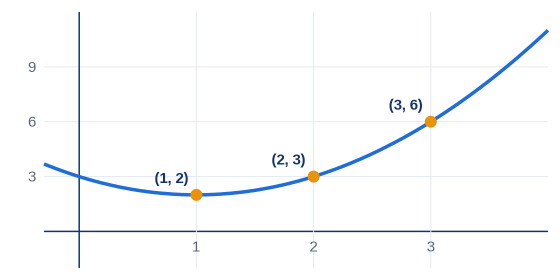
Try it: three points fix a parabola
A symmetrical trick
- 2 coffees, a tea and a muffin cost $17. A coffee, 2 teas and a muffin cost $16. A coffee, a tea and 2 muffins cost $19.
- 2c + t + m = 17, c + 2t + m = 16, c + t + 2m = 19
- add all three: 4(c + t + m) = 52
- c + t + m = 13divide by 4
- c = 4, t = 3, m = 6
Try it: one fact, one equation
Common mistakes
- Reusing the letter c for two things.Pick different letters for each unknown.
- Stopping at the letters.Answer in context.
Your turn
A parabola passes through (0, 3). Find c in y = ax² + bx + c.
a + b + c = 12, a = 2b and c = b. Find b.
How many facts are needed to find three unknowns?
Find the parabola through (0, 1), (1, 0) and (2, 3).
The parabola y = ax² + bx + c passes through (2, 5). Which equation does this point give?
A Hamilton show sold 200 tickets for $2,600: adults $16, children $8, seniors $12. Seniors equal children. How many children?
x + y = 9, y + z = 11 and x + z = 12. Find x.
A ball's height is h = at² + bt + c metres after t seconds. It is 2 m at t = 0, 7 m at t = 1 and 2 m at t = 2. Find its height at t = 1.5.
Show answer
1. c = 3 2. 4b = 12, so b = 3 3. Three independent facts 4. y = 2x² − 3x + 1 5. 4a + 2b + c = 5. Put x = 2 and y = 5 into y = ax² + bx + c, and 2² = 4. 6. 50 children. a + 2c = 200 and 16a + 8c + 12c = 2,600, so a = 200 − 2c gives 3,200 − 12c = 2,600 and c = 50 (with 100 adults). 7. x = 5. Adding all three gives 2(x + y + z) = 32, so x + y + z = 16 and x = 16 − 11 = 5. 8. 5.75 m. c = 2, a + b = 5 and 4a + 2b = 0 give h = −5t² + 10t + 2, so at t = 1.5, h = −11.25 + 15 + 2 = 5.75.
Sample question: Achieved
A school concert sold 250 tickets. Adult tickets cost $15, student tickets $8 and child tickets $5, and the total taken was $2550. Twice as many student tickets as child tickets were sold. How many of each ticket were sold?
Hint
Name three unknowns, write one equation for each fact, then substitute s = 2c.
Answer
100 adult, 100 student and 50 child tickets
Step by step
- Name the unknowns: a = adult tickets, s = student tickets, c = child tickets.
- Each fact gives one equation. Tickets: a + s + c = 250.
- Money: 15a + 8s + 5c = 2550.
- Twice as many students as children: s = 2c. Careful: it is s = 2c, not c = 2s.
- Substitute s = 2c into the first: a + 3c = 250, so a = 250 − 3c.
- Into the money equation: 15(250 − 3c) + 16c + 5c = 2550.
- 3750 − 45c + 21c = 2550, so −24c = −1200 and c = 50.
- s = 2 × 50 = 100 and a = 250 − 150 = 100.
- Check: 100 + 100 + 50 = 250 and 1500 + 800 + 250 = 2550. Both correct.
- Answer in context: 100 adult, 100 student and 50 child tickets.
Full working
- a + s + c = 250tickets
- 15a + 8s + 5c = 2550money
- s = 2ctwice as many students
- 15(250 − 3c) + 16c + 5c = 2550substitute
- 24c = 1200, c = 50
- 100 adult, 100 student, 50 child
Sample questions: Merit
A parabola y = ax² + bx + c passes through (−1, 8), (2, −1) and (3, 4). Find a, b and c, and hence find the exact minimum value of y.
Hint
Each point gives one equation in a, b and c. For the minimum, the vertex is at x = −b2a.
Answer
y = 2x² − 5x + 1; the minimum value is −178
Step by step
- The unknowns are a, b and c. Substitute each point's x and y.
- (−1, 8): a − b + c = 8. (2, −1): 4a + 2b + c = −1. (3, 4): 9a + 3b + c = 4.
- c has coefficient 1 in all three, so remove it by subtracting.
- Second − first: 3a + 3b = −9, so a + b = −3.
- Third − second: 5a + b = 5.
- Subtract: 4a = 8, so a = 2. Then b = −5, and c = 8 − 2 − 5 = 1.
- So y = 2x² − 5x + 1. a > 0, so the parabola opens upwards and has a minimum.
- The vertex is at x = −b2a = 54.
- y = 2 × 2516 − 5 × 54 + 1 = 258 − 508 + 88 = −178.
- Check a point: x = 3 gives 18 − 15 + 1 = 4. Correct.
Full working
- a − b + c = 8, 4a + 2b + c = −1, 9a + 3b + c = 4substitute the points
- a + b = −3 and 5a + b = 5remove c
- a = 2, b = −5, c = 1
- x = −b2a = 54vertex
- y = 258 − 508 + 88
- y = 2x² − 5x + 1, minimum −178
Mere invested $20 000 in three accounts paying 3%, 4% and 6% interest a year. After one year she earned $910 in interest. She put $3000 more in the 6% account than in the 3% account. How much did she put in each account?
Hint
Use x, y and z for the three amounts. The interest equation uses the rates as decimals.
Answer
$5000 at 3%, $7000 at 4% and $8000 at 6%
Step by step
- Name the unknowns: x at 3%, y at 4%, z at 6%, all in dollars.
- Total: x + y + z = 20 000.
- Interest: 0.03x + 0.04y + 0.06z = 910. Multiply by 100 to clear decimals: 3x + 4y + 6z = 91 000.
- $3000 more at 6% than at 3%: z = x + 3000.
- Substitute into the total: x + y + x + 3000 = 20 000, so y = 17 000 − 2x.
- Into the interest: 3x + 4(17 000 − 2x) + 6(x + 3000) = 91 000.
- 3x + 68 000 − 8x + 6x + 18 000 = 91 000, so x + 86 000 = 91 000 and x = 5000.
- y = 17 000 − 10 000 = 7000 and z = 8000.
- Check: 5000 + 7000 + 8000 = 20 000, and 150 + 280 + 480 = 910. Both correct.
- Classic mistake: using 3, 4 and 6 instead of 0.03, 0.04 and 0.06 without scaling the $910 too.
Full working
- x + y + z = 20 000total
- 3x + 4y + 6z = 91 000interest × 100
- z = x + 3000$3000 more at 6%
- y = 17 000 − 2xfrom the total
- 3x + 4(17 000 − 2x) + 6(x + 3000) = 91 000, x = 5000
- $5000 at 3%, $7000 at 4%, $8000 at 6%
Sample questions: Excellence
Video of a rugby up-and-under kick shows the ball is 11.25 m high after 0.5 s, 18.5 m high after 1 s and 22.5 m high after 3 s. Model the height as h = at² + bt + c. Find a, b and c. Hence find the greatest height and the time the ball would hit the ground if no one caught it, and give one limitation of the model.
Hint
Each time gives one linear equation in a, b and c. Then use the vertex for the greatest height and the quadratic formula for h = 0.
Answer
h = −5t² + 22t + 1.5; greatest height 25.7 m at 2.2 s; hits the ground at about 4.47 s
Step by step
- The unknowns are a, b and c. Substitute each (t, h) pair.
- t = 0.5: 0.25a + 0.5b + c = 11.25. t = 1: a + b + c = 18.5. t = 3: 9a + 3b + c = 22.5.
- Remove c. Second − first: 0.75a + 0.5b = 7.25. Third − second: 8a + 2b = 4, so 4a + b = 2.
- Double the first of these: 1.5a + b = 14.5. Subtract from 4a + b = 2: 2.5a = −12.5, so a = −5.
- b = 2 − 4 × (−5) = 22, and c = 18.5 + 5 − 22 = 1.5.
- So h = −5t² + 22t + 1.5. a = −5 matches gravity, about half of 9.8, which is a good sign. c = 1.5 m is the height of the boot at the kick.
- Greatest height at the vertex: t = −b2a = 2210 = 2.2 s. h = −5(2.2)² + 22(2.2) + 1.5 = 25.7 m.
- Ground: −5t² + 22t + 1.5 = 0. Quadratic formula: t = 22 + √51410, taking the positive root.
- √514 = 22.6716, so t = 4.47 s. The negative root is before the kick, so reject it.
- Check: t = 3 gives −45 + 66 + 1.5 = 22.5. Correct.
- Limitation: the model ignores air resistance and wind, and the heights read off video have measurement error, so the landing time is only an estimate.
Full working
- 0.25a + 0.5b + c = 11.25, a + b + c = 18.5, 9a + 3b + c = 22.5
- 0.75a + 0.5b = 7.25 and 4a + b = 2remove c
- 2.5a = −12.5, a = −5
- b = 22, c = 1.5
- t = 2210 = 2.2, h = 25.7vertex
- t = 22 + √51410 = 4.47h = 0, positive root
- h = −5t² + 22t + 1.5; max 25.7 m; lands at 4.47 s
A garden centre sells three fertiliser blends. One bag of A contains 4 kg of nitrogen, 2 kg of phosphorus and 2 kg of potassium. One bag of B contains 2 kg, 4 kg and 2 kg, and one bag of C contains 2 kg, 2 kg and 4 kg. A farmer wants a mix with exactly 44 kg of nitrogen, 30 kg of phosphorus and 22 kg of potassium. Show that this mix is impossible. Find the least amount of potassium the farmer would have to accept, keeping the nitrogen and phosphorus the same, for a mix to be possible.
Hint
Solve with x, y and z bags of A, B and C. A negative number of bags is not possible. Then replace 22 with K and require all three to be 0 or more.
Answer
The solution is x = 10, y = 3, z = −1, which needs a negative number of bags, so it is impossible. A mix is possible when K ≥ 743, so at least 24.7 kg of potassium
Step by step
- Let x, y and z be the bags of A, B and C.
- Nitrogen: 4x + 2y + 2z = 44. Phosphorus: 2x + 4y + 2z = 30. Potassium: 2x + 2y + 4z = 22.
- The pattern is symmetric, so add all three: 8(x + y + z) = 96, so x + y + z = 12.
- Nitrogen is 2(x + y + z) + 2x = 24 + 2x = 44, so x = 10.
- The same way: 24 + 2y = 30 gives y = 3, and 24 + 2z = 22 gives z = −1.
- There is exactly one solution, and it needs −1 bags of C. That cannot happen, so the mix is impossible.
- Now let the potassium be K kg. Adding gives 8(x + y + z) = 74 + K, so x + y + z = 74 + K8.
- z = K − 2(x + y + z)2 = (K − 74 + K4) ÷ 2 = 3K − 748.
- z ≥ 0 needs 3K ≥ 74, so K ≥ 743 = 24.67 kg.
- Also check x and y: y = 15 − 74 + K8 ≥ 0 needs K ≤ 46, and x needs K ≤ 102. So K = 743 is allowed.
- At K = 743 the mix is 293 ≈ 9.67 bags of A, 83 ≈ 2.67 of B and none of C. If only whole bags are sold, the farmer must look further.
- Classic mistake: stopping at the algebra. A correct solution of the equations can still be impossible in context.
Full working
- 4x + 2y + 2z = 44, 2x + 4y + 2z = 30, 2x + 2y + 4z = 22
- 8(x + y + z) = 96, x + y + z = 12add all three
- x = 10, y = 3, z = −1z < 0, impossible
- potassium K: x + y + z = 74 + K8
- z = 3K − 748 ≥ 0, K ≥ 743
- y ≥ 0 needs K ≤ 46; x ≥ 0 needs K ≤ 102
- impossible; at least 743 ≈ 24.7 kg of potassium
What to take away
- One fact, one equation.
- Check with the original story.
Challenge
In a rugby match a try is worth 5 points, a conversion 2 points and a penalty goal 3 points. A conversion can only be kicked after a try. A team scored 37 points from 10 scores (each try, conversion and penalty counts as one score), and exactly two of its tries were not converted. How many tries, conversions and penalties did it score? A radio report gave the same two facts (10 scores, two tries not converted) but a different points total. Which totals could the report have given?
Hint
Use T, C and P. "Two tries were not converted" links C and T. Solve with the points total left as N, then ask which values keep every count a whole number that is not negative.
Answer
5 tries, 3 conversions and 2 penalties. With the other facts the same, the total must be 34, 35, 36, 37 or 38 points.
Step by step
- Scores: T + C + P = 10. Points: 5T + 2C + 3P = 37. Two tries not converted: C = T − 2.
- Substitute into the scores equation: 2T − 2 + P = 10, so P = 12 − 2T.
- Points: 5T + 2(T − 2) + 3(12 − 2T) = T + 32. Setting this to 37 gives T = 5, so C = 3 and P = 2.
- For another total N, the same working gives T = N − 32, C = T − 2 and P = 12 − 2T.
- C ≥ 0 needs T ≥ 2, and P ≥ 0 needs T ≤ 6. So T is 2 to 6 and N = T + 32 is 34 to 38.
- Check 37: 25 + 6 + 6 = 37 points from 5 + 3 + 2 = 10 scores.
Full working
- T + C + P = 10, 5T + 2C + 3P = 37, C = T − 2
- P = 10 − T − (T − 2) = 12 − 2Tsubstitute
- 5T + 2(T − 2) + 3(12 − 2T) = T + 32 = 37
- T = 5, C = 3, P = 2
- total N: T = N − 32, need T ≥ 2 (C ≥ 0) and T ≤ 6 (P ≥ 0)
- 5 tries, 3 conversions, 2 penalties; possible totals 34 to 38 points
Mere cycles a trail from her bach to a café and back on the same day. The trail is 36 km each way and is made of flat, uphill and downhill sections. She rides at 24 km per hour on the flat, 12 km per hour uphill and 36 km per hour downhill. The ride there takes 1 hour 55 minutes and the ride back takes 1 hour 35 minutes. How many kilometres of the ride to the café are flat, uphill and downhill?
Hint
Let f, u and d be the flat, uphill and downhill distances on the way there. On the way back the uphill and downhill sections swap. Work in minutes, and time = distance ÷ speed.
Answer
18 km flat, 12 km uphill and 6 km downhill (on the way to the café)
Step by step
- Distance: f + u + d = 36.
- In minutes, a km takes 2.5 min on the flat, 5 min uphill and 53 min downhill. There: 2.5f + 5u + (53)d = 115. Multiply by 6: 15f + 30u + 10d = 690.
- Back, the uphill of the trip there is now downhill and the downhill is uphill: 2.5f + (53)u + 5d = 95, so 15f + 10u + 30d = 570.
- Subtract the two time equations: 20u − 20d = 120, so u − d = 6. Add them: 30f + 40(u + d) = 1260.
- Use u + d = 36 − f: 30f + 1440 − 40f = 1260, so f = 18. Then u + d = 18 and u − d = 6 give u = 12 and d = 6.
- Check there: 45 + 60 + 10 = 115 minutes. Back: 45 + 20 + 30 = 95 minutes.
Full working
- f + u + d = 36km
- 2.5f + 5u + (53)d = 115, so 15f + 30u + 10d = 690there, minutes × 6
- 2.5f + (53)u + 5d = 95, so 15f + 10u + 30d = 570back, up and down swap
- 20u − 20d = 120, u − d = 6subtract
- 30f + 40(u + d) = 1260, 30f + 40(36 − f) = 1260, f = 18add
- u + d = 18, u − d = 6: u = 12, d = 6
- 18 km flat, 12 km uphill, 6 km downhill
A cart rolls down a ramp. Its distance d metres from a mark is recorded at t = 0, 1, 2, 3 and 4 seconds: 0.5, 1.3, 2.1, 3.5 and 5.3. The model is d = at² + bt + c. Exactly one reading was written down wrongly. Find the model that fits the other four readings exactly, say which reading is wrong, and give its correct value. Explain why using the first three readings gives a misleading model.
Hint
Three readings fix a, b and c. Pick three, solve, and test the model on the other two. A model that also fits a fourth reading is very strong evidence. The reading at t = 0 gives c straight away.
Answer
d = 0.2t² + 0.4t + 0.5; the reading at t = 1 is wrong, it should be 1.1 m
Step by step
- Start with t = 0, which gives c = 0.5 straight away.
- Try t = 2 and t = 4: 4a + 2b = 1.6 and 16a + 4b = 4.8. Double the first and subtract: 8a = 1.6, so a = 0.2 and b = 0.4.
- Test t = 3: 1.8 + 1.2 + 0.5 = 3.5, which matches. So the model fits four readings: t = 0, 2, 3 and 4.
- Test t = 1: 0.2 + 0.4 + 0.5 = 1.1, but 1.3 was written. That is the wrong reading; it should be 1.1 m.
- The first three readings (0.5, 1.3, 2.1) go up by 0.8 each second, so they give a = 0: a straight line d = 0.8t + 0.5. It predicts 2.9 at t = 3 and 3.7 at t = 4, far below 3.5 and 5.3, because it is built on the bad reading.
- Three points always fit some quadratic, so a good fit to three readings proves nothing; agreement with a fourth reading is the real test.
Full working
- c = 0.5t = 0
- 4a + 2b + 0.5 = 2.1 and 16a + 4b + 0.5 = 5.3t = 2 and t = 4
- 8a = 4.8 − 3.2 = 1.6, a = 0.2, b = 0.42 × first subtracted
- t = 3: 0.2(9) + 0.4(3) + 0.5 = 3.5matches, four readings fit
- t = 1: 0.2 + 0.4 + 0.5 = 1.1 ≠ 1.3the wrong reading
- t = 0, 1, 2 only: a = 0, b = 0.8, d = 0.8t + 0.5 predicts 2.9 and 3.7fails both others
- d = 0.2t² + 0.4t + 0.5; the t = 1 reading should be 1.1 m