
The constant of integration: find c, never assume it

What this lesson covers
- Every indefinite integral carries a constant, and the question's conditions decide its value.
- A starting value of zero does not mean the constant is zero.
Why every integral ends in + c
- A constant differentiates to zero.
- So integrating cannot recover it.
- The question gives you enough to find it.
A family of curves: y = x² − 2x + c
- Each c shifts the curve up or down.
- Same gradient at every x.
- The point (3, 5) picks c = 2.
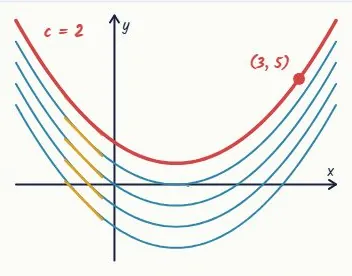
Try it: a point picks the curve
The curve through (3, 5)
- Integrate, keep + c.
- Substitute the point.
- y = ∫ (2x − 2) dx
- = x² − 2x + ckeep + c
- 5 = 3² − 2(3) + cx = 3, y = 5
- 5 = 3 + c
- c = 2
- y = x² − 2x + 2
Finding c from a point
- Integrate, keep + c.
- Substitute the point.
- Then write the curve.
- dy/dx = 6x² − 4x, through (1, 5)
- y = 6x³/3 − 4x²/2 + cintegrate, + c
- y = 2x³ − 2x² + c
- 5 = 2(1)³ − 2(1)² + cx = 1, y = 5
- 5 = 2 − 2 + c, so c = 5
- y = 2x³ − 2x² + 5
The 2025 error: + c left out
- Omitted, or assumed to be zero.
- Handled inconsistently in long solutions.
- Write + c, then find it straight away.
Acceleration to velocity
- v = 3, s = 0 when t = 0.
- Integrate a to get v.
- a = 6t − 4
- v = ∫ (6t − 4) dt
- = 3t² − 4t + ckeep + c
- v(0) = 3: 3 = 0 − 0 + c
- c = 3
- v = 3t² − 4t + 3
Try it: a to v to s
Velocity to displacement
- Integrate v to get s.
- A new letter: d.
- v = 3t² − 4t + 3
- s = ∫ (3t² − 4t + 3) dt
- = t³ − 2t² + 3t + da new constant, d
- s(0) = 0: 0 = 0 + d
- d = 0
- s = t³ − 2t² + 3t
- s(2) = 8 − 8 + 6 = 6t = 2
- s = 6 m at t = 2
Two integrations, two constants
- Find the first before integrating again.
- A different letter for each.
- Match each condition to its constant.
Starting at zero does not mean c = 0
- Polynomials: often c = 0 at t = 0.
- 2025: exponential s, s = 0 at t = 0.
- The constant was not zero.
v = 8e^(−2t), s = 0 at t = 0
- Integrate, keep + c.
- e⁰ = 1, not 0.
- So c = 4, not 0.
- s = ∫ 8e^(−2t) dt
- = 8 × (1/(−2))e^(−2t) + c÷ −2
- = −4e^(−2t) + c
- 0 = −4e⁰ + ct = 0, s = 0
- 0 = −4 + ce⁰ = 1
- c = 4
- s = 4 − 4e^(−2t)
Does the answer fit?
- c = 0 starts at −4.
- The correct s starts at 0.
- It approaches 4 m.
- c = 0: s = −4e^(−2t)
- s(0) = −4e⁰ = −4 ≠ 0does not fit
- s(0) = 4 − 4e⁰ = 0fits s(0) = 0
- s(1) = 4 − 4e^(−2)
- ≈ 3.46 mcalculator
- t → ∞: e^(−2t) → 0
- s → 4 m
Cos does it too: v = 2sin t
- tⁿ, sin t: 0 at t = 0.
- eᵏᵗ, cos t: 1 at t = 0.
- Substitute, never assume.
- s = ∫ 2sin t dt
- = −2cos t + csin to −cos
- 0 = −2cos 0 + ct = 0, s = 0
- 0 = −2 + ccos 0 = 1
- c = 2
- s = 2 − 2cos t
Try it: does it fit?
Where the marks are
- Achieved: find c from given information.
- Merit: a, v and s with starting values.
- Excellence: your own equations, consistent.
What to take away
- Keep + c, substitute the condition, and never assume c = 0.
| Every integral | + c |
| Find c | substitute the condition |
| a to v to s | a new constant each time |
| At t = 0 | e and cos give 1 |
| Check | your s fits the start |
Common mistakes
- s = 0 when t = 0, so c = 0 and s = −4e^(−2t).Substitute: 0 = −4e⁰ + c and e⁰ = 1, so c = 4 and s = 4 − 4e^(−2t).
- dy/dx = 6x² − 4x, so y = 2x³ − 2x².Write + c, then use the point (1, 5) to find it: c = 5, so y = 2x³ − 2x² + 5.
- v = 3t² − 4t + c, then s = t³ − 2t² + 3t + c with the same c.Each integration gives a new constant; use a new letter (d) and find it from its own starting value.
- s = −2cos t + c and s(0) = 0, so c = 0.cos 0 = 1, so 0 = −2 + c gives c = 2 and s = 2 − 2cos t.
Your turn: eight questions
- Questions 3 and 4 start at zero.
- Show the substitution that finds c.
| Given | Find | |
|---|---|---|
| 1 | dy/dx = 3x² + 2, (1, 6) | the curve |
| 2 | a = 12t, v = 2, s = 1 | s, if both at t = 0 |
| 3 | v = 6e^(3t) | s, if s = 0 at t = 0 |
| 4 | v = 4sin 2t | s, if s = 0 at t = 0 |
| 5 | dy/dx = 4x − 1/x², (1, 3) | the curve |
| 6 | v = 8 − 2t, s = 5 when t = 1 | s |
| 7 | a = −12cos 2t, v = 0, s = 0 | s, if both at t = 0 |
| 8 | v = 6e^(−2t), s = 2 at t = 0 | s in the long run |
Show answer
1. y = x³ + 2x + c, c = 3: y = x³ + 2x + 3. 2. v = 6t² + 2, s = 2t³ + 2t + 1. 3. s = 2e^(3t) + c, c = −2: s = 2e^(3t) − 2. 4. s = −2cos 2t + c, c = 2: s = 2 − 2cos 2t. 5. y = 2x² + 1/x. y = 2x² + 1/x + c, and 3 = 2 + 1 + c gives c = 0, found, not assumed. 6. s = 8t − t² − 2. s = 8t − t² + c, and 5 = 8 − 1 + c gives c = −2. 7. s = 3cos 2t − 3. v = −6sin 2t + c with c = 0, then s = 3cos 2t + d, and 3 + d = 0 gives d = −3. 8. s approaches 5 m. s = −3e^(−2t) + c, and 2 = −3 + c gives c = 5, so s = 5 − 3e^(−2t), and e^(−2t) heads to 0.
The answers: questions 1 and 2
- 1. y = x³ + 2x + cintegrate 3x² + 2
- 6 = 1 + 2 + c, so c = 3point (1, 6)
- y = x³ + 2x + 3
- 2. v = ∫ 12t dt = 6t² + c
- v(0) = 2: 2 = 0 + c, c = 2
- v = 6t² + 2
- s = ∫ (6t² + 2) dt = 2t³ + 2t + d
- s(0) = 1: 1 = 0 + d, d = 1
- s = 2t³ + 2t + 1
The answers: questions 3 and 4
- 3. s = ∫ 6e^(3t) dt
- = 2e^(3t) + c÷ 3
- 0 = 2e⁰ + c = 2 + ct = 0, s = 0
- c = −2, s = 2e^(3t) − 2
- 4. s = ∫ 4sin 2t dt
- = −2cos 2t + csin to −cos, ÷ 2
- 0 = −2cos 0 + c = −2 + ct = 0, s = 0
- c = 2, s = 2 − 2cos 2t
Sample question: Achieved
A curve has gradient dydx = 4x³ − 6x + 1 and passes through the point (2, 9). Find the equation of the curve.
Hint
Integrate, keep the + c, then put x = 2 and y = 9 in to find c.
Answer
y = x⁴ − 3x² + x + 3
Step by step
- The gradient function is the derivative, so integrating it gives back y. It only gives y up to a constant, so write + c.
- Integrate each term: add one to the power, then divide by the new power.
- 4x³ becomes x⁴, −6x becomes −3x², and 1 becomes x. So y = x⁴ − 3x² + x + c.
- The curve passes through (2, 9), so y = 9 when x = 2. Substitute: 9 = 16 − 12 + 2 + c.
- That is 9 = 6 + c, so c = 3.
- Classic mistake: leaving out + c, or assuming c = 0. The point decides it.
- So y = x⁴ − 3x² + x + 3.
- Check: at x = 2, y = 16 − 12 + 2 + 3 = 9. Correct.
Full working
- y = ∫ (4x³ − 6x + 1) dx = x⁴ − 3x² + x + ckeep + c
- 9 = 2⁴ − 3(2)² + 2 + cx = 2, y = 9
- 9 = 6 + c, so c = 3
- y = x⁴ − 3x² + x + 3
Sample questions: Merit
A particle moves in a straight line with acceleration a = 12 − 6t m s⁻². It starts from rest at a displacement of 4 m from O. Find its displacement when it is next at rest.
Hint
Integrate twice, using a different constant each time, and use the two starting facts to find them. Next at rest means v = 0 again.
Answer
36 m from O, at t = 4 s
Step by step
- Velocity is the integral of acceleration, and displacement is the integral of velocity. Each integration brings its own constant.
- v = ∫ (12 − 6t) dt = 12t − 3t² + c.
- Starts from rest means v = 0 when t = 0. So 0 = 0 − 0 + c, and c = 0. Here the constant really is zero, but we found it, not assumed it.
- So v = 12t − 3t².
- s = ∫ (12t − 3t²) dt = 6t² − t³ + d. Use a new letter, d, because it is a different constant.
- s = 4 when t = 0, so 4 = 0 − 0 + d and d = 4. So s = 6t² − t³ + 4.
- Classic mistake: assuming d = 0 because the particle starts at t = 0. It starts 4 m from O, so d = 4.
- Next at rest: v = 0, so 12t − 3t² = 3t(4 − t) = 0. t = 0 is the start, so the next time is t = 4.
- s(4) = 6(16) − 64 + 4 = 96 − 64 + 4 = 36 m.
- Check: differentiate s to get 12t − 3t², then again to get 12 − 6t. Both match.
Full working
- v = ∫ (12 − 6t) dt = 12t − 3t² + cintegrate a
- v(0) = 0 gives c = 0starts from rest
- s = ∫ (12t − 3t²) dt = 6t² − t³ + dnew constant
- s(0) = 4 gives d = 4s = 6t² − t³ + 4
- 3t(4 − t) = 0, so t = 4next time v = 0
- s(4) = 96 − 64 + 4 = 36 m
A kayak drifting on a lake has velocity v = 6e^(−3t) m s⁻¹, where t is in seconds. Its displacement is s = 0 when t = 0. Find s in terms of t, the displacement after 2 seconds, and the distance it approaches in the long run.
Hint
Integrate with the reverse chain rule, keep + c, and remember e⁰ = 1, not 0.
Answer
s = 2 − 2e^(−3t); about 1.995 m after 2 s; it approaches 2 m
Step by step
- Displacement is the integral of velocity, so integrate v and add a constant.
- e^(−3t) integrates to e^(−3t) divided by −3. So 6e^(−3t) gives 6 × (−13)e^(−3t) = −2e^(−3t).
- So s = −2e^(−3t) + c.
- Use s = 0 at t = 0: 0 = −2e⁰ + c. Since e⁰ = 1, 0 = −2 + c, so c = 2.
- Classic mistake: thinking s = 0 at t = 0 means c = 0. That would make s(0) = −2, not 0.
- So s = 2 − 2e^(−3t).
- After 2 seconds: s = 2 − 2e^(−6) ≈ 2 − 0.005 = 1.995 m.
- In the long run, e^(−3t) gets closer and closer to 0, so s gets closer to 2 m but never passes it.
- Check: s(0) = 2 − 2 = 0, which fits the start.
Full working
- s = ∫ 6e^(−3t) dt = −2e^(−3t) + c÷ −3
- 0 = −2e⁰ + c, so c = 2e⁰ = 1
- s = 2 − 2e^(−3t)
- s(2) = 2 − 2e^(−6) ≈ 1.995 m
- t → ∞: e^(−3t) → 0, so s → 2 m
- s = 2 − 2e^(−3t); 1.995 m; approaches 2 m
Sample questions: Excellence
A buoy bobbing on a swell has acceleration a = −8 sin 2t m s⁻². At t = 0 it is at s = 0 with velocity 6 m s⁻¹. Find when the buoy first comes to rest, and its exact displacement at that moment.
Hint
Integrate twice, finding each constant from the starting values (cos 0 = 1). Then solve v = 0 in radians.
Answer
First at rest at t = π3 s, with s = √3 + 2π3 ≈ 3.83 m
Step by step
- Integrate a to get v. −8 sin 2t: sin goes to −cos, and divide by 2. So v = 4 cos 2t + c.
- Use v = 6 at t = 0. cos 0 = 1, so 6 = 4 + c and c = 2. So v = 4 cos 2t + 2.
- Classic mistake: thinking c = 0 because the start is at t = 0. cos 0 is 1, not 0, so always substitute.
- Integrate again for s. 4 cos 2t gives 2 sin 2t, and 2 gives 2t. So s = 2 sin 2t + 2t + d.
- Use s = 0 at t = 0: sin 0 = 0, so 0 = 0 + 0 + d and d = 0. So s = 2 sin 2t + 2t.
- At rest means v = 0: 4 cos 2t + 2 = 0, so cos 2t = −12.
- Radians: cos is −12 first at an angle of 2π3. So 2t = 2π3 and t = π3 s. Before that, cos 2t > −12, so v > 0 and the buoy is still moving forward.
- Displacement: s(π3) = 2 sin(2π3) + 2π3.
- sin(2π3) = √32, so 2 sin(2π3) = √3. So s = √3 + 2π3.
- As a decimal, √3 + 2π3 ≈ 1.732 + 2.094 = 3.83 m.
- Check: differentiate s = 2 sin 2t + 2t to get 4 cos 2t + 2, then again to get −8 sin 2t. Both match.
Full working
- v = ∫ −8 sin 2t dt = 4 cos 2t + csin to −cos, ÷ 2
- 6 = 4 cos 0 + c, so c = 2cos 0 = 1
- s = ∫ (4 cos 2t + 2) dt = 2 sin 2t + 2t + d
- 0 = 2 sin 0 + 0 + d, so d = 0
- 4 cos 2t + 2 = 0, so cos 2t = −12v = 0
- 2t = 2π3, so t = π3first solution, radians
- s(π3) = 2 sin(2π3) + 2π3 = √3 + 2π3sin(2π3) = √32
- t = π3 s, s = √3 + 2π3 ≈ 3.83 m
A rain tank holds 50 litres at t = 0. Water flows in at a rate of dVdt = 30e^(−0.2t) litres per minute, where t is in minutes. Find V in terms of t, the volume the tank approaches in the long run, and the time when it holds 180 litres.
Hint
Integrate, find c from V = 50 at t = 0 (e⁰ = 1), then isolate the exponential and take ln of both sides.
Answer
V = 200 − 150e^(−0.2t); it approaches 200 litres; 180 litres after 5 ln 7.5 ≈ 10.1 minutes
Step by step
- The rate is given, so integrate it to get the volume, and keep + c.
- 30e^(−0.2t) integrates to 30 ÷ (−0.2) × e^(−0.2t) = −150e^(−0.2t). So V = −150e^(−0.2t) + c.
- At t = 0, V = 50: 50 = −150e⁰ + c = −150 + c, so c = 200.
- Classic mistake: thinking the starting 50 is the constant. The constant is 200, because e⁰ = 1.
- So V = 200 − 150e^(−0.2t).
- Long run: as t gets large, e^(−0.2t) gets close to 0, so V approaches 200 litres.
- 180 litres: 200 − 150e^(−0.2t) = 180, so 150e^(−0.2t) = 20 and e^(−0.2t) = 215.
- Take ln of both sides: −0.2t = ln(215) = −ln 7.5. So t = 5 ln 7.5.
- On a calculator, 5 ln 7.5 ≈ 10.07, so about 10.1 minutes.
- Check: V(10.07) = 200 − 150e^(−2.015) ≈ 200 − 20 = 180 litres.
- In context: the flow slows down as time goes on, so the tank fills quickly at first and then levels off at 200 litres.
Full working
- V = ∫ 30e^(−0.2t) dt = −150e^(−0.2t) + c÷ −0.2
- 50 = −150 + c, so c = 200t = 0, e⁰ = 1
- V = 200 − 150e^(−0.2t)
- t → ∞: V → 200 litrese^(−0.2t) → 0
- 150e^(−0.2t) = 20, so e^(−0.2t) = 215V = 180
- −0.2t = ln(215), so t = 5 ln 7.5ln both sides
- V = 200 − 150e^(−0.2t); 200 litres; t ≈ 10.1 minutes
Challenge
A curve has d²ydx² = 6x − 6. The line y = 5x − 7 is the tangent to the curve at the point where x = 2. Find the equation of the curve, and show that it has no stationary points.
Hint
One tangent line gives two facts: the gradient at x = 2 (from its slope) and the height at x = 2 (by substituting into the line). Use one fact for each constant.
Answer
y = x³ − 3x² + 5x − 3; dydx = 3x² − 6x + 5 has discriminant −24 < 0, so it is never zero
Step by step
- Integrate once for the gradient: dydx = 3x² − 6x + c.
- The tangent at x = 2 has gradient 5, so 5 = 12 − 12 + c and c = 5.
- Integrate again with a new constant: y = x³ − 3x² + 5x + d.
- The tangent touches the curve at x = 2, so the curve's height there is the line's height: y = 5(2) − 7 = 3. So 3 = 8 − 12 + 10 + d and d = −3.
- Classic mistake: using 5x − 7 as the gradient, or putting −7 in as d. The line gives one number for each constant, at x = 2.
- Stationary points need dydx = 0. For 3x² − 6x + 5, b² − 4ac = 36 − 60 = −24, which is negative, so there are none.
Full working
- dydx = ∫ (6x − 6) dx = 3x² − 6x + cfirst constant
- 5 = 3(2)² − 6(2) + c, so c = 5tangent gradient 5 at x = 2
- y = ∫ (3x² − 6x + 5) dx = x³ − 3x² + 5x + dnew constant
- y(2) = 5(2) − 7 = 3tangent touches the curve at x = 2
- 3 = 8 − 12 + 10 + d, so d = −3
- 36 − 4(3)(5) = −24 < 0dydx = 0 has no solutions
- y = x³ − 3x² + 5x − 3, with no stationary points
A boat leaves a buoy 3 m from O and moves away along a straight line with velocity v = ke^(−0.5t) m s⁻¹, where k is a constant and t is in seconds. In the long run its displacement from O approaches 19 m. Find k, write s in terms of t, and find exactly when the boat is 15 m from O.
Hint
Integrate with k still in it and keep + c. Let t grow large to find c first, then use the start to find k.
Answer
k = 8, s = 19 − 16e^(−0.5t); 15 m at t = 4 ln 2 ≈ 2.77 s
Step by step
- Integrate: ke^(−0.5t) ÷ (−0.5) = −2ke^(−0.5t), so s = c − 2ke^(−0.5t).
- As t grows, e^(−0.5t) gets close to 0, so s approaches c. The long run value is 19, so c = 19. Here the constant is the limit, not the start.
- At t = 0, s = 3. Since e⁰ = 1: 3 = 19 − 2k, so k = 8 and s = 19 − 16e^(−0.5t).
- Set s = 15: 16e^(−0.5t) = 4, so e^(−0.5t) = 14.
- Take ln: −0.5t = −ln 4, so t = 2 ln 4 = 4 ln 2 ≈ 2.77 seconds.
Full working
- s = ∫ ke^(−0.5t) dt = c − 2ke^(−0.5t)÷ −0.5, keep + c
- t → ∞: e^(−0.5t) → 0, so c = 19long run displacement
- 3 = 19 − 2k e⁰, so k = 8s = 3 at t = 0, e⁰ = 1
- s = 19 − 16e^(−0.5t)
- 19 − 16e^(−0.5t) = 15, so e^(−0.5t) = 14s = 15
- −0.5t = −ln 4, so t = 4 ln 2ln both sides
- k = 8; s = 19 − 16e^(−0.5t); t = 4 ln 2 ≈ 2.77 s
A particle moves in a straight line with acceleration a = 18 sin 3t m s⁻². Its velocity at the start is not known, but it is at O when t = 0 and its displacement is 2π m when t = π s. Find its starting velocity, and find when it first comes to rest and its displacement at that moment.
Hint
You cannot find the first constant straight away. Carry it through the second integration, then use both displacement facts together. Remember sin 3π = 0.
Answer
Starting velocity −4 m s⁻¹; first at rest at t = (13) cos⁻¹(13) ≈ 0.410 s, when s = (23) cos⁻¹(13) − 4√23 ≈ −1.06 m
Step by step
- Integrate a: v = −6 cos 3t + c. No velocity is given, so c stays unknown for now.
- Integrate again with a new constant: s = −2 sin 3t + ct + d. The first constant has become the ct term.
- s(0) = 0 gives d = 0. s(π) = 2π gives −2 sin 3π + cπ = 2π, and sin 3π = 0, so c = 2.
- So v = 2 − 6 cos 3t, and the starting velocity is 2 − 6 cos 0 = −4 m s⁻¹. It starts moving backwards.
- At rest: 2 − 6 cos 3t = 0, so cos 3t = 13. The first time is 3t = cos⁻¹(13), so t = (13) cos⁻¹(13) ≈ 0.410 s. Before that cos 3t > 13, so v < 0 the whole time.
- At that moment sin 3t = √(1 − 19) = 2√23, so s = −2(2√23) + 2t = (23) cos⁻¹(13) − 4√23 ≈ −1.06 m, about 1.06 m on the negative side of O.
Full working
- v = ∫ 18 sin 3t dt = −6 cos 3t + csin to −cos, ÷ 3
- s = ∫ (−6 cos 3t + c) dt = −2 sin 3t + ct + dc becomes ct
- s(0) = 0: d = 0sin 0 = 0
- s(π) = 2π: −2 sin 3π + cπ = 2π, so c = 2sin 3π = 0
- v(0) = 2 − 6 cos 0 = −4 m s⁻¹cos 0 = 1
- 2 − 6 cos 3t = 0, so t = (13) cos⁻¹(13) ≈ 0.410 sfirst time v = 0
- s = 2t − 2 sin 3t = (23) cos⁻¹(13) − 4√23sin 3t = 2√23
- v(0) = −4 m s⁻¹; at rest at t ≈ 0.410 s, s ≈ −1.06 m
Practise this
Report a mistake
More in AS 91579
 The integration toolkit: surds, e, trig and the chain rule10 min
 Integrating fractions: when it is ln, and when it is not9 minThe constant of integration: find c, never assume it9 min
 Definite integrals and area, including between two curves11 min
 Trapezium and Simpson's rules: numerical areas10 min
 Differential equations: growth, decay and Newton's cooling11 min
 Integration toolkit: 7 exam questions solved step by step10 min
 Integrating fractions: 7 exam questions solved step by step10 min
 Constant of integration: 7 exam questions solved step by step11 min
 Definite integrals: 7 exam questions solved step by step11 min
 Numerical integration: 6 exam questions solved step by step11 min
 Differential equations: 6 exam questions solved step by step11 min