
The integration toolkit: surds, e, trig and the chain rule

What this lesson covers
- Integration reverses differentiation, so every standard derivative gives a standard integral.
- The reverse chain rule divides by the inside derivative, and that factor is the one most often dropped.
Integration undoes differentiation
- Every derivative, read backwards.
- The booklet lists the standard ones.
- Get the question into that form, then + c.
∫ (6x² − 4x + 5) dx
- Add one to the power.
- Divide by the new power.
- Always + c.
- ∫ (6x² − 4x + 5) dx
- 6x² → 6x³/3 = 2x³power 2 to 3, ÷ 3
- −4x → −4x²/2 = −2x²power 1 to 2, ÷ 2
- 5 → 5x5 = 5x⁰
- = 2x³ − 2x² + 5x + calways + c
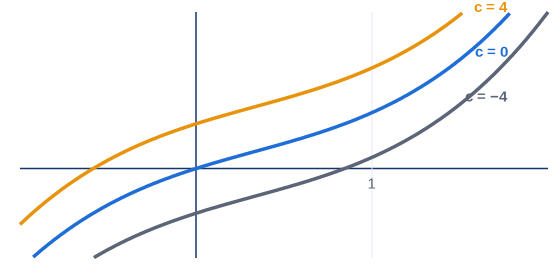
Try it: a family of curves
Surds as powers: a 2025 error
- √x = x^(1/2).
- 1/√x = x^(−1/2).
- √x = x^(1/2), 1/√x = x^(−1/2)
- ∫ 3√x dx = ∫ 3x^(1/2) dx
- = 3x^(3/2) ÷ (3/2)power 1/2 to 3/2
- = 2x^(3/2) + c
- ∫ 2/√x dx = ∫ 2x^(−1/2) dx
- = 2x^(1/2) ÷ (1/2)power −1/2 to 1/2
- = 4x^(1/2) + c = 4√x + c
∫ (x − 4)/√x dx: split first
- Split the fraction first.
- Then each term is a power.
- (x − 4)/√x = x/√x − 4/√xsplit the fraction
- = x^(1/2) − 4x^(−1/2)as powers
- ∫: x^(3/2)/(3/2) − 4x^(1/2)/(1/2)
- = (2/3)x^(3/2) − 8x^(1/2) + c
e to the ax + b
- ∫ eˣ dx = eˣ + c.
- e^(ax + b): divide by a.
- ∫ eˣ dx = eˣ + c
- ∫ e^(3x − 1) dx
- = (1/3)e^(3x − 1) + c÷ 3
- ∫ 4e^(−2x) dx
- = 4 × (−1/2)e^(−2x)÷ −2
- = −2e^(−2x) + c
- ∫ e^(kx) dx = (1/k)e^(kx) + c
Sine, cos and sec²
- Sin → −cos, cos → sin.
- Sec² → tan. Radians only.
- Divide by the x coefficient.
- ∫ sin 4x dx
- = −(1/4)cos 4x + csin to −cos, ÷ 4
- ∫ cos 2x dx
- = (1/2)sin 2x + ccos to sin, ÷ 2
- ∫ sec² 3x dx
- = (1/3)tan 3x + csec² to tan, ÷ 3
Try it: areas above and below
Reverse chain rule: ∫ (2x + 1)⁵ dx
- Raise the power by one.
- Divide by the new power.
- Divide by inside derivative.
- ∫ (2x + 1)⁵ dx
- (2x + 1)⁶raise the power to 6
- (2x + 1)⁶/6÷ the new power
- (2x + 1)⁶/(6 × 2)÷ 2, inside derivative
- = (2x + 1)⁶/12 + c
The dropped factor: a 2025 error
- A dropped factor scored 0.
- Differentiate to check.
- d/dx (2x + 1)⁶/6factor dropped
- = 6(2x + 1)⁵ × 2/6chain rule
- = 2(2x + 1)⁵double: wrong
- d/dx (2x + 1)⁶/12
- = 6(2x + 1)⁵ × 2/12chain rule
- = (2x + 1)⁵
- d/dx e^(3x − 1)no 1/3
- = 3e^(3x − 1)triple: wrong
∫ 1/√(4x + 1) dx
- Write it as a power.
- Then reverse chain rule.
- 1/√(4x + 1) = (4x + 1)^(−1/2)
- raise: (4x + 1)^(1/2)power −1/2 to 1/2
- ÷ 1/2: 2(4x + 1)^(1/2)doubles it
- ÷ 4: (2/4)(4x + 1)^(1/2)inside derivative
- = (1/2)√(4x + 1) + c
Try it: the factor in front
A trig product becomes a sum
- Booklet: product to sum.
- A = 3x, B = x.
- Integrate each sine.
- 2sin A cos B = sin(A+B) + sin(A−B)
- A = 3x, B = x
- 2sin 3x cos x = sin 4x + sin 2x
- ∫ sin 4x dx = −(1/4)cos 4x÷ 4
- ∫ sin 2x dx = −(1/2)cos 2x÷ 2
- = −(1/4)cos 4x − (1/2)cos 2x + c
∫ sin²x dx: rewrite it first
- Booklet: double angle.
- Rearrange for sin²x.
- cos 2x = 1 − 2sin²xbooklet
- 2sin²x = 1 − cos 2xrearrange
- sin²x = (1 − cos 2x)/2÷ 2
- = 1/2 − (1/2)cos 2xsplit
- ∫: x/2 − (1/2)(1/2)sin 2xintegrate each term
- = x/2 − (1/4)sin 2x + c
Show the integrated function
- No credit for a calculator answer alone.
- Unknown constants stop the calculator.
- Show the rewrite and the identity.
Where the marks are
- Achieved: surds, e, trig, (ax + b)ⁿ.
- Merit: a trig product into a sum.
- Excellence: choose the right identity.
What to take away
- Rewrite into a booklet form, divide by the inside derivative, add + c.
| Surds | powers first |
| xⁿ | raise, then divide |
| e^(ax + b) | × 1/a |
| sin, cos, sec² | × 1/a |
| Products, sin² | booklet identity |
| Check | differentiate back |
Common mistakes
- ∫ (2x + 1)⁵ dx = (2x + 1)⁶/6 + cAlso divide by the inside derivative 2: (2x + 1)⁶/12 + c. Differentiate to check; the dropped factor scored 0 in 2025.
- 1/√x = x^(1/2), so ∫ 2/√x dx = (4/3)x^(3/2) + c1/√x = x^(−1/2), so ∫ 2x^(−1/2) dx = 2x^(1/2) ÷ (1/2) = 4√x + c.
- ∫ sin 4x dx = (1/4)cos 4x + cSin integrates to −cos, so it is −(1/4)cos 4x + c; differentiate your answer to check the sign.
- ∫ sin²x dx = sin³x/3 + cRewrite with cos 2x = 1 − 2sin²x first: ∫ (1/2 − (1/2)cos 2x) dx = x/2 − (1/4)sin 2x + c.
Your turn: eight questions
- Question 1: rewrite the surd.
- Question 4: use an identity.
| Given | Find | |
|---|---|---|
| 1 | ∫ (x³ − 2√x) dx | the integral |
| 2 | ∫ 6e^(2x + 1) dx | the integral |
| 3 | ∫ (3x − 2)⁴ dx | the integral |
| 4 | ∫ tan²x dx | use an identity |
| 5 | ∫ (3sin 2x + sec²x) dx | the integral |
| 6 | ∫ (x + 4)/√x dx | split, then integrate |
| 7 | ∫ √(4x + 1) dx | the integral |
| 8 | ∫ 2cos 5x cos x dx | use an identity |
Show answer
1. x⁴/4 − (4/3)x^(3/2) + c. 2. 3e^(2x + 1) + c. 3. (3x − 2)⁵/15 + c. 4. tan²x = sec²x − 1, so tan x − x + c. 5. −(3/2)cos 2x + tan x + c. sin 2x integrates to −cos 2x ÷ 2, and sec²x to tan x. 6. (2/3)x^(3/2) + 8x^(1/2) + c. Split into x^(1/2) + 4x^(−1/2), then raise each power and divide by the new power. 7. (1/6)(4x + 1)^(3/2) + c. Write (4x + 1)^(1/2), raise to 3/2, then divide by 3/2 and by 4. 8. sin 6x/6 + sin 4x/4 + c. 2cos A cos B = cos(A + B) + cos(A − B) gives cos 6x + cos 4x, then divide each by its coefficient.
The answers: questions 1 and 2
- 1. x³ − 2√x = x³ − 2x^(1/2)surd as a power
- ∫: x⁴/4 − 2x^(3/2)/(3/2)raise, divide
- = x⁴/4 − (4/3)x^(3/2) + c
- 2. ∫ 6e^(2x + 1) dx
- = 6 × (1/2)e^(2x + 1)÷ 2
- = 3e^(2x + 1) + c
The answers: questions 3 and 4
- 3. ∫ (3x − 2)⁴ dx
- (3x − 2)⁵raise the power to 5
- (3x − 2)⁵/(5 × 3)÷ 5, then ÷ 3
- = (3x − 2)⁵/15 + c
- 4. tan²x + 1 = sec²xsin² + cos² = 1, ÷ cos²
- tan²x = sec²x − 1
- ∫ (sec²x − 1) dx
- = tan x − x + c
Sample question: Achieved
Find ∫ (6√x + 4e^(2x − 1) − 3 sin 3x) dx.
Hint
Write √x as a power first, then integrate each term on its own, dividing by the x coefficient for e^(2x − 1) and sin 3x.
Answer
4x^(32) + 2e^(2x − 1) + cos 3x + c
Step by step
- Integrate one term at a time. Each term uses a different rule.
- First term: √x = x^(12). Add one to the power to get x^(32), then divide by the new power 32. Dividing by 32 is the same as multiplying by 23.
- So 6x^(12) becomes 6 × (23)x^(32) = 4x^(32).
- Second term: e^(2x − 1) stays as it is, but divide by 2, the derivative of the inside. 4 ÷ 2 = 2, so it becomes 2e^(2x − 1).
- Third term: sin integrates to −cos, and we divide by 3. So −3 sin 3x becomes −3 × (−13)cos 3x = cos 3x.
- Classic mistake: forgetting to divide by the inside derivative, the 2 and the 3. Those are the marks examiners look for.
- Add + c at the end, because this is an indefinite integral.
- Check by differentiating: 4 × (32)x^(12) = 6√x, 2 × 2e^(2x − 1) = 4e^(2x − 1), and the derivative of cos 3x is −3 sin 3x. All three match.
Full working
- 6√x = 6x^(12) → 6x^(32) ÷ (32) = 4x^(32)surd as a power
- 4e^(2x − 1) → (42)e^(2x − 1) = 2e^(2x − 1)÷ inside derivative 2
- −3 sin 3x → −3 × (−13)cos 3x = cos 3xsin to −cos, ÷ 3
- 4x^(32) + 2e^(2x − 1) + cos 3x + c
Sample questions: Merit
Use the formula 2 sin A cos B = sin(A + B) + sin(A − B) to find the exact value of ∫₀^(π4) 4 sin 3x cos x dx.
Hint
Write 4 sin 3x cos x as 2 × (2 sin 3x cos x), turn the product into a sum, then integrate each sine.
Answer
2
Step by step
- We cannot integrate a product of sin and cos directly, so change it into a sum first. The booklet formula does that.
- Write 4 sin 3x cos x = 2 × (2 sin 3x cos x), so the formula fits with A = 3x and B = x.
- 2 sin 3x cos x = sin(3x + x) + sin(3x − x) = sin 4x + sin 2x. So the integrand is 2 sin 4x + 2 sin 2x.
- Integrate: sin goes to −cos, and divide by the x coefficient. 2 sin 4x gives −(12)cos 4x and 2 sin 2x gives −cos 2x.
- So F(x) = −(12)cos 4x − cos 2x.
- Top limit, x = π4: cos π = −1 and cos(π2) = 0. F(π4) = 12 − 0 = 12.
- Bottom limit, x = 0: cos 0 = 1. F(0) = −12 − 1 = −32.
- Subtract, with brackets: 12 − (−32) = 2.
- Classic mistake: working in degrees. The limits are in radians, so set the calculator to radians if you check it.
- Check: a calculator gives ∫₀^(π4) 4 sin 3x cos x dx ≈ 2.000. It matches.
Full working
- 4 sin 3x cos x = 2(sin 4x + sin 2x)A = 3x, B = x
- ∫ (2 sin 4x + 2 sin 2x) dx = −(12)cos 4x − cos 2xsin to −cos, ÷ x coefficient
- F(π4) = −(12)(−1) − 0 = 12cos π = −1, cos(π2) = 0
- F(0) = −12 − 1 = −32
- 12 − (−32) = 2
Find ∫ (x + 1)²√x dx.
Hint
Expand the top, then divide each term by x^(12) so every term is a single power of x.
Answer
(25)x^(52) + (43)x^(32) + 2√x + c
Step by step
- There is no rule for a fraction like this, so turn it into separate powers of x first.
- Expand the top: (x + 1)² = x² + 2x + 1. Classic mistake: writing x² + 1 and losing the middle term.
- Write √x as x^(12). Dividing by it means subtracting 12 from each power.
- x² ÷ x^(12) = x^(32), 2x ÷ x^(12) = 2x^(12), and 1 ÷ x^(12) = x^(−12).
- Now integrate each power: add one to the power and divide by the new power.
- x^(32) becomes x^(52) ÷ (52) = (25)x^(52).
- 2x^(12) becomes 2x^(32) ÷ (32) = (43)x^(32).
- x^(−12) becomes x^(12) ÷ (12) = 2x^(12) = 2√x.
- Add + c.
- Check by differentiating: x^(32) + 2x^(12) + x^(−12), which is x² + 2x + 1√x. It matches.
Full working
- (x + 1)² = x² + 2x + 1expand
- x² + 2x + 1√x = x^(32) + 2x^(12) + x^(−12)divide each term
- ∫ = x^(52)/(52) + 2x^(32)/(32) + x^(12)/(12)raise, then divide
- (25)x^(52) + (43)x^(32) + 2√x + c
Sample questions: Excellence
Find the exact value of ∫₀^(π2) sin²x cos²x dx.
Hint
Use sin 2x = 2 sin x cos x to make it (14)sin²2x, then use a double angle formula again to remove the square.
Answer
π16
Step by step
- A product of squares has no direct rule, and the calculator answer alone earns nothing. We need identities to reach a form we can integrate.
- Start with sin 2x = 2 sin x cos x, so sin x cos x = (12)sin 2x.
- Square both sides: sin²x cos²x = (14)sin²2x.
- We still have a square. From cos 2θ = 1 − 2sin²θ we get sin²θ = 1 − cos 2θ2.
- Use it with θ = 2x, so 2θ = 4x: sin²2x = 1 − cos 4x2.
- So the integrand is (14) × 1 − cos 4x2 = 1 − cos 4x8.
- Classic mistake: using cos 2x instead of cos 4x. The angle doubles from 2x, not from x.
- Integrate: (18)(x − (14)sin 4x) = x8 − (132)sin 4x.
- Top limit, π2: sin 2π = 0, so F(π2) = π16.
- Bottom limit, 0: F(0) = 0. The value is π16 − 0 = π16.
- Check: π16 ≈ 0.196, and a calculator gives ∫₀^(π2) sin²x cos²x dx ≈ 0.196.
Full working
- sin²x cos²x = (14)sin²2xsin 2x = 2 sin x cos x
- sin²2x = 1 − cos 4x2cos 2θ = 1 − 2sin²θ, θ = 2x
- ∫ 1 − cos 4x8 dx = x8 − (132)sin 4x÷ 4 for cos 4x
- F(π2) − F(0) = π16 − 0sin 2π = 0
- π16
k is a positive constant. Find ∫ (e^(kx) − e^(−kx))² dx in terms of k. Hence find the exact value of ∫₀^(ln 2) (eˣ − e^(−x))² dx.
Hint
Expand the square first. The middle term is e^(kx) × e^(−kx), which is e⁰.
Answer
e^(2kx)2k − 2x − e^(−2kx)2k + c; the exact value is 158 − 2 ln 2
Step by step
- The k stops the calculator, so this has to be done by hand. Square the bracket first.
- (a − b)² = a² − 2ab + b², with a = e^(kx) and b = e^(−kx).
- a² = e^(2kx). b² = e^(−2kx). The middle term is 2e^(kx)e^(−kx) = 2e⁰ = 2.
- Classic mistake: writing the square as e^(2kx) − e^(−2kx) and losing the −2.
- So the integrand is e^(2kx) − 2 + e^(−2kx).
- Reverse chain rule: divide each exponential by its x coefficient. e^(2kx) gives e^(2kx)2k, and e^(−2kx) gives −e^(−2kx)2k. The −2 gives −2x.
- So the integral is e^(2kx)2k − 2x − e^(−2kx)2k + c.
- Hence: the second integral is the case k = 1, so F(x) = e^(2x)2 − 2x − e^(−2x)2.
- Top limit: e^(2 ln 2) = e^(ln 4) = 4 and e^(−2 ln 2) = 14. F(ln 2) = 2 − 2 ln 2 − 18.
- Bottom limit: F(0) = 12 − 0 − 12 = 0.
- Value: 2 − 18 − 2 ln 2 = 158 − 2 ln 2.
- Check: 158 − 2 ln 2 ≈ 0.489, and a calculator gives the same for the integral.
Full working
- (e^(kx) − e^(−kx))² = e^(2kx) − 2 + e^(−2kx)e^(kx)e^(−kx) = e⁰ = 1
- ∫ = e^(2kx)2k − 2x − e^(−2kx)2k + c÷ 2k and ÷ (−2k)
- k = 1: F(x) = e^(2x)2 − 2x − e^(−2x)2hence
- F(ln 2) = 42 − 2 ln 2 − (14)/2 = 158 − 2 ln 2e^(2 ln 2) = 4
- F(0) = 12 − 12 = 0
- 158 − 2 ln 2 ≈ 0.489
Challenge
Find the exact value of ∫ from 0 to π3 of 1 − cos 2x1 + cos 2x dx.
Hint
None of the standard integrals fits yet. Use the booklet's two forms of cos 2x, one on the top and one on the bottom, and see what the fraction simplifies to.
Answer
√3 − π3 ≈ 0.685
Step by step
- Rewrite the top with cos 2x = 1 − 2sin²x, so 1 − cos 2x = 2sin²x.
- Rewrite the bottom with cos 2x = 2cos²x − 1, so 1 + cos 2x = 2cos²x.
- The fraction becomes sin²x ÷ cos²x, which is tan²x.
- tan²x has no direct integral, but tan²x = sec²x − 1, and sec²x integrates to tan x.
- So the integral is [tan x − x] from 0 to π3.
Full working
- 1 − cos 2x = 1 − (1 − 2sin²x) = 2sin²xcos 2x = 1 − 2sin²x
- 1 + cos 2x = 1 + (2cos²x − 1) = 2cos²xcos 2x = 2cos²x − 1
- 1 − cos 2x1 + cos 2x = sin²xcos²x = tan²xcancel the 2s
- tan²x = sec²x − 1from sin²x + cos²x = 1 divided by cos²x
- ∫ (sec²x − 1) dx = tan x − x + csec² to tan
- [tan x − x] from 0 to π3 = (√3 − π3) − (0 − 0)tan(π3) = √3
- = √3 − π3 ≈ 0.685
Differentiate x e^(2x). Hence find ∫ x e^(2x) dx, and find the exact value of ∫ from 0 to 1 of x e^(2x) dx.
Hint
The derivative has two terms, and one of them is a multiple of x e^(2x). Integrate both sides of your derivative, then make ∫ x e^(2x) dx the subject.
Answer
ddx (x e^(2x)) = e^(2x) + 2x e^(2x); ∫ x e^(2x) dx = (x2)e^(2x) − (14)e^(2x) + c; the exact value is e² + 14 ≈ 2.10
Step by step
- Product rule: the derivative of x e^(2x) is e^(2x) + 2x e^(2x).
- Integrating a derivative gets back the function, so x e^(2x) = ∫ e^(2x) dx + 2∫ x e^(2x) dx.
- ∫ e^(2x) dx = (12)e^(2x), so rearrange to get 2∫ x e^(2x) dx on its own, then halve.
- Check by differentiating the answer: it gives x e^(2x).
- Put in the limits 1 and 0, remembering e⁰ = 1, not 0.
Full working
- ddx (x e^(2x)) = 1 × e^(2x) + x × 2e^(2x)product rule
- x e^(2x) = ∫ e^(2x) dx + 2∫ x e^(2x) dxintegrate both sides
- 2∫ x e^(2x) dx = x e^(2x) − (12)e^(2x)∫ e^(2x) dx = (12)e^(2x)
- ∫ x e^(2x) dx = (x2)e^(2x) − (14)e^(2x) + chalve, then + c
- at x = 1: (12)e² − (14)e² = (14)e²top limit
- at x = 0: 0 − (14)e⁰ = −14bottom limit, e⁰ = 1
- (14)e² − (−14) = e² + 14 ≈ 2.10
Find the exact value of ∫ from 0 to π2 of cos⁵x dx.
Hint
Keep one cos x aside and write cos⁴x in terms of sin x. Then differentiate sinⁿx to see which integrals you can now read backwards.
Answer
815
Step by step
- Split cos⁵x into cos⁴x × cos x.
- cos²x = 1 − sin²x, so cos⁴x = (1 − sin²x)² = 1 − 2sin²x + sin⁴x.
- So cos⁵x = cos x − 2sin²x cos x + sin⁴x cos x.
- The derivative of sinⁿx is n sinⁿ⁻¹x cos x, so sinⁿ⁻¹x cos x integrates to sinⁿx ÷ n.
- Integrate each term, then put in π2 (sin = 1) and 0 (sin = 0).
Full working
- cos⁵x = (cos²x)² cos x = (1 − sin²x)² cos xkeep one cos x
- = cos x − 2sin²x cos x + sin⁴x cos xexpand
- ddx sin³x = 3sin²x cos x, ddx sin⁵x = 5sin⁴x cos xchain rule
- ∫ cos⁵x dx = sin x − (23)sin³x + (15)sin⁵x + cread the derivatives backwards
- at π2: 1 − 23 + 15 = 1515 − 1015 + 315 = 815sin(π2) = 1
- at 0: 0sin 0 = 0
- ∫ from 0 to π2 of cos⁵x dx = 815
Practise this
Report a mistake
More in AS 91579
The integration toolkit: surds, e, trig and the chain rule10 min Integrating fractions: when it is ln, and when it is not9 min
 The constant of integration: find c, never assume it9 min
 Definite integrals and area, including between two curves11 min
 Trapezium and Simpson's rules: numerical areas10 min
 Differential equations: growth, decay and Newton's cooling11 min
 Integration toolkit: 7 exam questions solved step by step10 min
 Integrating fractions: 7 exam questions solved step by step10 min
 Constant of integration: 7 exam questions solved step by step11 min
 Definite integrals: 7 exam questions solved step by step11 min
 Numerical integration: 6 exam questions solved step by step11 min
 Differential equations: 6 exam questions solved step by step11 min