
Tangents and normals: from gradient to finished equation
What this lesson covers
- The derivative gives the tangent's gradient; the normal's gradient is its negative reciprocal.
- An equation is finished only when it is in y = mx + c or general form.
Two lines through one point
- Tangent: the same gradient as the curve.
- Normal: at right angles to the tangent.
- Each needs a point and a gradient.
y = x³ − 3x + 1 at (2, 3)
- The tangent has the curve’s gradient.
- The normal is at right angles.
- Gradients multiply to −1.
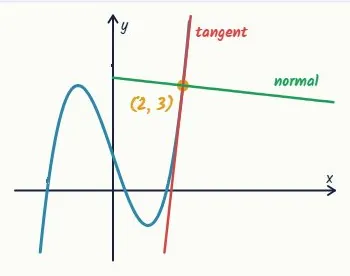
The tangent at x = 2
- A point, then a gradient.
- Finish as y = mx + c.
- x = 2: y = 8 − 6 + 1 = 3the point
- dy/dx = 3x² − 3differentiate
- x = 2: m = 3(4) − 3 = 9the gradient
- y − 3 = 9(x − 2)point-gradient form
- y − 3 = 9x − 18expand
- y = 9x − 15add 3
Try it: slide the tangent
The normal at x = 2
- Negative reciprocal: −1/9.
- Either form is finished.
- tangent m = 9
- normal m = −1/9−1 ÷ 9
- y − 3 = −(1/9)(x − 2)through (2, 3)
- y = −x/9 + 2/9 + 3expand
- y = −x/9 + 29/93 = 27/9
- 9y = −x + 29× 9
- x + 9y − 29 = 0general form
- 9 × (−1/9) = −1at right angles
Try it: tangent and normal
The 2025 error: unfinished equations
- Values substituted is not finished.
- y = mx + c, or general form.
- Evaluate every number fully.
| Written as | |
|---|---|
| y − 3 = 9(x − 2) | not finished |
| y = 9x − 15 | y = mx + c |
| 9x − y − 15 = 0 | general form |
Graphing calculator
A point with a given gradient
- Set dy/dx equal to 9.
- Two points: find both y.
- dy/dx = 3x² − 3
- 3x² − 3 = 9gradient 9
- 3x² = 12, so x² = 4
- x = ±2
- x = 2: y = 8 − 6 + 1 = 3
- x = −2: y = −8 + 6 + 1 = −1
- (2, 3) and (−2, −1)
Same gradient: parallel tangents
- Same gradient, 9.
- Parallel lines never meet.
- at (−2, −1): y + 1 = 9(x + 2)
- y + 1 = 9x + 18expand
- y = 9x + 17
- at (2, 3): y = 9x − 15as before
- m = 9 for both: parallelnever meet
Where a tangent meets an axis
- y = e²ˣ at x = 1.
- Then set y = 0.
- x = 1: y = e²the point (1, e²)
- dy/dx = 2e²ˣchain rule
- x = 1: m = 2e²the gradient
- y − e² = 2e²(x − 1)point-gradient form
- y = 2e²x − 2e² + e²expand
- y = 2e²x − e²
- y = 0: 2e²x = e²meets the x-axis
- x = 1/2divide by 2e²
Where two tangents meet
- Find each tangent first.
- Set the equations equal.
- x = 0: y = 1, m = 3(0) − 3 = −3
- y − 1 = −3(x − 0)point-gradient form
- y = −3x + 1
- x = 2: y = 9x − 15from before
- −3x + 1 = 9x − 15set them equal
- 16 = 12x, so x = 4/3add 3x + 15
- y = −3(4/3) + 1 = −3substitute back
- they meet at (4/3, −3)
Try it: finish, meet, match
A normal to y = tan x
- The same steps with trig.
- Normal gradient −1/2.
- x = π/4: y = tan(π/4) = 1
- dy/dx = sec² xderivative of tan x
- cos²(π/4) = 1/2
- m = sec²(π/4) = 21 ÷ (1/2)
- normal m = −1/2−1 ÷ 2
- y − 1 = −(1/2)(x − π/4)point-gradient form
- y = −x/2 + π/8 + 1expand
Calculus meets coordinate geometry
- Point, derivative, gradient, line.
- In that order, every time.
- Show the derivative.
Where the marks are
- Achieved: a tangent’s gradient.
- Merit: equations, given gradients, meetings.
- Excellence: form your own equations.
What to take away
- A point, a gradient, and a finished equation.
| Point | both coordinates |
| Gradient | dy/dx at that x |
| Normal | −1 ÷ tangent gradient |
| Finish | y = mx + c |
| Given gradient | dy/dx = m, solve |
| Meeting | solve together |
Common mistakes
- Tangent: y − 3 = (3(2)² − 3)(x − 2), done.Evaluate every number and finish the line: y = 9x − 15. Unfinished equations lost marks in 2025.
- The tangent has gradient 9, so the normal has gradient −9.The normal's gradient is the negative reciprocal, −1/9, so that 9 × (−1/9) = −1.
- y − 3 = (3x² − 3)(x − 2)The gradient of a line is a number: substitute x = 2 into dy/dx first, m = 3(4) − 3 = 9.
- 3x² − 3 = 9, so x² = 4 and x = 2.x² = 4 gives x = ±2, so there are two points with gradient 9: (2, 3) and (−2, −1).
Your turn: eight questions
- Question 1: the x-intercept too.
- Finish every equation.
| Curve | Find | |
|---|---|---|
| 1 | y = x ln x at x = e | tangent; x-intercept |
| 2 | y = √(4x + 1) at x = 2 | normal |
| 3 | y = x³ − 12x | points, gradient 15 |
| 4 | y = x², x = 1 and x = 3 | where tangents meet |
| 5 | y = 3x² − 4x at x = 1 | tangent |
| 6 | y = eˣ | point where normal gradient is −1/2 |
| 7 | y = ln(2x − 1) at x = 1 | normal; y-intercept |
| 8 | y = x², tangents through (1, −3) | points of contact |
Show answer
1. Point (e, e), dy/dx = ln x + 1 = 2: y = 2x − e, meeting the x-axis at x = e/2. 2. Point (2, 3), dy/dx = 2/√(4x + 1) = 2/3, normal gradient −3/2: y = −3x/2 + 6. 3. 3x² − 12 = 15, x = ±3: (3, −9) and (−3, 9). 4. y = 2x − 1 and y = 6x − 9 meet at (2, 3). 5. y = 2x − 3. Point (1, −1), dy/dx = 6x − 4 = 2, so y + 1 = 2(x − 1), finished as y = 2x − 3. 6. (ln 2, 2). The tangent gradient is −1 ÷ (−1/2) = 2, so eˣ = 2, x = ln 2 and y = 2. 7. y = −x/2 + 1/2; y-intercept 1/2. Point (1, 0), dy/dx = 2/(2x − 1) = 2, normal gradient −1/2. 8. (3, 9) and (−1, 1). The tangent at x = a is y = 2ax − a²; through (1, −3): a² − 2a − 3 = 0, so a = 3 or a = −1.
The answers: questions 1 and 2
- 1. x = e: y = e ln e = ethe point
- dy/dx = ln x + 1 = 2product rule
- y − e = 2(x − e), y = 2x − e
- y = 0: x = e/2meets the x-axis
- 2. x = 2: y = √9 = 3the point
- dy/dx = 2/√(4x + 1) = 2/3chain rule
- normal m = −3/2−1 ÷ (2/3)
- y − 3 = −(3/2)(x − 2)
- y = −3x/2 + 6expand
The answers: question 3
- 3. dy/dx = 3x² − 12
- 3x² − 12 = 15gradient 15
- 3x² = 27, x² = 9, x = ±3
- x = 3: y = 27 − 36 = −9
- x = −3: y = −27 + 36 = 9
- (3, −9) and (−3, 9)
The answers: question 4
- 4. dy/dx = 2x
- x = 1: point (1, 1), m = 2
- y − 1 = 2(x − 1), y = 2x − 1
- x = 3: point (3, 9), m = 6
- y − 9 = 6(x − 3), y = 6x − 9
- 2x − 1 = 6x − 9set them equal
- 4x = 8, so x = 2
- y = 2(2) − 1 = 3substitute back
- they meet at (2, 3)
Sample question: Achieved
Find the equation of the tangent to y = 2x² − 5x + 1 at the point where x = 3.
Hint
Find the y value at x = 3 and the gradient from dydx at x = 3. Then use y − y1 = m(x − x1).
Answer
y = 7x − 17
Step by step
- A tangent needs a point and a gradient.
- The point: x = 3 gives y = 18 − 15 + 1 = 4, so the point is (3, 4).
- The gradient: dydx = 4x − 5, which is 12 − 5 = 7 at x = 3.
- Use y − y1 = m(x − x1): y − 4 = 7(x − 3).
- Finish it: y − 4 = 7x − 21, so y = 7x − 17.
- Check the point is on the line: 7(3) − 17 = 4. Correct.
Full working
- x = 3: y = 18 − 15 + 1 = 4the point (3, 4)
- dydx = 4x − 5 = 7 at x = 3
- y − 4 = 7(x − 3)
- y = 7x − 17
Sample questions: Merit
Find the equation of the normal to y = √(2x + 5) at the point where x = 2, and the point where the normal crosses the x-axis.
Hint
Write y = (2x + 5)^½ and use the chain rule. The normal's gradient is the negative reciprocal of the tangent's.
Answer
The normal is y = −3x + 9, and it crosses the x-axis at (3, 0).
Step by step
- The point: x = 2 gives y = √9 = 3, so the point is (2, 3).
- Write y = (2x + 5)^½. Chain rule: dydx = ½(2x + 5)^−½ × 2 = 1√(2x + 5).
- At x = 2 the tangent's gradient is 1√9 = 13.
- The normal is at right angles to the tangent, so its gradient is the negative reciprocal: −1 ÷ (13) = −3.
- Normal: y − 3 = −3(x − 2), so y = −3x + 6 + 3 = −3x + 9.
- It crosses the x-axis where y = 0: −3x + 9 = 0, so x = 3. The point is (3, 0).
- The classic mistake is to use the tangent's gradient, 13, for the normal. Check: 13 × (−3) = −1, so they are perpendicular.
Full working
- x = 2: y = √9 = 3the point (2, 3)
- dydx = 1√(2x + 5) = 13 at x = 2chain rule
- normal gradient = −3negative reciprocal
- y − 3 = −3(x − 2), y = −3x + 9
- y = 0: x = 3
- y = −3x + 9, crossing the x-axis at (3, 0)
Find the equations of the two tangents to y = x³ − 3x² that are parallel to the line y = 9x + 1.
Hint
Parallel lines have the same gradient, so solve dydx = 9. Each solution gives a point and a tangent.
Answer
y = 9x − 27 and y = 9x + 5
Step by step
- Parallel lines have equal gradients. So the tangents we want have gradient 9.
- dydx = 3x² − 6x. Set it equal to 9: 3x² − 6x − 9 = 0.
- Divide by 3: x² − 2x − 3 = 0, which factorises to (x − 3)(x + 1) = 0. So x = 3 or x = −1.
- Find each point on the curve. x = 3: y = 27 − 27 = 0, so (3, 0). x = −1: y = −1 − 3 = −4, so (−1, −4).
- Tangent at (3, 0): y − 0 = 9(x − 3), so y = 9x − 27.
- Tangent at (−1, −4): y + 4 = 9(x + 1), so y = 9x + 5.
- Both have gradient 9, and neither is the line y = 9x + 1 itself, so they are both parallel to it.
- Check: 9(−1) + 5 = −4, so (−1, −4) is on the second tangent. Correct.
Full working
- dydx = 3x² − 6x = 9parallel: same gradient
- (x − 3)(x + 1) = 0, x = 3 or −1
- points (3, 0) and (−1, −4)
- y = 9(x − 3) = 9x − 27
- y + 4 = 9(x + 1), y = 9x + 5
- y = 9x − 27 and y = 9x + 5
Sample questions: Excellence
Find the equations of the tangents to the curve y = x² + 4 that pass through the origin, and the points where they touch the curve.
Hint
The origin is not on the curve. Let the tangent touch at (a, a² + 4), write its equation in terms of a, then make it pass through (0, 0).
Answer
y = 4x, touching at (2, 8), and y = −4x, touching at (−2, 8)
Step by step
- The origin is not on the curve (at x = 0, y = 4), so we do not know where the tangents touch. Call the touching point (a, a² + 4).
- The gradient there is dydx = 2x = 2a.
- Tangent: y − (a² + 4) = 2a(x − a).
- It must pass through (0, 0). Put x = 0 and y = 0: −(a² + 4) = 2a(−a) = −2a².
- So a² + 4 = 2a², which gives a² = 4 and a = 2 or a = −2.
- a = 2: the point is (2, 8) and the gradient is 4. The tangent is y − 8 = 4(x − 2), so y = 4x.
- a = −2: the point is (−2, 8) and the gradient is −4. The tangent is y − 8 = −4(x + 2), so y = −4x.
- Both lines pass through the origin, as required. The answer is symmetric because the curve is symmetric about the y-axis.
- Check that y = 4x only touches: x² + 4 = 4x gives (x − 2)² = 0, a repeated root. So it meets the curve at one point only.
Full working
- point (a, a² + 4), gradient 2a
- y − (a² + 4) = 2a(x − a)
- −(a² + 4) = −2a²passes through (0, 0)
- a² = 4, a = ±2
- a = 2: y = 4x at (2, 8); a = −2: y = −4x at (−2, 8)
- x² + 4 = 4x gives (x − 2)² = 0check: it touches
- y = 4x at (2, 8) and y = −4x at (−2, 8)
P is the point (1, 1) on the curve y = x². The normal at P meets the curve again at Q. Find the coordinates of Q, and the point where the tangents at P and Q meet.
Hint
Find the normal at P, then solve it together with y = x². You already know x = 1 is one solution. Then find the tangent at each point and solve them together.
Answer
Q = (−32, 94), and the tangents meet at (−14, −32).
Step by step
- At P, dydx = 2x = 2, so the tangent gradient is 2 and the normal gradient is −12.
- Normal: y − 1 = −(12)(x − 1), so y = −x2 + 32.
- Where it meets the curve: x² = −x2 + 32. Multiply by 2: 2x² + x − 3 = 0.
- We know x = 1 is a root, so x − 1 is a factor: (x − 1)(2x + 3) = 0. The other root is x = −32.
- Q: y = (−32)² = 94, so Q = (−32, 94).
- Tangent at P: gradient 2, so y − 1 = 2(x − 1), which is y = 2x − 1.
- Tangent at Q: gradient 2(−32) = −3, so y − 94 = −3(x + 32), which is y = −3x − 94.
- Solve them together: 2x − 1 = −3x − 94, so 5x = −54 and x = −14.
- Then y = 2(−14) − 1 = −32. The tangents meet at (−14, −32).
- Check on the other tangent: −3(−14) − 94 = 34 − 94 = −32. Correct.
Full working
- normal at P: gradient −12, y = −x2 + 32
- 2x² + x − 3 = (x − 1)(2x + 3) = 0x = 1 is P
- Q = (−32, 94)
- tangent at P: y = 2x − 1
- tangent at Q: gradient −3, y = −3x − 94
- 2x − 1 = −3x − 94, x = −14, y = −32
- Q = (−32, 94); tangents meet at (−14, −32)
Challenge
The curves y = sin 2x and y = cos x cross at exactly one point P with 0 < x < π2. Find the exact coordinates of P, and the acute angle between the two curves at P (the angle between their tangents there). The tangents to the two curves at P meet the x-axis at A and B. Show that triangle PAB has area exactly 98 units².
Hint
Use sin 2x = 2sin x cos x to find P. For the angle, find the angle each tangent makes with the positive x-axis. For the triangle, AB is the base and the y-coordinate of P is the height.
Answer
P = (π6, √32); the tangents have gradients 1 and −12, and the acute angle between them is ≈ 71.6°; A = (π6 − √32, 0) and B = (π6 + √3, 0), so AB = 3√32 and the area is (12)(3√32)(√32) = 98 units²
Step by step
- sin 2x = cos x becomes cos x(2sin x − 1) = 0. cos x ≠ 0 for 0 < x < π2, so sin x = 12, x = π6 and P = (π6, √32).
- The gradients at P are 2cos(π3) = 1 for y = sin 2x and −sin(π6) = −12 for y = cos x.
- The first tangent makes 45° with the x-axis and the second makes 180° − 26.57° = 153.43°, so they differ by 108.43° and the acute angle is ≈ 71.6°.
- The tangent with gradient 1 meets the x-axis √32 to the left of P, and the one with gradient −12 meets it √3 to the right, so AB = 3√32.
- The height of the triangle is the y-coordinate of P, √32, so the area is (12)(3√32)(√32) = 98.
Full working
- 2sin x cos x = cos x, cos x(2sin x − 1) = 0double angle
- cos x ≠ 0 on 0 < x < π2, so sin x = 12, x = π6the only crossing
- P = (π6, cos(π6)) = (π6, √32)the point
- y = sin 2x: dydx = 2cos 2x = 2cos(π3) = 1first gradient
- y = cos x: dydx = −sin x = −sin(π6) = −12second gradient
- tan⁻¹(1) = 45°, 180° − tan⁻¹(12) ≈ 153.43°angles with the x-axis
- 153.43° − 45° = 108.43°, acute angle 180° − 108.43° ≈ 71.6°angle between the curves
- A: x = π6 − (√32) ÷ 1 = π6 − √32; B: x = π6 − (√32) ÷ (−12) = π6 + √3put y = 0
- AB = √3 + √32 = 3√32, height = √32base and height
- area = (12)(3√32)(√32) = 98shown
- P(π6, √32); acute angle ≈ 71.6°; area 98 units²
A point (0, k) lies on the axis of the parabola y = x². Find the values of k for which exactly three different normals to the parabola pass through (0, k). For k = 52, find the equations of all three normals and the points on the parabola at which each one is normal.
Hint
The y-axis is always one normal (at the origin). For any other point (a, a²), write the normal there and make it pass through (0, k). How many values of a does that give?
Answer
Exactly three normals when k > 12; for k = 52 they are x = 0 (at (0, 0)), y = −(√24)x + 52 (at (√2, 2)) and y = (√24)x + 52 (at (−√2, 2))
Step by step
- At (0, 0) the tangent is horizontal, so the normal is the y-axis, which passes through (0, k) for every k.
- At (a, a²) with a ≠ 0 the tangent gradient is 2a, so the normal has gradient −12a.
- The normal is y − a² = −x − a2a. Putting x = 0, y = k gives k − a² = 12, so a² = k − 12.
- This gives two more values of a (a = ±√(k − 12)) only when k > 12, making three normals.
- For k = 52, a² = 2 and a = ±√2, and the normals have gradients ∓12√2 = ∓√24.
Full working
- dydx = 2xdifferentiate
- a = 0: tangent y = 0, normal x = 0always through (0, k)
- a ≠ 0: normal gradient = −12anegative reciprocal
- y − a² = −x − a2anormal at (a, a²)
- x = 0: k − a² = a2a = 12through (0, k)
- a² = k − 12, two values of a when k > 12plus x = 0 makes three
- k = 52: a² = 2, a = ±√2substitute
- a = √2: y − 2 = −x − √22√2, y = −(√24)x + 52expand
- a = −√2: y = (√24)x + 52by symmetry
- k > 12; x = 0, y = −(√24)x + 52 at (√2, 2), y = (√24)x + 52 at (−√2, 2)
Find the equation of the straight line that is a tangent to the curve y = x⁴ − 4x³ at two different points, and find the exact x-coordinates of those points. Show that the curve never goes below this line.
Hint
Let the two points have x = p and x = q, p ≠ q. The tangents there must have the same gradient and the same y-intercept. Divide out (p − q), then write everything in terms of s = p + q and P = pq.
Answer
y = −8x − 4, touching at x = 1 + √3 and x = 1 − √3; x⁴ − 4x³ − (−8x − 4) = (x² − 2x − 2)² ≥ 0, so the curve never goes below the line
Step by step
- The tangent at x = t has gradient 4t³ − 12t² and y-intercept f(t) − t f′(t) = −3t⁴ + 8t³.
- Equal gradients at p and q, after dividing by 4(p − q): p² + pq + q² = 3(p + q), so P = s² − 3s.
- Equal intercepts, after dividing by (p − q): 3(p + q)(p² + q²) = 8(p² + pq + q²), so 3s(s² − 2P) = 8(s² − P).
- Substituting P = s² − 3s gives s(s² − 6s + 8) = 0, so s = 0, 2 or 4. s = 0 and s = 4 make p = q, so s = 2 and P = −2.
- p and q solve z² − 2z − 2 = 0, so they are 1 ± √3; the gradient is −8 and the intercept −4, and the difference curve minus line is a perfect square.
Full working
- f′(t) = 4t³ − 12t²gradient at x = t
- c(t) = f(t) − t f′(t) = −3t⁴ + 8t³y-intercept of the tangent at t
- 4(p³ − q³) = 12(p² − q²), p² + pq + q² = 3(p + q)equal gradients, divide by 4(p − q)
- s² − P = 3s, P = s² − 3ss = p + q, P = pq
- 3(p⁴ − q⁴) = 8(p³ − q³), 3s(s² − 2P) = 8(s² − P)equal intercepts, divide by (p − q)
- 3s(−s² + 6s) = 8(3s), s(s² − 6s + 8) = 0substitute P
- s = 0 (P = 0) or s = 4 (P = 4): p = q, rejectrepeated roots
- s = 2, P = −2: z² − 2z − 2 = 0, z = 1 ± √3p and q
- f′(1 + √3) = −8, c(1 + √3) = −4, same at 1 − √3the line y = −8x − 4
- x⁴ − 4x³ + 8x + 4 = (x² − 2x − 2)² ≥ 0never below
- y = −8x − 4, touching at x = 1 ± √3
Practise this
Report a mistake
More in AS 91578
 The derivative toolkit: chain, product and quotient rules11 min
 Stationary points, concavity and points of inflection11 minTangents and normals: from gradient to finished equation11 min
 Parametric differentiation, and the second derivative11 min
 Related rates of change: spheres, cones and the chain rule10 min
 Optimisation: building the model and finding the max or min11 min
 Limits, continuity and differentiability from a graph8 min
 Derivative toolkit: 7 exam questions solved step by step11 min
 Stationary points: 7 exam questions solved step by step12 min
 Tangents and normals: 7 exam questions solved step by step12 min
 Parametric curves: 7 exam questions solved step by step11 min
 Related rates of change: 7 exam questions solved step by step11 min
 Optimisation: 7 exam questions solved step by step11 min
 Limits and continuity: 7 exam questions solved step by step11 min