
Limits and continuity: 7 exam questions solved step by step
What this lesson covers
- A function is continuous where its graph has no break, and differentiable where it also has no sharp corner.
- Reading these from a piecewise graph is Achieved-level work that is often left blank.
Limits, continuity, differentiability
- Limit: both sides approach the same value.
- Continuous: the limit equals the function's value.
- Differentiable: continuous, with one gradient there.
- Give a reason with every answer.
Question 1 · Achieved
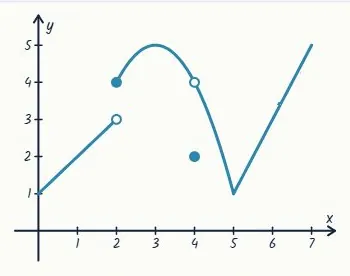
- The graph of y = f(x) is shown.
- Find the limit of f(x) as x → 2
- From the left, and from the right.
- Find lim(x→2) f(x), and f(2).
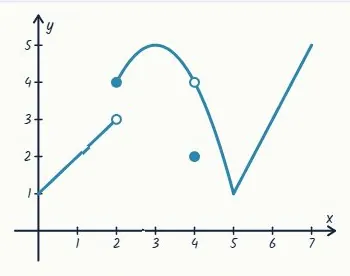
Q1: limits at x = 2
- Follow each piece in.
- Value: the closed dot.
- from the left: f(x) → 3along the line
- from the right: f(x) → 4along the curve
- 3 ≠ 4the sides disagree
- lim(x→2) f(x) does not exist
- f(2) = 4the closed dot
- f(2) = 3open dot: not on it
Try it: limits from both sides
Question 2 · Achieved
- The same graph.
- Find lim(x→4) f(x), and f(4).
- Is f continuous at x = 4? Give a reason.
- Careful: two dots sit above x = 4.
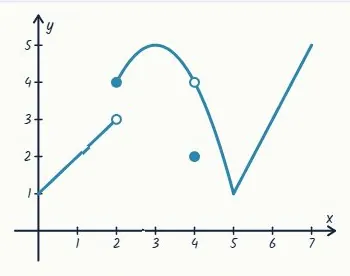
Q2: at x = 4
- Limit: where it heads.
- Value: the closed dot.
- from the left: f(x) → 4
- from the right: f(x) → 4
- lim(x→4) f(x) = 4both sides agree
- f(4) = 4open dot: a hole
- f(4) = 2the closed dot
- 4 ≠ 2limit ≠ value
- not continuous at x = 4
Question 3 · Merit
- The same graph.
- For 0 < x < 7, where is f
- Not differentiable? Give reasons.
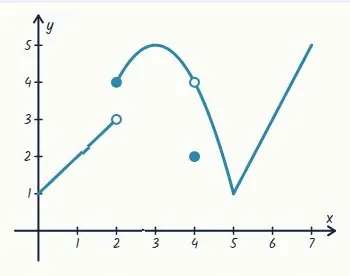
Q3: not differentiable where?
- Continuous first.
- Then one gradient.
- x = 2: a jumpnot continuous
- x = 4: a holenot continuous
- x = 5: lim f(x) = 1 = f(5)continuous
- left of 5: falling, f′ < 0
- right: (5 − 1) ÷ (7 − 5) = 2rise over run
- f′ < 0 and f′ = 2: a cornergradients differ
- x = 3: smooth, f′(3) = 0differentiable
- not differentiable at x = 2, 4, 5
Try it: a corner
Question 4 · Merit
- The same graph.
- For which values of x is f′(x) > 0?
- Where is f′(x) < 0, and f′(x) = 0?
- Careful at x = 2 and x = 4.
Q4: the sign of f′(x)
- Rising: f′ > 0.
- Falling: f′ < 0.
- 0 < x < 2: rising, gradient 1
- 2 < x < 3: rising
- x = 3: maximum, f′(3) = 0
- 3 < x < 5, x ≠ 4: falling
- 5 < x < 7: rising, gradient 2
- f′(x) > 0: 0 < x < 2, 2 < x < 3
- and 5 < x < 7
- f′(x) < 0: 3 < x < 4, 4 < x < 5
- f′(x) = 0: x = 3
Question 5 · Merit, in context
- A drone's height h m after t s is
- h = t² + 3 for 0 ≤ t ≤ 1,
- h = 6t − 2 for 1 < t ≤ 4.
- Is h continuous and differentiable at t = 1?
Q5: the drone at t = 1
- Do the heights meet?
- Do the rates match?
- left: h(1) = 1² + 3 = 4the first piece
- right: 6(1) − 2 = 4as t → 1 from above
- lim h(t) = 4 = h(1)continuous
- left: h′(t) = 2t, h′(1) = 2
- right: h′(t) = 6
- 2 ≠ 6the rates differ
- not differentiable at t = 1
- height 4 m both sides: no jump
- climb rate jumps 2 to 6 m/s
Question 6 · Excellence
- f(x) = a√x for 0 ≤ x ≤ 4,
- f(x) = x + b for x > 4.
- f is differentiable at x = 4.
- Find a and b.
Q6: find a and b
- The pieces meet.
- The gradients match.
- a√4 = 4 + bpieces meet at 4
- 2a = 4 + b
- d/dx a√x = a/(2√x)a√x = ax^(1/2)
- d/dx (x + b) = 1
- a/(2√4) = 1gradients match
- a/4 = 1, so a = 4
- 2(4) = 4 + b, so b = 4substitute a
- a = 4, b = 4
- 4√4 = 8 = 4 + 4
Try it: meet, then match
Question 7 · Excellence
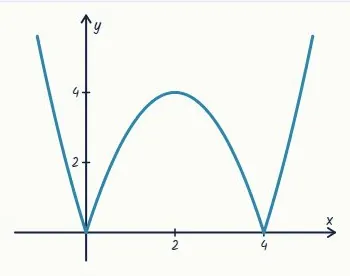
- The graph of f(x) = |x² − 4x| is shown.
- Find where f is not differentiable,
- And where f′(x) = 0. Justify both.
Q7: write f in pieces
- Where is x² − 4x negative?
- There, change its sign.
- x² − 4x = x(x − 4)
- x(x − 4) < 0 for 0 < x < 4between the roots
- f(x) = x² − 4x, x ≤ 0 or x ≥ 4
- f(x) = 4x − x², 0 < x < 4sign changed
- f′(x) = 2x − 4 outsidedifferentiate
- f′(x) = 4 − 2x inside
- f is continuous everywherepieces meet at 0, 4
Q7: corners, and f′(x) = 0
- Gradients at 0 and at 4.
- Reject a root off its piece.
- x = 0: left 2(0) − 4 = −4
- right 4 − 2(0) = 4
- x = 4: left 4 − 2(4) = −4
- right 2(4) − 4 = 4
- −4 ≠ 4 at both: cornersgradients differ
- not differentiable at x = 0, 4
- 2x − 4 = 0: x = 2not in x ≤ 0, x ≥ 4
- 4 − 2x = 0: x = 2, f(2) = 4the inside piece
- f′(x) = 0 only at (2, 4)
Common mistakes
- The limit at x = 4 is f(4).A limit depends on the values near x = 4, not on the value at x = 4.
- A function that is continuous at a point is differentiable there.A corner is continuous but has no single gradient.
- To join two pieces smoothly, match the values only.Differentiable needs the values and the gradients to match.
The checklist that solved all seven
- Both sides, then the value, then the gradients, with a reason each time.
| Step | How |
|---|---|
| Limit | both sides agree |
| Value | the closed dot |
| Continuous | limit equals value |
| Corner | gradients differ |
| Sign of f′ | rising +, falling − |
| Constants | meet, then match |
Challenge
f(x) = x − 4√x − 2 for x ≥ 0, x ≠ 4, and f(4) = k. (a) Find the value of k that makes f continuous at x = 4. (b) With that k, is f differentiable at x = 4? If so, find f′(4).
Hint
Substituting x = 4 gives 0 over 0, which tells you nothing. Think of x − 4 as a difference of two squares, with √x as one of the terms.
Answer
(a) k = 4. (b) Yes: for every x ≥ 0, f(x) = √x + 2, which is smooth at x = 4, so f is differentiable there with f′(4) = 14.
Step by step
- Putting x = 4 straight in gives 0 ÷ 0, so the limit has to be found another way.
- x − 4 = (√x)² − 2² = (√x − 2)(√x + 2), so for x ≠ 4 the factor √x − 2 cancels and f(x) = √x + 2.
- As x → 4 from either side, √x + 2 → 4. Continuity needs the value to equal the limit, so k = 4.
- With k = 4, f(x) = √x + 2 at every x ≥ 0, including x = 4. There is no jump, hole or corner.
- So f is differentiable at x = 4, and its gradient comes from differentiating √x + 2.
Full working
- x = 4: 4 − 42 − 2 = 0 ÷ 0undefined, not the limit
- x − 4 = (√x − 2)(√x + 2)difference of two squares
- f(x) = √x + 2 for x ≠ 4cancel √x − 2 ≠ 0
- lim(x→4) f(x) = √4 + 2 = 4both sides agree
- k = 4limit = value: continuous
- f(x) = √x + 2 for all x ≥ 0one smooth curve
- f′(x) = 12√xx^½ → ½x^−½
- f′(4) = 12 × 2 = 14
- (a) k = 4; (b) yes, f′(4) = 14
g(x) = ax² + bx for x ≤ 2, and g(x) = 12x for x > 2. (a) Find a and b so that g is differentiable at x = 2. (b) Hence find the coordinates of the stationary point of g, and say whether it is a maximum or a minimum.
Hint
Differentiable needs two things at x = 2: the pieces meet, and the gradients match. That gives two equations. For (b), check that your stationary point lies on the piece you used.
Answer
(a) a = −3, b = 9. (b) A maximum at (32, 274).
Step by step
- The pieces must meet at x = 2: the quadratic must equal 122 = 6 there.
- The gradients must match at x = 2: the derivative of 12x is −12x², which is −3 at x = 2.
- Solve the two equations together for a and b.
- The right-hand piece 12x has gradient −12x², which is never zero, so any stationary point is on the quadratic piece.
- Set the derivative of −3x² + 9x to zero. The answer x = 32 is less than 2, so it is on that piece. The quadratic opens downwards, so it is a maximum.
Full working
- 4a + 2b = 6pieces meet: 12 ÷ 2 = 6
- ddx(ax² + bx) = 2ax + b; ddx(12x) = −12x²gradients
- 4a + b = −124 = −3gradients match at x = 2
- (4a + 2b) − (4a + b) = 6 − (−3), so b = 9subtract
- 4a + 9 = −3, so a = −3
- g(x) = −3x² + 9x, x ≤ 2: g′(x) = −6x + 9 = 0, so x = 3232 ≤ 2: on this piece
- g(32) = −3(94) + 272 = −274 + 544 = 274the y value
- x > 2: −12x² < 0, never 0no stationary point there
- g″(x) = −6 < 0maximum
- (a) a = −3, b = 9; (b) maximum at (32, 274)
f(x) = (x − 1)|x − 1|. (a) Show that f is differentiable at x = 1, and find f′(1). (b) Show that f′(x) = 2|x − 1| for every x, and explain why f″(1) does not exist. (c) Describe the point (1, 0) on the graph of y = f(x), with reasons.
Hint
Write f in two pieces, one for x ≥ 1 and one for x < 1, without the modulus sign. Then check the values and the gradients at x = 1 from each side. For (c), look at the concavity on each side.
Answer
(a) Both pieces have value 0 and gradient 0 at x = 1, so f′(1) = 0. (b) f′(x) = 2(x − 1) for x ≥ 1 and −2(x − 1) for x < 1, which is 2|x − 1|; its gradient is −2 on the left and 2 on the right, a corner, so f″(1) does not exist. (c) A stationary point of inflection: gradient 0, concave down for x < 1, concave up for x > 1.
Step by step
- For x ≥ 1, |x − 1| = x − 1, so f(x) = (x − 1)². For x < 1, |x − 1| = −(x − 1), so f(x) = −(x − 1)².
- Both pieces give 0 at x = 1, so f is continuous. Both derivatives give 0 at x = 1, so the gradients match and f is differentiable there.
- The derivative is 2(x − 1) on the right and −2(x − 1) on the left. Both are never negative, and they equal 2|x − 1|.
- The graph of f′ is a V shape with its corner at x = 1: gradient −2 on the left, 2 on the right. So f′ is not differentiable at 1, and f″(1) does not exist.
- f″ = −2 for x < 1 and f″ = 2 for x > 1, so the concavity changes at x = 1. A point where the gradient is 0 and the concavity changes is a stationary point of inflection, even though f″(1) itself does not exist.
Full working
- x ≥ 1: f(x) = (x − 1)²; x < 1: f(x) = −(x − 1)²|x − 1| in pieces
- value at 1: 0 from both piecescontinuous
- x > 1: f′(x) = 2(x − 1) → 0; x < 1: f′(x) = −2(x − 1) → 0gradients from each side
- 0 = 0, so f′(1) = 0differentiable at 1
- f′(x) = 2(x − 1) for x ≥ 1, −2(x − 1) for x < 1both ≥ 0
- f′(x) = 2|x − 1|same as the pieces
- gradient of f′: −2 for x < 1, 2 for x > 1−2 ≠ 2: a corner
- f″(1) does not existf′ not differentiable at 1
- f″(x) = −2 < 0 for x < 1; f″(x) = 2 > 0 for x > 1concave down, then up
- (1, 0) is a stationary point of inflection, with f′(1) = 0 but no f″(1)
Practise this
Report a mistake
More in AS 91578
 The derivative toolkit: chain, product and quotient rules11 min
 Stationary points, concavity and points of inflection11 min
 Tangents and normals: from gradient to finished equation11 min
 Parametric differentiation, and the second derivative11 min
 Related rates of change: spheres, cones and the chain rule10 min
 Optimisation: building the model and finding the max or min11 min
 Limits, continuity and differentiability from a graph8 min
 Derivative toolkit: 7 exam questions solved step by step11 min
 Stationary points: 7 exam questions solved step by step12 min
 Tangents and normals: 7 exam questions solved step by step12 min
 Parametric curves: 7 exam questions solved step by step11 min
 Related rates of change: 7 exam questions solved step by step11 min
 Optimisation: 7 exam questions solved step by step11 minLimits and continuity: 7 exam questions solved step by step11 min