
Transforming graphs
What this lesson covers
- Adding outside moves a graph up or down.
- Changing x inside the bracket moves it the opposite way.
- A multiplier stretches, and a negative reflects.
The four moves
- Start from y = f(x).
| New graph | What happens |
|---|---|
| y = f(x) + a | Up a |
| y = f(x − a) | Right a |
| y = −f(x) | Reflected in the x-axis |
| y = k f(x) | Stretched vertically by k |
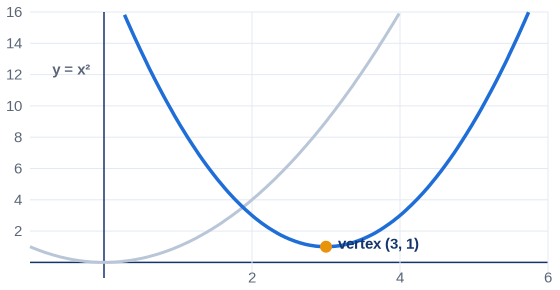
From y = x² to y = 2(x − 3)² + 1
- Read the moves from the numbers.
- right 3x − 3
- stretched by 2the multiplier
- up 1the + 1
- vertex (3, 1)
- y-intercept = 2(9) + 1 = 19
Try it: move the parabola
- Change a, h and k in y = a(x − h)² + k and watch the vertex.
Graphing calculator
The moves together
- The grey y = x² becomes the blue y = 2(x − 3)² + 1.
Try it: move every family
Common mistakes
- Moving y = (x − 3)² left by 3.x − 3 moves it right by 3, because x has to be 3 to give zero.
- Forgetting the stretch when finding the y-intercept.Substitute x = 0 into the whole equation.
Try it: read the moves
Your turn
How does y = x² + 5 differ from y = x²?
How does y = (x + 2)² differ from y = x²?
How does y = −x² differ from y = x²?
How does y = 3x² differ from y = x²?
y = x² is moved right 4 and down 1. Which equation gives the new graph?
Find the vertex of y = −2(x + 1)² + 6.
Find the y-intercept of y = 3(x − 2)² − 4.
y = f(x) has a maximum point at (2, 5). Find the turning point of y = −f(x − 1) + 3.
Show answer
1. Up 5 2. Left 2 3. Reflected in the x-axis 4. Stretched vertically by 3 5. y = (x − 4)² − 1. Moving right 4 puts x − 4 inside the bracket, and down 1 is − 1 outside. 6. (−1, 6). x + 1 moves the graph left 1 and + 6 moves it up 6; the −2 stretches and flips but does not move the vertex. 7. 8. Substitute x = 0 into the whole equation: 3(−2)² − 4 = 12 − 4 = 8. 8. Minimum at (3, −2). Reflecting turns (2, 5) into a minimum at (2, −5), x − 1 moves it right 1 to x = 3, and + 3 lifts it to −5 + 3 = −2.
Sample question: Achieved
The graph of y = x² is moved 3 to the left, stretched vertically by a factor of 2, then moved 5 down. Write its new equation and state its vertex.
Hint
Left 3 goes inside the bracket as + 3. The stretch multiplies the bracket. Down 5 goes on the end.
Answer
y = 2(x + 3)² − 5, vertex (−3, −5)
Step by step
- Moves inside the bracket act in reverse: to move left 3, write (x + 3).
- A vertical stretch by 2 multiplies the whole bracket: 2(x + 3)².
- Moving down 5 acts as written, outside: 2(x + 3)² − 5.
- The vertex of y = x² is (0, 0). Left 3 takes it to (−3, 0). The stretch leaves a point at height 0 where it is. Down 5 then gives (−3, −5).
- Classic mistake: writing (x − 3) for a move left. Inside the bracket, minus moves right.
- Check: x = −3 gives 2(0)² − 5 = −5, the lowest point.
Full working
- (x + 3)²left 3
- 2(x + 3)²stretch by 2
- 2(x + 3)² − 5down 5
- y = 2(x + 3)² − 5, vertex (−3, −5)
Sample questions: Merit
The graph of y = 1x is moved 2 to the right and 3 up. Write its equation, state both asymptotes, and find both intercepts.
Hint
Right 2 goes inside as (x − 2); up 3 goes on the end. The asymptotes move with the graph.
Answer
y = 1x − 2 + 3; asymptotes x = 2 and y = 3; y-intercept 2.5; x-intercept 53
Step by step
- Right 2 acts inside, in reverse: 1x − 2. Up 3 acts outside: + 3.
- So y = 1x − 2 + 3.
- y = 1x has asymptotes x = 0 and y = 0. They move with the graph: right 2 gives x = 2, and up 3 gives y = 3.
- y-intercept: x = 0 gives 1−2 + 3 = 2.5.
- x-intercept: set y = 0. 1x − 2 = −3, so x − 2 = −13.
- x = 2 − 13 = 53.
- Classic mistake: taking the horizontal asymptote as y = 0. The graph moved up 3, so the asymptote did too.
- Check: x = 53 gives 1−13 + 3 = −3 + 3 = 0. Correct.
Full working
- y = 1x − 2 + 3right 2, up 3
- asymptotes x = 2, y = 3moved with the graph
- x = 0: y = −12 + 3 = 2.5
- y = 0: x − 2 = −13, so x = 53
- y = 1x − 2 + 3; asymptotes x = 2, y = 3; intercepts (0, 2.5) and (53, 0)
The graph of y = 2ˣ is reflected in the x-axis and then moved up 8. Write the new equation, and find its asymptote, its y-intercept and its x-intercept.
Hint
Reflecting in the x-axis puts a minus in front of 2ˣ. Then add 8.
Answer
y = 8 − 2ˣ; asymptote y = 8; y-intercept 7; x-intercept 3
Step by step
- Reflecting in the x-axis makes every y value negative: y = −2ˣ.
- Moving up 8 adds 8 on the outside: y = −2ˣ + 8, or y = 8 − 2ˣ.
- y = 2ˣ has asymptote y = 0. Reflecting keeps it at y = 0, and moving up 8 takes it to y = 8.
- y-intercept: x = 0 gives 8 − 1 = 7.
- x-intercept: 8 − 2ˣ = 0, so 2ˣ = 8 = 2³ and x = 3.
- The graph now sits below its asymptote and falls steeply as x grows.
- Classic mistake: writing y = 2⁻ˣ + 8. A minus in the power reflects in the y-axis, not the x-axis.
- Check: x = 3 gives 8 − 8 = 0. Correct.
Full working
- y = −2ˣreflect in the x-axis
- y = 8 − 2ˣup 8
- asymptote y = 8
- x = 0: y = 7; y = 0: 2ˣ = 8, x = 3
- y = 8 − 2ˣ; asymptote y = 8; intercepts (0, 7) and (3, 0)
Sample questions: Excellence
Describe the transformations that take y = x² to y = x² − 6x + 11. The graph of y = x² − 6x + 11 is then reflected in the x-axis and moved 4 up. Find the new equation and its exact roots.
Hint
Complete the square to see the moves. Reflecting in the x-axis puts a minus in front of the whole expression.
Answer
y = (x − 3)² + 2, so right 3 and up 2; the new graph is y = 2 − (x − 3)², with roots x = 3 ± √2
Step by step
- To read moves, write the quadratic in vertex form by completing the square.
- x² − 6x + 11: half of −6 is −3, so use (x − 3)² = x² − 6x + 9. Then x² − 6x + 11 = (x − 3)² + 2.
- So from y = x² the graph moves right 3 and up 2. Its vertex is (3, 2).
- Reflect in the x-axis: every y value changes sign, so y = −(x − 3)² − 2. The vertex goes to (3, −2).
- Move up 4: y = −(x − 3)² − 2 + 4 = 2 − (x − 3)². The vertex is now (3, 2), a maximum.
- Roots: 2 − (x − 3)² = 0, so (x − 3)² = 2.
- x − 3 = ±√2, so x = 3 + √2 or x = 3 − √2.
- Classic mistake: reflecting only the squared part, giving −(x − 3)² + 2 before moving up. The + 2 must change sign too.
- Order matters: moving up first and then reflecting gives a different graph, y = −(x − 3)² − 6, with no roots.
- Check: x = 3 + √2 gives 2 − 2 = 0. Correct.
Full working
- x² − 6x + 11 = (x − 3)² + 2complete the square
- right 3, up 2from y = x²
- y = −(x − 3)² − 2reflect in the x-axis
- y = 2 − (x − 3)²up 4
- (x − 3)² = 2, so x = 3 ± √2
- right 3, up 2; then y = 2 − (x − 3)², roots 3 ± √2
Start with y = 2ˣ. Graph A: move it up 4, then reflect in the x-axis. Graph B: reflect it in the x-axis, then move it up 4. Find both equations and asymptotes, explain why they differ, and show that only one of them has an x-intercept.
Hint
Do the moves one at a time, in the order given. A reflection in the x-axis changes the sign of everything already there.
Answer
A: y = −2ˣ − 4, asymptote y = −4, no x-intercept because y < −4 always. B: y = 4 − 2ˣ, asymptote y = 4, x-intercept 2. They differ because the reflection also flips the earlier shift.
Step by step
- Graph A, step 1: up 4 gives y = 2ˣ + 4, with asymptote y = 4.
- Graph A, step 2: reflecting in the x-axis changes the sign of all of it: y = −(2ˣ + 4) = −2ˣ − 4. The asymptote flips to y = −4.
- Graph B, step 1: reflecting gives y = −2ˣ, with asymptote y = 0.
- Graph B, step 2: up 4 gives y = 4 − 2ˣ, with asymptote y = 4.
- Why they differ: in A the reflection acts on the shift too, so the 4 becomes −4. In B the shift comes after, so it stays +4.
- x-intercept of A: −2ˣ − 4 = 0 needs 2ˣ = −4. But 2ˣ is always positive, so there is no solution.
- In fact y = −2ˣ − 4 is always less than −4, so A never reaches the x-axis.
- x-intercept of B: 4 − 2ˣ = 0, so 2ˣ = 4 = 2² and x = 2.
- Classic mistake: assuming the order of moves never matters. It does matter whenever a reflection or stretch follows a shift.
- Check: B at x = 2 gives 4 − 4 = 0, and A at x = 0 gives −1 − 4 = −5, below −4 as expected.
Full working
- A: y = 2ˣ + 4, then y = −(2ˣ + 4) = −2ˣ − 4asymptote y = −4
- B: y = −2ˣ, then y = 4 − 2ˣasymptote y = 4
- A: 2ˣ = −4 has no solution2ˣ > 0
- B: 2ˣ = 4, so x = 2
- A: y = −2ˣ − 4, no x-intercept; B: y = 4 − 2ˣ, x-intercept 2
What to take away
- Outside the bracket acts as written.
- Inside the bracket acts in reverse.
Challenge
The graph of y = 1x is stretched vertically by a factor of 6, then moved 1 to the left and 2 down. Write its equation and find its asymptotes and both intercepts. The new graph does not pass through the origin. Find the single left or right move that would make it pass through the origin, and also the single up or down move that would.
Hint
A left or right move slides the x-intercept along the x-axis. An up or down move slides the y-intercept along the y-axis.
Answer
y = 6x + 1 − 2; asymptotes x = −1 and y = −2; intercepts (0, 4) and (2, 0); move it 2 left, giving y = 6x + 3 − 2, or 4 down, giving y = 6x + 1 − 6
Step by step
- Stretch by 6: y = 6x. Left 1 goes inside as x + 1, and down 2 goes on the end: y = 6x + 1 − 2.
- The asymptotes of y = 1x are x = 0 and y = 0. They move with the graph to x = −1 and y = −2.
- y-intercept: x = 0 gives 6 − 2 = 4. x-intercept: 6x + 1 = 2, so x + 1 = 3 and x = 2.
- A sideways move keeps the graph at the same heights, so the point (2, 0) must slide to (0, 0). That is 2 to the left: y = 6x + 3 − 2.
- An up or down move keeps the same x values, so the point (0, 4) must slide to (0, 0). That is 4 down: y = 6x + 1 − 6.
- Check: 63 − 2 = 0 and 61 − 6 = 0. Both pass through the origin.
Full working
- y = 6x + 1 − 2stretch 6, left 1, down 2
- asymptotes x = −1, y = −2moved with the graph
- x = 0: y = 4; y = 0: x + 1 = 3, x = 2intercepts
- (2, 0) → (0, 0): left 2, y = 6x + 3 − 2sideways move
- (0, 4) → (0, 0): down 4, y = 6x + 1 − 6vertical move
- y = 6x + 1 − 2; 2 left or 4 down puts it through the origin
A parabola y = f(x) is moved 3 to the right, then stretched vertically by a factor of 2, then reflected in the x-axis, then moved 5 up. The final graph is y = −2x² + 16x − 25. Find the equation of the original parabola, and its vertex.
Hint
Undo the moves in reverse order: take away 5, then reflect, then divide by 2, then move 3 to the left.
Answer
f(x) = x² − 2x, with vertex (1, −1)
Step by step
- Working forwards, the final graph is y = −2f(x − 3) + 5. So −2f(x − 3) + 5 = −2x² + 16x − 25.
- Undo the last two moves: −2f(x − 3) = −2x² + 16x − 30, so f(x − 3) = x² − 8x + 15 = (x − 3)(x − 5).
- Undo the move right by putting x + 3 in place of x: f(x) = x(x − 2) = x² − 2x.
- Its roots are 0 and 2, so its vertex is at x = 1, with y = 1 − 2 = −1.
- Check forwards: right 3 gives roots 3 and 5 and the expression x² − 8x + 15; stretch, reflect and up 5 give −2x² + 16x − 30 + 5 = −2x² + 16x − 25. Correct.
- The vertex follows the same path: (1, −1) → (4, −1) → (4, −2) → (4, 2) → (4, 7), and the final graph does have its vertex at (4, 7).
Full working
- −2f(x − 3) + 5 = −2x² + 16x − 25the four moves
- f(x − 3) = x² − 8x + 15 = (x − 3)(x − 5)take 5, divide by −2
- f(x) = x(x − 2)replace x with x + 3
- vertex at x = 1, y = −1halfway between roots 0 and 2
- (1, −1) → (4, 7)check the vertex forwards
- f(x) = x² − 2x, vertex (1, −1)
Reflecting in the horizontal line y = m sends every point (x, y) to (x, 2m − y). Show that this is the same as two moves from this lesson done one after the other. The parabola y = x² − 2x + 3 is reflected in a horizontal line, and the new graph passes through (3, 16). Find the line, the new equation, and the points where the two graphs meet.
Hint
Reflecting in the x-axis sends y to −y. What move then turns −y into 2m − y? For the meeting points, set the two heights equal and see what the original height must be.
Answer
Reflect in the x-axis, then move up 2m. The line is y = 11, the new graph is y = 20 − (x − 1)² = −x² + 2x + 19, and the graphs meet at (−2, 11) and (4, 11)
Step by step
- Reflecting in the x-axis takes (x, y) to (x, −y). Moving up 2m then takes it to (x, 2m − y). That is the reflection in y = m.
- So the new graph is y = 2m − (x² − 2x + 3).
- It passes through (3, 16): 16 = 2m − (9 − 6 + 3) = 2m − 6, so m = 11.
- New equation: y = 22 − (x² − 2x + 3) = −x² + 2x + 19. In vertex form the original is (x − 1)² + 2 and the new one is 20 − (x − 1)².
- At a meeting point both heights are equal: x² − 2x + 3 = 22 − (x² − 2x + 3), so x² − 2x + 3 = 11. The graphs meet on the mirror line: (x − 1)² + 2 = 11, so (x − 1)² = 9 and x = −2 or x = 4.
- Check: x = 4 gives 16 − 8 + 3 = 11 on the original and −16 + 8 + 19 = 11 on the new graph. Correct.
Full working
- (x, y) → (x, −y) → (x, 2m − y)reflect in x-axis, then up 2m
- y = 2m − (x² − 2x + 3)new graph
- 16 = 2m − 6, so m = 11through (3, 16)
- y = −x² + 2x + 19 = 20 − (x − 1)²new equation
- (x − 1)² + 2 = 11, so x = −2 or x = 4meet on the mirror line
- line y = 11; y = −x² + 2x + 19; meeting points (−2, 11) and (4, 11)