
Modelling with the right graph
What this lesson covers
- A steady rate suggests a straight line.
- Rising then falling suggests a parabola.
- Levelling off suggests an exponential with an asymptote.
Matching story to shape
- Ask how the quantity changes.
| Situation | Model |
|---|---|
| Steady hourly pay | Linear |
| Path of a thrown ball | Parabola |
| Hot drink cooling to room temperature | Exponential with an asymptote |
| Wait time as staff numbers rise | Hyperbola |
Try it: match the story to a shape
A ball's path
- A ball reaches its highest point of 5 m after travelling 10 m, and it starts on the ground.
- h = a(x − 10)² + 5vertex (10, 5)
- 0 = 100a + 5starts at (0, 0)
- a = −0.05
- h = −0.05(x − 10)² + 5
- It lands at x = 20 m, by symmetry
A cooling drink
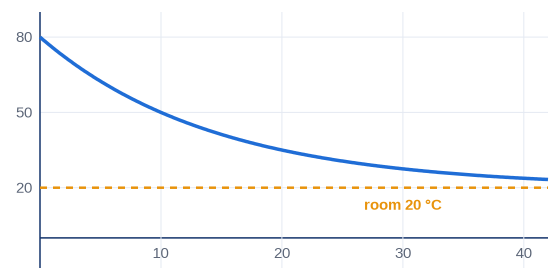
- T = 20 + 60(0.5)^(t/10), with t in minutes.
- t = 0: T = 80 °C
- t = 10: T = 50 °C
- t = 20: T = 35 °C
- It levels off at 20 °C, the asymptote
Try it: a cooling drink
Levelling off
- A hot drink falls fast, then slowly, towards room temperature.
Common mistakes
- Using a model outside the situation.A height below zero after landing is not part of the model, so state the domain.
- Giving the numbers with no units.Finish in the context of the question.
Try it: model a throw
Your turn
Which model suits a taxi with a flag fall and a rate per km?
Which model suits a thrown ball's height?
Which model suits a drink cooling in a room?
Find the highest point of h = −5t² + 20t.
Which model suits the number of days a fixed job takes as more workers share it?
h = −5t² + 30t is a ball's height in metres after t seconds. For which values of t does the model make sense?
A pie from a Dunedin bakery cools by T = 18 + 62(0.5)^(t/15), t in minutes. Find its temperature after 30 minutes.
A kicked rugby ball starts on the ground and peaks at 12 m high after 20 m. Using h = a(x − 20)² + 12, find a and where it lands.
Show answer
1. Linear 2. Parabola 3. An exponential with an asymptote 4. t = 2, h = 20 5. Hyperbola. Doubling the workers halves the days, so the time falls towards zero but never reaches it. 6. 0 ≤ t ≤ 6. h = 0 when t = 0 and t = 6, and after landing a negative height is not part of the model. 7. 33.5 °C. t/15 = 2, so T = 18 + 62 × 0.25 = 18 + 15.5 = 33.5. 8. a = −0.03, lands at 40 m. (0, 0) gives 0 = 400a + 12, so a = −0.03, and by symmetry it lands 20 m past the vertex, at x = 40 m.
Sample question: Achieved
A plumber charges a call-out fee of $60 plus $85 for each hour. Write a model for the cost C of a job lasting h hours, and find the cost of a 2.5 hour job.
Hint
A fixed fee plus a steady rate is a straight line: the fee is the intercept and the rate is the gradient.
Answer
C = 60 + 85h; a 2.5 hour job costs $272.50
Step by step
- A steady rate per hour means a straight-line model.
- The $60 is paid even for zero hours, so it is the intercept.
- Each hour adds $85, so 85 is the gradient.
- The model is C = 60 + 85h.
- For h = 2.5: C = 60 + 85 × 2.5 = 60 + 212.50 = 272.50.
- Check: 2 hours cost 60 + 170 = $230 and 3 hours cost $315. $272.50 is halfway between, as it should be.
Full working
- C = 60 + 85hintercept 60, gradient 85
- C = 60 + 85 × 2.5h = 2.5
- C = $272.50
Sample questions: Merit
A netball leaves a player's hands 2 m above the ground. It reaches its greatest height of 4.5 m when it is 5 m away horizontally. Model its height with a parabola, and find how far away it would land if no one caught it.
Hint
Use the vertex form h = a(x − 5)² + 4.5 and the starting point (0, 2) to find a.
Answer
h = −0.1(x − 5)² + 4.5; it lands 5 + √45 ≈ 11.7 m away
Step by step
- The ball rises then falls, so a parabola fits. We know the highest point, so use the vertex form.
- Vertex (5, 4.5): h = a(x − 5)² + 4.5, where x is the horizontal distance in metres.
- It starts at x = 0 with h = 2: 2 = a(25) + 4.5, so 25a = −2.5 and a = −0.1.
- The model is h = −0.1(x − 5)² + 4.5. The negative a fits a shape that opens downwards.
- It lands when h = 0: 0.1(x − 5)² = 4.5, so (x − 5)² = 45.
- x − 5 = ±√45 ≈ ±6.71. The negative answer is behind the player, so reject it.
- x = 5 + √45 ≈ 11.7 m.
- Classic mistake: using symmetry to say it lands at 10 m. The ball started 2 m up, not on the ground, so it keeps falling past x = 10.
- Check: at x = 10 the model gives −0.1 × 25 + 4.5 = 2 m, the same height it started at. That fits the symmetry.
Full working
- h = a(x − 5)² + 4.5vertex form
- 2 = 25a + 4.5, so a = −0.1starts at (0, 2)
- 0 = −0.1(x − 5)² + 4.5, so (x − 5)² = 45lands when h = 0
- x = 5 + √45 ≈ 11.7reject the negative root
- h = −0.1(x − 5)² + 4.5; lands about 11.7 m away
A cup of tea cools in a room. Its temperature after t minutes is T = 22 + 68(0.8)ᵗ °C. Find its starting temperature, state the temperature it levels off at, and find after how many whole minutes it is first below 50 °C.
Hint
t = 0 gives the start. The term 68(0.8)ᵗ shrinks towards 0. Then try whole values of t, or solve with logs.
Answer
Starts at 90 °C, levels off at 22 °C, first below 50 °C after 4 minutes (49.9 °C)
Step by step
- Start: t = 0 makes 0.8⁰ = 1, so T = 22 + 68 = 90 °C.
- Each minute multiplies 68(0.8)ᵗ by 0.8, so that part gets smaller and smaller towards 0. T levels off at 22 °C, the room temperature. That is the asymptote.
- Below 50 °C means 22 + 68(0.8)ᵗ < 50, so 68(0.8)ᵗ < 28 and 0.8ᵗ < 2868 ≈ 0.4118.
- Try whole minutes. t = 3: 0.8³ = 0.512, so T = 22 + 68 × 0.512 ≈ 56.8 °C. Still above 50.
- t = 4: 0.8⁴ = 0.4096, so T = 22 + 68 × 0.4096 ≈ 49.9 °C. Just below 50.
- So it is first below 50 °C after 4 minutes.
- With logs: t > log(0.4118) ÷ log(0.8) ≈ 3.98, which agrees.
- Classic mistake: solving 68(0.8)ᵗ = 50 and forgetting the 22. The 22 must come off first.
Full working
- t = 0: T = 22 + 68 = 90 °C
- 68(0.8)ᵗ → 0, so T → 22 °Casymptote
- 0.8ᵗ < 2868 ≈ 0.4118T < 50
- t = 3: T ≈ 56.8 °C; t = 4: T ≈ 49.9 °C
- starts 90 °C, levels off at 22 °C, below 50 °C after 4 minutes
Sample questions: Excellence
A pest-free island had 200 tīeke (saddlebacks) in 2020, 260 in 2021 and 338 in 2022. Decide whether a linear or an exponential model fits better, giving your reason. Write the model, use it to predict the population in 2026, and state one limitation of the model.
Hint
Compare the differences and the ratios of the yearly counts. Whichever stays constant tells you the family.
Answer
Exponential, because the ratio is 1.3 each year while the differences grow; P = 200 × 1.3ᵗ with t years after 2020; about 965 birds in 2026; but the island's food and space must eventually limit growth
Step by step
- To choose a family, look at how the numbers change.
- Differences: 260 − 200 = 60 and 338 − 260 = 78. They are not constant, so a straight line does not fit.
- Ratios: 260 ÷ 200 = 1.3 and 338 ÷ 260 = 1.3. A constant ratio means the same percentage growth each year: exponential.
- Let t be years after 2020. The model is P = 200 × 1.3ᵗ.
- 2026 is t = 6: P = 200 × 1.3⁶ = 200 × 4.8268 ≈ 965 birds.
- Limitation: an island has limited food and nesting space. Real growth slows and levels off, so the model will overestimate more and more over time.
- A model that levels off, such as one with a horizontal asymptote at the island's capacity, would be better long term.
- Classic mistake: adding 30% of 200 every year (60 each time). That is linear growth; percentage growth must compound.
- Check: t = 2 gives 200 × 1.69 = 338, the 2022 count.
Full working
- differences 60, 78not constant, so not linear
- ratios 260 ÷ 200 = 1.3, 338 ÷ 260 = 1.3constant, so exponential
- P = 200 × 1.3ᵗt years after 2020
- t = 6: P = 200 × 1.3⁶ ≈ 965
- limited food and spacegrowth must level off
- exponential, P = 200 × 1.3ᵗ, about 965 in 2026, overestimates long term
A footbridge has a parabolic arch over a river. At water level the arch is 24 m wide, and its highest point is 6 m above the water at the centre. A barge 5 m tall must pass under it. Find the greatest width the barge can have, and give one reason a real skipper would want a margin.
Hint
Put the origin on the water below the top of the arch, so h = 6 − ax². The barge's top corners must sit under the arch.
Answer
h = 6 − x²24; the barge can be at most 2√24 ≈ 9.80 m wide; waves, tide or steering error could push it up or sideways
Step by step
- Choose axes to make the maths easy: x = 0 at the centre, h = 0 at the water. The arch is symmetric, so h = 6 − ax².
- The arch meets the water 12 m either side of the centre, at x = ±12: 0 = 6 − 144a, so a = 6144 = 124.
- The model is h = 6 − x²24.
- The barge is 5 m tall. Its top corners are the tightest points, so they must be at or under the arch: 6 − x²24 ≥ 5.
- x²24 ≤ 1, so x² ≤ 24 and x ≤ √24 ≈ 4.90.
- That is half the barge's width, one side of the centre. The full width is 2√24 ≈ 9.80 m.
- Classic mistake: forgetting to double. x measures from the centre line, not from one side of the barge.
- Check: at x = 4.90, h = 6 − 2424 = 5 m. The corner just touches the arch.
- Limitation: the water level changes with tide and rain, and the barge rocks and drifts. A skipper would want a clear margin, so the real safe width is less than 9.80 m.
Full working
- h = 6 − ax²vertex (0, 6), symmetric
- 0 = 6 − 144a, so a = 124meets the water at x = 12
- 6 − x²24 ≥ 5the top corners stay under the arch
- x² ≤ 24, so x ≤ √24 ≈ 4.90half the width
- width ≤ 2√24 ≈ 9.80 m
What to take away
- Let the behaviour choose the family.
- State where the model stops making sense.
Challenge
A group of n friends books a bach in the Coromandel for a weekend. Bach A costs $600, shared equally, plus $35 each for food. Bach B costs $400, shared equally, but its food package is $45 each. Model the cost per person for each bach, and name the family of graph. Find the smallest group for which Bach A costs under $100 each, explain why Bach A can never cost $35 each, and find the group sizes for which Bach A is the cheaper choice.
Hint
A fixed amount shared between n people is 600n. That is a hyperbola in n. For the comparison, set up an inequality and multiply by n, which is positive.
Answer
A: C = 600n + 35 and B: C = 400n + 45, both hyperbolas; at least 10 people for under $100 each with Bach A; the cost per person only approaches the $35 asymptote; Bach A is cheaper for 21 or more people (both cost $65 each at 20)
Step by step
- The shared part shrinks as more people join, so each model is a hyperbola: C = 600n + 35 for A and C = 400n + 45 for B.
- Under $100 with A: 600n + 35 < 100, so 600n < 65 and n > 9.23. Groups come in whole people, so at least 10 (9 people pay about $101.67 each, 10 pay $95).
- 600n is never 0 however large n gets, so the cost per person gets closer and closer to $35 but never reaches it. y = 35 is the asymptote.
- A cheaper than B: 600n + 35 < 400n + 45, so 200n < 10 and n > 20.
- At n = 20 both cost $65 each. With 21 people, A is $63.57 and B is $64.05, so A is cheaper from 21 people up.
- The model only makes sense for whole numbers of people, and a real bach has a maximum number of beds.
Full working
- C = 600n + 35, C = 400n + 45fixed cost shared, plus a per-person cost
- 600n < 65, so n > 9.23Bach A under $100
- n = 9: $101.67; n = 10: $95whole people
- 600n → 0, so C → 35asymptote
- 200n < 10, so n > 20A cheaper than B
- n = 20: both $65equal
- at least 10 people; never $35 each; Bach A cheaper for 21 or more people
A hot chocolate cart at a winter market finds that at a price of $p it sells 600 − 100p cups a day. Each cup costs $1 to make, and running the cart costs $200 a day. Write the daily profit as a function of p and explain which family of graph it belongs to. Find the price that gives the most profit and that profit, and the exact range of prices for which the cart does not make a loss.
Hint
Profit = (profit on each cup) × (number of cups) − 200. The first part is zero at two prices, and the best price is halfway between them.
Answer
P = (p − 1)(600 − 100p) − 200, a parabola opening down; best price $3.50, profit $425 a day; no loss for 7 − √172 ≤ p ≤ 7 + √172, about $1.44 to $5.56
Step by step
- Each cup makes p − 1 dollars and 600 − 100p cups are sold, so P = (p − 1)(600 − 100p) − 200.
- Multiplying out gives −100p² + 700p − 800, a parabola that opens downwards, so it has a highest point.
- (p − 1)(600 − 100p) is zero at p = 1 and p = 6. By symmetry the vertex is halfway: p = 3.5.
- At p = 3.5: 250 cups at $2.50 profit each is $625, minus $200, so P = $425.
- No loss: −100p² + 700p − 800 ≥ 0, so p² − 7p + 8 ≤ 0. The roots are 7 ± √172, about 1.44 and 5.56, and the parabola is above the axis between them.
- The model only holds for 0 ≤ p ≤ 6, where the number of cups sold is not negative.
Full working
- P = (p − 1)(600 − 100p) − 200profit per cup × cups − fixed cost
- P = −100p² + 700p − 800parabola, opens down
- p = (1 + 6) ÷ 2 = 3.5halfway between p = 1 and p = 6
- P = 2.5 × 250 − 200 = 425best profit
- p² − 7p + 8 = 0, so p = 7 ± √172break even
- best price $3.50 for $425 a day; no loss for $1.44 ≤ p ≤ $5.56 (exactly 7 ± √172)
A mug of coffee is left to cool in a room whose temperature is not known. It reads 90 °C at the start, 62 °C after 5 minutes and 45.2 °C after 10 minutes. Model the temperature with T = R + A × b^(t5), where t is in minutes and R is the room temperature. Find R, A and b, and find the first whole minute at which the coffee is below 30 °C.
Hint
The room temperature cancels when you subtract one reading from the next. Compare the two drops: their ratio is b.
Answer
b = 0.6, A = 70, R = 20, so T = 20 + 70 × 0.6^(t5); the coffee is first below 30 °C at 20 minutes (about 30.05 °C at 19 minutes, 29.07 °C at 20)
Step by step
- The drops are 90 − 62 = 28 and 62 − 45.2 = 16.8. R cancels in each drop, and each drop is the previous one times b.
- So b = 16.8 ÷ 28 = 0.6.
- From t = 0 to t = 5 the term A × b^(t5) goes from A to 0.6A, a drop of 0.4A. So 0.4A = 28 and A = 70.
- At t = 0: 90 = R + 70, so R = 20 °C, the room temperature and the asymptote.
- Below 30 °C: 70 × 0.6^(t5) < 10, so 0.6^(t5) < 17. Logs give t > 19.05 minutes.
- Check whole minutes: t = 19 gives about 30.05 °C, still just above. t = 20 gives about 29.07 °C. So the answer is 20 minutes, not 19.
Full working
- 90 − 62 = 28, 62 − 45.2 = 16.8R cancels
- b = 16.8 ÷ 28 = 0.6ratio of drops
- A − 0.6A = 28, so A = 70first drop
- R = 90 − 70 = 20t = 0
- 0.6^(t5) < 17, so t > 5 × log(17) ÷ log(0.6) ≈ 19.05below 30 °C
- T(19) ≈ 30.05, T(20) ≈ 29.07check whole minutes
- T = 20 + 70 × 0.6^(t5); first below 30 °C at 20 minutes