
Independent or exclusive: 7 exam questions solved step by step
What this lesson covers
- Mutually exclusive events cannot happen together; independent events do not affect each other.
- Each has its own test, and each test must be written as a probability statement.
Two tests: exclusive and independent
- Mutually exclusive: P(A and B) = 0.
- Independent: P(A and B) = P(A) × P(B).
- Or test independence with P(A | B) = P(A).
- Explain the result in context.
Question 1 · Achieved
- At a bakery: P(buys a pie) = 0.3,
- P(pays by card) = 0.8, P(both) = 0.24.
- Independent? Mutually exclusive?
Q1: both tests
- Multiply, then compare.
- Then test for 0.
- P(pie) = 0.3, P(card) = 0.8
- P(pie and card) = 0.24given
- P(pie) × P(card) = 0.3 × 0.8
- = 0.24
- P(pie and card) = P(pie) × P(card)
- pie and card are independent
- P(pie and card) = 0.24 ≠ 0not mutually exclusive
Try it: both tests
Question 2 · Achieved
- At a school: P(takes Art) = 0.25,
- P(Music) = 0.4, P(Art or Music) = 0.5.
- Are Art and Music mutually exclusive?
Q2: find "and" first
- Addition rule.
- Test: is "and" 0?
- P(A or M) = P(A) + P(M)addition rule
- − P(A and M)
- 0.5 = 0.25 + 0.4 − P(A and M)
- P(A and M) = 0.65 − 0.5 = 0.15
- 0.15 ≠ 0some take both
- not mutually exclusive
- exclusive: P(A or M) = 0.65but it is 0.5
Question 3 · Merit
- 400 shoppers at a supermarket:
- Brought a bag (B), used self-checkout (S).
- Are B and S independent? Explain.
| Self | Staffed | Total | |
|---|---|---|---|
| Bag | 90 | 170 | 260 |
| No bag | 60 | 80 | 140 |
| Total | 150 | 250 | 400 |
Q3: the product test
- Counts into probabilities.
- Then explain with "given".
- P(B and S) = 90 ÷ 400 = 0.225
- P(B) = 260 ÷ 400 = 0.65
- P(S) = 150 ÷ 400 = 0.375
- P(B) × P(S) = 0.65 × 0.375
- = 0.24375
- 0.225 ≠ 0.24375product test fails
- B and S are not independent
- P(B | S) = 90 ÷ 150 = 0.6
- 0.6 < 0.65self-checkout: fewer bags
Try it: the product test
Question 4 · Merit
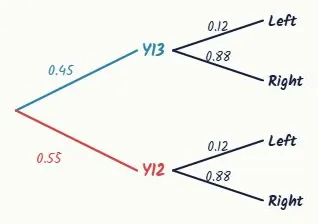
- Seniors at a college: 45% Year 13.
- 12% of Year 13s and 12% of Year 12s
- Are left-handed. Is being left-handed
- Independent of year level? Explain.
Q4: the conditional test
- Find P(L) overall.
- Compare with P(L | Y13).
- P(L | Y13) = 0.12from the tree
- P(L | Y12) = 0.12
- P(L) = 0.45 × 0.12 + 0.55 × 0.12
- = 0.054 + 0.066 = 0.12
- P(L | Y13) = P(L) = 0.12conditional test
- Y13 and L are independent
- knowing the year changes nothing
Question 5 · Merit, in context
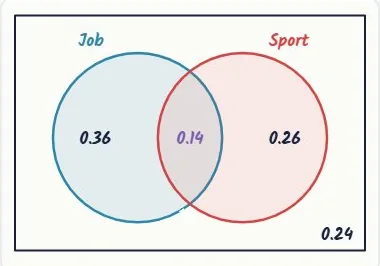
- Year 13s: P(part-time job) = 0.5,
- P(club sport) = 0.4, P(both) = 0.14.
- Test both ideas. Explain in context.
Q5: both tests, then context
- Two tests, two statements.
- Compare P(S | J), P(S).
- P(J and S) = 0.14 ≠ 0not mutually exclusive
- P(J) × P(S) = 0.5 × 0.4 = 0.2
- 0.2 ≠ 0.14product test fails
- J and S are not independent
- P(S | J) = 0.14 ÷ 0.5 = 0.28
- P(S | no job) = 0.26 ÷ 0.5 = 0.52
- 0.28 < P(S) = 0.4job: less club sport
Question 6 · Excellence
- Mere and Josh enter a speech contest.
- P(Mere places) = 0.4, P(at least one) = 0.7.
- Find P(Josh places) if the events are
- (a) independent, (b) mutually exclusive.
Q6 (a): independent
- Let P(J) = x.
- "And" = product.
- P(M) = 0.4, P(J) = x
- P(M or J) = 0.4 + x − P(M and J)
- P(M and J) = 0.4xindependent
- 0.7 = 0.4 + x − 0.4x
- 0.3 = 0.6x− 0.4, collect x
- x = 0.5
- P(M and J) = 0.4 × 0.5 = 0.2
- 0.4 + 0.5 − 0.2 = 0.7
Q6 (b): mutually exclusive
- "And" = 0 now.
- A different answer.
- P(M and J) = 0mutually exclusive
- 0.7 = 0.4 + x − 0
- x = 0.3
- independent 0.5, exclusive 0.3
Question 7 · Excellence
- 600 workers' main way to work.
- Claim: "Bus and drive are independent,
- Because no worker does both."
- Evaluate the claim.
| Main way | Workers |
|---|---|
| Bus | 150 |
| Drive | 270 |
| Other | 180 |
| Total | 600 |
Q7: test the claim
- No overlap: exclusive.
- Now the product test.
- P(B) = 150 ÷ 600 = 0.25
- P(D) = 270 ÷ 600 = 0.45
- P(B and D) = 0 ÷ 600 = 0mutually exclusive
- P(B) × P(D) = 0.25 × 0.45
- = 0.1125
- 0 ≠ 0.1125product test fails
- P(D | B) = 0, but P(D) = 0.45
- claim not supported
Q7: why this always happens
- Any A and B with P > 0.
- Exclusive is dependent.
- P(A) > 0 and P(B) > 0
- so P(A) × P(B) > 0
- exclusive: P(A and B) = 0
- P(A and B) ≠ P(A) × P(B)
- exclusive means not independent
Try it: test, level, explain
Common mistakes
- Mutually exclusive events are independent.If one happens the other cannot, so they depend on each other.
- Testing independence with P(A or B).Compare P(A and B) with P(A) × P(B), or P(A | B) with P(A).
- Writing 'not independent' with no reason.Show the numbers, then say what they mean in context.
The two tests that solved all seven
- Two ideas, two tests, each a probability statement.
| Step | How |
|---|---|
| Exclusive | P(A and B) = 0 |
| Independent | P(A and B) = P(A) × P(B) |
| Or, given | P(A | B) = P(A) |
| Write it | as a probability statement |
| Explain | compare P(A | B) with P(A) |
| Never both | exclusive means dependent |
Challenge
In an invented town, 30% of adults own a dog and 50% walk for at least 30 minutes every day. Among adults who do not walk daily, 20% own a dog. Are owning a dog and walking daily independent? Are they mutually exclusive? Find P(owns a dog or walks daily) and explain your answers in context.
Hint
Use the 20% to find P(dog and not walk). Then subtract from P(dog) to get P(dog and walk), and compare P(dog | walk) with P(dog).
Answer
P(dog and walk) = 0.2 ≠ 0, so not mutually exclusive. P(dog | walk) = 0.4 ≠ P(dog) = 0.3 (and 0.2 ≠ 0.3 × 0.5 = 0.15), so not independent: daily walkers are more likely to own a dog. P(dog or walk) = 0.6.
Step by step
- "Among those who do not walk daily, 20%" is P(dog | not walk). Multiply by P(not walk) = 0.5 to get P(dog and not walk) = 0.1.
- The rest of the dog owners walk daily: 0.3 − 0.1 = 0.2.
- 0.2 is not 0, so some adults do both: not mutually exclusive.
- P(dog | walk) = 0.2 ÷ 0.5 = 0.4, which is not P(dog) = 0.3, so they are not independent.
- The addition rule gives P(dog or walk) = 0.3 + 0.5 − 0.2 = 0.6.
Full working
- P(D and not W) = 0.5 × 0.2 = 0.1P(not W) × P(D given not W)
- P(D and W) = 0.3 − 0.1 = 0.2rest of P(D)
- 0.2 ≠ 0not mutually exclusive
- P(D) × P(W) = 0.3 × 0.5 = 0.15 ≠ 0.2product test fails
- P(D given W) = 0.2 ÷ 0.5 = 0.4 > 0.3 = P(D)walkers more likely to own a dog
- P(D or W) = 0.3 + 0.5 − 0.2 = 0.6addition rule
- not independent, not mutually exclusive; P(dog or walk) = 0.6
(a) Show that if A and B are independent events, then "not A" and "not B" are also independent. (b) Aroha and Tama each try a hard puzzle on their own, so their results are independent. P(Aroha solves it) = 0.4, and the probability that neither of them solves it is 0.42. Find P(Tama solves it) and P(exactly one of them solves it).
Hint
For (a), "neither" is everything outside A or B, so P(not A and not B) = 1 − P(A or B). Expand with the addition rule and the product rule, then factorise. For (b), use (a) to write P(neither) as a product.
Answer
(a) P(not A and not B) = 1 − P(A) − P(B) + P(A)P(B) = (1 − P(A))(1 − P(B)) = P(not A) × P(not B). (b) P(Tama) = 0.3, P(exactly one) = 0.46.
Step by step
- "Neither" is the complement of "A or B", so P(not A and not B) = 1 − P(A or B).
- By the addition rule and independence, P(A or B) = P(A) + P(B) − P(A)P(B).
- So P(not A and not B) = 1 − P(A) − P(B) + P(A)P(B), which factorises to (1 − P(A))(1 − P(B)): the product test holds.
- For the puzzle: P(neither) = 0.6 × P(Tama fails) = 0.42, so P(Tama fails) = 0.7 and P(Tama solves) = 0.3.
- Exactly one: Aroha only is 0.4 × 0.7 = 0.28, Tama only is 0.6 × 0.3 = 0.18, total 0.46.
Full working
- P(A′ and B′) = 1 − P(A or B)complement
- = 1 − [P(A) + P(B) − P(A)P(B)]addition rule, independent
- = (1 − P(A))(1 − P(B)) = P(A′) × P(B′)factorise, so A′ and B′ independent
- 0.6 × P(T′) = 0.42P(A′) = 1 − 0.4
- P(T′) = 0.7, P(T) = 0.3solve
- P(exactly one) = 0.4 × 0.7 + 0.6 × 0.3 = 0.28 + 0.18two cases
- check: 0.12 + 0.28 + 0.18 + 0.42 = 1all four outcomes
- P(Tama solves) = 0.3, P(exactly one) = 0.46
A fair six-sided dice is rolled once. Let A be "the number is even" and let B be "the number is at most k", where k is a whole number from 1 to 6. For which values of k are A and B independent? For which values are they mutually exclusive? Explain why no value of k makes them both.
Hint
For each k, list the numbers in B and count how many are even. Compare P(A and B) with P(A) × P(B) = (12) × (k6).
Answer
Independent for k = 2, 4 and 6 (k = 6 makes B certain). Mutually exclusive only for k = 1. For k = 1 the events cannot happen together, so P(A and B) = 0 but P(A) × P(B) = 112 > 0: exclusive events with non-zero probabilities are never independent.
Step by step
- P(A) = 12 and P(B) = k6, so independence needs P(A and B) = k12.
- P(A and B) is the number of even numbers from 1 to k, divided by 6.
- When k is even, exactly half the numbers 1 to k are even, so P(A and B) = (k2) ÷ 6 = k12: independent.
- When k is odd, there is one more odd than even number, so P(A and B) is less than k12: not independent.
- Only k = 1 gives no even number in B, so P(A and B) = 0: mutually exclusive, but then the product is 112, not 0.
Full working
- k = 1: P(A and B) = 0, product 112exclusive, not independent
- k = 2: 16 = 16independent
- k = 3: 16 ≠ 14not independent
- k = 4: 26 = 13 = 13independent
- k = 5: 26 = 13 ≠ 512not independent
- k = 6: 36 = 12 = 12independent (B certain)
- independent for k = 2, 4, 6; mutually exclusive only for k = 1; never both
Practise this
Report a mistake
More in AS 91585
 Tables, trees and Venn diagrams from written information10 min
 Conditional probability from tables, trees and Venn diagrams9 min
 Independent or mutually exclusive? The two tests10 min
 Relative risk: times as likely, and when you need a ratio9 min
 True probability, model estimates and experimental estimates8 min
 Organising information: 7 exam questions solved step by step11 min
 Conditional probability: 7 exam questions solved step by step10 minIndependent or exclusive: 7 exam questions solved step by step10 min
 Relative risk: 7 exam questions solved step by step10 min
 Probability estimates: 7 exam questions solved step by step9 min