
Conditional probability: 7 exam questions solved step by step
What this lesson covers
- A conditional probability restricts attention to one group, so its denominator is that group's total.
- The notation P(A | B) is read 'A given B', and the order matters.
"Given B": B is the whole group
- Given B: only count what is in B.
- Divide by the total of B.
- P(A | B) = P(A and B) ÷ P(B).
- Write the notation, round to 4 d.p., give context.
Question 1 · Achieved
- 320 visitors to a museum.
- Find P(ate at the café | adult).
| Café | No café | Total | |
|---|---|---|---|
| Adult | 72 | 108 | 180 |
| Child | 28 | 112 | 140 |
| Total | 100 | 220 | 320 |
Q1: P(C | A)
- Given adult: adults only.
- Divide by the row total.
- A: adult, C: ate at the café
- P(C | A)given adult
- adults: 180the reduced total
- P(C | A) = 72 ÷ 180
- = 0.4
- 72 ÷ 320 = 0.225that is P(A and C)
- 40% of adults ate at the café
Try it: given changes the total
Question 2 · Achieved
- Same museum table.
- Find P(adult | ate at the café).
- Careful: the order has changed.
| Café | No café | Total | |
|---|---|---|---|
| Adult | 72 | 108 | 180 |
| Child | 28 | 112 | 140 |
| Total | 100 | 220 | 320 |
Q2: P(A | C)
- Given café: café column.
- Order matters.
- P(A | C)given café
- café visitors: 100the reduced total
- P(A | C) = 72 ÷ 100 = 0.72
- P(C | A) = 0.4question 1
- P(A | C) ≠ P(C | A)order matters
- P(A and C) = 72 ÷ 320 = 0.225
- 72% of café visitors: adults
Question 3 · Merit
- Customers of an online store:
- Bought a book (B), a game (G).
- Find P(B | G) and P(G | not B).
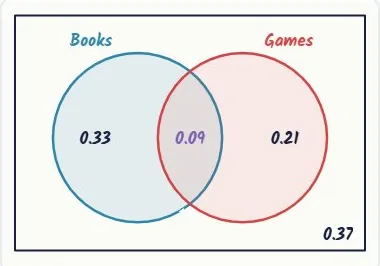
Q3: the given region
- Given G: the G circle.
- Not B: outside B.
- P(G) = 0.09 + 0.21 = 0.3the games circle
- P(B | G) = 0.09 ÷ 0.3both ÷ P(G)
- = 0.3
- P(not B) = 0.21 + 0.37outside books
- = 0.58
- P(G | not B) = 0.21 ÷ 0.58only G ÷ P(not B)
- = 0.36214 d.p.
Question 4 · Merit
- On school days in a town:
- P(rain) = 0.35, P(bus late) = 0.5,
- P(rain or bus late) = 0.65.
- Find P(bus late | rain).
Q4: P(L | R) from "or"
- Find "and" first.
- Then divide by P(R).
- P(R or L) = P(R) + P(L)addition rule
- − P(R and L)
- 0.65 = 0.35 + 0.5 − P(R and L)
- P(R and L) = 0.85 − 0.65 = 0.2
- P(L | R) = P(R and L) ÷ P(R)
- = 0.2 ÷ 0.35
- = 0.57144 d.p.
- P(R | L) = 0.2 ÷ 0.5 = 0.4wrong way round
Question 5 · Merit, in context
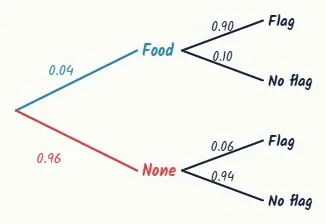
- At an airport, 4% of bags hold food.
- A dog flags 90% of bags with food
- And 6% of bags without.
- Find P(a bag is flagged).
Q5: build the tree
- First: food 0.04, none 0.96.
- Second branches are conditional.
- Each pair adds to 1.
Q5: P(flag)
- Two paths end in a flag.
- Multiply, then add.
- food, flag: 0.04 × 0.9 = 0.036
- no food, flag: 0.96 × 0.06
- = 0.0576
- P(flag) = 0.036 + 0.0576both flag paths
- = 0.0936
- about 94 in every 1000 bags
Question 6 · Excellence
- Same dog. A bag has been flagged.
- Find P(it holds food | flagged).
- Claim: "A flagged bag almost always
- Holds food." Judge the claim.
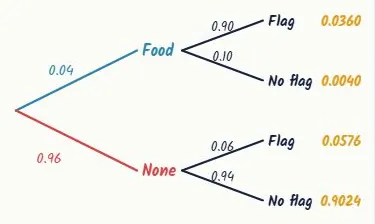
Q6: reverse the tree
- Given flag: flag paths.
- Path ÷ all flags.
- P(F | flag)
- = P(F and flag) ÷ P(flag)
- = 0.036 ÷ 0.0936food path ÷ all flags
- = 0.38464 d.p.
- P(flag | F) = 0.9wrong way round
- per 1000: 36 food, about 58 not
- claim not supported
Try it: reverse the tree
Question 7 · Excellence
- In a city, 30% of homes have solar
- Panels; 40% of those have a heat pump.
- Overall, 50% have a heat pump. Claim:
- "Solar homes are more likely to have one."
Q7: the missing branch
- Solar against no solar.
- Find the missing branch.
- P(S and H) = P(S) × P(H | S)
- = 0.3 × 0.4 = 0.12
- P(not S and H) = 0.5 − 0.12the rest of P(H)
- = 0.38
- P(not S) = 1 − 0.3 = 0.7
- P(H | not S) = 0.38 ÷ 0.7
- = 0.54294 d.p.
- 0.4 < 0.5429solar: less likely
- claim not supported
Try it: given picks the whole
Common mistakes
- P(A | B) and P(B | A) are the same.The condition sets the denominator, so read which group you are inside.
- A dog that flags 90% of food bags is right 90% of the time when it flags.Rare events flood the flags with false alarms. Find P(food | flag) with a tree or table.
- Taking the row total for the denominator every time.Use the total of the group named after the bar.
The method that solved all seven
- Given picks the group, and the group picks the denominator.
| Step | How |
|---|---|
| P(A | B) | A given B: B is the group |
| Table | divide by that row or column |
| Venn | divide by the given region |
| Tree | multiply along each path |
| Reverse | path ÷ all matching paths |
| Answer | notation, 4 d.p., context |
Challenge
At an invented Hamilton school, 60% of students catch the bus. 25% of bus students were late at least once last week. Of all the students who were late at least once last week, 75% catch the bus. Find P(late | does not catch the bus), and say which group is more likely to be late.
Hint
Find P(bus and late) first. Then use the 75% the other way round: P(bus | late) = P(bus and late) ÷ P(late) lets you find P(late).
Answer
P(late | not bus) = 0.125. Bus students (0.25) are twice as likely to be late as other students (0.125).
Step by step
- "25% of bus students" is P(late | bus), so P(bus and late) = 0.6 × 0.25 = 0.15.
- "75% of late students catch the bus" is P(bus | late), so 0.15 ÷ P(late) = 0.75.
- That gives P(late) = 0.2.
- The rest of the late students do not catch the bus: 0.2 − 0.15 = 0.05.
- Divide by P(not bus) = 0.4 to get P(late | not bus) = 0.125.
Full working
- P(B and L) = P(B) × P(L given B) = 0.6 × 0.25 = 0.15given bus
- P(B given L) = P(B and L) ÷ P(L) = 0.75given late
- P(L) = 0.15 ÷ 0.75 = 0.2rearrange
- P(not B and L) = 0.2 − 0.15 = 0.05the rest of the late students
- P(not B) = 1 − 0.6 = 0.4not bus
- P(L given not B) = 0.05 ÷ 0.4 = 0.125given not bus
- P(late given not bus) = 0.125; bus students are more likely to be late (0.25)
An invented factory scanner checks parts. 4% of parts are faulty. The scanner rejects 90% of faulty parts, and overall it rejects 8.4% of all parts. (a) Find the probability that a good part is rejected, and P(faulty | rejected). (b) The manager wants at least 60% of rejected parts to be faulty, with the same 90% detection. What is the highest false-reject rate (good parts rejected) that achieves this?
Hint
Build the tree with an unknown f for P(rejected | good). P(rejected) is the sum of two paths. For (b), write P(faulty | rejected) as a fraction with f in it and set it equal to 0.6.
Answer
(a) P(rejected | good) = 0.05 and P(faulty | rejected) = 0.4286. (b) The false-reject rate must be at most 0.025, that is 2.5% of good parts.
Step by step
- Faulty and rejected: 0.04 × 0.9 = 0.036.
- Good and rejected: 0.96 × f. Together these make the 8.4%, so 0.036 + 0.96f = 0.084 and f = 0.05.
- P(faulty | rejected) = 0.036 ÷ 0.084 = 0.4286, so most rejected parts are actually good.
- For 60%, we need 0.036 ÷ (0.036 + 0.96f) = 0.6, so 0.036 + 0.96f = 0.06.
- Then 0.96f = 0.024 and f = 0.025. A smaller f gives a higher proportion, so f must be at most 0.025.
Full working
- P(faulty and reject) = 0.04 × 0.9 = 0.036path 1
- P(good and reject) = 0.96fpath 2, f = P(reject given good)
- 0.036 + 0.96f = 0.084all rejects
- f = 0.048 ÷ 0.96 = 0.05(a)
- P(faulty given reject) = 0.036 ÷ 0.084 = 0.42864 d.p.
- 0.036 ÷ (0.036 + 0.96f) = 0.6target for (b)
- 0.036 + 0.96f = 0.036 ÷ 0.6 = 0.06rearrange
- 0.96f = 0.024, f = 0.025solve
- (a) 0.05 and 0.4286; (b) false-reject rate at most 0.025 (2.5%)
An invented screening test is used where 2% of people have a condition. The test is positive for 95% of people with the condition and for 10% of people without it. Anyone who tests positive is tested a second time, and assume the second result depends only on whether the person has the condition, with the same rates. Find P(has the condition | positive once), and P(has the condition | positive twice). Comment on the claim: "Two positives means you almost certainly have the condition."
Hint
For two positives, the tree has three stages: condition or not, first test, second test. Multiply along each path that gives two positives, then divide the condition path by the total of both.
Answer
After one positive, P(condition) = 0.1624. After two positives, P(condition) = 0.6481. Two positives make the condition much more likely, but about 35% of people with two positives still do not have it, so the claim is not supported.
Step by step
- One test: condition and positive is 0.02 × 0.95 = 0.019; no condition and positive is 0.98 × 0.1 = 0.098.
- So P(condition | one positive) = 0.019 ÷ 0.117 = 0.1624: most positives are false alarms because the condition is rare.
- Two positives with the condition: 0.02 × 0.95 × 0.95 = 0.01805.
- Two positives without it: 0.98 × 0.1 × 0.1 = 0.0098.
- P(condition | two positives) = 0.01805 ÷ 0.02785 = 0.6481.
- That is far from almost certain: about 1 in 3 people with two positives are healthy.
Full working
- C and +: 0.02 × 0.95 = 0.019one test
- not C and +: 0.98 × 0.1 = 0.098false positive
- P(C given +) = 0.019 ÷ (0.019 + 0.098) = 0.019 ÷ 0.117 = 0.16244 d.p.
- C, +, +: 0.02 × 0.95² = 0.01805multiply along
- not C, +, +: 0.98 × 0.1² = 0.0098multiply along
- P(+ +) = 0.01805 + 0.0098 = 0.02785both paths
- P(C given + +) = 0.01805 ÷ 0.02785 = 0.64814 d.p.
- 1 − 0.6481 = 0.3519still healthy
- 0.1624 after one positive, 0.6481 after two; claim not supported
Practise this
Report a mistake
More in AS 91585
 Tables, trees and Venn diagrams from written information10 min
 Conditional probability from tables, trees and Venn diagrams9 min
 Independent or mutually exclusive? The two tests10 min
 Relative risk: times as likely, and when you need a ratio9 min
 True probability, model estimates and experimental estimates8 min
 Organising information: 7 exam questions solved step by step11 minConditional probability: 7 exam questions solved step by step10 min
 Independent or exclusive: 7 exam questions solved step by step10 min
 Relative risk: 7 exam questions solved step by step10 min
 Probability estimates: 7 exam questions solved step by step9 min