
Percentages and fractions in context: change, GST and points
What this lesson covers
- A percentage is always a percentage of something, so the base must be identified first.
- Percentage change compares the change with the original amount, not with the new one.
What this exam looks like
- A booklet of real-looking information.
- Questions about what it says and how good it is.
- Percentages are where most marks are lost.
| Resource booklet | infographics, graphs, articles |
| Three questions | each with several parts |
| You | identify, relate, critically engage |
| Top lost marks | percentage and fraction working |
A percentage of what?
- "40% said yes." 40% of whom?
- All 480 students, or the 25 who replied?
- Find the base before anything else.
Finding and writing percentages
- A percentage of an amount: multiply.
- A fraction of an amount: divide, then multiply.
- Part out of whole, times 100: a percentage.
| Working | Answer | |
|---|---|---|
| 35% of 480 | 0.35 × 480 | 168 students |
| 3/8 of 480 | 480 ÷ 8 × 3 | 180 students |
| 72 out of 480 | 72 ÷ 480 × 100 | 15% |
Try it: change a percentage
Parts of different wholes
- School B has more students who walk.
- But School A has the higher rate.
- Different wholes: compare percentages.
| Walkers | Rate | |
|---|---|---|
| School A | 45 of 180 | 25% |
| School B | 60 of 300 | 20% |
| More students | School B | 60 > 45 |
| Higher rate | School A | 25% > 20% |
Percentage increase
- Find the change first: $0.36.
- Divide by the ORIGINAL, $2.40.
- A 15% increase.
| Value | Result | |
|---|---|---|
| Old fare | $2.40 | |
| New fare | $2.76 | |
| Change | $0.36 | |
| ÷ original | 0.36 ÷ 2.40 | 15% increase |
Divide by the original, always
- Dividing by the new fare gives 13%.
- That answers a different question.
- Change is compared with where you started.
Try it: which base?
Percentage decrease
- The same method, going down.
- $35 off a $250 bill.
- A 14% decrease.
| Value | Result | |
|---|---|---|
| Old bill | $250 | |
| New bill | $215 | |
| Change | $35 | |
| ÷ original | 35 ÷ 250 | 14% decrease |
Taking GST back off
- A price with GST is 115% of the original.
- So divide by 1.15, to get $60.
- Taking 15% off gives $58.65: wrong base.
| Working | Result | |
|---|---|---|
| Price with GST | 115% of the original | $69 |
| Undo it | $69 ÷ 1.15 | $60 |
| Wrong way | $69 × 0.85 | $58.65 |
| Check | $60 × 1.15 | $69 |
Money calculator
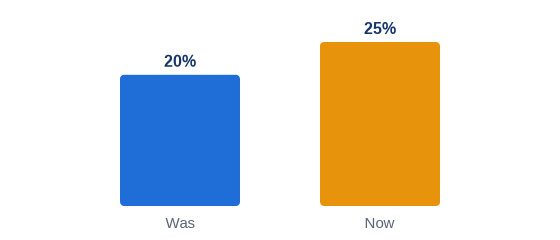
Percent or percentage points?
- From 20% to 25% is up 5 percentage points.
- As a percentage change, it is up 25%.
- Articles pick whichever sounds bigger.
| Was | 20% of students | |
| Now | 25% of students | |
| Rose by | 5 percentage points | the difference |
| Rose by | 25% | 5 ÷ 20 |
Try it: percent or percentage points?
Up 10%, then down 10%
- The second change has a different base.
- $100 becomes $110, then $99.
- Not back to where it started.
| Working | Price | |
|---|---|---|
| Start | $100 | |
| Up 10% | $100 × 1.1 | $110 |
| Down 10% | $110 × 0.9 | $99 |
Say what the number means
- "15%" alone earns little.
- "The bus fare rose by 15%, from $2.40 to $2.76."
- The context goes in every answer.
How the grades step up
- Achieved: accurate, relevant calculations.
- Merit: in context, clearly communicated.
- Excellence: used to justify a decision.
What to take away
- Every percentage has a base. Name it first.
| First | a percentage of what? |
| Compare wholes | use percentages, not counts |
| Change | change ÷ original × 100 |
| Remove GST | divide by 1.15 |
| Points | difference of two percentages |
| Up then down | does not return to the start |
| Answer | a sentence in the context |
Common mistakes
- Fare $2.40 to $2.76: 0.36 ÷ 2.76 = 13% increaseDivide the change by the original amount: 0.36 ÷ 2.40 = 15% increase.
- $69 including GST, so before GST it was $69 × 0.85 = $58.65The GST price is 115% of the original, so divide: $69 ÷ 1.15 = $60. Check: $60 × 1.15 = $69.
- Support rose from 20% to 25%, so it went up 5%.That is up 5 percentage points; as a percentage change it is 5 ÷ 20 = 25%.
- Up 10% then down 10% takes $100 back to $100.The second 10% is of a bigger base: $100 × 1.1 = $110, then $110 × 0.9 = $99.
Your turn: eight questions
- Name the base before you divide.
- Question 4 has two answers.
28 of 350 students cycle to school. What percentage is that?
A jacket went from $80 to $92. Find the percentage increase.
A price including 15% GST is $46. What was it before GST?
Support went from 40% to 50%. By how many points, and by what %?
At a Taupō school 54 of 360 students walk to school. At a Napier school 70 of 560 walk. Which has the higher walking rate?
A bus fare fell from $3.00 to $2.40. Aroha says it fell 25%, since 0.60 ÷ 2.40 = 0.25. What is the correct decrease?
A $50 hoodie goes up 20%, then is reduced by 20% in a sale. What is the sale price?
Store A sells a drill for $84 with 25% off. Store B sells it for $55 plus 15% GST. Which is cheaper, and by how much?
Show answer
1. 28 ÷ 350 × 100 = 8%. 2. Change $12; 12 ÷ 80 × 100 = 15% increase. 3. $46 ÷ 1.15 = $40. Check: 40 × 1.15 = 46. 4. Up 10 percentage points; 10 ÷ 40 × 100 = a 25% increase. 5. Taupō: 54 ÷ 360 = 15%. Napier: 70 ÷ 560 = 12.5%. Napier has more walkers, but Taupō has the higher rate, 15% against 12.5%. 6. She divided by the new fare. Divide by the original: 0.60 ÷ 3.00 × 100 = a 20% decrease. 7. $50 × 1.2 = $60, then $60 × 0.8 = $48. The second 20% is of $60, so it does not return to $50. 8. A: $84 × 0.75 = $63. B: $55 × 1.15 = $63.25. Store A is cheaper by $0.25.
The answers
- 28 ÷ 350 × 100 = 8%.
- $12 ÷ $80 × 100 = 15% increase.
- $46 ÷ 1.15 = $40.
- 10 percentage points, which is a 25% increase.
Sample question: Achieved
A school has 640 students. 38 of them walk to school and 15% cycle. How many students walk, how many cycle, and what percentage of the school do neither?
Hint
Find each count from the whole school, 640, then find what is left and write it out of 640 as a percentage.
Answer
240 walk, 96 cycle, and 47.5% do neither.
Step by step
- Name the base first: every fraction and percentage here is of the whole school, 640 students.
- A fraction of an amount: divide by the bottom, multiply by the top. 640 ÷ 8 = 80, and 80 × 3 = 240 walk.
- A percentage of an amount: 15% = 0.15, and 0.15 × 640 = 96 cycle.
- Students who do neither: 640 − 240 − 96 = 304.
- As a percentage of the school: 304 ÷ 640 × 100 = 47.5%.
- Classic mistake: adding 38 and 15% as if they were the same kind of number. Change both to counts, or both to percentages, first.
- Check another way: 38 = 37.5%. 37.5% + 15% + 47.5% = 100%.
Full working
- 38 × 640 = 240640 ÷ 8 × 3
- 0.15 × 640 = 96
- 640 − 240 − 96 = 304
- 304 ÷ 640 × 100 = 47.5%part ÷ whole × 100
- 240 walk, 96 cycle, 47.5% neither
Sample questions: Merit
A pair of boots costs $149.50 including 15% GST. (a) What is the price without GST? (b) In a sale, 20% is taken off the price including GST. Find the sale price. (c) How much of the sale price is GST? Write each answer as a sentence.
Hint
A price with GST is 115% of the price without it, so divide by 1.15 to undo it.
Answer
(a) The boots cost $130 before GST. (b) The sale price is $119.60. (c) $15.60 of the sale price is GST.
Step by step
- Recall: adding 15% GST multiplies the price by 1.15. So to take it off, divide by 1.15.
- (a) $149.50 ÷ 1.15 = $130. The boots cost $130 before GST.
- Classic mistake: taking 15% off $149.50, which gives $127.08. That uses the wrong base: the 15% was of $130, not of $149.50.
- (b) 20% off means paying 80%: $149.50 × 0.8 = $119.60. The sale price is $119.60.
- (c) The sale price also includes GST. Undo it the same way: $119.60 ÷ 1.15 = $104.
- GST = $119.60 − $104 = $15.60. So $15.60 of the sale price is GST.
- Check (a): $130 × 1.15 = $149.50. Check (c): $104 × 0.15 = $15.60.
Full working
- 149.50 ÷ 1.15 = 130GST price is 115%
- 149.50 × 0.8 = 119.6020% off: pay 80%
- 119.60 ÷ 1.15 = 104
- 119.60 − 104 = 15.60GST part
- $130; $119.60; $15.60 GST
At a school, 72 of the 480 Year 11 students walked to school in 2023. In 2025, 99 of the 450 Year 11 students walked. A newsletter says "Walking is up 37.5%!" Find the percentage who walked each year, the change in percentage points, and the percentage change in the rate. Explain where the 37.5% came from and whether it is the best way to describe the change.
Hint
The years have different totals, so compare rates, not counts. Percentage change always divides by the original.
Answer
2023: 15%. 2025: 22%. Up 7 percentage points, which is a 46.7% increase in the rate. The 37.5% is the increase in the number of walkers, 27 more on 72. Because the number of students fell, the rate is the fairer measure: the share of students who walk rose from 15% to 22%.
Step by step
- The two years have different numbers of students, 480 and 450. So the counts cannot be compared fairly. Use percentages.
- 2023: 72 ÷ 480 × 100 = 15%. 2025: 99 ÷ 450 × 100 = 22%.
- Percentage points are the plain difference of two percentages: 22 − 15 = 7 percentage points.
- Percentage change in the rate divides by the original rate: 7 ÷ 15 × 100 ≈ 46.7%.
- Where does 37.5% come from? The count went from 72 to 99, up 27. And 27 ÷ 72 × 100 = 37.5%. It is the change in the number of walkers.
- That is not wrong, but it ignores that there were fewer students in 2025. Fewer students and more walkers means the rate rose even faster than the count.
- The clearest description: the share of Year 11s who walk rose from 15% to 22%, up 7 percentage points.
- Classic mistake: saying "walking rose 7%". It rose 7 percentage points, which is about a 47% rise in the rate.
- Check: 15% of 480 = 72 and 22% of 450 = 99. Both match the data.
Full working
- 72 ÷ 480 × 100 = 15%; 99 ÷ 450 × 100 = 22%different wholes: use rates
- 22 − 15 = 7 percentage points
- 7 ÷ 15 × 100 ≈ 46.7%change ÷ original
- (99 − 72) ÷ 72 × 100 = 37.5%change in the count
- 15% to 22%: up 7 points, a 46.7% rise in the rate; 37.5% is the count
Sample questions: Excellence
(a) A price goes up by x% and then down by x%, where x > 0. Show that the final price is always lower than the start, by x²100 percent of the start. (b) Hence, without doing it step by step, say what happens to a $250 jacket that goes up 20% and then down 20%. (c) A shop raises a price by 25%. What percentage decrease brings it back exactly to where it started? Explain why it is not 25%.
Hint
Write an increase of x% as multiplying by (1 + x100) and a decrease as multiplying by (1 − x100), then multiply out the brackets.
Answer
(a) Final = start × (1 + x100)(1 − x100) = start × (1 − x²10000), which is x²100 percent below the start. (b) It ends 20²100 = 4% lower: $240. (c) 20%, because the decrease is taken from the bigger, raised price.
Step by step
- (a) Recall: an increase of x% multiplies by 1 + x100, and a decrease of x% multiplies by 1 − x100.
- Do both: final = start × (1 + x100)(1 − x100).
- Multiply out the brackets. This is a difference of two squares: (1 + a)(1 − a) = 1 − a². So final = start × (1 − x²10000).
- The drop is start × x²10000. As a percentage of the start that is x²10000 × 100 = x²100 percent.
- x² is positive for any x that is not 0, so the final price is always lower. The second change uses a bigger base, so it takes off more.
- (b) Hence: x = 20 gives a drop of 20²100 = 400 ÷ 100 = 4%. 4% of $250 is $10, so the jacket ends at $240.
- Check step by step: $250 × 1.2 = $300, and $300 × 0.8 = $240. It matches.
- (c) After a 25% rise the price is 1.25 times the start. To get back, multiply by 1 ÷ 1.25 = 0.8.
- Multiplying by 0.8 is a 20% decrease.
- It is not 25% because the decrease is worked out on the new, bigger price. 25% of the bigger price is more than the amount that was added.
- Check (c): $100 rises to $125. 20% of $125 is $25, and $125 − $25 = $100.
Full working
- final = start × (1 + x100)(1 − x100)
- = start × (1 − x²10000)(1 + a)(1 − a) = 1 − a²
- drop = x²100 percent of the startx² > 0, so always lower
- x = 20: 400 ÷ 100 = 4%, so $250 × 0.96 = $240
- 1 ÷ 1.25 = 0.8a 20% decrease
- Always x²100 percent lower; $240; 20%
Two schools report how many Year 11 students gained NCEA Level 1. Kauri College: 168 of 210 in 2024, 198 of 240 in 2025. Rimu High: 252 of 336 in 2024, 279 of 360 in 2025. A newspaper says "Rimu High is doing better: 279 students passed, far more than Kauri's 198." Use percentages, percentage points and percentage change to judge this claim, decide which school's result was better and which improved more, and say what extra information you would want before deciding.
Hint
The schools have different numbers of students, so compare pass rates; then look at the change in two ways.
Answer
Pass rates: Kauri 80% then 82.5%; Rimu 75% then 77.5%. The claim uses counts from different-sized schools, so it is misleading: Kauri has the higher pass rate both years. Both rose by 2.5 percentage points; as a percentage change Rimu's rate rose slightly more (3.3% against 3.1%), so improvement is about equal. I would want to know about the students each school serves, how many sat the qualification, and more than two years of results.
Step by step
- The claim compares counts, 279 and 198. But Rimu has more students, 360 against 240, so of course more of them passed. Different wholes need percentages.
- Kauri: 168 ÷ 210 = 80% in 2024 and 198 ÷ 240 = 82.5% in 2025.
- Rimu: 252 ÷ 336 = 75% in 2024 and 279 ÷ 360 = 77.5% in 2025.
- So Kauri had the higher pass rate in both years. The newspaper's claim is not supported.
- Change in percentage points: Kauri 82.5 − 80 = 2.5. Rimu 77.5 − 75 = 2.5. Exactly the same.
- Percentage change in the rate: Kauri 2.5 ÷ 80 × 100 ≈ 3.1%. Rimu 2.5 ÷ 75 × 100 ≈ 3.3%. Rimu's is a little bigger, only because it started lower.
- Judgement: Kauri's result is better. The improvement is about the same; the measure you choose decides who looks ahead, and the gap is too small to matter.
- Critically engage: pass rates depend on the students each school serves, and two years is too short to call a trend.
- Extra information: the background of each school's students, how many students did not sit, and results over five or more years.
- Classic mistake: picking whichever number suits the story. At Excellence, say which measure fits the question and why.
- Check: 0.8 × 210 = 168, 0.825 × 240 = 198, 0.75 × 336 = 252, 0.775 × 360 = 279.
Full working
- different wholes: 240 and 360compare rates, not counts
- Kauri: 168 ÷ 210 = 80%, 198 ÷ 240 = 82.5%
- Rimu: 252 ÷ 336 = 75%, 279 ÷ 360 = 77.5%
- both up 2.5 percentage points
- Kauri 2.5 ÷ 80 ≈ 3.1%; Rimu 2.5 ÷ 75 ≈ 3.3%relative change
- Kauri has the higher rate; improvement about equal; the claim is misleading
Challenge
The same jacket is priced at $230, including 15% GST, in two shops. Shop A has "15% off everything". Shop B says "We pay the GST!", meaning you pay the price without GST. A customer says the two deals must be the same, because GST is 15%. (a) Find the price at each shop. (b) What percentage discount is Shop B really giving? (c) Explain why the two deals are not the same.
Hint
Taking off GST means dividing by 1.15. Taking 15% off means multiplying by 0.85. These use different bases.
Answer
(a) Shop A $195.50, Shop B $200, so Shop A is $4.50 cheaper. (b) $30 off $230 is about 13.0%. (c) GST is 15% of the price without GST ($200), but Shop A takes 15% of the bigger GST-inclusive price ($230), so it takes off more: $34.50 instead of $30.
Step by step
- Shop A: 15% off means paying 85% of $230.
- Shop B: the GST price is 115% of the price without GST, so divide by 1.15.
- Compare the two prices.
- Shop B's saving, $30, as a percentage of the original $230.
- The 15% in each deal is a percentage of a different amount.
Full working
- Shop A: 230 × 0.85 = 195.5015% off the GST price
- Shop B: 230 ÷ 1.15 = 200remove GST
- check: 200 × 1.15 = 230correct
- 200 − 195.50 = 4.50Shop A cheaper
- 30 ÷ 230 × 100 ≈ 13.0%Shop B's real discount
- Shop A $195.50, Shop B $200; Shop B is only about a 13% discount
A shop sign says "Save up to 40%!". Every item has x% off the ticket price, and at the checkout an extra 10% is taken off the reduced price. Hemi pays $151.20 for a jacket with a ticket price of $240. (a) Find x. (b) What percentage did Hemi save altogether? Is the sign honest about this jacket? (c) Would Hemi pay a different amount if the 10% were taken off first and the x% second? Explain.
Hint
Each discount multiplies the price: x% off means multiplying by (1 − x100), and 10% off means multiplying by 0.9. Work backwards from $151.20.
Answer
(a) x = 30. (b) Hemi saved $88.80, which is 37% of $240, not 40%: 30% then 10% is not 40%, because the second 10% comes off a smaller price. The sign is not false for this jacket, since 37% is within 'up to 40%', but a shopper who adds 30% and 10% would expect to save more than they do. (c) No: multiplying by 0.7 and then 0.9 gives the same as 0.9 then 0.7, so the price is $151.20 either way.
Step by step
- Undo the checkout discount: divide $151.20 by 0.9 to get the price after the first discount.
- Compare that with $240 to find the multiplier, then the percentage.
- The two discounts multiply to 0.7 × 0.9 = 0.63, so Hemi paid 63% of the ticket price.
- Paying 63% means saving 37%.
- Multiplying in either order gives the same answer.
Full working
- 151.20 ÷ 0.9 = 168undo the extra 10%
- 168 ÷ 240 = 0.7multiplier for the first discount
- 1 − 0.7 = 0.3, x = 3030% off
- 0.7 × 0.9 = 0.63paid 63% of the ticket price
- 240 − 151.20 = 88.80, 88.80 ÷ 240 = 0.3737% saved
- 240 × 0.9 × 0.7 = 151.20same price in the other order
- x = 30; Hemi saved 37%, not 40%; the order does not matter
From 2024 to 2025, the roll at Kōwhai College rose by 10% and the number of students who cycle to school rose by 32%. In 2025, 30% of the students cycle. (a) Without knowing the roll, show that the share of students who cycle rose by 20% as a percentage change. (b) What percentage of students cycled in 2024, and what is the change in percentage points? (c) Three headlines: "Cycling up 32%", "Cycling up 20%" and "Cycling up 5%". Say what each one measures and which is clearest. (d) If the 2024 roll was 600, how many students cycled each year?
Hint
Share = cyclists ÷ roll. The cyclists are multiplied by 1.32 and the roll by 1.10, so the share is multiplied by 1.32 ÷ 1.10.
Answer
(a) 1.32 ÷ 1.10 = 1.2, so the share is 1.2 times what it was: up 20%. (b) 2024 share 25%; up 5 percentage points. (c) 32% is the rise in the number of cyclists, partly because the school grew; 20% is the relative rise in the share; 5% should be "5 percentage points", the change in the share. Clearest: "The share who cycle rose from 25% to 30%, up 5 percentage points." (d) 150 in 2024 and 198 in 2025.
Step by step
- Write the 2025 share as (1.32 × cyclists) ÷ (1.10 × roll).
- That is 1.2 times the 2024 share, an increase of 20%.
- Work backwards: the 2024 share is 30% ÷ 1.2.
- The difference of the two shares is in percentage points.
- Use the 2024 roll to turn the shares into counts and check against the 32% and 10% rises.
Full working
- new share = (1.32 × C) ÷ (1.10 × R)C cyclists, R roll in 2024
- 1.32 ÷ 1.10 = 1.2share × 1.2, up 20%
- 30% ÷ 1.2 = 25%2024 share
- 30 − 25 = 5up 5 percentage points
- 0.25 × 600 = 150; 600 × 1.1 = 660; 0.30 × 660 = 198counts
- check: 198 ÷ 150 = 1.32up 32%
- 2024: 25% (150 students); 2025: 30% (198 students); share up 20%, or 5 percentage points
Where science uses this
Practise this
Report a mistake
More in AS 91946
Percentages and fractions in context: change, GST and points6 min Time series graphs: trend, seasonal pattern and unusual points6 min
 Interpreting box plots and scatter plots in the 91946 exam6 min
 Is this information any good? Bias, misleading graphs and risk6 min
 Percentages and fractions: 7 exam questions step by step10 min
 Time series: 7 exam questions solved step by step9 min
 Interpreting displays: 7 exam questions solved step by step10 min
 Evaluating information: 7 exam questions solved step by step10 min