Excellence: assumptions, limitations and general rules
What this lesson covers
- Every model rests on assumptions, and changing one can change the answer.
- Extending a problem means asking what happens in general, or what the model cannot tell you.
Excellence means extending the problem
- Take at least one problem further than asked.
- Four ways to do it.
- All four, on one rainwater tank.
| Extend by | Means |
|---|---|
| Assumptions | what the model takes for granted |
| Limitations | what it cannot tell you |
| Generalising | a rule with a variable |
| Predicting | using the rule for a new case |
The model so far
- A roof collecting into a cylinder tank.
- 147 mm of rain fills it.
- A full tank lasts 78 days.
| Result | |
|---|---|
| Roof | 96 m² collecting area |
| Tank | 14 137 litres |
| Rain to fill | 147 mm |
| Lasts | 78 full days at 180 L a day |
What the model assumes
- Every answer rests on assumptions.
- Write them down, one by one.
- Say which ones are doubtful.
| Assumption | But really |
|---|---|
| Every drop is collected | gutters and splash lose some |
| Use is always 180 L | washing days, visitors |
| No rain while it empties | rarely true |
| No overflow | a full tank spills |
Test one: only 80% collected
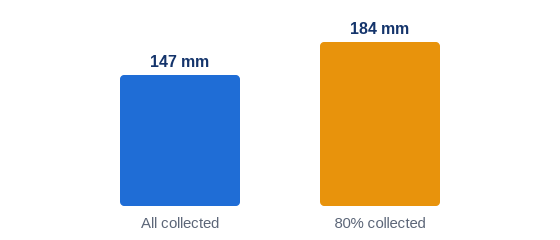
- Suppose gutters and splash lose a fifth.
- The roof now collects 76.8d cubic metres.
- 184 mm of rain, not 147.
| Working | ||
|---|---|---|
| Collected | 0.8 × 96d = 76.8d | |
| Equation | 76.8d = 14.137 | |
| Rain needed | d = 0.184 m | 184 mm |
| Was | 147 mm | 37 mm more |
How sensitive is the answer?
- Collecting 80% means needing 1.25 times the rain.
- A 20% loss costs 25% more rain.
- That is worth saying in the conclusion.
| Water collected | falls to 80% |
| Rain needed | 1 ÷ 0.8 = 1.25 times as much |
| Check | 147 × 1.25 ≈ 184 mm |
Try it: change the assumptions
A general rule
- Replace the fixed 180 L with a variable.
- p people, 45 litres each a day.
- D = 14 137 ÷ 45p.
| Use per person | 45 L a day |
| People | p |
| Daily use | 45p litres |
| Days | D = 14 137 ÷ 45p |
Using the rule to predict
- Four people: 78 full days, as before.
- Six people over the holidays: 52 days.
- Two visitors cost 26 days of water.
| People | Working | Lasts |
|---|---|---|
| p = 4 | 14 137 ÷ 180 = 78.5 | 78 days |
| p = 6 | 14 137 ÷ 270 = 52.4 | 52 days |
| So | two visitors cost | 26 days |
A limitation: overflow
- The storm model assumed an empty tank.
- At 90% full, there is room for 1414 L.
- The rest of the storm spills.
| Value | ||
|---|---|---|
| Tank | 90% full | |
| Space left | 10% of 14 137 | 1414 L |
| Storm gives | 2400 L | |
| Kept | 1414 L | the rest spills |
Try it: push the tank model
What the model cannot tell you
- It ignores rain that falls while the tank empties.
- It treats daily use as fixed.
- Say which way each one moves the answer.
| Ignored | Effect |
|---|---|
| Rain during use | model says 78 days; really longer |
| Changing use | summer use is higher |
| Leaks, evaporation | small, but not zero |
| Sloped roof | plan area is what counts |
Say which way the answer moves
- Losses: more rain needed.
- More people: fewer days.
- Rain during use: more days.
Try it: which way does it push the answer?
When the model stops being useful
- Fine for a rough plan for a dry spell.
- Not for a drought lasting months.
- Say where the line is, and why.
An Excellence paragraph, spoken
- The answer, and the rule behind it.
- One assumption tested, with numbers.
- A limitation, and what it means.
What to take away
- An answer, and an honest account of how far to trust it.
| Extend | at least one problem, further |
| Assumptions | name them, then test one |
| Sensitivity | how far does the answer move? |
| General rule | replace a number with a variable |
| Predict | use the rule on a new case |
| Limitations | what the model ignores |
| Conclude | the answer and how far to trust it |
Common mistakes
- Only 80% collected, so 20% more rain: 147 × 1.2 ≈ 176 mmDivide by 0.8: 147 ÷ 0.8 ≈ 184 mm, so a 20% loss needs 25% more rain.
- D = 14 137 ÷ 250 = 56.5, so a full tank lasts 57 days for 5 people.The tank runs dry during day 57, so it lasts 56 full days; round down here.
- One assumption is that use stays at 50 L a person each day.Also say which way breaking it moves D: if use rises on hot days, the tank empties sooner and D is smaller.
- The tank is 90% full, so it keeps all 2400 L of the storm.Only 10% of 14 137 L, about 1414 L, of space is left, so the rest of the storm overflows.
Your turn: eight questions
- The same tank and roof.
- Question 4 wants a direction, not just a name.
| Question | |
|---|---|
| Tank | 14 137 L tank, 96 m² roof. |
| 1 | Only 75% of rain is collected. How much rain fills the empty tank? |
| 2 | Each person uses 50 L a day. Write D, the days a full tank lasts, for p people. |
| 3 | Use your rule to find D for 5 people. |
| 4 | Name one assumption in question 3 and how breaking it changes D. |
| 5 | A 200 mm downpour exactly fills the empty tank. What percentage of the rain falling on the roof was collected? |
| 6 | Using D = 14 137 ÷ 50p, what is the largest household a full tank can supply for at least 60 full days? |
| 7 | The tank is 80% full when a 20 mm storm falls. If every drop is collected, how many litres does the tank keep? |
| 8 | Generalise: write d, the rain in mm that fills the empty tank, for a roof of plan area A m². |
Show answer
1. 0.75 × 96 = 72, so 72d = 14.137 and d = 0.196 m: 196 mm of rain. 2. D = 14 137 ÷ 50p. 3. 14 137 ÷ 250 = 56.5, so 56 full days. 4. For example: use stays at exactly 50 L a person every day. If use rises on hot days, the tank empties sooner and D is smaller. Or: no rain falls; any rain makes D larger. 5. Rain on the roof: 96 × 0.2 = 19.2 m³ = 19 200 L. 14 137 ÷ 19 200 = 0.736, so about 74% was collected. 6. 14 137 ÷ (60 × 50) = 4.71, so p must be at most 4.71: 4 people (5 people get only 56 days). 7. Space left: 20% of 14 137 = 2827 L. The storm gives 96 × 0.02 = 1.92 m³ = 1920 L, which fits, so all 1920 L is kept. 8. A m² of roof collects A litres for each mm of rain, so Ad = 14 137 and d = 14 137 ÷ A. Check: 14 137 ÷ 96 = 147 mm.
The answers
- 72d = 14.137, d = 0.196 m: 196 mm.
- D = 14 137 ÷ 50p.
- 14 137 ÷ 250 = 56.5: 56 full days.
- e.g. use is fixed; more use means fewer days.
Sample question: Achieved
A full rainwater tank holds 12 000 litres. A family of 4 uses 50 litres each a day. How many days does a full tank last? State two assumptions your answer depends on.
Hint
Find the daily use for the whole family first, then divide the tank by it.
Answer
60 days. Assumptions: each person uses exactly 50 litres every day, and no rain falls while the tank empties (also acceptable: no leaks or evaporation, the tank starts completely full).
Step by step
- Daily use for the family = 4 × 50 = 200 litres a day.
- Days = 12 000 ÷ 200 = 60 days. It divides exactly, so no rounding is needed.
- An assumption is something the calculation takes for granted. Ask: what would have to be true for 60 to be exactly right?
- Use must stay at exactly 50 litres a person every day. Washing days or visitors would change that.
- No rain may fall in those 60 days. Any rain would top up the tank.
- Classic mistake: listing things the calculation does not use, such as the shape of the tank. An assumption must matter to the answer.
- Check: 60 × 200 = 12 000 litres.
Full working
- 4 × 50 = 200 L a daywhole family
- 12 000 ÷ 200 = 60 days
- assume: use fixed at 50 L each, no rain while emptying
- 60 days, assuming fixed use and no rain
Sample questions: Merit
A roof of 90 m² collects into a tank of 11 310 litres. (a) If every drop is collected, how much rain (in mm) fills the empty tank? (b) Test the assumption: if only 85% of the water reaches the tank, how much rain is needed now? (c) By what percentage did the rain needed go up, and why is it not 15%?
Hint
Write the water collected as (collecting area) × d, and set it equal to the tank volume in cubic metres.
Answer
(a) About 126 mm. (b) About 148 mm. (c) About 17.6% more, because the rain needed is multiplied by 1 ÷ 0.85 ≈ 1.176, not by 1.15.
Step by step
- Change the tank to cubic metres so it matches the roof in square metres: 11 310 litres = 11.31 m³.
- (a) Let d be the rain in metres. Water collected = 90d. Set 90d = 11.31, so d = 0.1257 m, about 126 mm.
- (b) Now only 85% is kept, so the roof acts like 0.85 × 90 = 76.5 m².
- Set 76.5d = 11.31, so d = 0.1478 m, about 148 mm.
- (c) Compare the two: 0.1478 ÷ 0.1257 ≈ 1.176. That is about 17.6% more rain.
- Why not 15%? Collecting 85% means dividing by 0.85, and 1 ÷ 0.85 ≈ 1.176. Losing a part of the water costs more than that part in extra rain.
- So the answer is sensitive to this assumption: a 15% loss means about 22 mm more rain is needed.
- Classic mistake: adding 15% to 126 mm to get about 145 mm. That uses the wrong base.
- Check (b): 76.5 × 0.1478 ≈ 11.31 m³. Correct.
Full working
- 11 310 L = 11.31 m³
- 90d = 11.31, d ≈ 0.1257 m ≈ 126 mmall collected
- 0.85 × 90 = 76.5 m²85% collected
- 76.5d = 11.31, d ≈ 0.1478 m ≈ 148 mm
- 1 ÷ 0.85 ≈ 1.176about 17.6% more
- 126 mm; 148 mm; about 17.6% more rain, not 15%
A 9000 litre tank supplies a house where each person uses 45 litres a day. (a) Write a general rule for the number of full days D a full tank lasts for p people. (b) Use it for 3 people and for 5 people. (c) What is the largest number of people for whom a full tank lasts at least 30 days?
Hint
Daily use is 45p litres, so D is the tank divided by 45p. For (c), solve D ≥ 30.
Answer
(a) D = 900045p, rounded down to full days. (b) 3 people: 66 full days. 5 people: 40 days. (c) 6 people.
Step by step
- (a) Replace the fixed number of people with a variable p. Daily use = 45p litres.
- Days = tank ÷ daily use, so D = 900045p, rounded down to whole days.
- (b) p = 3: daily use 135 litres. 9000 ÷ 135 = 66.7, so 66 full days.
- p = 5: daily use 225 litres. 9000 ÷ 225 = 40 exactly, so 40 days.
- (c) We need D ≥ 30: 9000 ÷ (45p) ≥ 30.
- Multiply both sides by 45p: 9000 ≥ 1350p. Divide by 1350: p ≤ 6.67.
- People come in whole numbers, so the largest is 6.
- Check 6: 9000 ÷ 270 = 33.3 days, at least 30. Check 7: 9000 ÷ 315 = 28.6 days, too few.
- Notice the pattern: more people means fewer days, but not in equal steps, because p is on the bottom of the fraction.
Full working
- daily use = 45pp people
- D = 900045p
- p = 3: 9000 ÷ 135 = 66.7 → 66; p = 5: 9000 ÷ 225 = 40
- 9000 ÷ (45p) ≥ 30, so 1350p ≤ 9000
- p ≤ 6.67 → 6check: 7 people give 28.6 days
- D = 900045p; 66 and 40 days; at most 6 people
Sample questions: Excellence
The basic model says a full 14 137 litre tank lasts D = 14 13745p days for p people using 45 litres each a day. It assumes no rain falls while the tank empties. (a) Improve the model: if rain adds an average of R litres a day, write a new rule for D. (b) For 4 people with R = 60, how many full days does the tank last, compared with the basic model? (c) For 4 people, for which values of R does the new model say the tank never empties? Explain why that answer is a limitation of the model, not a fact about the tank.
Hint
Rain makes the tank empty more slowly, so the net loss each day is the use minus R.
Answer
(a) D = 14 13745p − R. (b) 14 137 ÷ 120 ≈ 117.8, so 117 full days, against 78 days in the basic model. (c) R ≥ 180 litres a day. The model treats rain as a steady daily trickle, but real rain comes in storms with dry spells between, and a full tank overflows, so in a long dry spell the tank can still run out.
Step by step
- (a) Each day the family uses 45p litres and the rain adds R litres. The tank only loses the difference: 45p − R litres a day.
- So D = 14 13745p − R. With R = 0 this gives the basic model back, which is a good check.
- (b) p = 4: use = 180 litres a day. Net loss = 180 − 60 = 120 litres a day.
- D = 14 137 ÷ 120 ≈ 117.8, so 117 full days.
- The basic model gave 14 137 ÷ 180 ≈ 78.5, so 78 full days. Allowing for rain adds 39 days, a big change from one assumption.
- (c) The tank never empties if the net loss is zero or less: 180 − R ≤ 0, so R ≥ 180 litres a day.
- At R = 180 the bottom of the fraction is 0, and the rule breaks down. That is the algebra warning us the model has reached its edge.
- Why this is a limitation: R is an average. Real rain comes in storms, with dry weeks between them. A run of dry weeks can still empty the tank.
- Also, when the tank is full, extra rain overflows and is lost. The model pretends every litre is saved for later.
- So the model is useful for typical weather, but not for planning for a drought, which is exactly when you most need it.
- Check (b): 117 × 120 = 14 040 litres, under 14 137; 118 × 120 = 14 160, over. So 117 is right.
Full working
- net loss = 45p − R a dayrain tops up
- D = 14 13745p − R
- p = 4, R = 60: 14 137 ÷ 120 ≈ 117.8 → 117 days
- basic: 14 137 ÷ 180 ≈ 78.5 → 78 days
- never empties: 180 − R ≤ 0, R ≥ 180
- limitation: rain is not steady, and overflow is lost
- D = 14 13745p − R; 117 days against 78; R ≥ 180, a limitation of the averaging
A 10 000 litre tank is fed by a 120 m² roof. A storm of 30 mm falls. (a) If the tank is f% full when the storm starts, for which values of f does some water spill? (b) The tank is 80% full: how much is kept and how much spills? (c) Write a rule for the litres spilled, S, in terms of f, for the tanks that spill. (d) Now test the assumption that every drop is collected: if only 80% reaches the tank, for which f does water spill? Say which way this assumption moved your answer to (a).
Hint
The storm gives a fixed amount of water. The space in the tank is (100 − f)% of 10 000 litres. Water spills when the storm is bigger than the space.
Answer
(a) The storm gives 3600 litres; water spills when f > 64. (b) Kept 2000 litres, spilled 1600 litres. (c) S = 100f − 6400, for f > 64. (d) The storm gives 2880 litres, so water spills when f > 71.2. Assuming every drop is collected made the spill start at a lower f, so it overstated how often the tank spills.
Step by step
- Storm water: 120 × 0.03 = 3.6 m³ = 3600 litres.
- Space in the tank when it is f% full: (100 − f)% of 10 000 = 10 000 − 100f litres.
- (a) Water spills when the storm is bigger than the space: 3600 > 10 000 − 100f.
- Rearrange: 100f > 6400, so f > 64. Any tank more than 64% full will spill.
- (b) At 80% full the space is 10 000 − 8000 = 2000 litres. 2000 is kept, and 3600 − 2000 = 1600 litres spill.
- (c) Spill = storm − space = 3600 − (10 000 − 100f) = 100f − 6400. Check with f = 80: 8000 − 6400 = 1600. It matches.
- (d) With 80% collected the storm gives 0.8 × 3600 = 2880 litres.
- Spills when 2880 > 10 000 − 100f, so 100f > 7120 and f > 71.2.
- Direction: assuming every drop is collected made the storm look bigger, so the model predicted spilling from 64% full. With losses, the tank only spills from 71.2% full.
- Limitation to state: the model treats the storm as arriving all at once and ignores any water used during the storm.
- Check (a): at f = 64 the space is 3600 litres, exactly the storm, so nothing spills. Just above 64, some does.
Full working
- storm: 120 × 0.03 = 3.6 m³ = 3600 L
- space = 10 000 − 100f(100 − f)% of 10 000
- 3600 > 10 000 − 100f, so f > 64
- f = 80: space 2000, kept 2000, spilled 1600
- S = 3600 − (10 000 − 100f) = 100f − 6400
- 80% collected: 2880 > 10 000 − 100f, so f > 71.2
- f > 64; 2000 kept, 1600 spilled; S = 100f − 6400; with losses f > 71.2
Challenge
A tank model assumes every drop of rain on the roof reaches the tank. (a) Show that if k% of the water is lost, the rain needed to fill the tank goes up by 100k ÷ (100 − k) percent, and check it against the lesson's 20% loss. (b) What loss makes the rain needed go up by 60%? (c) For the 14 137 litre tank on a 96 m² roof, how much rain fills it with that loss? (d) A gutter guard cuts the loss from that value to 20%. How many fewer millimetres of rain are then needed to fill the tank?
Hint
If (100 − k)% is collected, the rain needed is multiplied by 100 ÷ (100 − k). Subtract 1 and write it as a percentage. On a roof of A m², 1 mm of rain gives A litres.
Answer
(a) Rain needed is multiplied by 100 ÷ (100 − k), an increase of 100 ÷ (100 − k) − 1 = k ÷ (100 − k), which is 100k ÷ (100 − k) percent. For k = 20: 2000 ÷ 80 = 25%, as in the lesson. (b) 37.5%. (c) About 236 mm. (d) About 52 mm fewer (236 mm down to 184 mm).
Step by step
- With no loss, the rain needed is 14 137 ÷ 96 ≈ 147.3 mm. With (100 − k)% collected, each millimetre gives less water, so you need 100 ÷ (100 − k) times as much rain.
- The increase is that multiplier minus 1: 100 ÷ (100 − k) − 1 = k ÷ (100 − k). As a percentage, 100k ÷ (100 − k).
- Check with k = 20: 100 × 20 ÷ 80 = 25%, matching the lesson's 147 mm to 184 mm.
- Set 100k ÷ (100 − k) = 60 and solve: 100k = 6000 − 60k, so 160k = 6000 and k = 37.5.
- With a 37.5% loss, the rain needed is 1.6 times as much: 147.26 × 1.6 ≈ 235.6 mm.
- With a 20% loss it is 147.26 × 1.25 ≈ 184.1 mm. The difference is 235.6 − 184.1 ≈ 51.5 mm, about 52 mm.
Full working
- multiplier = 100 ÷ (100 − k)only (100 − k)% is collected
- increase = 100 ÷ (100 − k) − 1 = k ÷ (100 − k), or 100k ÷ (100 − k) %subtract the original 1
- k = 20: 2000 ÷ 80 = 25%matches the lesson
- 100k = 60(100 − k), 160k = 6000, k = 37.5
- no loss: 14 137 ÷ 96 = 147.26 mm; × 1.6 = 235.6 mm; × 1.25 = 184.1 mm
- 235.6 − 184.1 = 51.5 mm
- Loss 37.5%; about 236 mm fills the tank; the gutter guard saves about 52 mm of rain
A new house has a gable roof: two sloping faces, each 12 m long, measuring 4.5 m from the ridge down to the gutter. The ridge is 2.7 m higher than the gutters. The owner measures the sloping faces and uses their area in the tank model. (a) Find the area the owner used and the plan area (the area seen from above). (b) The tank holds 14 137 litres. How much rain does each area say fills it from empty? (c) By what percentage did the owner's model overstate the water collected? (d) Which way does this assumption push the answer to (b), and would the owner's mistake make her more or less likely to run short of water?
Hint
Rain falls straight down, so what counts is the roof's shadow from above. Each face is the sloping side of a right-angled triangle: find its horizontal width with Pythagoras.
Answer
(a) The owner used 2 × 12 × 4.5 = 108 m². Each face is 3.6 m wide from above, so the plan area is 2 × 12 × 3.6 = 86.4 m². (b) Owner: 14 137 ÷ 108 ≈ 131 mm. Plan area: 14 137 ÷ 86.4 ≈ 164 mm. (c) 108 ÷ 86.4 = 1.25, so it overstated the water by 25%. (d) The owner's model says less rain is needed than is true, by about 33 mm, so it is too hopeful: she would expect the tank to fill sooner than it does and is more likely to run short.
Step by step
- Rain falls straight down, so a sloping roof catches only as much as the area it covers when seen from above.
- Each face, from the side, is a right-angled triangle: sloping length 4.5 m, height 2.7 m. The horizontal width is √(4.5² − 2.7²) = √12.96 = 3.6 m.
- Sloping area: 2 faces × 12 × 4.5 = 108 m². Plan area: 2 × 12 × 3.6 = 86.4 m².
- On A m², 1 mm of rain gives A litres. So the rain needed is 14 137 ÷ 108 ≈ 130.9 mm by the owner's model, but 14 137 ÷ 86.4 ≈ 163.6 mm in reality.
- 108 ÷ 86.4 = 1.25: the owner's model thinks every storm gives 25% more water than it really does.
- So the wrong assumption makes the tank look easier to fill. Real rain needed is about 33 mm more, and the water runs short sooner than she plans for.
Full working
- width from above = √(4.5² − 2.7²) = √12.96 = 3.6 mPythagoras
- sloping area = 2 × 12 × 4.5 = 108 m²
- plan area = 2 × 12 × 3.6 = 86.4 m²
- 14 137 ÷ 108 = 130.9 mm; 14 137 ÷ 86.4 = 163.6 mm1 mm on A m² gives A litres
- 108 ÷ 86.4 = 1.2525% overstated
- 163.6 − 130.9 = 32.7 mm more rain really needed
- Plan area 86.4 m²; about 164 mm needed, not 131 mm; the sloping-area model is 25% too hopeful
A full 14 137 litre tank supplies a family of 4, each using 45 litres a day. After t full days, 2 visitors arrive and stay, also using 45 litres each a day. (a) Write a rule for T, the total number of days the full tank lasts, in terms of t (ignore rounding for now). (b) The family wants the water to last at least 60 full days. What is the smallest number of full days, t, before the visitors can arrive? Check your answer by counting full days. (c) Name one assumption in your rule and say which way breaking it moves your answer to (b).
Hint
Find how much water is used in the first t days, how much is left, and how long that lasts at the new daily use. Then add t.
Answer
(a) T = t + (14 137 − 180t) ÷ 270, which simplifies to T = (14 137 + 90t) ÷ 270. (b) T ≥ 60 gives t ≥ 22.9, so the visitors must arrive after at least 23 full days. Check: t = 23 leaves 9 997 litres, 37 full days, total 60; t = 22 leaves 10 177 litres, 37 full days, total 59. (c) For example, use is exactly 45 litres per person every day. If use rises in hot weather, the tank empties faster, so the visitors would have to arrive later than day 23 (t would need to be bigger).
Step by step
- For the first t days, 4 people use 4 × 45 = 180 litres a day, so 180t litres are used.
- That leaves 14 137 − 180t litres. Now 6 people use 270 litres a day, so it lasts (14 137 − 180t) ÷ 270 more days.
- Add the two parts: T = t + (14 137 − 180t) ÷ 270. Writing t as 270t ÷ 270 gives T = (14 137 + 90t) ÷ 270.
- Solve (14 137 + 90t) ÷ 270 ≥ 60: 14 137 + 90t ≥ 16 200, so 90t ≥ 2063 and t ≥ 22.9. So t must be at least 23.
- Check with full days, because the tank runs dry partway through a day. t = 23 gives 23 + 37 = 60. t = 22 gives only 22 + 37 = 59.
- The rule assumes steady use and no rain. Heavier use pushes the arrival later; any rain during the period would let them arrive earlier.
Full working
- used in t days: 180t litres4 × 45 = 180
- left: 14 137 − 180t; lasts (14 137 − 180t) ÷ 270 days6 × 45 = 270
- T = (14 137 + 90t) ÷ 270combine over 270
- 14 137 + 90t ≥ 16 200, t ≥ 2063 ÷ 90 = 22.960 × 270 = 16 200
- t = 23: 14 137 − 4140 = 9997, 9997 ÷ 270 = 37.0, total 60 days
- t = 22: 14 137 − 3960 = 10 177, 10 177 ÷ 270 = 37.7, 37 full days, total 59
- T = (14 137 + 90t) ÷ 270; visitors must arrive after at least 23 full days