
Tests for hydrogen, oxygen, carbon dioxide and water
What this lesson covers
- Why invisible gases need chemical tests
- The pop test for hydrogen
- The glowing splint test for oxygen
- The limewater test for carbon dioxide
- The cobalt chloride paper test for water
- Natural indicators such as red cabbage for sorting acids and alkalis
- Safe handling of corrosive substances
Why we need tests
- Hydrogen, oxygen and carbon dioxide are all colourless and have no smell, so you cannot tell them apart by looking or sniffing.
- A standard test is a reaction with a clear, agreed result that only one substance gives.
- Because everyone uses the same test, a result in an Auckland lab means the same as a result in a Dunedin one.
| Substance | Test | Positive result |
|---|---|---|
| Hydrogen gas | Hold a lit splint at the mouth of the tube | Squeaky pop |
| Oxygen gas | Put a glowing splint into the tube | Splint relights |
| Carbon dioxide gas | Bubble the gas through limewater | Limewater turns milky |
| Water (liquid) | Touch with dry blue cobalt chloride paper | Paper turns pink |
Hydrogen: the pop test
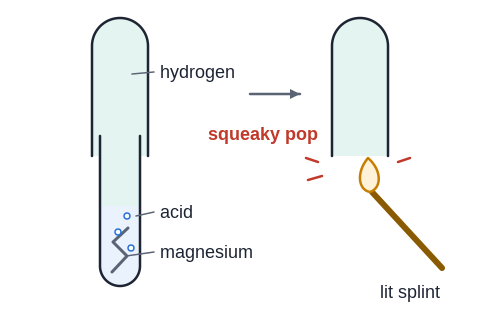
- A simple way to make hydrogen is to drop a piece of magnesium ribbon into dilute hydrochloric acid: magnesium + hydrochloric acid → magnesium chloride + hydrogen.
- Hydrogen is lighter than air, so collect it in a test tube held upside down.
- Bring a lit splint to the mouth of the tube. The hydrogen burns very quickly with the oxygen in the air and makes a squeaky pop.
- The product of that tiny explosion is water: hydrogen + oxygen → water.
Oxygen: the glowing splint test
- Oxygen can be made by adding a pinch of manganese dioxide to hydrogen peroxide; the manganese dioxide speeds up the breakdown without being used up.
- Light a wooden splint, then blow it out so only the tip glows.
- Lower the glowing splint into the tube. If it bursts back into flame, the gas is oxygen.
- Air is only about 21 percent oxygen, which is not enough to relight the splint; nearly pure oxygen is needed.
Carbon dioxide: the limewater test
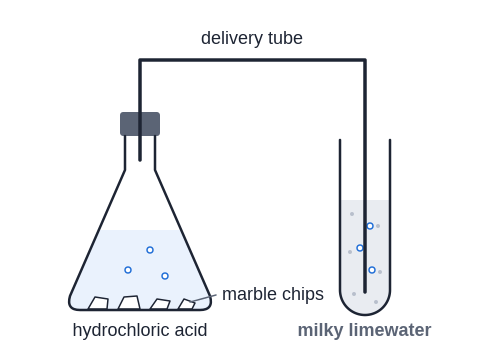
- Carbon dioxide forms when an acid reacts with a carbonate, such as marble chips in hydrochloric acid or baking soda in vinegar.
- Limewater is a clear solution of calcium hydroxide in water.
- Bubble the gas through it with a delivery tube. If the limewater turns cloudy or milky, the gas is carbon dioxide.
- The cloudiness is tiny grains of solid calcium carbonate: carbon dioxide + calcium hydroxide → calcium carbonate + water.
- A lit splint goes out in carbon dioxide, but it also goes out in nitrogen, so that is not a reliable test on its own.
Water: cobalt chloride paper
- Cobalt chloride paper is blue when completely dry and turns pink when it touches water.
- Dry the paper in a warm oven or keep it sealed with a drying agent, otherwise moisture in the air turns it pink before you start.
- A positive result shows that water is present, not that the liquid is pure water; sea water and orange juice also turn it pink.
- To show a liquid is pure water, you also measure its boiling point (100 °C at sea level) and its freezing point (0 °C).
- Cobalt chloride is toxic, so handle the paper with tweezers and wash your hands afterwards.
Which gas came off the zinc?
- A student adds zinc granules to dilute sulfuric acid and collects the bubbles. A glowing splint does not relight. A lit splint gives a squeaky pop. Identify the gas.
- Glowing splint does not relightso it is not oxygen
- Lit splint makes a squeaky popthe positive result for hydrogen
- Metal + acid fitsreactive metals and acids give off hydrogen
- The gas is hydrogen
Try it: identify the mystery gas
Is there carbon dioxide in your breath?
- You breathe out gently through a straw into limewater for a minute. Air from a pump is bubbled through a second tube of limewater for the same time. What result shows your breath contains extra carbon dioxide?
- Pumped air: limewater stays clear or turns cloudy very slowlyair has only about 0.04 percent carbon dioxide
- Breath: limewater turns milky within a minuteexhaled air has about 4 percent carbon dioxide
- Same time and same volume of limewatera fair comparison
- Breath contains much more carbon dioxide than airyour cells make it in respiration
Making a natural pH indicator
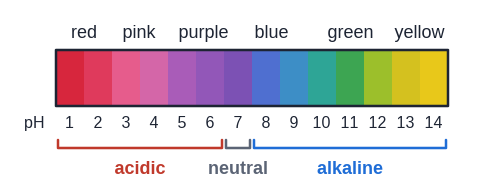
- Many plants contain coloured chemicals that change colour with pH, so you can make an indicator in a kitchen.
- Chop some red cabbage, cover it with hot water for about ten minutes, then strain off the purple liquid.
- Add a few drops to each test liquid in a clean, clear container and compare the colours against a white background.
- To check your colour chart, test something you already know: vinegar for acid, tap water for roughly neutral, and baking soda solution for alkali.
- Turmeric works too, but it only changes from yellow to red-brown in alkalis, so it cannot tell an acid from a neutral liquid.
| Liquid | Red cabbage colour | Turmeric colour | Conclusion |
|---|---|---|---|
| Lemon juice | Red to pink | Yellow | Acidic |
| Vinegar | Pink | Yellow | Acidic |
| Distilled water | Purple | Yellow | Neutral |
| Baking soda solution | Blue to green | Orange-red | Alkaline |
| Washing soda solution | Green to yellow | Red-brown | Strongly alkaline |
Try it: red cabbage indicator
Handling corrosive substances safely
- A corrosive substance destroys skin and damages metal; containers show a hazard symbol of liquid dripping onto a hand and a bar of metal.
- Wear safety glasses for any acid or alkali, even a dilute one, because an eye is damaged far faster than skin.
- When diluting, add the acid slowly to water, never water to concentrated acid, because the heat released can make it spit.
- If any splashes onto skin or into an eye, rinse it with running water for at least 15 minutes and tell a teacher or get medical help.
- At home, never mix bleach with acidic toilet cleaners or with ammonia cleaners, because both mixtures release toxic gases.
- In New Zealand workplaces, every hazardous chemical comes with a safety data sheet that lists its dangers, the protective gear to wear and the first aid to give.
| Setting | Example corrosive | Key safety steps |
|---|---|---|
| School lab | Dilute hydrochloric acid | Safety glasses, small volumes, wipe spills, wash hands |
| Home | Drain or oven cleaner | Gloves, ventilation, never mix products, store away from children |
| Workplace | Concentrated sulfuric acid | Read the safety data sheet, face shield and gloves, eyewash station nearby |
Try it: water test and corrosives
Common mistakes
- A lit splint went out in the gas, so it must be carbon dioxide.A splint also goes out in nitrogen and other gases, so only limewater turning milky confirms carbon dioxide.
- Hydrogen relights a glowing splint, and oxygen pops with a lit one.It is the other way round: hydrogen gives a squeaky pop with a lit splint, and oxygen relights a glowing one.
- The liquid turned cobalt chloride paper pink, so it is pure water.Pink only shows water is present; a pure sample also has a boiling point of exactly 100 °C at sea level.
- To dilute an acid, pour the water into the acid.Add the acid slowly to the water, because water poured into concentrated acid heats up fast and can spit acid out.
Identify four mystery white powders
You need: salt, sugar, baking soda, cornflour, vinegar, 4 small cups or saucers, a teaspoon, a helper
- Your helper puts half a teaspoon of each powder into a cup and labels the cups only A, B, C and D, keeping a secret list of which is which.
- Water test: add 2 teaspoons of cold water to half of each sample and stir. Three dissolve to a clear liquid; one stays cloudy and settles to the bottom. That one is cornflour.
- Vinegar test: add a few drops of vinegar to the other half of each sample. One fizzes as carbon dioxide forms. That one is baking soda.
- Crystal test: put a few drops of the two remaining clear liquids on a dark plate and leave them on a windowsill overnight. Salt leaves small square crystals; sugar leaves a sticky film.
- Look for: each test sorts the powders by one property, so together they name all four without tasting any; check your answers against your helper's list.
Safety: Never identify a powder by tasting or sniffing it, even in a kitchen, and keep vinegar splashes away from your eyes.
Your turn
A gas relights a glowing splint. What is it?
Marble chips are added to hydrochloric acid. Which test would you use on the gas, and what result do you expect?
A clear liquid turns blue cobalt chloride paper pink. Does this prove the liquid is pure water? Explain.
Red cabbage indicator turns blue-green in a cleaning spray. Is the spray acidic, neutral or alkaline?
A student spills dilute sodium hydroxide on their hand. What should they do first?
Mere says a lit splint went out in her gas, so it must be carbon dioxide. What is wrong with her conclusion?
Someone plans to mix bleach with an acidic toilet cleaner so it cleans better. Why must they never do this?
Turmeric indicator stays yellow when added to a clear liquid. Which conclusion is safe?
Show answer
1. Oxygen; only nearly pure oxygen relights a glowing splint. 2. Bubble it through limewater; the limewater turns milky because the gas is carbon dioxide from the acid and carbonate. 3. No. It shows water is present, but the liquid could have other things dissolved in it; you would also check its boiling point is 100 °C. 4. Alkaline, since red cabbage turns blue to green above pH 7. 5. Rinse the hand under running water for at least 15 minutes and tell the teacher; sodium hydroxide is corrosive even when dilute. 6. A lit splint also goes out in nitrogen and other gases, so only limewater turning milky confirms carbon dioxide. 7. Mixing bleach with an acidic toilet cleaner (or with ammonia cleaner) releases a toxic gas, so cleaning products are never mixed. 8. The liquid is not alkaline, but it could be acidic or neutral: turmeric only changes colour in alkalis, so it cannot tell an acid from a neutral liquid.
Recap
- Hydrogen gives a squeaky pop with a lit splint.
- Oxygen relights a glowing splint.
- Carbon dioxide turns limewater milky as calcium carbonate forms.
- Water turns dry blue cobalt chloride paper pink, though that shows water is present, not that it is pure.
- Plant dyes such as red cabbage act as indicators; check them with known acids and alkalis first.
- Treat acids and alkalis with eye protection, dilute acid into water, never mix cleaning products, and rinse any splash for 15 minutes.
Challenge
In one lab's limewater (made-up figure), a tube turns clearly milky once about 60 mL of carbon dioxide has bubbled through it. Outside air is about 0.04% carbon dioxide and breathed-out air about 4%. (a) Each breath a student blows through the limewater is 500 mL. How many breaths are needed to turn it milky? (b) A hand pump pushes 500 mL of outside air through a fresh tube with each stroke. How many strokes are needed, and how many litres of air is that? (c) Air pumped from a stuffy classroom at the end of the day turns a fresh tube milky after 60 strokes. What percentage of that air is carbon dioxide, and how many times the outside level is it?
Hint
Work out how many mL of carbon dioxide are in one 500 mL breath or stroke, then how many are needed to reach 60 mL. For (c), work backwards from the total volume of air that held the 60 mL.
Answer
(a) 3 breaths. (b) 300 strokes, which is 150 L of air. (c) 0.2% carbon dioxide, 5 times the outside level, because the students have been breathing out carbon dioxide all day.
Step by step
- Find the carbon dioxide in one breath: 4% of 500 mL.
- Divide the 60 mL needed by that amount to get the number of breaths.
- Do the same for outside air at 0.04%; each stroke carries far less carbon dioxide.
- For the classroom, the 60 mL came from 60 strokes of 500 mL, so divide 60 mL by the total volume.
- Compare that percentage with 0.04%.
Full working
- breath: 0.04 × 500 = 20 mL of CO₂4% of 500 mL
- 60 ÷ 20 = 3 breaths60 mL needed
- outside air: 0.0004 × 500 = 0.2 mL of CO₂ per stroke0.04% of 500 mL
- 60 ÷ 0.2 = 300 strokes, and 300 × 0.5 L = 150 Lvolume pumped
- classroom: 60 × 500 = 30 000 mL of air60 strokes
- 60 ÷ 30 000 × 100% = 0.2%, and 0.2 ÷ 0.04 = 5share of CO₂ and comparison
- (a) 3 (b) 300 strokes, 150 L (c) 0.2%, 5 times outside air
Five sealed tubes, P, Q, R, S and T, each hold one of these gases: hydrogen, oxygen, carbon dioxide, nitrogen and ordinary air. Results: P: a lit splint goes out, and bubbling the gas through limewater leaves it clear. Q: a glowing splint bursts into flame. R: a lit splint goes out, and the limewater turns milky. S: a lit splint keeps burning normally, but a glowing splint does not relight. T: a lit splint gives a squeaky pop, and afterwards the tube is misted inside and the mist turns dry blue cobalt chloride paper pink. (a) Identify each gas, giving the evidence. (b) Explain the mist in tube T. (c) A second student has time only for the lit-splint test on every tube. Which gases can she identify for certain, which pairs can she not tell apart, and which second test would separate each pair?
Hint
Air is only about 21% oxygen, so it keeps a flame burning but cannot relight a glowing splint. Two different gases can make a lit splint go out.
Answer
(a) P nitrogen (puts out a flame but is not carbon dioxide), Q oxygen, R carbon dioxide, S air, T hydrogen. (b) Hydrogen burns with oxygen in the air to make water, which condenses on the cool glass and turns the paper pink. (c) Only hydrogen (the pop). Nitrogen and carbon dioxide both put the splint out: limewater separates them. Air and oxygen both keep it burning: a glowing splint relights only in oxygen.
Step by step
- Use the one test with a unique positive result for each gas first: pop for hydrogen, relight for oxygen, milky limewater for carbon dioxide.
- P puts out a flame but fails the limewater test, so it is the gas left over that does not support burning: nitrogen.
- S lets a flame burn but cannot relight a glowing splint, which fits air with only about 21% oxygen.
- The pop is hydrogen reacting with oxygen to make water, which the cobalt chloride paper detects.
- A lit splint only splits the gases into three groups, so each pair needs a second test.
Full working
- T: squeaky pop → hydrogenthe hydrogen test
- Q: glowing splint relights → oxygenneeds nearly pure oxygen
- R: flame out and limewater milky → carbon dioxidethe limewater test
- P: flame out, limewater clear → nitrogennot CO₂, and the only gas left that will not burn or support burning
- S: flame burns, glowing splint does not relight → airabout 21% oxygen
- hydrogen + oxygen → water; blue cobalt chloride → pinkthe mist in T
- lit splint only: pop (hydrogen); goes out (nitrogen or CO₂); keeps burning (air or oxygen)three groups
- P nitrogen, Q oxygen, R carbon dioxide, S air, T hydrogen; limewater splits N₂ and CO₂, glowing splint splits air and O₂
A student wants to find out what elements candle wax contains. She holds a cold, dry beaker upside down over a burning candle: mist forms inside, and it turns dry blue cobalt chloride paper pink. She then draws the gases from above the flame through limewater, which turns milky within a minute. (a) What two products has the candle made, and what two elements must the wax contain? Explain why. (b) Why can she not use these tests to decide whether the wax contains oxygen? (c) Air contains a little water vapour and carbon dioxide too. Describe a control she should run, and the result that would show the products really came from the burning. (d) In a careful experiment (rounded figures), 1.0 g of wax burns completely and makes about 3.1 g of carbon dioxide and 1.3 g of water. Explain how the products can weigh more than the wax, and find the mass that came from the air.
Hint
Atoms are not made or destroyed in a reaction; they are only rearranged. Think about what was added to the wax as it burned.
Answer
(a) Water and carbon dioxide; the wax must contain hydrogen and carbon, because the hydrogen in the water and the carbon in the carbon dioxide had to come from somewhere, and the only other thing involved was the air's oxygen. (b) The oxygen in both products could have come from the air, so the tests cannot show whether any came from the wax. (c) Draw the same volume of air past an unlit candle through fresh limewater for the same time, and hold a cold dry beaker in the same place without the flame: the limewater should stay clear (or turn milky only very slowly) and little or no mist should form. (d) Oxygen from the air joined the wax as it burned; 3.1 + 1.3 − 1.0 = 3.4 g came from the air.
Step by step
- Cobalt chloride turning pink shows water; limewater turning milky shows carbon dioxide.
- Burning joins a fuel with oxygen from the air, so any hydrogen and carbon in the products must have come from the wax.
- Oxygen appears in both products but the air supplied oxygen, so its source cannot be pinned on the wax.
- A control run without the flame shows how much water and carbon dioxide the air alone gives; it should be far less.
- Mass is conserved: the products weigh the wax plus the oxygen it took from the air.
Full working
- mist + blue cobalt chloride → pinkwater is a product
- limewater → milkycarbon dioxide is a product
- wax + oxygen → carbon dioxide + waterburning in air
- H in water and C in CO₂ must come from the waxair's oxygen has no carbon or hydrogen
- control: same air, no flame → limewater stays clear, little mistair alone gives far less
- products: 3.1 + 1.3 = 4.4 gmass of carbon dioxide plus water
- 4.4 − 1.0 = 3.4 goxygen taken from the air
- (a) water and CO₂, so hydrogen and carbon (d) 3.4 g of oxygen from the air